

DXY Broadcast Cafe Files IPO Prospectus, Pioneering Doctor IP Development and Digital Pharma Marketing
“Doctor IP” has become a hot topic in the medical field in recent years. Doctors such as Zhang Qiang, Duan Tao, Yu Ying, and Cui Yutao have built personal brands through their presence on internet platforms, establishing reputations that rival those of hospitals.
The emergence of physician brands has disrupted the traditional hospital-centric healthcare relationship, significantly facilitating the mobility of medical talent and driving the prosperity of private hospitals, physician groups, and private clinics.
As China’s largest physician platform, DXY started as an online discussion community for physicians and has gradually developed a comprehensive suite of physician-focused services and content. In June 2017, DXY launched its Physician IP Building Initiative and introduced its physician live-streaming platform, Dingxiang Boka.
Recently, DXY revealed to VCBeat (WeChat ID: vcbeat) the performance metrics of Dingxiang Boka since its launch: in just seven months, the platform has attracted hundreds of experts to conduct live broadcasts. These experts hail from nearly 200 hospitals and departments across dozens of cities. The live content covers 19 therapeutic areas, including cardiology, endocrinology, and oncology, with over a hundred medical topics broadcast and discussed. More than 280,000 physicians have viewed the streams or participated in interactions.
Building a Professional Operational System to Establish Physician Brands
Physician brands can be broadly categorized into two types. The first type consists of high-quality physician users who attract followers on self-media platforms such as Weibo and WeChat by popularizing medical knowledge, commenting on current events, or sharing humorous content, thereby becoming "internet celebrities." Examples include Duan Tao, Cui Yutao, and Yu Ying, as mentioned earlier. The second type involves physicians who disseminate academic content on professional healthcare platforms, becoming "key opinion leaders" within the industry, with a greater emphasis on demonstrating academic value.
To build a physician’s intellectual property (IP) and develop their personal brand, several key elements are required: professional expertise, target audience selection, brand positioning, communication platforms, interactive operations, and strategy optimization.
In short, physicians building a personal brand must possess strong professional expertise, identify their target audience and topics of interest, and consistently produce content on appropriate platforms to gradually establish their personal brand.
From this perspective, DXY undoubtedly possesses highly compatible conditions. It has over 2 million physician users, covering nearly 70% of the physician population in China; its mass/patient user base exceeds 30 million, and it boasts a comprehensive matrix of medical knowledge and new media platforms.
Prior to the launch of its physician IP-building initiative, DXY had already cultivated numerous branded physicians. For instance, Dr. Liu Guanghui, an attending physician in the Department of Endocrinology and Metabolism at Tongji Hospital affiliated with Tongji University, began disseminating professional content on the DXY platform in October 2006. Over the following decade, he delivered multiple open courses on DXY and published more than twenty books based on this work, successfully establishing his own physician brand.
Dingxiang Yuan’s Physician IP-Building Initiative aims to cultivate more “Liu Guanghui”-style physicians, enabling those with ideas and expertise to find suitable content platforms and supporting them in consistently producing high-quality content, thereby establishing their personal brands.
For this initiative, DXY has chosen live streaming as its vehicle—DXY BoKa. DXY defines DXY BoKa as a “data-driven live interactive tool for doctor-doctor and doctor-patient engagement,” providing physicians with an integrated live-streaming interaction experience.
Introducing live streaming—a highly time-sensitive and interactive tool—into the medical field was not pioneered by DXY. Previously, some physician users had attempted to showcase themselves on mass-market live-streaming platforms, but with mediocre results. The initiative stalled due to a lack of targeted audiences; mass-market platforms do not have strong demand for medical content, nor do they foster sufficient user stickiness. In contrast, DXY boasts a large base of physician users who have a strong demand for professional medical content, as their careers require continuous learning and professional development.
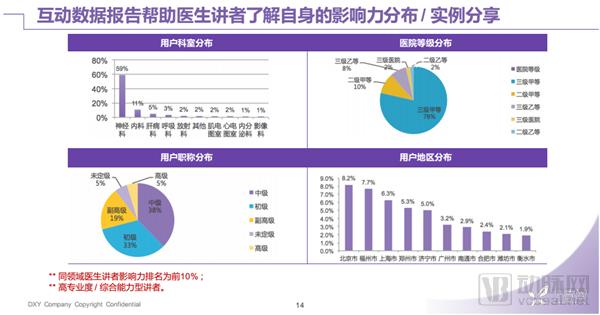
Dingxiang Boka also provides physician speakers with comprehensive data monitoring tools, enabling them to view metrics such as audience viewing time distribution, user engagement levels, and user demographics. This allows speakers to identify who is watching their live broadcasts, where they are located, and who they are.
According to data analysis, Dingxiang Boka can also provide speakers with customized analytical reports to help partners build a scientific value-based decision-making mechanism. The content of the customized analytical reports includes: the geographical regions and hospitals that a physician speaker can influence, quantifying the geographic scope of the speaker's influence; a roadmap of the transmission of the speaker's professional influence, showing the sources of the audience influenced by the physician speaker; the comprehensive influence ranking of the physician speaker within specific attribute groups; and the comprehensive influence within their respective disease areas.
These data analysis reports clearly elucidate key audience metrics, including size, distribution, and demographics, thereby enabling content distributors to analyze their audience and formulate more refined and precise content dissemination strategies.
Exploring the Commercial Value of Dingxiang Bojia
Once a physician’s personal brand has been established, the focus must shift to monetization. Currently, the value of branded physicians can be realized through content creation, offline patient conversion, and commercial operations. Commercial operations remain an exploratory approach; for instance, physicians such as Zhang Qiang, Duan Tao, and Yu Ying have left the public healthcare system to launch their own ventures, transitioning from the “asset-light” model of physician groups to the “asset-heavy” model of clinics and medical institutions. However, the prospects for this path are not yet clear, and it lacks replicability.
Just like physician brands monetizing their influence, Dingxiang Boka is also exploring commercial possibilities. Currently, digital marketing appears to be the most viable approach.
Digital marketing refers to pharmaceutical companies leveraging digital tools for academic dissemination, introduction of treatment pathways, and drug promotion. Foreign pharmaceutical companies began experimenting with digital marketing early on, with many establishing dedicated digital marketing departments.
According to an earlier survey conducted by Strategy&, the consulting arm of PwC, which polled more than 150 pharmaceutical executives in Europe and the United States, 90% of pharmaceutical companies have extensively rolled out or piloted digital tools as one of their marketing channels to deliver information and services related to diseases, products, cutting-edge academic technologies, and medical education.
Major pharmaceutical companies leverage digital tools primarily to serve two groups—physicians and patients. From the perspective of serving physicians, pharmaceutical companies choose digital tools for academic promotion and marketing mainly as a supplement to the traditional model of medical representative visits. By capitalizing on the advantages of low cost and diversity, these tools better facilitate an information communication platform between pharmaceutical companies and physicians, who have also demonstrated an optimistic and open attitude toward digital solutions. Furthermore, pharmaceutical companies can utilize digital tools to aggregate more professional knowledge and resources, thereby establishing centers of academic excellence.
From a domestic perspective, prescription drug marketing in China has traditionally relied on medical representative visits, industry conferences, and academic promotion. Driven by policy advancements, the medical representative visit model is facing increasingly stringent compliance pressures, prompting active efforts to identify breakthroughs. Meanwhile, the rapid development of the internet and the emergence of digital tools have undoubtedly provided supplementary solutions to the legacy marketing system. Furthermore, China’s pharmaceutical industry is undergoing profound transformation. The implementation of policies such as the “Two-Invoice System,” the replacement of business tax with value-added tax (VAT), and the medical representative registration system has also spurred changes in pharmaceutical marketing strategies and channels.
“Advertisers follow users.” This principle applies equally to digital pharmaceutical marketing. Platforms that aggregate physicians, such as Dingxiang Boka, boast precise targeting of physician and patient user bases. Their content delivery through formats like live streaming sustains user engagement, thereby facilitating stakeholders’ efforts in digital marketing initiatives on these platforms.
In fact, at the time of its launch, Dingxiang Bojia evaluated this collaborative model and engaged in discussions with numerous healthcare enterprises to explore specific implementation approaches. These included selecting physician groups aligned with development strategies in partnership with collaborators, establishing long-term cooperative relationships with select branded physicians through practical iteration; or providing more diversified and differentiated communication strategies tailored to different branded physicians, thereby forming a more precise information dissemination system and influence model.
The key lies in how all relevant stakeholders can engage in Dingxiang Bojia’s physician IP-building initiative and integrate it with digital marketing.
The solution offered by Dingxiang Boka is the “Boka Assistant,” which enables relevant parties to collaborate with physicians during live broadcasts, effectively serving as their “agents.” The Boka Assistant acts as a professional aide for physicians conducting academic live streams, with responsibilities including applying to create live sessions, planning broadcast content, pre-broadcast promotion, and post-broadcast content dissemination.
The value of Dingxiang Boka and the Boka Assistant lies in their dual role: they serve as a platform for physicians to disseminate content and build their personal brands, while also providing an intermediary platform for pharmaceutical companies’ digital marketing. Through this platform, pharmaceutical companies can participate in the process of building physician IPs, deepen their engagement in digital marketing and online academic dissemination, and achieve collaborative resource integration and mutual benefits for all parties involved.