

Can Smart Aging Solutions Enhance Elderly Care Efficiency? Three Key Market Challenges Remain
At this year’s Two Sessions, “elderly care” has, unsurprisingly, once again become one of the most discussed topics. In the Government Work Report, in addition to raising basic pension benefits,It also put forward requirements such as “actively responding to population aging, developing home-based, community-based, and mutual-aid elderly care services, promoting the integration of medical and elderly care, and improving the quality of nursing home services.”For elderly individuals living alone,Improving the efficiency of elderly care services has become key to enhancing quality, with smart elderly care playing a significant role.
In recent years, the policies introduced for smart elderly care have been substantial and ambitious in scope. The "Action Plan for the Development of the Smart Elderly Care Industry (2017-2020)," released in February 2017, pointed out:
By 2020, a smart health and elderly care industrial system covering the entire life cycle will be basically established. More than 100 demonstration bases for smart health and elderly care applications will be set up, over 100 industry-leading enterprises with exemplary and guiding roles will be cultivated, and a number of smart health and elderly care service brands will be created. Smart health and elderly care services, such as health management and home-based elderly care, will be basically popularized, and the quality and efficiency of these services will be significantly improved. The development environment for the smart health and elderly care industry will be continuously optimized, with 50 standards for smart health and elderly care products and services formulated, and information security assurance capabilities substantially enhanced.
With targets of 100 demonstration bases, 100 leading enterprises, and 50 standards, everything seems to follow a predictable path for entrepreneurs in the field. However, policy is one thing, and reality another. How has smart elderly care, riding the fast track of big data and informatization, actually been implemented on the ground? What is the true feasibility of smart elderly care projects, and why do “negative comments,” as mentioned by the reporter at the beginning, emerge even when companies announce positive news? To investigate the actual implementation of smart elderly care projects, VCBeat interviewed three entrepreneurs navigating the market tide, aiming to gain a closer look at how this industry is truly developing.
According to the concept outlined in the "White Paper on Smart Health and Elderly Care" (hereinafter referred to as the "White Paper") issued by the CCID Industry Research Institute, smart health and elderly care refers to the integrated application of information technologies and products—such as health and medical electronics, the Internet of Things (IoT), cloud computing, big data, and mobile internet—to collect data on human vital signs and home environments. It aims to achieve interconnectivity and analytical processing of information among households, community medical institutions, health and elderly care service providers, and professional medical institutions, thereby providing intelligent, personalized, and diversified products and services to meet the increasingly urgent health and elderly care needs of the public.
The smart health and elderly care industry is a collection of economic activities centered on smart health and elderly care products and services. It is an emerging industrial form that has evolved from the traditional health and elderly care industry through the deep integration and application of next-generation information technologies. This industry is characterized by its broad scope, diverse product forms, significant cross-sector features, strong user stickiness, and high growth potential.
According to the classification in the "White Paper," smart elderly care projects currently on the market include terminal devices, software products, and system integration services. Application services mainly cover remote monitoring for the elderly, chronic disease management, online medical care, and community-based health and elderly care.
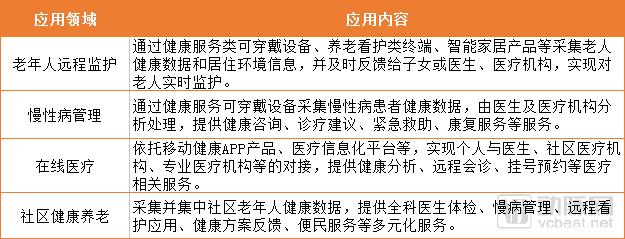
Smart Elderly Care Application Services in the Market (Source: White Paper on the Development of the Smart Elderly Care Industry)
China’s elderly care structure follows the “9073” model, whereby 90% of seniors age in place with family-based home care, 7% rely on community elderly care service centers for daytime care, and 3% reside in institutional care facilities.
Song Guangju, Chairman of Poly Real Estate (Group) Co., Ltd., once pointed out that companies’ current efforts in the elderly care industry are still concentrated on the 3% represented by institutional care facilities. However, given the non-negligible importance Chinese seniors place on traditional family care and emotional support, “the elderly care market is not limited to the 3% covered by institutional facilities; home-based and community-based elderly care will be the next lucrative direction for enterprises.”
In the advancement of the new elderly care model combining community-based and home-based services, the technology sector has begun to integrate “smart” elements into community elderly care. Older adults can not only access elderly care services provided by traditional nursing homes within their communities and homes but also enjoy borderless smart elderly care services.
Currently, the established development models for smart health and elderly care mainly include the internet platform-based comprehensive service model for smart health and elderly care, the smart home-based elderly care model, and the integrated medical, nursing, and healthcare model at the community and sub-district levels.
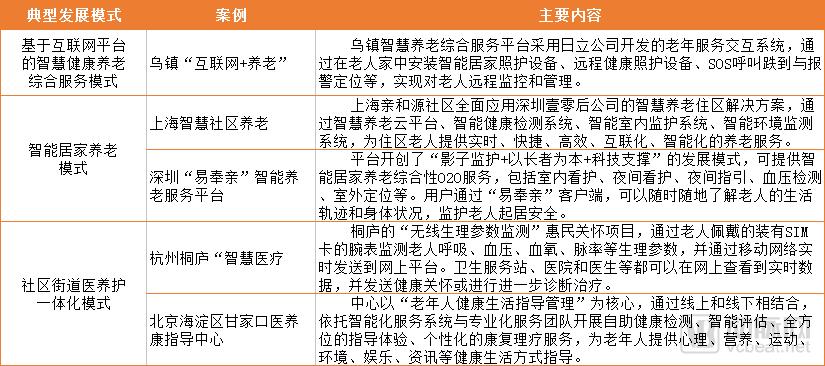
Representative Projects of Different Models (Source: White Paper on the Development of the Smart Elderly Care Industry)
To address the needs of home-based elderly care, some enterprises have organically integrated the establishment and dynamic management of health records through databases, leveraging cloud computing as the foundational support for their services. In addition to meeting seniors’ most essential daily care and basic health needs, these solutions also provide supplementary services such as remote emergency assistance, urgent alerts, and precise matching with caregiving personnel.
Natali China, a subsidiary of the Sanpower Group, introduces advanced Israeli concepts and operational models for health and elderly care services. By integrating domestic and international medical service resources, it provides Chinese users with one-stop smart medical and elderly care solutions, which comprise four major service systems:
First, home-based elderly care services provide seniors with emergency assistance, proactive care, domestic housekeeping, telemedicine consultations, and medical guidance and referral services through its proprietary distributed call center and independently developed CRM system.
Second, intelligent care services: the introduction of SmartCare, a high-tech intelligent care system from Israel, which uses smart algorithms to learn elderly individuals’ behavior patterns and conducts big data analysis to provide automatic alert services for those with abnormal health conditions.
Third, telemedicine services enable Chinese users to enjoy 24/7 remote ECG monitoring from the comfort of their homes through Israeli medical-grade hardware—the ECG smart glove.
Fourth, chronic disease management services provide comprehensive guidance tailored to each client’s individual circumstances across three dimensions—medical care, lifestyle, and environment—to reduce the incidence of complications and improve quality of life.
In addition, Natali China has opened a Western medicine clinic in Wenchang, Hainan, leveraging an online-to-offline service model to bring the best domestic and international medical resources to the elderly in Hainan.
Yi Ban (Beijing) Information Technology Co., Ltd.’s product, eBan Xiaoxin, leverages human behavior recognition technology to monitor safety incidents and abnormal behaviors among elderly individuals living alone in empty-nest households. Currently, monitoring of such seniors still relies primarily on manual efforts. eBan Xiaoxin achieves unmanned, real-time, and intelligent data collection, fundamentally transforming the outdated approach that previously depended solely on phone calls or in-person visits to obtain information. According to Wan Yong, compared with traditional monitoring methods employed by community-based elderly care institutions, the solution can reduce manpower requirements by two-thirds and cut costs by at least 50%.
Drawing on tens of billions of data points accumulated over the past two years through its smart elderly care monitoring services, eBan will soon release the “2018 Behavioral Atlas of Chinese Seniors’ Daily Lives.” This is the first big-data report in China’s elderly care monitoring sector, and the atlas provides long-term, systematic data support for analytical research on home-based elderly care services.
Since smart elderly care enterprises mostly start by building platforms, this has objectively led to differences between traditional and smart elderly care service models.
Below is a partial list of listed companies and startups involved in smart elderly care businesses or services, as compiled by VCBeat.
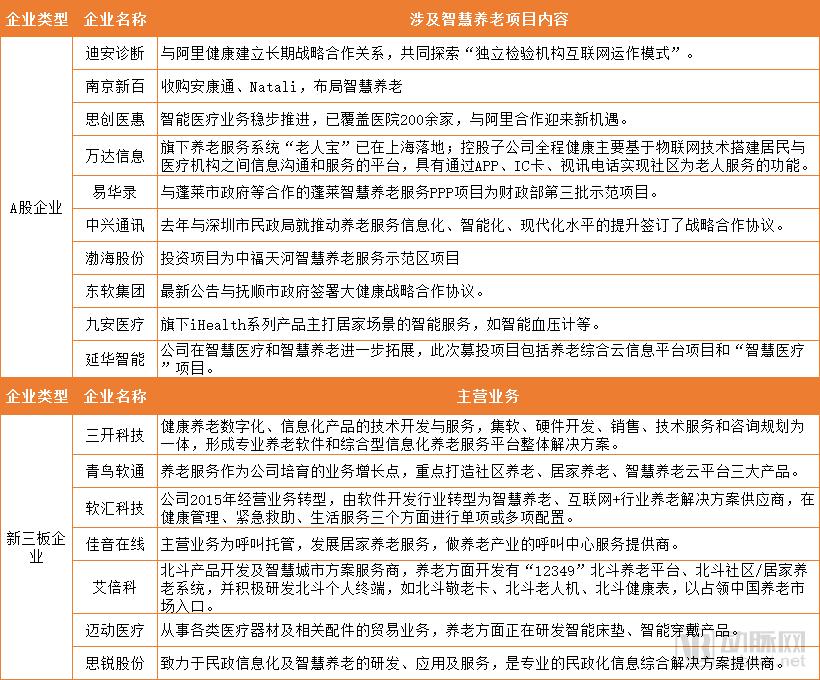
Smart Elderly Care Companies Listed on the A-Share Market and the New Third Board
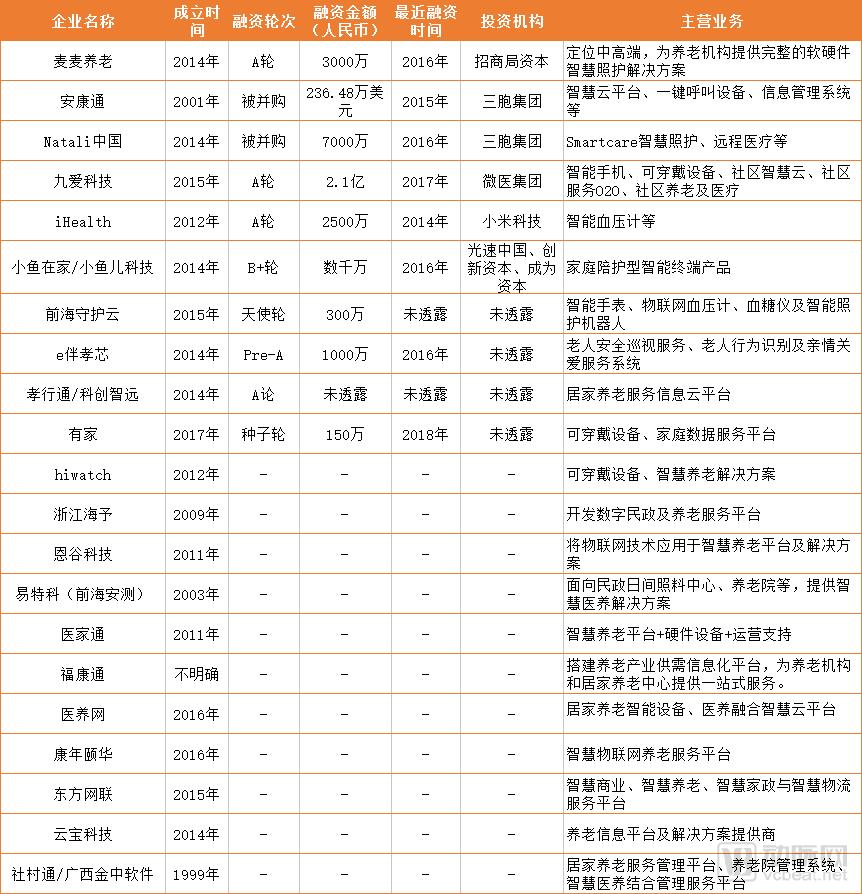
Some Smart Elderly Care Startups
According to Hejun Consulting’s analysis, from the perspective of participant enterprise types in the market, three categories are particularly representative: traditional enterprises crossing over into the sector, established IT companies expanding their market presence, and start-ups newly entering the field.
Traditional enterprises such as Wanda Information and Nanjing Xinjiekou Department Store typically choose to integrate internal resources to build their own third-party smart elderly care platforms, or enter the smart elderly care sector by incubating specialized teams;
Established high-tech enterprises such as Qingniao Ruantong and Aibeike have entered the smart elderly care industry, leveraging their technological strengths to expand their customer base in pursuit of new growth drivers and emerging markets.
Startups primarily secure funding from the primary market and investors, exploring mature business models in the marketplace with the aim of replication and expansion.
According to Du Wei, VP of NataLi China, the company’s current business model primarily comprises two categories: B2B and B2C, with a focus on the B-side and the C-side playing a supplementary role. The main reason for this is that elderly consumers in China currently hold relatively conservative spending habits; even when they have the financial means, they are more inclined to spend on their children and grandchildren. Consequently, the explosive growth of the C-side market is expected to lag slightly behind that of the B-side.
One of the primary clients of the SmartCare intelligent caregiving system is high-end senior living communities. Property owners aim to leverage SmartCare to identify potential safety hazards with greater operational efficiency and lower costs, thereby enabling seniors to enjoy a safe, warm, and high-quality lifestyle in their golden years.
Furthermore, Natali China has collaborated with civil affairs bureaus in several provinces to deliver home-based elderly care services to seniors living alone within their communities. Related services have been deployed in more than ten provinces across China. In March 2016, the Changzhou Municipal Government in Jiangsu Province signed a pilot cooperation agreement with Natali for remote ECG medical services, with Natali China responsible for the specific operation of the project.
Natali China has also partnered with Country Garden, Sunac, and other real estate developers to create senior living properties, providing them with supporting health and elderly care services. Its elderly care service network has already been established in cities such as Shanghai, Wuxi, Nanjing, and Wenchang.
In contrast, Ankangtong, a sister company of NataLi China and also a smart elderly care enterprise under the Sanpower Group, has taken a different path by targeting local governments.
Currently, Ankangtong has launched elderly care services in Beijing, Shanghai, Jiangsu, Shandong, Guangxi, Hainan, Jiangxi, Tianjin, Inner Mongolia, Shaanxi, Sichuan, Chongqing, Yunnan, and Heilongjiang, covering more than 10 million seniors across China.
Natalie’s greatest advantage over competitors lies in its ability to leverage Ankangtong’s extensive offline network and service teams, thereby providing local elderly residents with faster, higher-quality, and more considerate eldercare services.
Unlike Natali, which strategically prioritized the B2B market, eBan Xiaoxin’s shift to this sector was more a matter of necessity. Wan Yong stated, “We initially focused on the B2C market, but later found it extremely challenging due to high customer acquisition costs. Consequently, we pivoted to the B2B segment. After only a few months of developing our distribution channels, we have secured letters of intent worth approximately RMB 10 million.”
eBan’s promotional approach is highly rudimentary, relying on “legwork”—that is, cold canvassing. “We have personally visited the civil affairs bureaus and aging offices in all 16 districts of Beijing, every sub-district office, every community residents’ committee, and all home-based elderly care service operators in Beijing.”
For Hiwatch, a brand of wearable devices and smartwatches for the elderly, its founder and CEO, Wu Qing, is in a relatively favorable position. He revealed that the company’s smartwatches for seniors currently rank among the market leaders in terms of share, and it is actively exploring pathways to “go global,” aiming to expand the Hiwatch brand into Southeast Asia and other regions.
In the market, Hiwatch adopts a distribution model for sales, achieving an annual revenue of RMB 60 million. In addition to its consumer-facing products, Wu Qing has expanded into business-to-business (B2B) services, providing integrated smart elderly care solutions to enterprises undertaking government projects.
He stated, “Whether it is smart elderly care or internet-based elderly care, the objective remains to improve efficiency and reduce costs. There are substantial market opportunities, regardless of whether solutions are developed through software or hardware.”
Insufficient market education and ambiguous understanding of the concept of smart elderly care
As the smart elderly care system is promoted and applied in areas such as family companionship, eldercare support, community-based home care, senior living apartments, and remote healthcare, age-friendly smart products are gradually gaining acceptance among older adults. However, as an emerging business model, it remains in its early stages, and its cultivation and development still face numerous challenges.
Currently, many smart products on the market require an internet connection. However, some smart elderly care technology products are detached from the actual needs of older adults, featuring overly complex and impractical functions that make them difficult to use. This is a key reason why many high-tech age-friendly products fail to gain widespread adoption. Many older adults lack home internet access and the ability to operate complex smart systems, resulting in poor user experiences and preventing those in need from accessing quality smart elderly care services.
Furthermore, the current cohort of individuals aged 65 and above, who came of age before the rise of internet-based healthcare, were mostly born prior to the 1950s. Shaped by unique historical circumstances, this generation endured significant hardships. Their lifestyle is deeply influenced by traditional mindsets such as “aging before achieving wealth,” reluctance to spend, and a willingness to live frugally to leave resources for the next generation. These factors have hindered the widespread market adoption of smart elderly care products.
Du Wei believes that smart elderly care is currently undergoing a window period, which may explode within 5-10 years. At that time, the change in consumption structure will lead to more disposable income for the elderly born in the 1950s and 1960s, making them more willing to spend money on themselves. Perhaps the phenomenon of "the elderly spending their own money to purchase high-end elderly care services" will become increasingly common. This is also why Ankangtong and Natali China are rapidly expanding and laying out their strategies across China in advance. Du Wei stated: "Quickly occupying the national elderly care market and building the leading brand in elderly care services is the most crucial factor."
Regarding market education, Wan Yong believes that the cost of promoting in the market is the highest. “The current challenge is how to explain what smart elderly care is,” he said. “The process of market education is akin to the launch of Apple’s iPhone 11 years ago; educating the market when smartphones first emerged was also extremely arduous. The iPhone did not gain traction initially; it was not until 2009 that it began to secure a foothold in the market.”
Industrial Synergy Promotion Mechanism Has Not Yet Been Established
Smart health and elderly care encompass a wide range of fields, including the information technology industry, healthcare, health management, and eldercare. Currently, collaboration among various industries and institutions remains inadequate.
Currently, a development model featuring positive interaction and equitable benefit distribution has yet to take shape in areas such as medical market access for information technology products, the open sharing of medical and health data, and the coordinated development of medical treatment, nursing, and elderly care. Consequently, health and elderly care institutions exhibit limited willingness to collaborate with information technology enterprises in domains such as early-stage health management and chronic disease management.
Wu Qing holds an optimistic view on smart elderly care, but he believes the biggest challenge currently facing the industry is the lack of integration between smart technologies and elderly care services into a cohesive system. “The so-called ‘integration of medical and elderly care’ still sees a disconnect between elderly care and healthcare, indicating that the concept is not yet fully understood. Similarly, in the realm of smart elderly care, such fragmentation persists; for instance, companies developing testing devices, those creating algorithms, and providers of health and elderly care services operate in silos rather than being fully integrated.”
Wan Yong told reporters that whether it is smart elderly care products or elderly care institutions, the essence must ultimately revolve around “service”: “All equipment is merely a tool for the service industry. If I have other tools that can serve as substitutes, I can switch to them, but my core mission remains unchanged—my fundamental purpose is to provide elderly care monitoring services.”
A sustainable and scalable mature business model has yet to be established
In China, the entire smart elderly care industry is still in a market development stage, with most projects lacking clear business or profitability models and requiring continued exploration and innovation.
In China’s developed regions, medical and elderly care institutions such as home-based elderly care service centers largely adopt an operational model in which enterprises manage operations while the government covers the costs. Enterprises rent premises provided by the government free of charge, and smart health terminal products are distributed to users at no cost through government procurement of services.
This has resulted in the unsustainability of the profit models for medical and elderly care institutions, as well as the non-replicability of such models when promoted to less economically developed regions with constrained local fiscal capacities across China.
Therefore, there is a particular need for large enterprises and capital to take the lead in getting involved. These enterprises must possess long-term development strategies in the elderly care sector, have certain capabilities in R&D and market risk tolerance, as well as strong abilities in market development and integration of public service resources.
The survival and development of the elderly care industry ultimately depend on market revenue. Launching this market requires a sophisticated business model that addresses capital operations, resource allocation, and other key elements.
According to an incomplete count by reporters, in 2017 alone, national-level policies such as the Action Plan for the Development of the Smart Health and Elderly Care Industry (2017–2020) and the Notice on Launching Pilot Demonstrations of Smart Health and Elderly Care Applications were issued. Furthermore, documents including the Notice on the Development Plan for New-Generation Artificial Intelligence and the Guiding Opinions on Further Expanding and Upgrading Information Consumption to Continuously Unleash Domestic Demand Potential also contained provisions encouraging the age-friendly adaptation of smart products and the development of health management wearable devices tailored for the elderly.
Amid a favorable policy environment, various private capital entities have begun exploring smart elderly care models. In March, Anxin Qiao, an intelligent home-based elderly care system, secured RMB 5 million in financing from Yunchuang Shiji. In September, Yang Ni Yibeizi, a shared platform for home-based elderly care, raised RMB 20 million from Mayi Investment. Dian Diagnostics established a long-term strategic partnership with Ali Health to jointly explore “smart elderly care operational models,” leading to a surge in smart elderly care projects.
Traditional home appliance giants such as Haier and Midea are flocking into this “blue ocean.” Haier’s U-home smart elderly care support solution has been implemented in a North American town project; TCL has launched the “Wanmei” series of mobile phones designed for seniors; and Midea has partnered with Yaskawa to enter the smart elderly care market, planning to introduce medical rehabilitation robots next year.
Although the investments from major real estate developers and insurance capital have concentrated most of the market funds into the 3% segment of institutional elderly care, market demand influences supply. Consequently, the majority of smart elderly care products or services still target the remaining 97% of the market, which comprises community-based and home-based elderly care. Among these, “government-funded projects” are akin to a “prized opportunity” for startup enterprises.
At this stage, with strong government support, local governments are actively establishing regional smart elderly care platforms to serve the local elderly population.
Taking Wuhan as an example, the city employs health bands and monitoring devices to conduct real-time surveillance of physiological parameters—such as blood pressure and blood glucose—and health information among elderly individuals residing in community-based home care settings. This approach facilitates timely online management and early warning systems. Furthermore, it enables real-time interaction with physicians from major hospitals through text-and-image consultations, allowing the elderly to access high-quality medical services without leaving their communities.
When discussing the challenges encountered in development, Du Wei pointed out that the current smart elderly care market suffers from weak bargaining power, and it will take more time for high-end products to fully penetrate community and home-based settings. Although government procurement is a favorable model, its primary objective is to meet the basic needs of the local elderly population, making it difficult to justify paying for premium elderly care services. This, in turn, compresses companies’ profit margins.
Although various service models have been established across different regions, insiders reveal that smart elderly care pilots suffer from a situation where “the government sets the stage and enterprises perform, but the audience refuses to pay.” With the exception of a few products and services tailored for home-based care scenarios, models such as day care centers and community service stations are not widely accepted by the elderly. In Beijing’s market, several community stations even rely on providing “meals for the elderly” as their primary source of profit.
Smart elderly care cannot rely solely on government-built platforms to achieve success. It is a systemic project and a lifestyle that requires collaborative efforts among the government, elderly care institutions, medical and health services, and domestic service providers to function effectively.
Compared with other industries, smart elderly care is still in its early stage of development. The mainstream market is characterized by a large number of participating enterprises, small scales, and uneven quality of products and services.
Currently, smart elderly care relies primarily on government funding and support, but such resources are inherently limited. Only by relaxing market access restrictions for private capital, lowering entry barriers, streamlining multi-layered approval processes, and implementing preferential policies such as tax reductions and exemptions for elderly care service institutions can new market opportunities be continuously generated.
Even the best smart elderly care products will become “castles in the air” without users.