

Can Digital Mental Health Platforms Break Through the Stigma? Addressing China's 180 Million Underserved Patients
Chinese people often avoid seeking medical help for fear of stigma, particularly among patients with mental disorders. Deep-seated cultural biases label these individuals as “outcasts,” while legal protective restraints further cast them as “dangerous.”
Compared to the centuries-long development history abroad, China’s mental healthcare industry is still very young. Marked by the implementation of the Mental Health Law of the People’s Republic of China in 2013, the development of China’s mental health sector has gained a legal basis and entered a new stage of comprehensive and standardized growth.
According to official statistics from the Ministry of Health, by the end of 2015, China had more than 16 million patients with severe mental disorders and over 90 million patients with depression and anxiety. The total number of individuals in China suffering from various mental illnesses caused by these central nervous system disorders has exceeded 180 million. Jin Fengchun, a partner at SAIF Partners, once stated that the overall treatment-seeking rate for mental health conditions in China was less than 10%, while the global market size for mental health services had surpassed $150 billion.
A review of mobile health companies in the mental health sector, both domestically and internationally, reveals a stark contrast to the once-fierce “Hundred Glucose Wars” in diabetes management: mental health platforms remain few and far between. However, this scarcity does not indicate poor development within the field, as there is no shortage of pioneers exploring this space.
Among them, Fine Hin has been quietly cultivating the mental health sector for two years. Unlike Kangning Hospital, which has recently sparked widespread discussion, Fine Hin started with online services. In this vertical field, it aims to address the mental health concerns of hundreds of millions of people by leveraging an internet platform model. By adopting a private, efficient, and professional approach via the internet, Fine Hin is making significant investments in the mental health sector. From online consultations to prescription refill services, Fine Hin directly tackles the pain points in the diagnosis and treatment of mental health disorders.

Mobile Platform Dedicated to Mental Health
Looking at the mental health industry in China as a whole, the immature business model has added a degree of uncertainty to capital investment; however, from another perspective, the market void presents an opportune moment for entrepreneurs to rise.
In early 2016, Haoxinqing was founded under the leadership of CEO Chen Guanwei. The company’s app, also named “Haoxinqing,” provides a professional online service platform tailored for psychiatrists, psychologists, and users in the mental health field.
In December 2017, at the Future Healthcare Top 100 Forum hosted by VCBeat, “Haoxinqing” became the sole recipient of the “Most Promising Enterprise” award in the mental health sector.
On the physician side, HaoXinqing’s services include online medical education, patient follow-up, and publication of academic articles. On the user side, it provides personalized psychiatric and psychological care, online consultations, tracking and recording of user data, intelligent disease management plans, and prescription refills. On the hospital side, HaoXinqing has equipped nearly 100 specialized psychiatric hospitals with SaaS-based WeChat Official Account systems, offering a professional suite of tools to facilitate academic exchange, promote brand visibility, and manage patients.
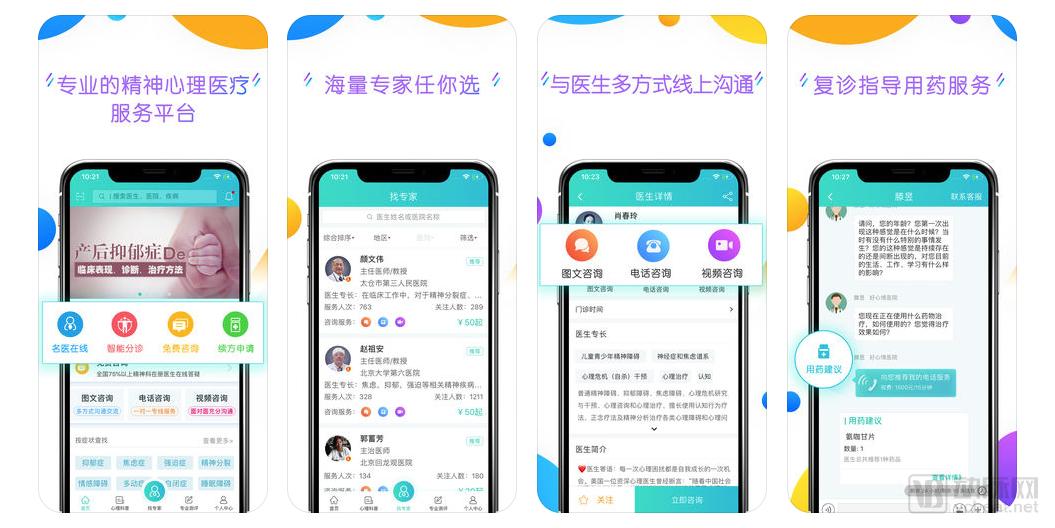
iOS Version of the Fine Hin APP Interface
Beijing Fine Hin Mobile Medical Technology Co., Ltd. focuses on building a vertically specialized platform, establishing strong competitive barriers across its business model, user services, and resource allocation. This strategy enables the company to explore innovative monetization models while securing a strategic position in core resources.
Chen Guanwei has been dedicated to exploring innovative models in China’s mobile healthcare sector. Early in his career, he spent eight years working in brand marketing and sales at Xiaoxiong Online, a well-known internet media company. In 2012, he co-founded Shanhaishu Technology and served as CEO of Beijing Shanhaishu Technology Co., Ltd., leading his team to provide remote health management systems for dozens of large hospitals and institutions across China. He also participated in the architectural design of telemedicine and health management information systems for multiple hospitals. Under his leadership, the company developed “Doctor Tree,” an industry-leading mobile healthcare software platform, and “Yao Kuai Hao,” an O2O pharmaceutical service platform, making him one of the early pioneers in exploring the “medical care + pharmaceuticals” closed-loop concept within the industry.
As of 2017, the Haoxinqing platform had recruited over 18,000 registered psychiatrists, accounting for more than 75% of all licensed psychiatrists in China. The platform covered more than 2,000 psychiatric specialty hospitals and psychology departments in general hospitals across the country, with a focus on mid- to senior-level clinicians while encompassing psychiatrists at all career stages.
Currently, Haoxinqing has over 2 million registered users and has provided more than 1 million cumulative psychiatric and psychological consultations. The platform offers systematic features including online mental health scale assessments, remote physician consultations, and post-diagnosis patient follow-up.
Starting with Psychiatrists to Explore Monetization Models
In the face of a vast mental health counseling market, most users have not yet developed the habit of seeking professional medical services; they are either reluctant to seek care or unsure how to access it. Meanwhile, the majority of capital has not yet entered this sector, rendering the market a blue ocean. Furthermore, severe information asymmetry exists on both the supply and demand sides of psychological counseling services, resulting in a typical market structure characterized by high fragmentation and low efficiency for both parties. Additionally, the rehabilitation cycle for mental disorders is prolonged, often requiring treatment for more than one year or even lifelong. Since such treatment rarely relies on offline diagnostic and testing equipment, the sector is highly suitable for the development of platform-based enterprises.
From both a social and economic perspective, Chen Guanwei believes it is highly worthwhile to pursue. First, the internet market in the mental health sector is virtually untapped, whereas the general practice sector has already seen the emergence of internet healthcare companies such as Haodf.com and Xunyi Wenyao Network, resulting in a saturated “red ocean” market. With the competitive landscape becoming increasingly clear, opportunities for new entrants are limited.
Secondly, mobile healthcare has entered its second half, where the focus is on monetization strategies and strengthening in-depth service capabilities. Pure traffic-based integrated platforms, constrained by their business models, energy, and resources, now have limited opportunities for deep market penetration.
So, how can one find opportunities in the second half of the mobile healthcare market? Chen Guanwei believes that the future undoubtedly lies with specialized platforms, as specialties can develop operational models rooted in medical attributes that comprehensive platforms cannot reach—such as the integration and layout of upstream and downstream resources, the professionalism of product tools, and talent acquisition.
Can the power of the internet be leveraged to oversee the quality of mental health and psychological counseling services, while providing users with private, professional, and convenient access to such care? Can mobile internet truly enhance value in the mental health industry? These are the questions Chen Guanwei is exploring.
Unlike other online mental health and psychological counseling platforms that focus on light-touch services such as mild psychological counseling, peer support among users, and emotional venting, Hao Xinqing enters the market through professional psychiatrists. It leverages specialized clinical methods and technologies to assist patients with psychological and psychiatric conditions, positioning itself as a medical service platform dedicated to disease management and mental health. The platform provides core medical services, including professional clinical guidance and consultation, post-diagnosis patient follow-up, and prescription refill services.
Furthermore, differences in service providers distinguish Haoxinqing from social psychological counselors, community forum-style counseling, or simple emotional sharing. Chen Guanwei stated, “Haoxinqing’s in-depth specialty model has strong medical attributes and offers greater potential for commercial value creation.”
From a market perspective, internet-based psychiatry represents a chronic disease market valued at hundreds of billions of yuan. Beijing Fine Hin Mobile Medical Technology Co., Ltd. (Haoxinqing) has adopted an “Internet + Psychiatry” model, which provides patients with mental and psychological disorders more convenient access to remote medical services, improves the efficiency of psychiatrists in patient management and follow-up visits, and accumulates high-quality clinical data, thereby driving the development of the entire psychiatric healthcare industry.
Mental Health Embraces Mobile Healthcare: Precedents Already Exist Abroad
With WellDoc, a U.S.-based mobile health company specializing in personal health management, receiving FDA clearance for its diabetes management platform—becoming a mobile application that helps physicians optimize prescription decisions—mobile health technologies have increasingly become a focal point for research institutions and investors. In contrast to China’s mental healthcare sector, which currently has only two or three mature platforms, the overseas market boasts numerous mobile health platforms dedicated to mental health.

Akili Interactive, a subsidiary of the biotechnology company PureTech, employs non-pharmacological therapies by developing video games to treat conditions such as attention-deficit/hyperactivity disorder (ADHD), autism, Alzheimer’s disease, and traumatic brain injury. Last July, the company raised a total of $72.9 million in its Series B financing round. Its flagship product, the Project Evo game, is designed to train children with ADHD by presenting them with substantial amounts of information to prioritize, thereby enhancing their attention span.

Big Health is dedicated to providing “evidence-based, non-pharmacological” solutions to address various mental health disorders. By tracking user data, the company creates personalized digital programs that enable users to access behavioral interventions anytime via the web or mobile devices. Its flagship product, Sleepio, is a digital sleep improvement program designed to help users overcome sleep problems and enhance their mental well-being in the process.

Happify, founded in 2012 and headquartered in New York, delivers its products through a mobile app and website. Drawing on decades of scientific research in positive psychology, competency-based training, and mindfulness, Happify provides users with online courses, activities, and mini-games. The platform offers more than 60 courses covering diverse topics ranging from resilience and mindfulness to depression and anxiety, and has added content to help users manage secondary stress caused by chronic diseases.

iExhale is a startup providing an online mental health service platform, headquartered in Los Angeles, USA. Through its iOS mobile app, users can communicate online with licensed counselors or anonymously share perspectives on iExhale’s social platform, offering mental health support and encouragement to other members of the community.

As a leading online therapy company, Talkspace has transformed the diagnosis and treatment of mental illness by bringing therapist-client conversations into the digital age through a platform that facilitates communication between them. Since its inception, the company has been driven by a mission to eliminate the stigma associated with mental illness and make treatment accessible to millions. Talkspace’s flagship product, Unlimited Messaging Therapy, has been tried by more than 300,000 users.
Mobile healthcare can, on one hand, enhance public awareness of the symptoms, treatment, and prevention of mental disorders, aggregate diagnostic and therapeutic resources, and achieve information symmetry.
On the other hand, virtual scenarios on mobile devices can, to some extent, reduce the stigma associated with mental illness during consultations and increase consultation rates. A public survey in Australia showed that 76% of respondents were willing to use mobile phones for mental health monitoring and self-management.
Furthermore, mobile management platforms help address the issues of poor treatment adherence and high relapse rates among patients with mental disorders, enabling post-diagnosis follow-up and assessment.
Yu Rong, Chairman of Meinian Onehealth Healthcare and Shanghai Tianyi Investment Group, stated as early as 2015 at the China Health Service Management Summit Forum that the competitive landscape in the mobile health sector can be categorized into four aspects: vying for physicians, competing for entry points, intensifying offline services, and providing personalized care.
Fine Hin leverages the professional expertise of psychiatrists from public hospitals in the mobile health sector, along with the advantage of serving as a traffic gateway that integrates online and offline services.
Chen Guanwei believes that in the healthcare institution development plan for the next five years, psychiatry will be a major “growth hotspot,” while deep vertical specialization will become the most important trend in the future development of internet healthcare.
Under the highly specialized and vertically integrated internet healthcare service model, patients can access a comprehensive suite of medical services through a single platform. This significantly enhances the patient experience by minimizing inconvenience and reducing the potential for errors. The professionalism of the medical resources is unquestionable, and the delivery of more precise services helps improve treatment outcomes.
For enterprises, seamless data interoperability enables a more comprehensive understanding of patients’ health conditions, thereby facilitating the delivery of personalized value-added services and making information and data accumulation more targeted and personalized.
As industrial capital increasingly focuses on participating in the mental health sector, providing ample funding and accelerating industry growth, VCBeat will continue to monitor whether psychiatry can emerge as a new dark horse in the mobile healthcare field.