

DXY Doctor Achieved 3.17 Billion Reads in 2017, with Eastern China Leading in Health Literacy Engagement
Dingxiang Doctor, a leading health science popularization platform on the Chinese internet, recently announced that in 2017, it provided a cumulative total of 3.17 billion views of health-related educational content to online users. This is equivalent to an average of two Dingxiang Doctor articles read per person across China over the past year. Statistical data shows that among cities categorized by region, East China accounted for the highest proportion; furthermore, female users demonstrated a 20% higher level of attention to general health knowledge compared to their male counterparts.
Health literacy is a comprehensive indicator reflecting the level of economic and social development. Data from the National Health and Family Planning Commission in 2016 showed that the health literacy level of Chinese residents was 11.58%, an increase of 5.1 percentage points from 6.48% in 2008 and a rise of 1.33 percentage points from 10.25% in 2015. In accordance with the requirements of the Outline of the Healthy China 2030 Plan, the target is to reach 20% by 2020 and 30% by 2030.
Although China’s health literacy level has maintained a steady upward trend, it is essential to recognize that the overall health literacy of Chinese residents remains relatively low. Disseminating health knowledge through health education and promoting healthy lifestyles are among the most cost-effective strategies for improving the health status of the population.
Based on this, DXY Doctor embarked on its journey of public health science popularization in 2014 and has since become China’s largest health science platform, with nearly 30 million users.
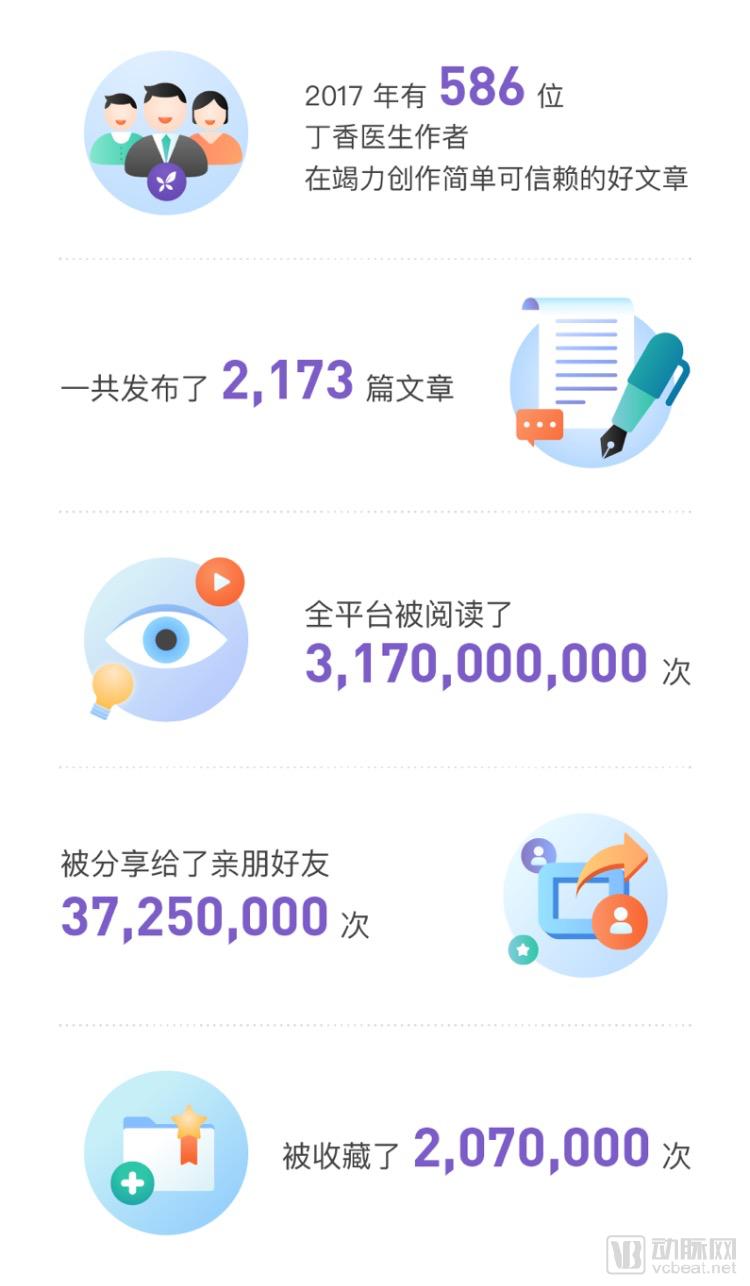
In 2016, DXY’s new media platform produced a total of 26 million words of health science content, accumulating 560 million reads on WeChat. In the just-concluded year of 2017, leveraging the rapid growth of internet content distribution platforms, DXY’s health science communication entered a new stage of development. Of the 3.17 billion total reads in 2017, 69% came from channels other than the WeChat public account.
Currently, DXY has established a presence on dozens of content platforms, including Toutiao, Yidian Zixun, Sohu Hao, UC Hao, Phoenix Hao, and Baidu Baijiahao. Articles are initially published on DXY’s WeChat Official Account and subsequently redistributed across other external platforms, achieving nearly 10 million daily views.
Behind the figures lies DXY Doctor’s core content production capability.
Leveraging its platform of over 800 contracted high-quality health science communicators, DXY Doctor enjoys a distinct advantage in content creation. The basic workflow is as follows: First, the DXY Doctor new media team uses big data analytics and other methods to determine topics, then collaborates with professional science communicators on the platform to draft initial manuscripts. Next, the new media team “translates” these drafts into accessible, easy-to-understand medical science articles—making professional content relatable to the general public. Finally, the articles are published only after approval by a “Review Committee” composed of experts in the relevant fields.
Due to the disparity in discourse systems between doctors and patients, which leads to information asymmetry, many popular science articles are often written in an obscure and difficult-to-understand manner, laden with specialized terminology. However, this practice is strictly prohibited at DXY Doctor. The DXY Doctor team advocates for the goal of being “simple and trustworthy,” aiming to ensure that even readers with only a primary school education can understand their articles. Meanwhile, thanks to its rigorous content production mechanism, professional accuracy is also fully guaranteed.
Data from DXY shows that East China, represented by the Jiangsu-Zhejiang-Shanghai region, contributed 840 million health science popularization reads, ranking first among all regions. To some extent, this indicates that residents of East China place the greatest emphasis on accumulating knowledge about health science. In terms of user gender, female users accounted for approximately 60% of the total readership on DXY, suggesting that health science information is more likely to attract the attention of female users.
As an official rumor-refuting organization certified by Tencent and a science popularization platform that has consistently ranked first in the health sector on Newrank, DXY has produced numerous viral hits this year.
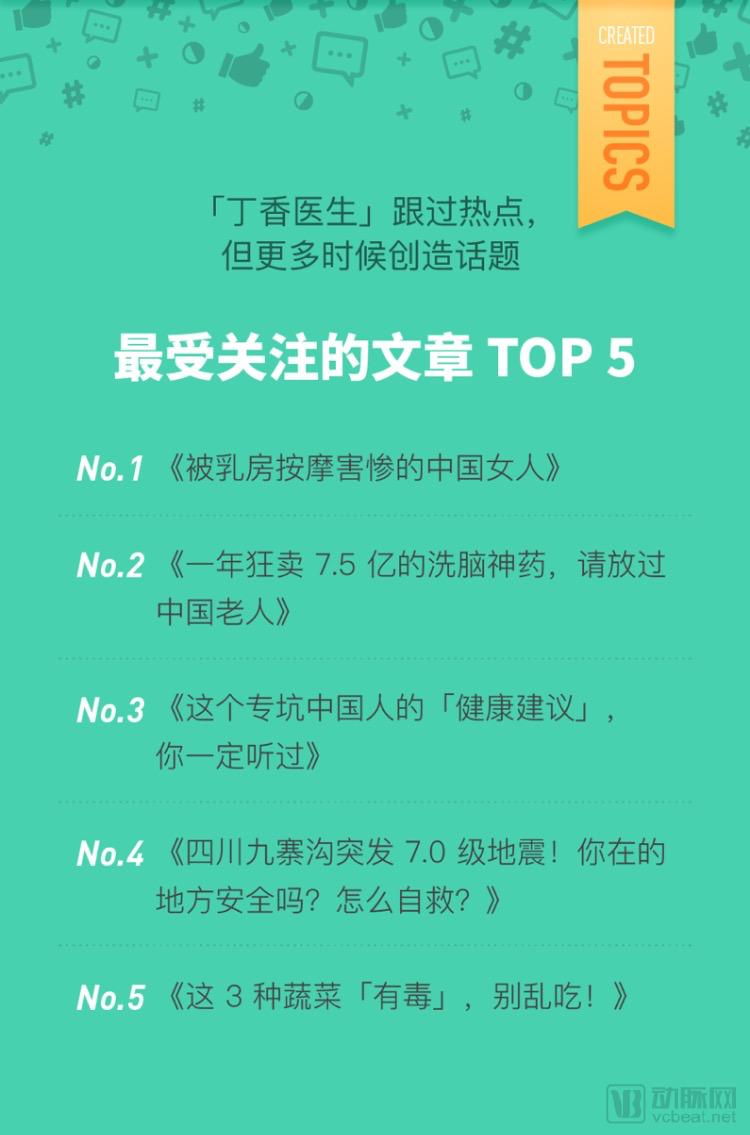
“Chinese Women Severely Harmed by Breast Massage” became DXY’s most-read article of 2017, amassing over 7.5 million views on WeChat. “Please Spare Chinese Seniors: The Brainwashing ‘Miracle Drug’ That Raked in 750 Million Yuan in a Year,” a science-based article with an investigative journalism angle, also garnered more than 7 million views. The resulting black-swan event sparked nationwide debate, prompting regulatory authorities to swiftly mandate that the company conduct new clinical trials, thereby toppling the “miracle drug” from its pedestal.
Reducing the information asymmetry between doctors and patients is the original intention behind DXY Doctor’s continuous provision of high-quality medical content. Chu Yang, Vice President of DXY and Head of DXY Doctor, stated that as a new media platform characterized by “principled stance, compassionate care, and rapid response,” DXY Doctor should assume greater social responsibility.
Chuyang stated that "attitude" refers to a belief in science and an advocacy for evidence-based medicine; "warmth" signifies humanistic care, providing the simplest and most trustworthy medical popularization services; and "speed" denotes rapid response to social hotspots and public health events.
Further Reading:
Research by the World Health Organization indicates that among the numerous factors affecting population health, behavioral and lifestyle factors account for 60%, biological factors for 15%, social and environmental factors for 17%, and healthcare services for only 8%. In other words, behavior and lifestyle have become the primary determinants of population health. To address the main threats to modern health—namely, unhealthy behaviors and lifestyles—the World Health Organization has proposed the “Four Cornerstones of Health”: a balanced diet, moderate physical activity, smoking cessation and limited alcohol consumption, and psychological balance.
Studies have shown that adhering to the above four measures can reduce hypertension by 55%, stroke and coronary heart disease by 75%, diabetes by 50%, and cancer by one-third, while extending average life expectancy by more than 10 years. Therefore, promoting a healthy lifestyle is of great significance for improving population health.