

Yingci Healthcare and Keyi Real Estate to Jointly Develop $1.2 Billion International Specialty Hospital in Hangzhou
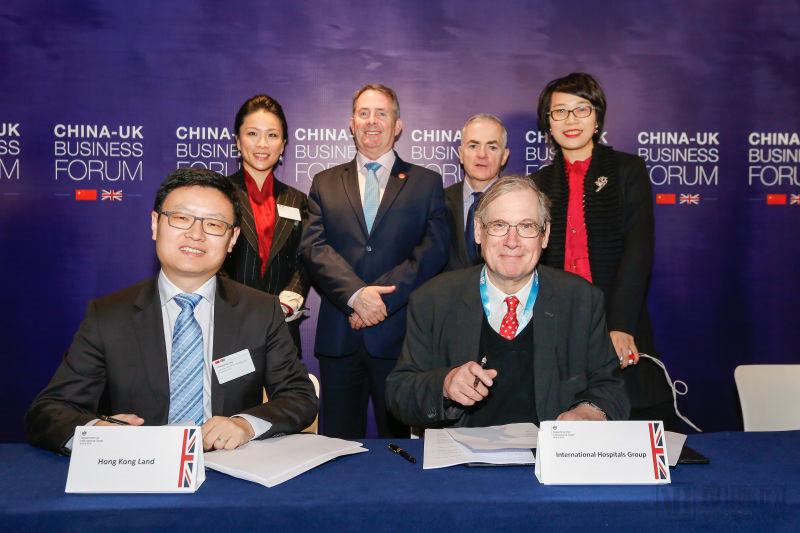
Back row, from right to left: Tao Chun, Executive President of China Xiaoshan Science and Technology City; Richard Burn, Director for China at the UK Department for International Trade; Liam Fox, UK Secretary of State for International Trade; Ye Xiaomeng, CEO of Yingci Medical. Front row, from left to right: Ling Changfeng, Executive Director of China Property Development and Investment at Hongkong Land Holdings Limited; Adam Williams, Vice Chairman of Yingci Medical.
According to VCBeat, on February 2, 2018, UK Prime Minister Theresa May arrived in Shanghai. To promote Sino-UK trade relations, facilitate cooperation between Chinese and British enterprises, and encourage the UK’s participation in the Belt and Road Initiative, Theresa May attended the Sino-UK Business Forum. At the forum, witnessed by Liam Fox, UK Secretary of State for International Trade, Yingci Medical, a Chinese brand under the International Hospitals Group, formally signed a cooperation agreement with Hangzhou Keyi Real Estate Development Co., Ltd. The two parties will jointly develop and construct the Hangzhou Yingci International Hospital in the Sino-UK Industrial New City in Xiaoshan District, Hangzhou, with a total investment of RMB 840 million.
Under the agreement, the above-ground building area of Hangzhou Yingci International Hospital will reach 38,500 square meters, with a planned capacity of 200 beds. It is an international general hospital featuring specialized departments in obstetrics and pediatrics, oncology, orthopedics, cardiovascular medicine, and mental health.
Upon completion, the hospital will become the only foreign-invested hospital in the Hangzhou area, addressing the current issues of insufficient and unevenly distributed local medical resources, relatively low levels of medical technology, and a scarcity of high-quality, diversified healthcare services.
Pursuant to the cooperation agreement, Hangzhou Keyi Real Estate Development Co., Ltd. (hereinafter referred to as “Keyi Real Estate”) shall be responsible for the preliminary development, construction, and equipment provisioning of the hospital. As a professional partner in the healthcare sector, Yingci Medical will provide consultancy on hospital planning, setup, and construction in accordance with international standards during the early stages of the project. In the later stages, it will offer brand licensing and managed operational services. Leveraging its parent company, UK International Healthcare Group, Yingci Medical will introduce internationally benchmarked hospital management practices, cutting-edge technologies, and top-tier talent, while facilitating access to premium collaborative resources from leading hospitals under the UK’s National Health Service (NHS).
The collaboration between the two parties aligns with the current trends. In recent years, China has been undergoing significant changes: economic structural adjustment, consumption upgrading, shifts in the disease spectrum, relaxation of fertility policies, rapid global advancements in life sciences and medical technologies, gradual improvement of the national healthcare security system, growing public demand for medical services, and increasingly diversified levels of such demand.
In contrast, the supply of medical services in China has become increasingly rigid, failing to meet the growing healthcare demands of the population in terms of quantity, quality, and diversity.
According to the 2016 Statistical Bulletin on the Development of Health and Family Planning in China, the total number of patient visits to medical and health institutions nationwide reached 7.93 billion in 2016, an increase of 240 million from the previous year. Among these, public hospitals accounted for a significant 87.2% of patient visits, while private hospitals accounted for only 12.8%. In terms of service volume, public hospitals still maintain an absolute dominant position; however, in terms of quantity, the number of private hospitals had already reached 14,518 in 2015, surpassing that of public hospitals.
As China’s economic development enters a “new normal,” its traditional pillar industries have entered a low-growth cycle, making the counter-cyclical healthcare sector a hot area of intense competition for social capital. It is evident that sectors with strong synergies with healthcare—such as real estate, insurance, pharmaceuticals, and the internet—are intensively expanding their presence in the healthcare industry.
As the dividends from technology, demographics, and policy are gradually unleashed, the next decade will witness rapid development in China’s medical services industry.
Medical professionals with specialized technical expertise are the key to unlocking technological potential. It is reported that by the end of 2017, the number of physician groups, based on unofficial statistics, had exceeded 600. In terms of demographics, population aging and the relaxation of the one-child policy (allowing for a second child) will trigger a surge in demand. On the policy front, in line with the broader trend of transitioning from a planned economy to a market-oriented economic system, the government will further deregulate and loosen restrictions on privately run medical institutions.
Against this backdrop, capital from non-medical sectors such as real estate, finance, and the internet has made significant inroads into the healthcare industry, partnering with overseas medical institutions and investing heavily to establish mid-to-high-end hospitals that differ from traditional private healthcare providers. Since 2000, at least 30 real estate companies listed on China’s A-share market have diversified into the healthcare sector. Between 2013 and 2016, a total of 21 foreign-funded medical institutions entered the Chinese market, including International Healthcare Group (IHG). In 2015, IHG established its Chinese brand, Yingci Medical, and reached an agreement with Wanda Group to build three new international hospitals in Qingdao, Chengdu, and Shanghai.
In the past two years, new trends have emerged. After several years of screening and adjustment, cooperation between foreign-funded medical institutions and non-medical industry capital has gradually “broken the ice,” exploring several sustainable and replicable cooperation paths and entering a track of accelerated development. In this process, companies from different industries and foreign-funded medical institutions are gradually returning to their respective roles, each performing its own functions—more and more foreign medical providers are moving away from asset-heavy models and adopting an asset-light development path, shifting from joint construction and investment to specializing in providing professional medical management and consulting services.
Given the unique and complex nature of the healthcare industry, Yingci Medical will engage in the project from its initial stages in this collaboration. It will be involved throughout the entire process—from hospital planning, design, setup, and construction, to medical equipment procurement, as well as brand licensing, trusteeship, and operations—providing partners with a one-stop healthcare solution. This marks the first time such a comprehensive approach has been implemented among numerous Sino-foreign cooperative healthcare projects.
About Hangzhou Keyi Real Estate Development Co., Ltd.
Hangzhou Keyi Real Estate Development Co., Ltd. is a subsidiary jointly invested and established by a consortium led by Hongkong Land, Yanlord Land Group, and Zhejiang Transfar Group. It is primarily engaged in the development, management, and operation of the healthcare component within the Hangzhou Xiaoshan Sino-British Industrial New City.
About Yingci Medical
Yingci Medical is a Chinese brand under the UK-based International Hospitals Group.
Established in 1978 and headquartered in the United Kingdom, UK International Healthcare Group is the world’s most experienced healthcare management services company. It provides professional consulting, one-stop design and construction for new hospitals, medical equipment configuration, and hospital operational management services to hospitals and healthcare institutions worldwide. To date, the group has successfully completed over 480 projects in the public and private healthcare sectors across 52 countries. Its clientele includes the governments of 24 countries, the United Nations, the World Bank, and the International Finance Corporation (IFC).
In 2015, UK International Healthcare Group entered the Chinese market and established its Chinese brand, “Yingci Medical.” Since then, the company has signed cooperation agreements with numerous enterprises and government institutions, including Wanda Group, the People’s Government of Xiaoshan District in Hangzhou, Country Garden, Hongkong Land, and Nanjing International Health City, providing consulting services for hospital development and construction as well as entrusted operational management.