

Inflection Point Reached in Internet + Pharmaceutical Industry: Alibaba Health, 111 Inc., Jianke, and Quanyuantang Shift Toward Refined Operations
If one sentence were to describe the changes in the “Internet + Healthcare” sector in 2017, “progress amidst twists and turns” would undoubtedly be the most apt characterization.
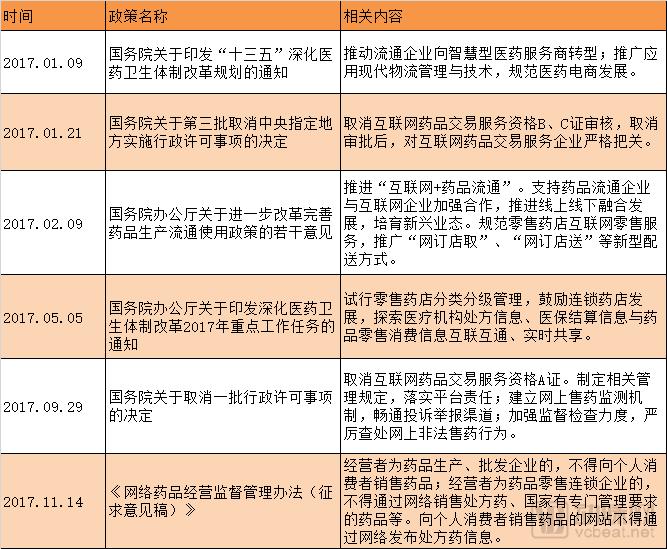
This Year, Policies Were Frequently Issued:
On January 9, promote the transformation of circulation enterprises into smart pharmaceutical service providers;
On January 21, the review of Qualification Certificates B and C for Internet Drug Transaction Services was abolished;
February 9: Encourage “online ordering with in-store pickup” and “online ordering with store delivery”;
On May 5, the 2017 healthcare reform tasks proposed piloting a classified and tiered management system for retail pharmacies and encouraging the development of chain pharmacies.
On September 29, the review of Class A certification for online drug transaction services was abolished;
On November 14, the “Draft for Comments” proposed that prescription drugs shall not be sold online, and information on prescription drugs shall not be published via the internet.
Relevant Policies in the Pharmaceutical Industry in 2017
This Year, Industrial Innovation Continues Unabated
Alibaba Health has made multi-faceted strides in the “smart healthcare” sector, launching the medical AI product “DoctorYou” and applying blockchain technology to the development of medical consortiums...
Jianke has acquired or established multiple physical hospitals in Guangzhou, Wuhan, Chongqing, Hangzhou, and Hainan; strengthened its supply chain by partnering with numerous domestic and foreign pharmaceutical and medical device companies; and enhanced its offline network by laying out multiple pharmacies and DTP (Direct-to-Patient) pharmacies...
Qilekang Announces Launch of “1 Billion Doctor Entrepreneurship Fund” to Provide a Range of Support, Including Funding, Space, and Manpower, for Physicians Practicing on the Qilekang Internet Hospital...
Kangaiduo Celebrates Its 6th Anniversary: Leveraging Tai’an Tang’s Industry Resources to Complete Online-Offline Integration and Accelerate Transformation into a Comprehensive Health Service Provider; Signs Tripartite Cooperation Agreement with Kunming Pharmaceutical Group and Guangdong Medicinal Materials & Pharmaceutical Company to Strengthen Supply Chain Foundations...
In the pharmaceutical O2O sector, Kuai Fang Song Yao has launched an intelligent pharmacy system, aiming to provide retail pharmacies with informatization solutions and delivery services to “empower” them. Meanwhile, Dingdang Kuai Yao has introduced AI robots, smart vending machines, and its Smart Pharmacy 3.0 system, while also unveiling its “Smart Pharmacy” initiative.
This Year, Capital Flows Surge
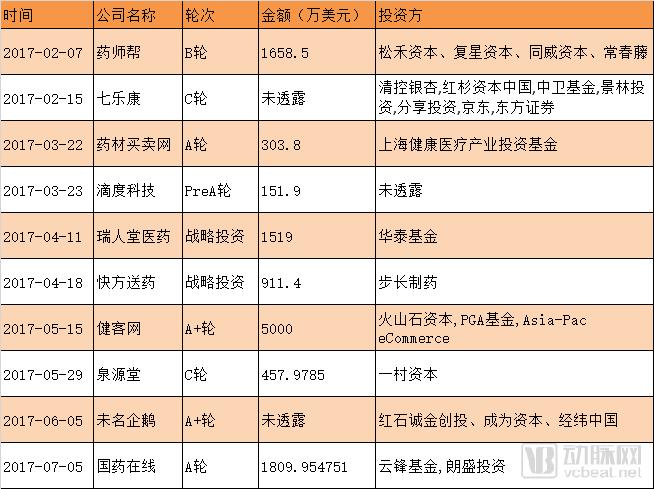
YaoShiBang, QiLeKang, Medicinal Materials Trading Network, KuaiFang SongYao, JianKe, QuanYuanTang, WeiMing Penguin, and Sinopharm Online have successively secured financing. The “Internet + Healthcare” sector raised nearly RMB 1 billion in funding throughout the year, with capital support making the path forward for “Internet + Healthcare” more solid.
Overview of Financing in the Internet + Healthcare Sector in 2017
If 2017 was a year of rapid change in the “Internet + Healthcare” sector from the media’s perspective, what did it look like through the eyes of industry players?
VCBeat (WeChat ID: vcbeat) interviewed leading industry players such as Ali Health, 111.com, Jianke, and Quanyuantang to interpret, from a corporate perspective, the developments in the “Internet Plus Healthcare” sector over the past year. The interviews explored how these companies have structured their strategies, their understanding of industry trends, and the key areas they will focus on in 2018.
Alibaba Health’s Kang Kai: Transitioning from an Extensive to an Efficiency-Driven Model, with Emphasis on Alignment with Regulatory Directions

Kang Kai, Director of Alibaba Health and General Manager of Tmall Medical Pavilion
The development of the “Internet + Healthcare” sector this year can be described as a mixed bag.
On the positive side, documents issued by the State Council demonstrate the national government’s supportive and encouraging stance toward “Internet + Healthcare.” On the negative side, the rollout of implementing policies aligned with this supportive attitude has been relatively slow. For instance, regarding policies related to prescription drugs, the November 2017 Draft for Comment stipulated that pharmaceutical retailers were prohibited from selling prescription drugs online or publishing prescription drug information via the internet. This indicates that significant uncertainties remain at the level of concrete policy implementation. The resulting ambiguity creates an unclear outlook for the overall market and businesses, leading merchants to adopt a wait-and-see approach, which ultimately hinders the forward progress of the industry and the market.
Regarding prescription drugs, as previously mentioned, two key issues need to be addressed. First, the issue of online prescribing must be resolved. Although internet hospitals have made some progress, they still operate in a relatively gray area. Second, the delivery of prescription drugs needs to be addressed. The State Council has explicitly endorsed the models of “online ordering with in-store pickup” and “online ordering with store-based delivery.” However, the specific details of how these national policies will be implemented remain unclear. Furthermore, the precise definition of “store” in the context of “online ordering with in-store pickup” and “online ordering with store-based delivery” is not yet clearly defined.
Therefore, I currently view the situation as “mixed.” Overall, however, we remain optimistic about the broader direction. The key challenge we will need to address in the coming year lies in balancing risk management, ensuring compatibility with existing systems, and meeting current market demands during implementation. I still believe that policymakers should allow some room for flexibility.
From an industry perspective, although 2017 cannot be described as lackluster, the progress made that year was not particularly exciting, with few industry hotspots or highlights emerging. The entire sector largely continued to operate along its existing logic and trajectory, without significant breakthroughs. This situation was partly due to relevant policies and partly because the industry as a whole was in a phase of reflection and cognitive adjustment.
Key Competitive Factors for the Industry’s FutureThe foremost determinant of future industry competition will undoubtedly be the team, along with the integrated innovation capabilities built upon that foundational team strength; capital ranks second. Another critical factor is whether a company’s voice can be heard and acknowledged at the policy level. Today, we observe significant uncertainty and lack of clarity in policymaking, accompanied by substantial regional disparities in local policies. The ability to secure supportive policy environments from various localities constitutes a key element enabling enterprises to emerge as standout players.
Regarding development trends, if viewed solely from the perspective of the pharmaceutical retail industry, the sector should gradually transition from its previous extensive growth model to one that focuses more on enhancing efficiency and improving user experience. This shift represents the overarching trend for the entire industry. The former strategy of relying on capital for rapid market expansion will inevitably give way to a greater emphasis on operational capabilities, delivering enhanced value to brand partners, and providing consumers with novel experiences.
1Drug.com’s Yu Gang: Aligning with Industry Trends, Organically Integrating Resources to Build an Internet-Based Pharmaceutical and Healthcare Ecosystem
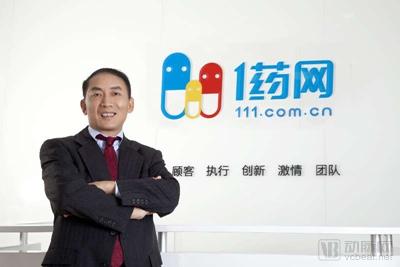
Yu Gang, Co-Founder and Executive Chairman of the Board of Directors, Gangling Group
If one keyword were to be used to characterize the development of the “Internet Plus” pharmaceutical and healthcare sector in 2017, we believe the most significant would be “integration,” encompassing the integration of online and offline channels, the convergence of pharmaceuticals with medical services, the merging of retail and wholesale models, and the synergy between technology and distribution channels.
Online channels offer distinct advantages. They transcend geographical boundaries, providing nationwide coverage; operate without time constraints, offering 24/7 service; and are free from shelf-space limitations, allowing for an unlimited expansion of product varieties and categories. Furthermore, big data and business intelligence can be effectively leveraged online to gain deep insights into user behavior. The internet also enhances supply chain transparency by eliminating or shortening intermediate links, thereby improving efficiency.
Offline channels offer distinct advantages. Customers can obtain desired items immediately, ensuring instant availability; store staff can provide personalized, face-to-face service and implement experiential marketing strategies.
In the future, the distinction between online and offline channels will disappear, giving way to deep integration that enables mutual traffic generation, shared SKUs, “buy online, pick up in store” services, and the combination of medical consultations with medication purchases. Our goal is to deliver the products and services customers desire, at their preferred time and location, in their preferred format, with guaranteed quality and quantity.
Along this main thread, Gangling Group (which includes the B2C pharmaceutical platform “1 Drug Network,” the B2B online pharmaceutical wholesale platform “No. 1 Drug City,” and the online hospital “1 Diagnosis”) underwent comprehensive integration in 2017, forming a core strategic model of “B2B2C.” The integrated development encompasses the convergence of B-side and C-side businesses, the integration of online and offline operations, the combination of self-operated and platform-based models, and the merging of medical services with pharmaceuticals.
Our goal of integrated development is to provide the public with comprehensive solutions for medical consultations and medication purchases, thereby enhancing operational efficiency. Ultimately, we aim to translate these efficiency gains into improved customer experiences, creating a virtuous cycle that more effectively builds an “Internet + Pharmaceutical Healthcare” ecosystem.
In 2017, as our user reputation and brand influence continued to grow, we established deep strategic partnerships with major domestic and international pharmaceutical companies, including Pfizer, Bayer, Eli Lilly, AstraZeneca, Dong-E-E-Jiao, Wyeth, Slian, and BiShengYuan, thereby strengthening our supply chain resources.
In 2017, our supply chain management efficiency also saw a significant improvement. By leveraging big data and business intelligence technologies to transform the supply chain, inventory turnover time was markedly reduced, and the number of orders processed per person per day increased by more than 50%.
From a data perspective, 1YaoWang already has over 20 million registered users, with 80% of sales revenue generated through its self-operated channels and 80% of its customer base coming from mobile platforms. Additionally, more than 40,000 pharmacy members procure medicines through our Yihaoyaocheng platform. Our business operations are becoming increasingly robust, with continuous improvements in operational efficiency and inventory turnover. We are allocating greater resources to technological innovation, big data, business intelligence, and supply chain management, eliminating the need to burn cash on marketing or purchasing traffic.
The pharmaceutical and healthcare industry is characterized by significant policy and industry barriers. Both external and internal factors are influencing and transforming this sector. External factors, such as the introduction of multiple healthcare reform policies—including tiered diagnosis and treatment, the separation of prescribing from dispensing, and the implementation of the two-invoice system—have brought developmental dividends to the industry. Internally, the industry’s concentration remains low, with leading enterprises holding only a small market share, making consolidation an inevitable trend.
In response to the current situation, we are actively cooperating and contributing to healthcare reform to address the challenges of “difficult access to medical care and high drug prices.” By leveraging our internet-based mindset and business model, we employ new technologies to resolve the mismatch between the supply and demand of medical resources and the excessively long pharmaceutical distribution chain. We reduce intermediate links and flatten the supply chain, enabling numerous small and medium-sized chain pharmacies and independent pharmacies to enjoy the same procurement capabilities and services as large chains through the internet, ultimately benefiting end consumers.
In 2018, we will primarily focus on the following initiatives:
1. Continuously advance “integration,” with tighter business synergy and seamless alignment among 1 Drug Network, 1 Clinic, and No. 1 Drug City;
2. Empower partners, with the aim of enabling 1st Medicine City to provide products and services to over 100,000 pharmacies and more than 10,000 hospitals in the future, while also helping upstream pharmaceutical companies distribute drugs to end-users more efficiently;
3. Continuously build core competencies, including supply chain management and business intelligence capabilities, leveraging business intelligence and big data to provide users with precision marketing and personalized services;
4. Continuously innovate by exploring new technologies and directions, such as AI+pharmaceuticals and blockchain-based traceability for pharmaceutical distribution.
The era presents us with a unique opportunity, as the integration of the internet into the pharmaceutical and healthcare industry is still in its nascent stages. Gangling Group will fully leverage its existing advantages in platforms, technology, and supply chain management to contribute to the “Healthy China” initiative and forge ahead on the path of breakthrough development in the pharmaceutical and healthcare sector.
Jianke Xie Fangmin: Regulation Gradually Clarifies, Adjusting and Setting Off Again

Xie Fangmin, Founder & CEO of Jianke
We believe that “rational restraint and steady progress” is the most apt description of the changes in the “Internet + Healthcare” sector in 2017.
For the “Internet + Healthcare” industry, 2017 marked a significant turning point in its development. This transition was driven both by macro-level policies and by the industry’s own rational adjustments.
In terms of macro-level policies, while the industry was previously in a phase of exploration and development, it has now officially entered a stage of rational and standardized growth, as regulatory boundaries have become clearly defined. At the level of corporate development, the entire industry had, by 2017, reached a point where it needed to rationally reassess its own growth trajectory and make adjustments before moving forward.
In 2017, bolstered by capital support and favorable policies, Jianke made comprehensive efforts to upgrade its corporate strategy, deepen its supply chain layout, acquire physical hospitals, expand its retail pharmacy network, and optimize its mobile health app. In May 2017, the company completed a $50 million Series A+ financing round, bringing its total Series A funding to $150 million to date.
Most importantly, 2017 was a pivotal year for Jianke’s strategic upgrade and transformation. In accordance with Jianke’s development strategy, the company began transitioning from Phase II, “Pharmaceutical E-commerce,” toward its Phase III objective of becoming an “Online Health Management Enterprise.” In 2017, Jianke comprehensively intensified its efforts to deploy resources in internet healthcare. We not only established a Mobile Healthcare Division but also operationalized three physical hospitals and two internet hospitals through acquisitions and greenfield development.
In 2017, we will continue to provide high-quality online health management services to the Chinese public, offering our extensive customer base precise and meticulous services including online medication purchasing, chronic disease management, and online health management.
In 2017, Jianke also secured exclusive e-commerce channel rights for the latest products launched by multinational pharmaceutical giants in the Chinese market. Gaining recognition from these global industry leaders demonstrates that Jianke’s team competitiveness, product operational capabilities, and service quality have reached world-class standards, marking a dual breakthrough in both its comprehensive strength and brand influence.
As consumer health awareness strengthens and internet technology becomes more widely applied, the future of “Internet + Healthcare” is very promising. Policy regulation will become increasingly transparent, relevant restrictive policies will be gradually relaxed, and the overall market potential will continue to be unleashed.
For established companies in the industry, the current competitive landscape has largely stabilized after years of development, with the hierarchy among leading players clearly defined. In the future, sustaining a competitive advantage will depend on competing through key factors such as professional service capabilities, operational expertise, and technological proficiency.
The future trend lies in the integrated development of online and offline channels. Under the current policy framework, relying solely on online operations offers extremely limited growth potential for enterprises. Only by integrating resources and fostering the convergence of online and offline models can service coverage be significantly expanded. It is by committing to deep, hands-on service delivery that market opportunities will continue to grow.
In 2018, Jianke will focus on a new model of online health management and continue to deepen its ECSO model for online brand operations. Centered on user operations, it will drive product optimization, establish a comprehensive content operation system, and further expand its strategic layout to build a leading integrated platform for online health management, continuing to provide trustworthy and professional online health management services to the Chinese public.
Currently, Jianke has established a presence in pharmaceutical e-commerce, mobile healthcare, physical hospitals, and retail pharmacies. In addition to its deep cultivation of the “pharmaceutical” sector, Jianke has already laid out five physical hospitals across China through self-construction or acquisitions, primarily located in Guangzhou, Wuhan, Chongqing, Hainan, Hangzhou, and other regions. In 2018, Jianke will also make comprehensive efforts to expand into the “medical care” sector.
Chen Zhouhua of Quanyuantang: Dissolving Boundaries Between Online and Offline Channels, Multi-Format Integration Sparks Chemical Reactions

Chen Zhouhua, General Manager of Quanyuantang
We can use a visual metaphor to understand the landscape of the “Internet + Healthcare” sector in 2017: A large flag symbolizing the industry’s promising prospects is planted just ahead on the mountain peak. Competitors from various backgrounds are sprinting toward the summit via different paths, but along the way lies a dense forest—representing government regulation and entrenched traditional interests. No one knows whether the path is clear or if they will successfully reach the top.
In response to the complex and volatile external environment, Quanyuantang primarily focused on three key initiatives this year:
1. B2C pharmaceutical sales remain firmly in the top three, with sound operational performance;
2. The pilot program for new retail pharmacies achieved successful breakthroughs, becoming a strategic support business for the company;
3. Recognized as a National E-Commerce Demonstration Enterprise and elected as the leading member unit of the Pharmaceutical E-Commerce Branch of the Sichuan Provincial Pharmaceutical Commerce Association—the first provincial-level pharmaceutical e-commerce branch in China—gaining recognition from the government and competent authorities;
Overall, we remain committed to advancing our core strategy of new retail in pharmaceuticals, transforming users’ health management experience and efficiency, and realizing our brand promise: “For medications, turn to Quanyuantang.”
We believe the prospects for healthcare reform are promising, with policy dividends continuing to be released and the industrial environment gradually improving, which will benefit the entire “Internet + Healthcare” sector. Against the backdrop of the separation of prescribing and dispensing, “Internet + Healthcare” represents the most efficient means to break the ice.
After more than a decade of development and consolidation, the “Internet + Healthcare” sector is currently experiencing a flourishing and highly competitive landscape. Following the initial phase of rapid industry growth, the sector is poised for differentiation, with each player’s distinct strategic positioning becoming increasingly pronounced.
With the separation of prescribing and dispensing, the circulation of prescriptions, and the development of internet hospitals, an increasing share of the pharmaceutical market is shifting toward the retail sector, making “Internet + Healthcare” the most effective channel to capture this demand.
The effects of the separation between medical services and pharmaceutical sales, along with the outflow of prescriptions from hospitals, will continue to manifest in the future. Taking Sichuan Province as an example, a series of newly issued policies have released key signals regarding innovative drug distribution channels, the promotion of diversified composite health insurance payment methods, diagnosis-related group (DRG) payment, and curbing unreasonable growth in medical and pharmaceutical expenses—all of which chart our course forward.
We believe that the key competitive factors in the future of the “Internet + Healthcare” industry will continue to center on “efficiency” and “user experience,” by promptly meeting users’ diverse pharmaceutical care needs, creating a superior medication purchasing experience, and establishing systematic, modular health management solutions.
There is still room for growth in online and offline traffic penetration, while user education and awareness are becoming increasingly mature, all of which will drive rapid industry expansion.
Under the current circumstances, the rise of the new retail concept actually reflects a major trend: online traffic for pharmaceutical e-commerce has basically reached its “ceiling.” With insufficient penetration into offline channels, future development requires integrated online-offline coordination—strengthening offline experience while focusing on online efficiency, and leveraging marketing advantages to rapidly expand market presence.
The boundary between online and offline will become increasingly blurred. In this trend, success hinges on strategic thinking: those who leverage the internet effectively and create stronger synergies in their business portfolios will emerge as the clear leaders.
In 2018, Quanyuantang set the following goals: to maintain its traditional e-commerce business among the top three players; to aggressively expand its new retail stores, aiming to operate 1,000 new retail pharmacies across 50 cities within three years; to provide more convenient and professional high-quality pharmaceutical services to over 20 million members; and to build brand recognition with the slogans “For medications, go to Quanyuantang” and “Your neighborhood family pharmacy.”
Summary and Outlook
Most turning points do not arrive with a sudden “whoosh,” but rather, as described in Carl Sandburg’s famous poem about fog, “on little cat feet.” Only those who listen patiently can detect the subtle shifts of the times.
"Internet + Healthcare" spans the retail and service sectors and is subject to stringent regulatory oversight. Industry changes are primarily driven by policy shifts, with "outflow of prescription drugs" and "smart pharmaceutical logistics" currently serving as the key drivers fostering new business models. Secondly, within the industrial landscape—characterized by traffic concentration among leading enterprises and deep integration of pharmaceuticals and medical services—companies are striving to establish closed-loop business ecosystems, aiming to capture and retain users through platform-based strategies.
The vast market space has provided enterprises with a significant platform, enabling a continuous rollout of diverse innovations. Currently, companies are pursuing distinct strategic priorities, and direct, head-to-head competition has not yet emerged. With business models largely established, 2018 is poised to become a turning point for the “Internet + Healthcare” industry, with “intensive cultivation and meticulous operation” serving as the key theme for the year.