

WeDoctor and idsMED Establish Smart Healthcare Supply Chain and Procurement Platform to Enhance Efficiency in China's Medical Supply Chain
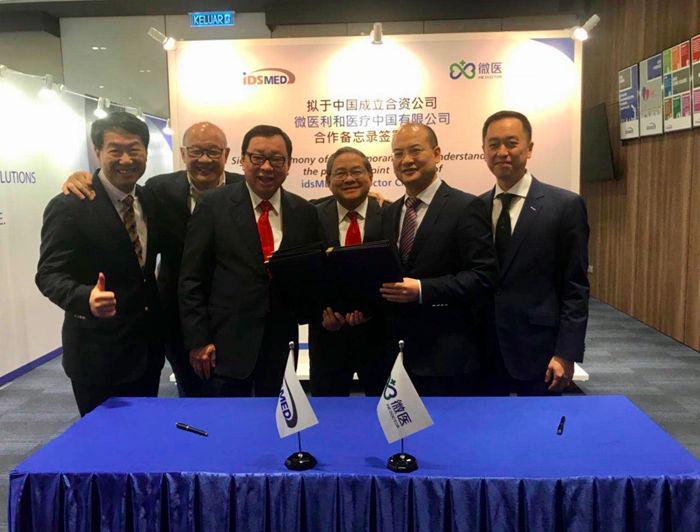
On February 2, WeDoctor and Li & Fung Medical Group Limited (hereinafter referred to as “Li & Fung Medical”), a subsidiary of Hong Kong’s Fung Group, signed a memorandum of cooperation in Kuala Lumpur, Malaysia, announcing the establishment of a joint venture for smart healthcare supply chain and procurement—WeDoctor Li & Fung Medical China Co., Ltd. (hereinafter referred to as “WeDoctor Li & Fung”)—to enter China’s rapidly growing medical device and consumables market, which is valued at approximately $20 billion.
Under the agreement, Weiyi Lihe will connect medical device manufacturers, service providers, hospitals, and care institutions to facilitate centralized procurement of medical devices, consumables, and services via the Weiyi platform. It will also provide real-time, optimal supply chain coordination and value-added services, including data analytics and intelligence. Furthermore, Weiyi Lihe will establish a premier medical training and education institute in China, offering training on the use of medical products, professional medical courses, and medical education lectures to hospital administrators, physicians, nurses, and administrative staff.
WeDoctor is China’s leading intelligent healthcare platform, delivering integrated online and offline medical and health services through big data, artificial intelligence, and other advanced technologies. To date, the WeDoctor platform has connected more than 2,700 key hospitals across China, over 100 internet-based medical consortia and WeDoctor General Practice Centers, as well as a healthcare service network comprising nearly 20,000 primary care institutions and pharmacies. It serves more than 220,000 specialist physicians and over 110 million real-name registered users.
Li & Fung Healthcare Group is a company specializing in comprehensive medical supply chain solutions, primarily providing medical equipment, consumables, and value-added services to thousands of hospitals and care facilities across the Asia-Pacific region. Li & Fung Healthcare boasts an extensive distribution network in the Asia-Pacific region, representing over 200 global medical device and consumable brands, including GE Healthcare, Philips, Maquet, Trumpf, Hill-Rom, Hamilton, Biosensors, Biotronik, Smiths Medical, Teleflex, and Ansell, among others, serving more than 10,000 healthcare institutions. The Li & Fung Healthcare Group employs 1,600 staff members, including 700 experienced frontline sales, product, and medical specialists, as well as over 300 professional biomedical technology engineers who provide installation and maintenance services. Li & Fung Healthcare Group is a member company of Fung Investments.
At the signing ceremony, Liao Jieyuan, founder of WeDoctor, stated that as a leader in the medical supply chain industry, Lihe Medical Group possesses deep expertise in both the healthcare sector and supply chain management. Integrating this expertise with WeDoctor’s big data- and AI-driven platform will undoubtedly accelerate the process of making high-quality medical services more accessible and widely available to the general public.
Zheng Youde, CEO and Co-founder of Lihe Medical Group, stated that WeDoctor’s accumulation and practical experience in the field of internet healthcare will help enhance primary healthcare capabilities in China, and that collaboration with WeDoctor is certain to bring a new landscape to the medical device distribution system.
According to VCBeat (WeChat ID: vcbeat), Weiyi Liyou differs from other transaction-based platforms. It aims to reshape the current fragmented, relationship-driven, and trade-oriented procurement model for medical devices and consumables by establishing an open market procurement system, significantly reducing costs, and thereby enhancing the efficiency of China’s healthcare supply chain.