

Paige.AI Secures $25 Million Series A Funding to Advance AI-Powered Cancer Diagnostics from Pathology Images
VCBeat has learned that Paige.AI, a developer of cancer diagnostic technologies, recently completed a $25 million Series A financing round. The round was led by Jim Breyer, hailed as the number one venture capitalist in the U.S. and an early investor in Facebook, with participation from several anonymous investors, including a Menlo Park, California-based investment firm.
Although Paige.AI announced its establishment concurrently with its financing announcement, the Wall Street Journal reported that insiders claimed it had already been registered last year.
Pathology serves as the cornerstone of cancer diagnosis; however, the majority of pathological diagnoses still rely on conventional manual assessment. This diagnostic approach is time-consuming and prone to misdiagnosis.
For instance, during a breast biopsy, pathologists typically need to review approximately 60 pathological images to determine whether the patient is diseased. Each image contains over 20 million pixels and carries a vast amount of information, yet only a few images are truly relevant to the affected areas. Although the digitization of pathological images has been in place for more than a decade, healthcare institutions have not yet established a comprehensive digital diagnostic workflow, making it difficult to effectively utilize these digital images.
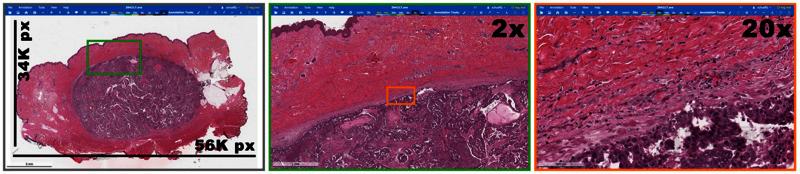
Example of Pathological Images
Paige.AI has developed artificial intelligence technologies tailored to this process, enabling the standardization of cancer diagnosis. This helps physicians narrow down image regions of interest, thereby improving diagnostic efficiency and accuracy while reducing costs. Computer scientists integrate AI with clinical workflows to analyze existing pathology images, performing computations related to probabilistic treatment models, medical regimens, and pattern recognition. Consequently, pathologists can devote the majority of their time to interpreting existing data and formulating detailed diagnostic and treatment plans, rather than manually counting cells in individual images.
Paige.AI states that its goal is to infuse foundational medicine with artificial intelligence, shifting the principles of pathology and diagnosis from qualitative to quantitative. In the short term, it aims to develop a series of modules for cancer diagnosis and treatment; in the long term, it plans to integrate artificial intelligence into the entire diagnostic and therapeutic model.
However,Artificial intelligence training relies heavily on large-scale databases. In a recent announcement, the company stated that Paige.AI has entered into a comprehensive licensing agreement with Memorial Sloan Kettering Cancer Center, securing exclusive rights to its computational pathology data.The Memorial Sloan Kettering Cancer Center database is one of the largest oncology pathology archives in the world. Over the past five years, it has been dedicated to digitizing pathology images and now houses millions of such images from the last 60 years. According to The Wall Street Journal, Memorial Sloan Kettering Cancer Center is currently the sole client of Paige.AI, but the company plans to seek collaborations with other cancer centers in the future.

At this stage, Paige.AI will focus on research into breast cancer, prostate cancer, and other major cancers, and will launch its first product—a digital pathology image viewing application—in 2018. This device-agnostic application not only provides modules for pathologists but also integrates with laboratory information systems (LIS), enabling seamless incorporation into clinical workflows.。
Regarding the team, Paige.AI currently has five employees and plans to use part of its financing to expand the team. Founder and CEO Thomas Fuchs is the Director of the Center for Digital and Computational Pathology at Memorial Sloan Kettering Cancer Center and a Professor at Weill Cornell Medicine; he previously held positions at GlaxoSmithKline and NASA. David Klimstra, Head of Pathology Research, has 30 years of experience in surgical pathology diagnosis. Computer scientist Peter Schüffler holds a Ph.D. from ETH Zurich and has ten years of experience in machine learning, pathology, and radiology.
Source: 36Kr