

Huami Becomes First Xiaomi Ecosystem Company to List on NYSE with $656 Million Valuation
VCBeat (WeChat ID: vcbeat) has learnedOn the evening of February 8, 2018 (Beijing Time), Huami Technology successfully listed on the New York Stock Exchange in the United States, with the stock ticker symbol “HMI.” The company offered 10 million shares at $11 per share, raising over $110 million. The underwriters were Credit Suisse, Citigroup, and China Renaissance Capital.
At the close, Huami Technology’s stock price rose by $0.03 to $11.03, representing an increase of approximately 0.27% over its IPO price, with a market capitalization of $656 million.
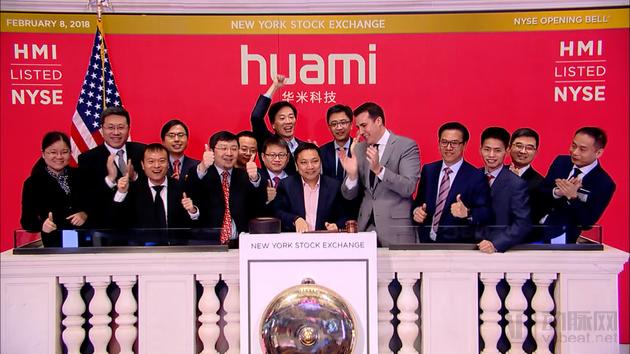
Huami Technology Officially Listed on the New York Stock Exchange
Xiaomi's Founder andCEOLei Jun also posted on Weibo, stating that Huami’s successful listing in the U.S. is a major victory for Xiaomi’s ecosystem model.
Surpassing Fitbit in Three Years to Become the World’s No. 1
Huami Technology, founded in 2014, is a company with extensive expertise in biometric recognition and sports data-driven solutions within the field of smart wearable technology. Possessing a massive global database of biometric and sports data from its users, the company provides comprehensive assessment and analysis services.
Huami Technology’s product portfolio primarily includes Xiaomi-branded smart bands and smart scales, as well as its proprietary AMAZFIT Mi Band series of smartwatches and smart bands.
It turns out that Huami seized the opportunity presented by the wearable device boom at just the right time. The Xiaomi Mi Band was an instant hit from its launch, with its ultra-low price of 79 yuan stunning nearly all fitness tracker manufacturers in China. From August to November 2014, it took only three months for Xiaomi Mi Band sales to surpass one million units. A few months later, shipments of the Xiaomi Mi Band continued to surge, reaching a monthly volume of one million units.
According to the prospectus, Huami’s shipments in the first three quarters of 2017 reached 11.6 million units, securing the top global market share and surpassing U.S.-based Fitbit to become the world’s largest wearable device manufacturer.
From the data perspective, in the first three quarters of 2017 ending September 30, 2017, revenue increased by 37.4% year-on-year to RMB 1.296 billion. For the fiscal year 2016 ending December 31, 2016, revenue grew by 73.6% year-on-year to RMB 1.557 billion. The net profit for the full year 2016 was RMB 23.95 million, with a net profit margin of only 1.5%; the net profit for the first three quarters of 2017 was RMB 95.37 million, with a net profit margin of 7.4%. According to the prospectus, Huami conservatively estimates that its full-year net profit for 2017 will be approximately RMB 170 million.
Huang Wang, founder and CEO of Huami Technology, once stated that at the outset of their entrepreneurial journey, they had no intention of surpassing international industry leaders such as Fitbit and Jawbone; they considered it a significant achievement simply to outcompete the numerous domestic counterfeit manufacturers. At that time, many companies based in Shenzhen and Hangzhou had already emerged in China.
Fitbit has struggled to gain traction in China, whereas Huami quickly earned market recognition. Huang Wang once pointed out that the underlying logic differs: Fitbit focused exclusively on fitness trackers from the outset, emphasizing features such as step counting. However, the proportion of Chinese people who regularly engage in exercise is relatively low. In contrast, the Mi Band was designed to integrate seamlessly with smartphones right from its launch—for example, enabling automatic phone unlocking when the band is nearby—functioning more like a personal data hub.
From Device Manufacturers to Data Providers
In May 2017, Huami announced its entry into the broader health sector, with the Amazfit Mi Band Health Edition serving as its inaugural product in this domain. By this logic, Huami Technology is not merely a wearable band manufacturer but a human biometric data company that leverages user information to channel traffic across various offline service sectors. Huami’s devices capture multidimensional user data.
Since its establishment, the company had shipped a total of 45.3 million units and registered 49.6 million users by September 30, 2017. It has collected more than 10 types of user data, including heart rate, electrocardiogram (ECG), body weight, body fat percentage, GPS running tracks, step count, and sleep duration, thereby generating extensive biological and activity data.
Smart wearable technology connects biosignal application scenarios, continuously optimizes algorithms, and naturally integrates with artificial intelligence, turning these data into a vast treasure trove for the future with significant monetization potential.
At the listing ceremony, Huang Wang, Founder and CEO of Huami Technology, also stated: “Huami Technology has always been committed to seamlessly connecting human emotions and activities to the internet world, thereby improving people’s lives. Following its public listing, Huami Technology will increase its investment in technology and product research and development, enabling more extensive and diverse collection and analysis of biometric recognition and activity data, and driving continuous innovation and rapid growth in the smart wearable market.”