How Distributed Storage in Blockchain Technology Ensures Security of Healthcare Data: Keyword Interpretation and Product Insights
The current internet is built upon a multitude of protocols, such as the TCP/IP protocol for computer network communications, the HTTP protocol for web content, the SMTP protocol for email, and the FTP protocol for file transfer. Blockchain has the potential to become another protocol that fosters trust and verifies identities, thereby enhancing the security of information stored on the internet. By establishing the trust, accountability, and transparency essential to modern commerce, blockchain technology can support a new generation of transactional applications and streamline business processes.
Beyond transactional and financial data storage, niche sectors across other industries also require blockchain to ensure the security of data storage. Ensuring both security and liquidity has become a major concern for virtually all industries, and the emergence of blockchain technology has provided a viable solution to this widespread problem.
Data security and circulation in the healthcare sector have long been persistent issues that remain inadequately addressed. With the large-scale adoption of electronic health records (EHRs), wearable devices, sensors, and the Internet of Things (IoT), data volume has surged dramatically in recent years. Consequently, achieving effective recording, tracking, and management of data information has become a significant challenge.
Therefore, even though stakeholders in the healthcare sector have already grasped what blockchain is, they are more eager to understand how blockchain should be practically implemented in the medical and health field. What are the modes of participation in various market segments? What benefits can it bring us? To address these questions, VCBeat (WeChat ID: vcbeat) has compiled articles on blockchain and case studies from the medical and health sector.
In the coming period, VCBeat’s editorial plan for blockchain-related topics is as follows: In addition to closely monitoring the development of blockchain technology in the healthcare sector, we have established a blockchain discussion group. To join and gain access to more blockchain resources, company information, project whitepapers, and updates on offline events, please add VCBeat’s membership assistant on WeChat (WeChat ID: vcbeat_m; note “blockchain” in your friend request).
VCBeat Blockchain Report Series I: Decoding Key Blockchain Terms
VCBeat Blockchain Report Series II: Interpreting Blockchain Application Scenarios in Healthcare
VCBeat Blockchain Report Series III: Case Studies of Blockchain Healthcare Enterprises in China and Abroad
Decoding Key Blockchain Terms (I): “Block” and “Chain”
Decoding Blockchain Keywords (II): Distributed Storage
Distributed Storage Ensures Data Consistency
In the previous article, we introduced the structural characteristics of blockchain. Essentially, it is a chain of events linked in chronological order, with all transactions since the genesis block recorded within blocks. Account information, such as transaction records, is packaged into individual blocks, encrypted, and timestamped. All blocks are then connected in chronological order based on their timestamps to form a comprehensive ledger.
Blockchain employs cryptographic mechanisms specified by its protocols to ensure authentication, thereby preventing tampering and forgery; as a result, all value exchange activities between any two transacting parties are traceable and auditable.
To modify the “ledger records” on a blockchain, one would need to crack and alter the encrypted data across the entire chain, an extremely difficult task dictated by the blockchain’s structure. Another factor ensuring security is the adoption of distributed storage. In other words, even if hackers were to crack and modify the information on a single node, it would be futile; tamperers would need to simultaneously alter the data on more than half of the network’s nodes to successfully manipulate the records. The prohibitively high cost of such tampering renders it virtually impossible, thereby underpinning the security of blockchain technology.
The security of blockchain is jointly ensured by the following characteristics.
(1) Block Data Encryption
(2) Interlinked into a “chain” to prevent tampering
(3) Distributed Storage Ensures Ledger Consistency
The security of blockchain is attributed to the three points mentioned above. The first and second points are determined by the characteristics of its data structure. The third point, distributed storage, is another factor that enhances blockchain security.
Concept of Distributed Systems
What Is Distributed Storage? Conventional data storage, known as centralized storage, stores critical data on a central server, with other clients reading data from this central storage pool. Blockchain technology distributes data across multiple nodes throughout the network, with each node maintaining complete data storage and backups, thereby forming a large-scale storage resource pool.
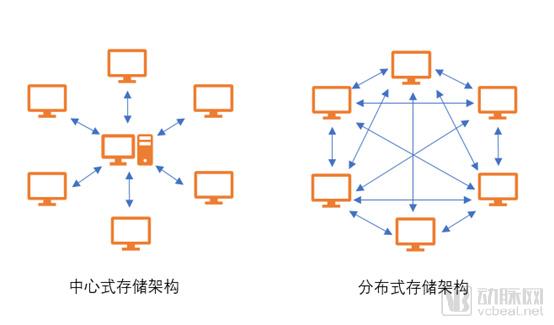
Data Transmission and Storage Paths for Distributed Storage
Blockchain constructs a network system with a distributed structure to ensure the integrity of the database. Instead of reserving a specific central location and central authority for professional ledger keepers, blockchain designers aim to establish a distributed bookkeeping system in which anyone can participate in recording information on a voluntary basis. This approach decentralizes accounting responsibilities, allowing all participants in the network to jointly maintain the records. All data in the database is updated in real time and stored across all network nodes involved in the recording process. Consequently, even if some nodes are damaged or compromised by cyberattacks, the overall data integrity and information updates of the entire database remain unaffected.
It has been 20 years since we first encountered the concept of “distributed” systems. At that time, many large-scale scientific computing projects adopted a “distributed computing” design, such as Seti@Home for searching for extraterrestrial intelligence and Folding@Home for simulating protein folding. These computational tasks were extremely intensive and traditionally required supercomputers, resulting in long processing times and high costs—a model known as “centralized computing.” In contrast, distributed computing breaks down portions of these computational tasks and distributes the data over the Internet to personal computers equipped with client software, leveraging idle computing resources to collectively complete the calculations. This approach is referred to as “distributed computing.”
Computation and storage are both fundamental components of computer architecture. Distributed computing addresses the cost of data processing by leveraging collective computational power, while distributed storage enhances data security through collaborative ledger-keeping. In fact, blockchain technology incorporates not only distributed storage but also distributed computing.
Among the blockchain introductions online, the most widely circulated educational comic depicts blockchain as countless “accountants” jointly performing bookkeeping tasks to ensure ledger security. Although the comic is simple and easy to understand, it is a misconception to view blockchain merely as a distributed storage system. While blockchain employs distributed storage, not all distributed storage systems constitute blockchain.
Before the emergence of blockchain, ordinary users had already encountered distributed storage applications in the form of BitTorrent (BT downloads). The data required for BT downloads is distributed across users’ computers, utilizing peer-to-peer (P2P) data transmission. Music, software, and film resources are shared freely among individuals through BT software, with data transferred in a distributed, peer-to-peer manner between users. Due to the absence of centralized servers, with data residing on users’ personal computers, authorities have no means to remove such data. Blockchain technology employs a similar approach to data storage.
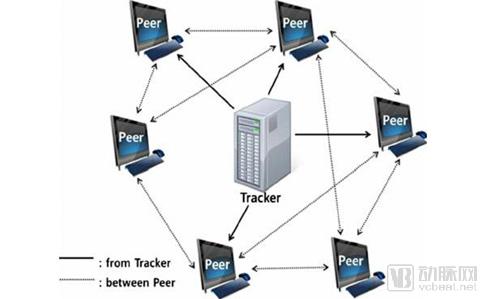
Schematic Diagram of BitTorrent Downloading, Similar to Blockchain Storage Mechanisms. According to the BitTorrent protocol, files released by publishers generate torrent files, which consist of two parts: tracker information and file information. The tracker information primarily includes the addresses of tracker servers required for BitTorrent downloads. At the initiation of a BitTorrent download, the client first connects to a central tracker server to obtain the IP addresses of other users, and then establishes connections with those users to commence peer-to-peer (P2P) downloading.
All nodes are equal
Blockchain establishes a comprehensive set of protocol mechanisms that enable every node in the network to validate the accuracy of other nodes’ recorded results while participating in the recording process. The authenticity of a record is recognized across the entire network, and the data is permitted to be written into a block, only when a majority of nodes (or even all nodes) concurrently deem the record correct, or when all nodes involved in the recording reach a consistent consensus after comparing their results.
Blockchain technology adopts distributed data storage to address ledger disaster recovery, while also aiming to establish peer-to-peer (P2P) relationships among equal participants, thereby forming a decentralized data system. In this system, there are no intermediary institutions; all nodes have equal rights and obligations, and the failure of any single node does not affect the overall operation of the system. Therefore, one advantage of distributed storage is referred to as “decentralization.”
From Decentralization to Weak Centralization
The core of blockchain is not decentralization, but distribution. In the early stages of blockchain technology (such as Bitcoin), it was described as a fully decentralized, anarchic technology. In reality, blockchain technology still has a center; although there is no third-party platform acting as a central authority to provide credit endorsement, the transaction protocols and algorithms themselves serve as its center. In the future, as blockchain is applied in industries that “originally had only a few large centers,” it will gradually evolve into a system with “a large number of smaller-scale centers.”
The benefit of decentralization is low trust costs, but the multi-node confirmation model of P2P networks also reduces transaction efficiency. Due to the unique nature of the financial industry, it is impractical to completely eliminate the supervisory authority of regulatory bodies. Multiple regulators, including central banks, are studying how to introduce super accounts into blockchain systems. However, certain specific operations, such as freezing transaction accounts, would need to be executed through these super accounts.
In practice, many business scenarios already possess a certain foundation of trust, such as mutual trust within an institution or among industry alliances. Building upon this existing trust, blockchain technology is evolving toward consortium chains and private chains. The future architecture of blockchain systems will aim to construct a trustworthy multi-center framework, elevating dispersed, independent single-center entities into a unified multi-center system with multi-party participation. This transformation will enhance the efficiency of trust transmission and reduce transaction costs, thereby establishing a “trust” ecosystem that supports the occurrence and development of various activities in environments characterized by information asymmetry and uncertainty.
Distributed Storage of Medical Health Records
Financial, legal, healthcare, and other types of transactions share certain common requirements. It is necessary to verify the identities of the parties involved, maintain trust, ensure that transaction records are accurate and immutable, and guarantee the stability of the underlying infrastructure. Prior to the emergence of blockchain technology, the only way to achieve these objectives was to establish a robust centralized entity to provide such services, such as banks, governments, and clearinghouses.
In the field of electronic health records (EHRs), each hospital or healthcare system operates its own central institution to provide services for recording, storing, and transmitting health records. Traditional centralized storage facilities have long been considered the optimal solution to this challenge. While this approach offers numerous advantages, it also has significant drawbacks. Centralized storage is vulnerable to data loss, unauthorized modification, and cyberattacks. Furthermore, this architectural model has contributed to the widespread prevalence of information silos in the healthcare sector today.
According to data from the U.S. Department of Health and Human Services, in 2015, 112 million medical records were compromised due to hacking/IT incidents. In 2016, it was estimated that one-third of patients would become victims of data breaches. Blockchain’s public/private key access mechanism and distributed data storage have established a new paradigm for the security of healthcare information.
Taking the data storage method of a hospital's HIS (Hospital Information System) as an example, it adopts a traditional centralized storage approach, where all data is stored in the system’s central data center. The computers in each department serve as clients, responsible only for data collection, entry, and queries, but not for data storage. If distributed storage were adopted, there would be no dedicated servers; instead, all client computers would act as data servers, storing data locally, with all nodes transmitting data via peer-to-peer (P2P) communication.
Immutability is one of the core characteristics of blockchain technology. However, in practical applications, particularly within private blockchains, data modifications are often necessary when erroneous information is identified. Healthcare institutions can maintain updated copies of patients’ electronic medical records (EMRs), with distributed storage safeguarding these copies against malicious attacks. In cases such as incorrect patient gender or age, where historical data blocks on the blockchain require adjustment, consensus must be reached among all blockchain participants, or approval must be obtained from 51% of network participants. If a block replacement does occur, it will leave an auditable trail of changes visible to all participants. This feature enhances security and helps mitigate the risk of malicious alterations, as any change is immediately broadcast across the network.
Consulting services giant Accenture has secured patents for an editable blockchain model in Europe and the United States. This type of blockchain allows a central administrator to modify and delete stored information within authorized blockchain systems. Some proponents of blockchain technology argue that editable blockchains undermine the original concept of blockchain, representing a technological regression.
Through this article, we have explored the concept of “distributed storage” and its application in blockchain-based healthcare systems. In the next article, we will delve into “asymmetric encryption.”
Decoding Key Blockchain Terms (I): “Block” and “Chain”
Join the blockchain exchange group,Access more blockchain resources, corporate information, project whitepapers, and updates on offline events,Please scan the QR code to add VCBeat’s Membership Assistant on WeChat (WeChat ID: vcbeat_m; please note “Blockchain”). Companies involved in healthcare blockchain businesses may also contact Liu Zongyu from VCBeat (WeChat ID: q19930797) for media coverage.