

Artery Network's 402nd Report on Medical AI: Reflecting on the Evolution of Healthcare Artificial Intelligence in 2017 [2018 New Year Special]
Happy New Year! This is VCBeat’s 402nd report on artificial intelligence in healthcare. In 2017, VCBeat published a total of 274 articles related to AI in healthcare. As the new year arrives, we extend our best wishes to the industry and its practitioners for continued growth and success. Below, we present VCBeat’s perspective on the landscape of AI in healthcare in 2017.
In 2017, VCBeat’s content department underwent significant restructuring, requiring each journalist to track industry developments and deeply root themselves in their respective fields through diligent, ground-level reporting, with the aim of presenting readers with an authentic pulse of the industry.
Over the past year, we published more than 200 articles, two reports on medical AI, and hosted one medical AI forum. We interviewed over a hundred industry professionals, including CEOs of startups, university professors, researchers, investors, consultants, project leads, product managers, technical experts, hospital physicians, department heads, hospital directors, and primary-care doctors, spanning all levels of the healthcare ecosystem.
At different stages, the development status and industry understanding vary. We roughly divide the development of medical artificial intelligence in 2017 into four phases:
During this period, domestic medical AI companies were still in their infancy. Apart from Infervision, Vize Medical, Senyi Intelligence, and Yiyutong, which secured angel or Series A financing, other companies had yet to make significant moves.
Watson for Oncology entered China in 2016. After a six-month period of integration, it began to be implemented in hospitals in 2017 and gained widespread recognition, leveraging IBM’s reputation.Many people also began to understand medical artificial intelligence through Watson for Oncology., it can be said that Watson for Oncology made a certain contribution to initial market education.
However, there is still some confusion regarding the specific benefits that medical AI can bring to doctors and hospitals. Therefore, in March 2017, we interviewed the first batch of physicians using Watson through Hangzhou Cognitive Medical Technology. They shared insights on the applications of AI and conducted an implementation survey. For details, see “Exclusive Interview with One of China’s First Physicians to Use Watson: He Identifies Four Major Applications and Two Shortcomings of AI" and "Watson for Oncology Practice Survey: Serves Over 10,000 Patients, Partners with Dozens of Hospitals, and Has Three Major Applications》
The four applications are: selecting the optimal treatment plan based on empirical evidence; reducing physicians' misdiagnosis rates; providing physicians with novel treatment options for reference; and assisting in the training of junior physicians.
Meanwhile, there are two shortcomings: first, Watson itself is positioned as an assistant to physicians and cannot adjust to the real-life circumstances of patients; second, there is the issue of integrating traditional Chinese medicine with Western medicine.。
Later, Baiyang Intelligent Technology became a strategic partner of IBM, successively distributing Watson for Oncology and Watson Genomics. We then organized Watson’s product line 《An Analysis of Watson Health’s Four Major Product Lines: Oncology Products Have Formed a Comprehensive System, While Imaging Products May Enter the Chinese Market》and《IBM Watson AI Focuses on Oncology, Achieving Breakthroughs Across Nine Major Healthcare Domains: A Review and Outlook》
In addition, during this period, iFlytek and Alibaba announced their entry into the field of medical artificial intelligence. See “[Exclusive] Unveiling iFlytek’s Three Strategic Moves in Smart Healthcare: The New Blue Ocean of Voice Input》,《Alibaba Cloud’s ET Medical Brain Goes Live, Using Artificial Intelligence to Tackle Cancer》. The entry of major companies has greatly promoted public awareness of artificial intelligence.
After a period of dedicated research, domestic medical AI companies have developed rapidly. In April, we conducted an industry survey and found that 55 companies had business activities related to medical artificial intelligence. See details in 《Data Landscape of China's Medical AI Industry: A Comprehensive Scan of 55 Medical AI Companies》。
At this stage, statistical data already indicates that medical imaging and healthcare text will be key areas where artificial intelligence can make significant strides. Among the 55 companies, 12 are engaged in medical imaging research, with 9 having secured financing. Notably, Yitu Technology’s RMB 380 million funding round in May sent shockwaves through the industry.
In addition, there are 11 other companies related to medical big data. Among them, LinkDoc Technology, Senyi Intelligence, and Yidu Cloud have all experienced rapid growth in their later development.
This period is referred to as the “Human-AI PK” stage primarily because it saw widespread claims that artificial intelligence would replace physicians. Companies promoted their products at exhibitions and forums through human-versus-AI competitions (with AI almost invariably emerging victorious), and industries reacted with great excitement to AI’s performance, as if discovering a new continent.
Amidst the frenzy, some doctors are engaging in calm reflection, with many sharing their experiences using medical AI. In May, we wrote “Real-World Feedback on Medical AI: How Seven Categories of Physicians View Its Value?》, it was learned that physicians generally hold positive views toward medical AI; they merely hope that companies will engage in more communication with doctors during product development, which would help enhance the user experience of their products.
During this period, Jianpei Medical, Deepwise Medical, Dyingjia, Weikan Intelligence, ShangGong Yixin, and Wuhan Landin all secured angel and Series A financing. Compared to the millions raised in the first stage, funding amounts at this time reached tens of millions, driving up the valuations of medical AI companies.
The development of medical AI during this phase can be described as frenzied. Over the past six months, there were a total of 19 financing events in the medical AI sector. Prior to September, most of these were Series A rounds. In September, Infervision’s RMB 120 million Series B financing round ushered in the era of Series B funding for medical AI. This was quickly followed by Huiyi Huiying, Yiming Technology, and Tuma Shenwei, all of which announced their own Series B financing rounds, each exceeding RMB 100 million.
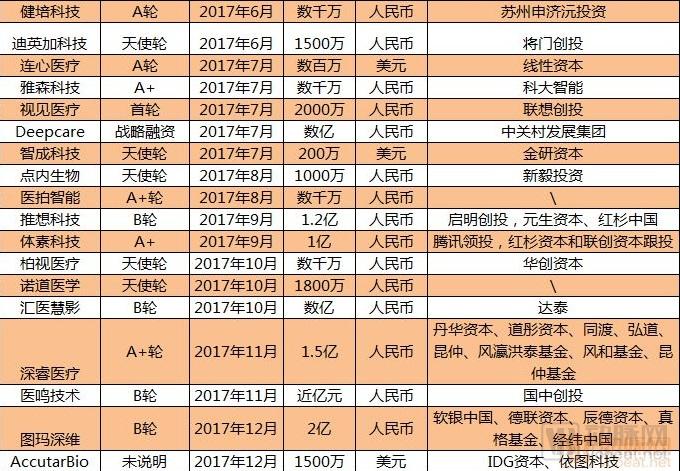
In addition to breakthroughs in financing amounts, companies have also made significant progress in hospital implementation, data accumulation, and business model exploration, with each achieving substantial breakthroughs. In October, VCBeat’s “Inventory of Clinical Data Implementation by Leading Domestic Medical AI Companies: Accelerating CFDA Submissions Is Crucial》pointed out that, as of October, each company had acquired tens of thousands of medical records, with implementation ranging from dozens to hundreds of hospitals.
At this point, people have come to realize that artificial intelligence is no longer a gimmick; it can be practically applied in healthcare institutions and integrated into physicians’ workflows.
In addition, companies are also exploring profit models. Beyond revenue streams such as research grants and technical services, medical AI companies are actively collaborating with medical device manufacturers. In “How Are These 8 Top Medical Device Companies Embracing Artificial Intelligence Through Intelligent Solutions?” article mentions that the collaboration between medical device companies and artificial intelligence companies is a win-win situation.
For traditional medical device companies, establishing a new department to develop products involves a complex process. However, by partnering with artificial intelligence (AI) companies, they can avoid expending time, financial resources, and effort on this endeavor. Through such collaborations, AI systems can be integrated into medical devices for sale, thereby enhancing the competitiveness of these devices.
For medical AI companies, collaborating with device manufacturers after product development offers two key benefits: on one hand, it allows them to validate the actual clinical efficacy of their products through research collaborations; on the other hand, device companies are required to pay for these services.
The integration of such devices with AI is now highly valued by many companies and is bound to become one of the key revenue streams for medical AI firms in the future.. United Imaging Healthcare also established a medical artificial intelligence division with a dedicated investment of RMB 300 million to enhance its capabilities.
Even pigs can fly in a strong wind; when the trend arrives, all sorts of things pretend to be pigs taking flight. By the end of 2017, a large number of companies falsely claiming to be artificial intelligence firms had emerged in the industry. This prompted people to start reflecting on certain issues.
The first question to consider isWhat Is True Artificial Intelligence?To this end, we have specially curated a feature on identifying genuine medical AI—“Real or Fake? Exclusive Interviews with Seven AI Experts to Distinguish the Authenticity of Medical Artificial Intelligence》。
Experts have offered various perspectives on how to identify true artificial intelligence. As the old saying goes, “Viewed horizontally, it appears as a ridge; from the side, as a peak—distant or near, high or low, each view differs.” Everyone has their own vantage point. Among these insights, Zhong Xin, CEO of Tuma Shenwei, provided an easily understandable method for distinguishing genuine AI, leaving a deep impression.
1- Possesses a core technical team with extensive experience in AI technology research within the medical field 。
2、Participate in domestic and international academic conferences and exhibitions related to medical artificial intelligence to exchange achievements.. During the conference, companies will engage in academic and scientific discussions, naturally showcasing their corporate profiles and products through these exchanges. Moreover, when presenting their achievements, discerning observers can readily distinguish genuine innovations from fabricated claims. If a company remains long disconnected from the artificial intelligence community and merely engages in superficial packaging and promotional activities, its credibility warrants suspicion.
3、The company needs to have products implemented in hospitals, as well as recognition of these products by doctors.. If a company merely states on its website that it is an AI firm without offering any actual products, it will struggle to gain acceptance from end-users for practical implementation, thereby jeopardizing its long-term viability.
Of course, this differentiation method is only preliminary. As one doctor aptly put it, regardless of the technology used, if it ultimately achieves the desired outcomes for both physicians and patients, then it is a good technology.
The second consideration is how medical AI can achieve profitability and sustain it over time.One of the current bottlenecks in industry development lies in certification by the China Food and Drug Administration (CFDA). As the state has not yet issued detailed certification rules for medical AI products, it has only provided guidance in the new edition of the "Medical Device Classification Catalog." According to the latest classification regulations, if diagnostic software uses algorithms to provide diagnostic suggestions and serves solely as an auxiliary diagnostic tool without directly issuing diagnostic conclusions, it should be registered as a Class II medical device. However, if it automatically identifies lesions and provides explicit diagnostic prompts, it shall be regulated as a Class III medical device.
Therefore, no medical AI products in the industry have obtained certification from the China Food and Drug Administration (CFDA). Achieving commercialization and sustained profitability will take time. According to VCBeat, relevant authorities are already working on this front and have achieved preliminary results.
For instance, changes to medical products require regulatory filing. However, the rapid pace of change in medical AI products leads to frequent filings, which clearly fails to meet practical needs. Relevant authorities are currently discussing what constitutes a major change for medical AI products—such as the extent of database updates or algorithm modifications—and preliminary conclusions have already been reached.。
The third consideration is: which medical AI products address pseudo-demands?. Some medical AI products are developed through extensive communication with healthcare professionals, making them well-received by physicians. However, there are also products that are conceived arbitrarily without proper consultation, primarily designed for fundraising purposes rather than addressing actual clinical needs.
In December 2017, we conducted a comprehensive review of the entire medical AI industry: “Medical AI: 27 Frenetic Funding Rounds Throughout the Year, Totaling Over RMB 1.7 Billion; Entering a Phase of Implementation Competition After a Period of Diverse Growth [2017 Year-End Review]》。
Through our review, we have learned that the state has issued numerous detailed guidance policies, and the industry has entered the Series B development stage. Various medical artificial intelligence alliances and laboratories have quietly emerged. Major companies such as Tencent, Alibaba, and iFlytek have entered the field, leveraging their deep expertise in natural language processing, computer vision, machine learning, and speech recognition. However, after applying these technologies to the medical field, each has pursued a distinct development path.
Although all three companies have developed specific medical AI products, their current implementation strategies differ: Tencent and iFlytek Medical deploy their products by co-building “Smart Hospitals” with healthcare institutions, while Alibaba Cloud primarily provides technical platforms to startups. In contrast, most other startups enter the market by offering individual products targeted at specific hospital departments.
As the industry has evolved, it has become increasingly standardized, with niche leaders emerging and competition intensifying. Multimodal research has become a key trend in R&D. 《“Medical Imaging AI+” Cross-Domain Collaboration May Become a New Direction for the Development of Medical AI Enterprises》. Following the financing boom, consolidation is inevitable, and securing the next round of funding will become relatively more difficult, particularly for Series B and C rounds. The ability to present hospitals and investors with impressive product and operational metrics before obtaining the next round of financing is critical to future development.
Therefore, professionals in the medical AI industry must prepare for the impending storm.
On the occasion of this Lunar New Year, VCBeat extends its gratitude to the medical AI practitioners, physicians, and industry researchers who have provided answers and insights throughout the past year. We wish you all a joyful Lunar New Year!
We extend our sincere gratitude to the following organizations for their strong support of VCBeat’s content development (listed in no particular order):Huiyi Huiying, Infervision, Yasen Technology, Yitu Technology, Xishi Yigou, TomoDeep, Deepwise, VoxelCloud, Airdoc, Baiyang Technology, Wuhan Landing, Hangzhou CognitivCare, Watson Health, Shangong Yixin, Zhiyuan Huitu, Lianxin Medical, Deepcare, Diannei Biology, Yiming Technology, Senyi Intelligence, Data Capital, SoftBank Capital, Legend Capital, as well as all doctors and professors.