

AI Empowers Healthcare: Smart Medical Market Expected to Reach RMB 20 Billion
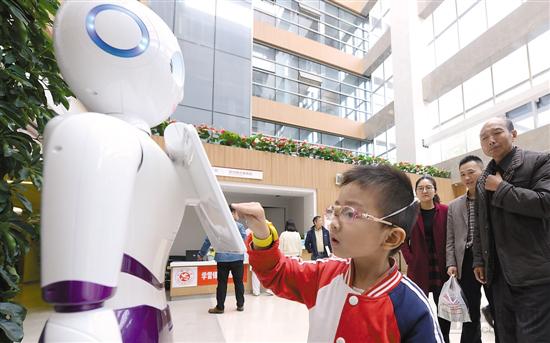
Rapid image analysis for cancer diagnosis, assistance in outpatient consultations, and support in clinical surgeries... The artificial intelligence (AI) revolution is permeating the healthcare sector, with significant breakthroughs continually emerging, and smart healthcare is beginning to transform the public’s approach to seeking medical care. Data indicates that the AI healthcare market size was projected to reach RMB 20 billion in 2018. Recent interviews by reporters have revealed that AI has been continuously integrating into every aspect of healthcare delivery.
Policy Support Fuels Industry Growth
So-called AI healthcare broadly refers to the application of artificial intelligence and related technologies in the medical field. The reporter learned that in March 2017, Guangzhou released a blueprint for strategic emerging industries: by implementing the “IAB” plan—namely, developing strategic emerging industries such as next-generation information technology, artificial intelligence, and biomedicine—it aims to build several industrial clusters with output values reaching hundreds of billions of yuan. In July of the same year, the State Council issued the Development Plan for Next-Generation Artificial Intelligence, elevating artificial intelligence to the level of national strategy.
Policy support has also fueled the industry’s growth. According to the “2016–2017 AI + Healthcare Market Analysis and Trends Report” by HC3i China Digital Health Network, the era of medical AI in China has arrived: the market size for AI + healthcare in China reached RMB 9.661 billion in 2016 and is expected to reach RMB 20 billion by 2018.
“We began conceiving the idea of developing AI-powered robots two years ago,” Professor Ding Yanqing, Director of the Department of Pathology at Southern Medical University, told reporters. As 2017 dawned, various artificial intelligence companies emerged “like mushrooms after rain,” signaling that “the time had come to embark on the development of AI in healthcare.”
Formation of Five Major Industrial Clusters
Industry insiders point out that the development of artificial intelligence (AI) has reached a turning point, with one key hallmark being the accelerated commercialization of AI technologies. In the healthcare sector, which AI applications have already been transformed into market-ready products? A reporter’s field visits revealed that in Guangzhou, AI is continuously permeating every aspect of medical care. Examples include the AI-powered pathology robot independently developed by Professor Ding Yanqing’s team at the Department of Pathology, Southern Medical University; “Mimixiong,” an AI assistant capable of aiding patient consultations at the Guangzhou Women and Children’s Medical Center; and the Da Vinci surgical robot, which has been introduced into multiple hospitals. All these innovations exemplify the application of AI in healthcare.
Notably, the R&D capabilities of domestic AI companies are coming to the fore, ranging from the introduction of the US-made “Da Vinci” system to the independent development of “Mimixiong” and “AI pathology robots.” The AI technology team behind Mimixiong is Yitu Technology based in Shanghai, while the pathology robot is backed by Shenzhen-based YiYuan Intelligence.
According to the "China Smart Healthcare Industry Map" released by VCBeat, five major industrial clusters have already taken shape among China’s 2,751 smart healthcare enterprises, namely in Beijing, Guangdong, Shanghai, Jiangsu, and Zhejiang.
In Guangzhou, this industrial cluster continues to strengthen. In the past two years, following LinkDoc Technology’s announcement of its entry into the Guangzhou AI Research Institute and the establishment of a medical intelligence technology company in Guangzhou, iFlytek also announced the establishment of the South China Artificial Intelligence Research Institute in Nansha.
Luo Ligang, Chief Technology Officer of LinkDoc Technology, told reporters, “The application of artificial intelligence in the healthcare industry first and foremost requires data; intelligence cannot exist without it. With access to data, the healthcare industry can provide more accurate and tailored treatment plans, while physicians can leverage data to enhance the precision of clinical diagnosis and treatment.” It was learned that LinkDoc Technology has aggregated tumor diagnosis and treatment data from thousands of specialists across China, along with final patient outcomes, by processing case data from millions of cancer patients, thereby forming replicable clinical diagnostic and therapeutic experience.
Leveraging its strengths in speech recognition, iFlytek has implemented a series of smart healthcare initiatives, including triage robots, medical imaging diagnostic systems, and voice-enabled electronic medical records. Its AI-powered “Smart Medical Assistant” successfully passed the 2017 National Comprehensive Written Examination for Clinical Practicing Physicians.
Can AI in Healthcare Replace Doctors?
“Since 2017, AI has achieved significant breakthroughs in the healthcare sector,” said Liu Jiehao, an analyst at iiMedia Research, in an interview with reporters. He noted that AI technology has now been applied across multiple fields—including intelligent medical imaging, drug discovery, and virtual assistants—transitioning from conceptual stages to practical implementation.
So, will AI replace doctors? Multiple experts told reporters that AI primarily serves to assist in medical decision-making, acting as a physician’s assistant rather than a replacement. Ding Yanqing, Director of the Department of Pathology at Nanfang Hospital, stated that AI’s development is inseparable from physicians’ clinical reasoning. In fact, whether it involves pathological robots or systems such as “Mimu Bear” and the “Da Vinci” surgical robot, professional physicians must provide guidance during their initial learning and application phases.
For standardized, repetitive, and routine diagnostic tasks, AI can take over, allowing physicians to focus on the diagnosis and treatment of complex cases, thereby significantly improving healthcare efficiency.
Source: Yangcheng Evening News