

Exclusive Interview with Li Cenyan, Managing Partner of Beijing Zhijin Law Firm: Building a Specialized Legal Service System for the Pharmaceutical Industry
Health Intelligence Valley is an innovative health industry cluster centered on health management and precision medicine. Leveraging Meinian Onehealth, China’s largest health-focused traffic gateway and big data platform, it provides innovative enterprises with support in samples, data, market access, and capital.
In 2017, Health Intelligence Valley implemented a strategic layout across six major parks, cumulatively investing in and incubating nearly 100 startup teams, including dozens of highly valued “dark horse” enterprises in the health sector with valuations exceeding RMB 100 million. Series Report on Enterprises in Health Intelligence Valley Parks – Zhijin Law Firm: Building a Professional Law Firm with Investment Banking Mindset to Provide Comprehensive Legal Services for the Pharmaceutical Industry.
“As the legal services market matures, legal practice is evolving toward greater specialization; the once-prevalent ‘jack-of-all-trades’ lawyers and law firms are increasingly misaligned with the demands of the market and the industry.”
“Legal services should be built upon specialized expertise, such as gradually transitioning from labor and employment matters across all industries to those within a single industry. Needs and practical circumstances vary across different sectors, requiring lawyers and law firms with both legal professionalism and industry-specific knowledge. This is the primary reason we established a law firm dedicated to providing legal services for the pharmaceutical industry.”
The aforementioned remarks were made by Li Cenyan, Managing Partner at Beijing Zhijin Law Firm. She believes that with the development of the pharmaceutical industry, there is a growing demand for legal services, accompanied by increasingly higher expectations. There is a need for law firms and lawyers who possess both in-depth knowledge of the pharmaceutical sector and expertise in legal affairs to provide specialized services, thereby safeguarding the healthy and sustainable development of the pharmaceutical industry.
During his academic years, Attorney Li Cenyan earned degrees in both medicine and law, and passed the National Bar Examination in 1994. He subsequently practiced as a physician for six years and as an attorney for eight years. Later, he was admitted to the Graduate School of the Chinese Academy of Social Sciences (CASS) with the top ranking in the Faculty of Law, where he studied under Researcher Xiong Qiuhong, a renowned legal scholar and Director of the Department of Procedural Law at CASS. During his graduate studies, he served as Vice Chairman of the Graduate Student Union and was consecutively named an Outstanding Graduate Student for three years. Since beginning his legal practice in Beijing, he has primarily focused on medical dispute resolution, corporate legal affairs, and tax planning.
Profile of Attorney Li Cenyan
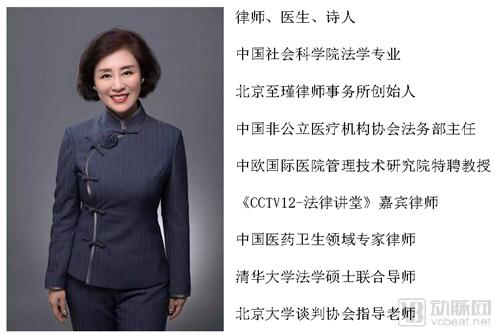
In 2014, Attorney Li Cenyan and a group of like-minded partners founded Beijing Zhijin Law Firm, specializing in legal services for the pharmaceutical industry.
Building a Law Firm with an Investment Banking Mindset
Lawyer Li Cenyan told VCBeat that Zhi Jin Law Firm aims to build a law firm specializing in the healthcare industry, offering comprehensive, end-to-end, one-stop legal services to provide full-spectrum legal support for healthcare enterprises.
Zhi Jin Law Firm currently has over 30 professional lawyers with extensive experience in pharmacy, biomedicine, and hospital management.
In terms of its management structure, Zhijin Law Firm has established specialized divisions including the Corporate Division, General Operations Division, Healthcare Operations Division, Emerging Healthcare Enterprise Division, and Capital Operations Division. These units provide legal services covering business architecture, equity structure, labor and human resources, and routine operations for companies in the pharmaceutical and healthcare industries. Dedicated departments have been set up to specifically support rapidly growing emerging enterprises such as physician groups, internet healthcare providers, medical aesthetics clinics, and elderly care institutions.
Zhijin Law Firm has provided legal services to pharmaceutical companies and healthcare groups such as Aier Eye Hospital, the China Non-public Medical Association, Huayi Xincheng, and Miaoshou Anorectal Physicians Group. According to Attorney Li Cenyan, Zhijin Law Firm currently serves over 300 clients, including pharmaceutical enterprises, medical institutions, and physician groups.
Zhi Jin has internally formulated the “One-Ten-Hundred-Thousand-Ten Thousand Project,” which entails: establishing a legal services lawyer group covering China’s pharmaceutical and healthcare sector; selecting ten pharmaceutical and healthcare enterprises for capital cooperation; providing comprehensive, in-depth services to one hundred listed pharmaceutical and healthcare companies; serving as regular legal counsel to one thousand pharmaceutical and healthcare enterprises; and delivering standardized online legal services to ten thousand enterprises and institutions in the pharmaceutical and healthcare industry.
“Zhijin Law Firm aims to establish more than 30 business divisions spanning medicine, pharmaceuticals, investment, and other sectors, while cultivating over 600 specialized lawyers to better serve the healthcare industry.”
In addition, the Zhijin brand also encompasses Zhijin Investment Management Company, which focuses on building a financial capital ecosystem platform for the healthcare industry and providing corporate investment and financing risk management services. Together with Zhijin Law Firm, it establishes an ecological service system integrating “medicine, law, finance, and business” for enterprises.
Practical Guide to Legal Issues for Physician Groups
As an emerging and popular phenomenon in the pharmaceutical industry, physician groups have received sustained attention in recent times. Behind their rapid development, legal issues have become increasingly prominent. Since its establishment, Zhijin Law Firm has served numerous physician groups and accumulated extensive experience in providing legal services to this sector.
Li Cenyan told VCBeat that, as an emerging entity, physician groups currently lack a clearly defined classification system. They were previously categorized into types such as in-system/out-of-system physician groups, platform-based physician groups, and internet-based physician groups. However, with the rapid development of physician groups, the boundaries between these categories are becoming increasingly blurred.
“Production factors among physician groups are increasingly moving toward complementarity and integration, with different types of physician groups all seeking to make their mark on the stage.”
For instance, there are Medical Mall and Dayi Hui, which are anchored by physical medical institutions; Huayi Xincheng and Zhang Qiang Doctor Group, which adopt asset-light models; and Zhongyu Doctor Group, which operates on a networked basis. “The concept of a ‘doctor group’ is not static; its organizational forms and service models are continuously evolving.”
However, from the perspective of lawyer Li Cenyan, regardless of how the structure of physician groups evolves, legal affairs remain an indispensable component throughout their development.
From a developmental timeline perspective, when a small group of physicians forms an alliance with the intention of establishing a physician group, the initial considerations must include company registration and whether the participating physicians are eligible to serve as shareholders. Subsequent issues to address encompass business architecture and equity allocation, collaboration mechanisms for newly joined physicians, partnership models with hospitals, financial management, brand management, financing and investment, and equity incentive programs.
“Legal issues permeate every aspect of a physician group’s formation and operations; improper handling of certain matters can create hidden risks that undermine the group’s future development,” stated Attorney Li Cenyan. “For instance, one physician group initially allocated equity equally among its founders. However, as operations progressed, it became evident that members’ contributions varied significantly. This discrepancy led to complications in equity redistribution during a subsequent financing round, directly impeding the fundraising process and hindering the group’s growth.”
Attorney Li Cenyan advises practitioners in physician groups to establish relatively clear plans for legal, financial, and equity allocation issues from the outset, so as to facilitate subsequent business operations and ensure sound, healthy development.
The Regulatory Environment for Physician Groups Needs Improvement
As a nascent entity, physician groups still face significant gaps in supporting policies and legal oversight.
One key issue is physicians practicing at multiple locations. On February 28, 2017, the National Health and Family Planning Commission issued the Administrative Measures for Physician Practice Registration, which stipulates that “a physician’s practice in medical, preventive, and healthcare institutions shall be based on contracts (agreements), with registration at one primary practice institution and filing at other practice institutions, without any limit on the number of practice institutions.” This can be regarded, to some extent, as an encouragement of physicians’ “multi-site practice.” However, in practical implementation, challenges remain regarding how to manage the relationship between physicians and their original employers, as well as how to enforce cross-provincial multi-site practice.
“Multi-site practice by physicians depends on personnel system reforms in medical institutions, promoting the mobility of talent within public healthcare facilities and implementing more flexible performance evaluations for doctors. With the development of telemedicine and ‘Internet+ Healthcare,’ cross-provincial medical practice by physicians has emerged, yet regulatory oversight of this phenomenon remains entirely absent.”
Another issue concerns the billing items for services provided by physician groups in their collaborations with public medical institutions, as well as how public hospitals issue invoices. The lack of clear financial pathways has led to difficulties in payment collection for physician groups.
“The development of physician groups is a systemic issue with far-reaching implications, involving public hospital reform, the mobility of medical professionals, and integration with medical insurance systems. Only as supporting policies and regulatory frameworks are gradually improved can physician groups sustain their operations and achieve better outcomes.”
Lawyer Li Cenyan further stated that the development of physician groups hinges on the stance of policymakers. Facilitating the full mobility of medical professionals is of paramount importance for implementing tiered diagnosis and treatment, establishing a multi-level and diversified healthcare service system, and better meeting the public’s health and medical needs. Supporting policies and regulatory mechanisms will also be gradually established and refined.
In his concluding remarks, Attorney Li Cenyan stated that Zhijin Law Firm will continue to conduct in-depth research on legal issues and practical applications within the pharmaceutical industry, gradually enriching its service portfolio to provide more comprehensive and standardized legal services, thereby facilitating the industry’s transformation and progress.