

Akon Health Files IPO Prospectus Amid Prescription Drug Diversion Trend, Empowering B2B and Serving C2C
Prescription Outflow: A Buzzword in the Pharmaceutical Sector in Recent YearsAgainst the backdrop of the broader "separation of prescribing and dispensing," drug sales are undergoing structural adjustments, with out-of-hospital channels poised to share in the dividends brought by prescription outflow.
In the process of accommodating the outflow of prescriptions from hospitals, pharmaceutical manufacturers, distributors, retail pharmacies, and e-commerce platforms have actively explored various models, including hospital-adjacent pharmacies, Direct-to-Patient (DTP) pharmacies, and new retail formats.
Among the many companies vying for a share of the prescription outflow market, there are also those transformed from traditional integrated wholesale and retail enterprises. Guangdong Akang Health Technology Group Co., Ltd. is one such example.
Recently, VCBeat (WeChat ID: vcbeat) interviewed Zhang Yibing, General Manager of Akang Chain. The industry “veteran” shared his insights on the issues and opportunities in the pharmaceutical e-commerce sector, as well as the opportunities and challenges that prescription outflow will bring to the market.

Zhang Yibing, General Manager of Akang Chain
# Pharmaceutical E-commerce Will Continue to Maintain Rapid Growth
Zhang Yibing is a seasoned veteran in the pharmaceutical e-commerce industry, with over ten years of experience. He has held positions at companies such as Jointown Pharmaceutical Group, Kangaidu, Simcere Zaikang, and Haoyaoshi, witnessing the development of the pharmaceutical e-commerce sector.
He believes that the most core keyword for the development of pharmaceutical e-commerce in China, from scratch and from small to large, is "efficiency".
“E-commerce models have significantly improved the efficiency of pharmaceutical retail. Pharmaceuticals are highly standardized products, which means they can be traded online as conveniently as 3C (computer, communication, and consumer electronics) products, thereby reducing intermediaries and enhancing transactional efficiency.”
The most intuitive manifestation of improved efficiency is the price advantage—pharmaceuticals sold via e-commerce are generally priced lower than those in offline channels. In terms of cost structure, the primary costs for offline pharmaceutical retail stem from labor and store rent. In contrast, the e-commerce model achieves higher per-employee productivity, while rental costs can be minimized to the greatest extent by locating warehouses in suburban areas with lower rents.
“E-commerce customer service representatives can assist more than 200 patients per day, a feat unimaginable to traditional pharmacies, which lack both the sufficient foot traffic and the capacity to serve such a large patient volume. Rent constitutes a significant portion of a pharmacy’s revenue, whereas e-commerce platforms are free from rental costs, thereby granting them a greater advantage in product variety.”
Beyond “efficiency” as the core, policy has also been a major driver of the rapid development of pharmaceutical e-commerce. Examples include the “separation of prescribing and dispensing” promoted by the new healthcare reform, encouragement of “Internet + Healthcare” development, and support for innovative enterprises with advantages in scale, technology, and services.
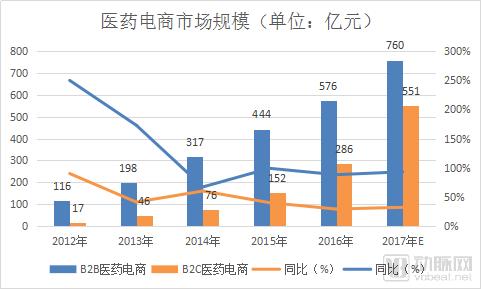
In recent years, the market size of pharmaceutical e-commerce has grown rapidly. According to data from the Department of Market Order under the Ministry of Commerce, the total sales revenue of pharmaceutical e-commerce enterprises with direct reporting obligations reached RMB 61.2 billion in 2016. Among this, B2B business accounted for RMB 57.6 billion, while B2C business amounted to RMB 3.6 billion. Additionally, data from Choice indicates that the scale of B2C pharmaceutical e-commerce reached RMB 28.6 billion in 2016.
In terms of growth, the B2B pharmaceutical e-commerce sector has achieved a compound annual growth rate (CAGR) of 40% over the past five years, with the transaction volume projected to reach RMB 76 billion in 2017. The B2C pharmaceutical e-commerce sector has recorded a CAGR exceeding 100% over the same period, with its 2017 transaction volume expected to surpass RMB 50 billion. Overall, the total scale of China’s pharmaceutical e-commerce market is anticipated to exceed RMB 100 billion in 2017.
Data sources: Department of Market Order Regulation, Ministry of Commerce; Choice; VCBeat
As the market size of pharmaceutical e-commerce expands rapidly, policies are also undergoing adjustments, with regulatory red lines still in place—specifically, restrictions on the online sale of prescription drugs. For instance, in its request for public comments released on February 9, the China Food and Drug Administration (CFDA) stated that the online sale of prescription drugs to individual consumers remains prohibited, as does the online sale of drugs by standalone pharmacies.
In Zhang Yibing’s view, restrictive policies such as the ban on online sales of prescription drugs may be lifted in the future, ushering in greater development opportunities for pharmaceutical e-commerce. He stated, “The core of the new healthcare reform is to mandate the ‘separation of prescribing and dispensing.’ Pharmaceutical e-commerce serves as an effective solution to achieve this separation. Within the regulatory red lines, policies also emphasize adhering to the ‘principle of consistent oversight for online and offline channels,’ while encouraging the development of innovative models such as ‘online ordering with in-store pickup’ and ‘online ordering with store-based delivery.’”
He believes that the nationwide integration of medical insurance systems and the interoperability of diagnostic and treatment information among hospitals will lay the foundation for the next step: opening up online sales of prescription drugs. “Benchmarking against pharmaceutical retail in the United States, where approximately 30% of prescription drugs are sold online, such a high proportion is attributable to America’s robust prescription regulation and verification system. With the nationwide integration of medical insurance and the interoperability of diagnostic and treatment information among hospitals in China, a conducive environment for the development and regulation of online prescription drug sales will emerge, leading to continued expansion of the pharmaceutical e-commerce market.”
From Pharmaceutical E-commerce to the Outflow of Prescriptions
After assuming the role of General Manager at Akang Health Chain, Zhang Yibing’s focus extended beyond the niche of pharmaceutical e-commerce to the broader market opportunity presented by the outflow of prescription drugs.
“Outpatient prescription circulation or prescription outflow is likely to represent a key market opportunity in the near future. On one hand, policies mandate the separation of pharmaceuticals from medical services and the comprehensive elimination of the practice of subsidizing healthcare with drug profits; on the other hand, as comprehensive reforms of public hospitals advance, pharmaceuticals have become a central focus, requiring their divestiture from hospitals and transfer to external channels for distribution.”
The policy of separating medical services from pharmaceutical sales continues to be implemented. As stated in the report to the 19th National Congress of the Communist Party of China, it is necessary to completely abolish the practice of subsidizing healthcare with drug profits and to improve the drug supply and guarantee system. This means that the separation of medical services from pharmaceutical sales will continue to advance, making adjustments to pharmaceutical retail channels inevitable.
Multiple securities research reports predict that by 2018, the outflow of prescription drugs from hospitals will bring an incremental market size of over RMB 130 billion or RMB 165 billion to the out-of-hospital market. Taking a conservative approach and lowering the target value, the scale of prescription outflow in 2018 will still reach at least RMB 100 billion. This also means that closely monitoring the trend of prescription outflow will reveal significant market opportunities.
A-Kang Health Technology Group is now turning its attention to the market for outpatient prescription outflow.
According to Zhang Yibing, Aikang Health was formerly known as Guangdong Zhenkang Pharmaceutical Co., Ltd., established in 2005. In its early stages, the company focused on the marketing and distribution of prescription drugs, positioning itself as a “professional oncology drug supplier” dedicated to expanding the county-level oncology drug supply market. In 2010, building on its existing business, it established Kangaiduo to enter the pharmaceutical e-commerce sector. Kangaiduo once stood out as the best-performing company in the pharmaceutical e-commerce industry before being acquired by Tai'an Tang.
In 2014, Zhenkang Company launched a new pharmaceutical e-commerce project, “Cloud Pharmacy,” to provide comprehensive and professional drug supply services to various terminals in the pharmaceutical distribution market. In 2015, it introduced the “Cloud Prescription” project to address prescription extension issues for physicians and provide medication refill services for patients with chronic diseases. In 2016, it established Akang Health Group, targeting the prescription drug market and diversifying its business operations.
A-Kang Health currently owns three subsidiaries: Zhenkang Pharmaceutical, A-Kang Pharmacy Chain, and Hemukang Pharmaceutical Technology. Its business operations encompass pharmaceutical distribution, retail, DTP (Direct-to-Patient) pharmacies, e-pharmacy, and chronic disease patient services.
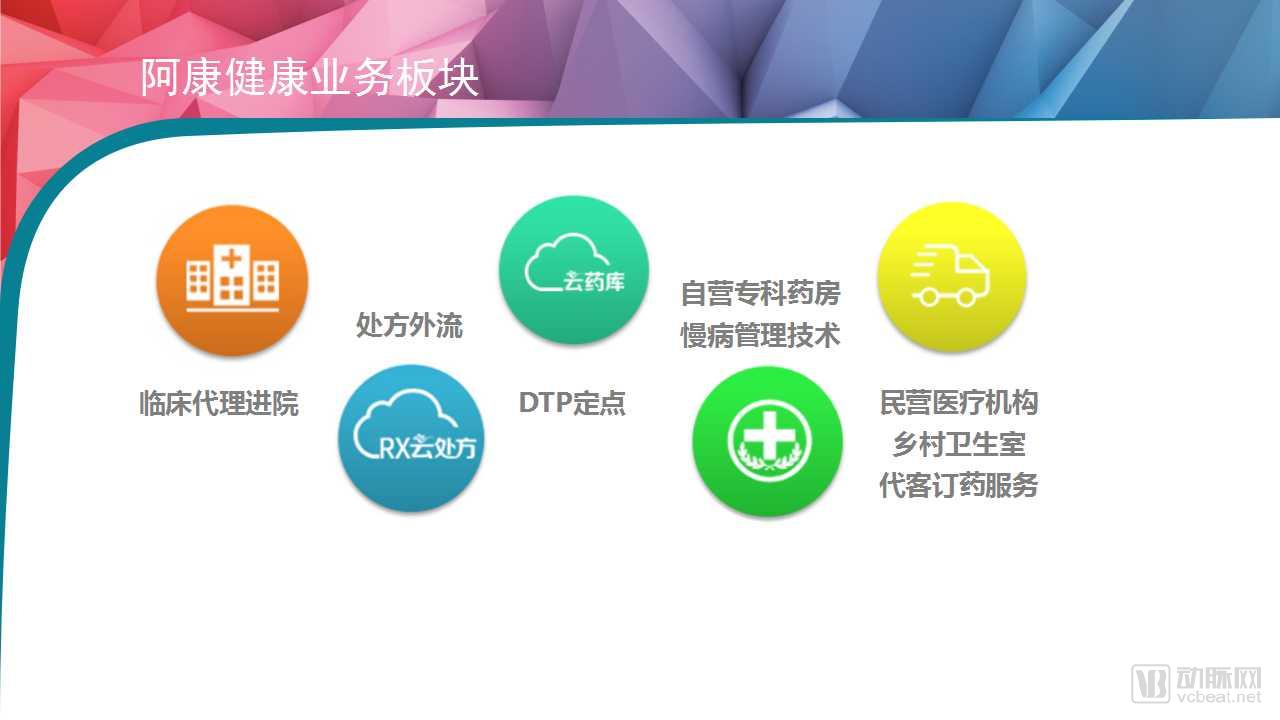
“Cloud Pharmacy” and “Cloud Prescription” are Aikang Health’s key strategic initiatives in the prescription sector. “Cloud Pharmacy” is an off-hospital platform for the controlled distribution of prescription drugs, currently offering over 10,000 stock-keeping units (SKUs). It serves as a procurement platform for hospitals, chain pharmacies, and pharmaceutical companies. To date, it has partnered with more than 50 hospitals, over 1,000 chain pharmacies, and more than 80 pharmaceutical companies on a long-term basis.
“Cloud Prescriptions” refer to an integrated online pharmacy that combines diagnosis and medication. By leveraging mobile internet platforms, it enables physicians to establish their own mobile medical clinics, facilitating a range of services including prescription issuance, patient management, and follow-up care. Additionally, through authorized DTP (Direct-to-Patient) cloud pharmacies, it provides medication delivery and professional pharmaceutical guidance, ensuring patients can use their medications with confidence and ease.
Aikang Health’s strategy for prescription outflow can be summarized as “empowering” B-side stakeholders and “serving” C-side consumers. By leveraging a centralized prescription drug supply platform and capabilities, it provides prescription medications to numerous small and medium-sized pharmacies, primary healthcare clinics, and outpatient clinics, thereby enhancing their prescription supply capacity and empowering them to accommodate prescription outflow. For patients with chronic diseases, Aikang Health offers an integrated diagnosis, treatment, and medication platform to meet their needs for out-of-hospital chronic disease management and prescription refills.
“A Kang has years of extensive experience in the marketing and market supply of prescription drugs. Amid the major trend of prescription outflow, he will leverage resource and technological advantages to provide the industry and patients with a richer product portfolio, meet market demand, and unlock the commercial and social value of prescription outflow.”
Beyond Akang Health, more pharmaceutical companies are capitalizing on the market opportunity presented by the outflow of prescription drugs, through models such as pharmacy trusteeship, DTP (Direct-to-Patient) pharmacies, pharmacy-clinic hybrids, and out-of-hospital prescription circulation platforms. Taking a long-term view, the outflow of prescriptions is an inevitable trend that will cultivate a new blue ocean for pharmaceutical retail. Innovative companies like Akang Health are likely to have greater development opportunities in the future.