

Illumina 2017 Annual Financial Report: $278M Grail Stake Sale and $515M Instrument Revenue Highlight Strategic Shifts

Illumina's current CEO, Francis de Souza
VCBeat has learned that the global sequencing giantIlluminaRecently released2017Annual Financial Report. AsCEO Francis de SouzaAtJ.P.MorganConferenceIt was revealed that,Illumina2017Full-year revenue will increase year-on-year.15%, reaching27.5hundred million U.S. dollars.
Instrument and equipment sales have always been a significant source of revenue for Illumina. In early 2017, Illumina launched its flagship product, the NovaSeq. One year later, how did the sales performance of Illumina’s sequencer portfolio fare under the leadership of the NovaSeq? With deeper penetration into clinical applications and the spin-off of subsidiaries, what kind of results did Illumina deliver in 2017? Let us find the answers together in its annual report.
Instrument Market Revenue Reaches $515 Million, NovaSeq Balances Revenue Matrix
Illumina’s revenue is primarily derived from four segments: instrument sales, array-based genetic analysis products, reagents and consumables, and other services. Instrument sales have long served as the starting point of the company’s value chain, accounting for 27% and 20% of total revenue in 2015 and 2016, respectively.
These sold instruments will generate substantial revenue for the company in the future, with this income showing continuous growth over a short period. In 2015 and 2016, the company’s revenue from reagents and consumables accounted for 58% and 64%, respectively. In 2017, the total sales revenue from reagents and consumables increased from RMB 1.543 billion in 2016 to RMB 1.753 billion, representing a growth rate of approximately 14%.
Unlike reagents and consumables, new instruments tend to experience a decline in sales after several years on the market. Therefore, if a company aims to maintain stable instrument sales revenue, it must continuously launch new products.
The launch of the NovaSeq further reduced sales of the HiSeq and HiSeq X Ten. However, overall, the new instruments drove revenue growth in the instrument sales market. In 2017, the company’s total instrument revenue was approximately $515 million, representing an increase of about 10% compared to 2016.
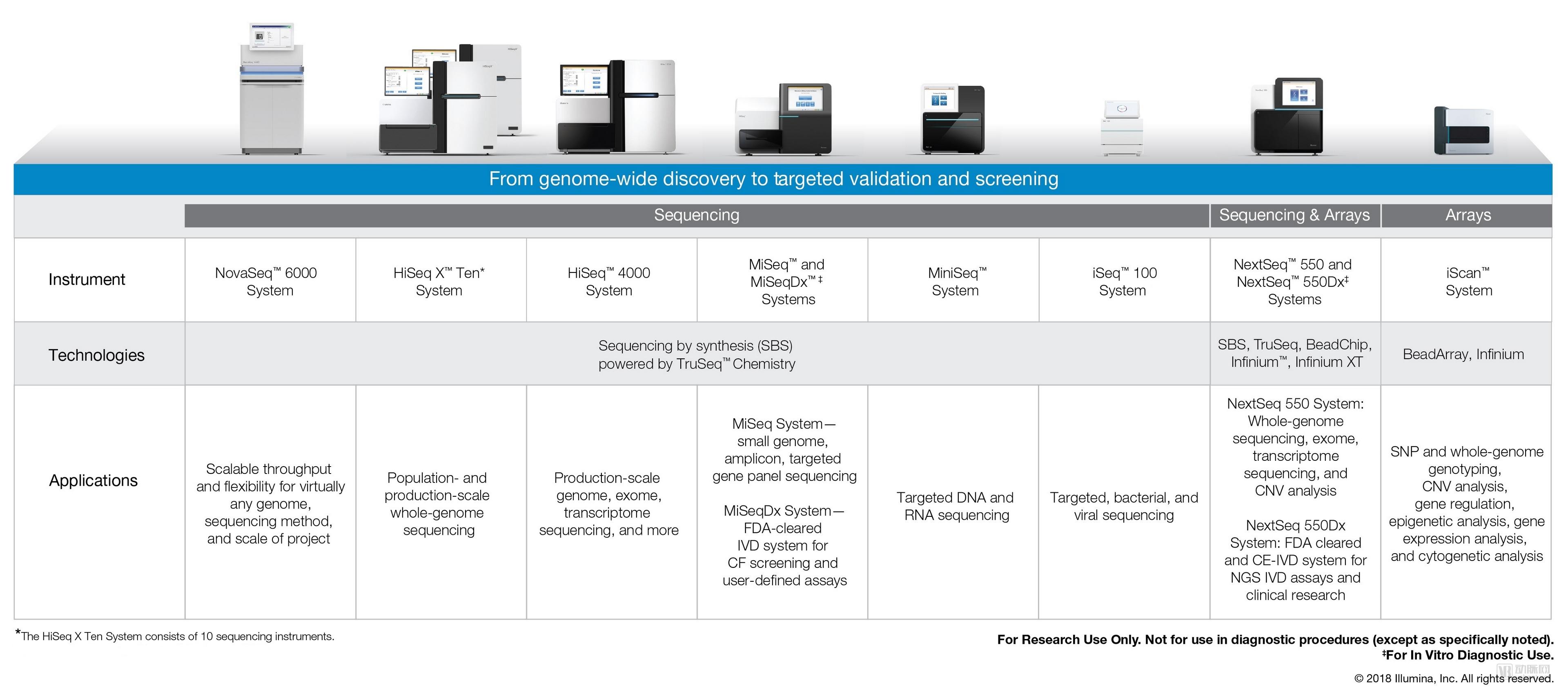
Overall, the launch of NovaSeq did not cause significant fluctuations in the company’s instrument sales. In 2017, revenue from instrument sales accounted for 19% of total revenue, while reagents and consumables contributed 64%. The performance of NovaSeq in 2017 primarily served to balance Illumina’s revenue portfolio.
Subsidiaries Deliver Returns as In-House R&D Investment Continues to Rise
“He who would wear the crown must bear its weight.” As the global leader in the sequencing market, Illumina also faces significant market pressure.
First, there is pressure from the overall market. The company’s continued growth depends on the sustained expansion of the genetic variation and analytics markets. The company has launched corresponding products for various sectors, including life sciences, clinical diagnostics, livestock and agriculture, biopharmaceuticals, and consumer genomics. The practicality of these technologies hinges on their utility in detection applications within each respective field.
Next is the competitive pressure from other companies in the industry. In many countries and regions around the world, genetic testing has already become a red ocean market. The company faces fierce competition in every segment of the genetic testing value chain.
Whether in genetic variant analysis or biofunctional products, the Company faces competition from numerous life sciences companies. As competitors’ technologies mature and improve, more competing products and technologies will enter the market, leading to intensifying market competition.
Moreover, Illumina remains highly vigilant about the risk that its current partners may become competitors. Many life sciences and pharmaceutical companies collaborating with Illumina possess robust R&D capabilities and could potentially develop competitive products. While some companies exhibit dependency and loyalty toward their initial suppliers, the emergence of new potential partners poses a strategic challenge: if a company fails to secure its position as the primary supplier, it may face disadvantages in subsequent competition.
The molecular diagnostics market currently offers a limited range of products, with several large companies already holding significant market share. For instance, the non-invasive prenatal testing (NIPT) market is expanding rapidly; if competitors introduce lower-priced commercialized products, business performance could be adversely affected.
Finally, the company also faces competitive pressure from its own product portfolio. New products typically experience a surge in sales shortly after launch; however, as they become obsolete, significant price reductions or a decline in sales volume may occur, which will negatively impact the company’s revenue.
Therefore, to sustain a competitive advantage, a company must make continuous and substantial investments in research and development as well as marketing.
Over the past three years, Illumina has continued to invest in research and development (R&D). The total R&D expenditures for 2015, 2016, and 2017 were US$410 million, US$504 million, and US$546 million, respectively. R&D spending is expected to continue rising in 2018 to support the company’s business growth.
Compared with 2016, the company’s R&D investment in 2017 increased by USD 42 million, representing an approximate 8% growth. Of this increase, R&D spending at Illumina’s headquarters rose by USD 58 million, primarily allocated to new product development, improvements to existing products, and personnel costs. Meanwhile, due to the spin-off of its subsidiary Grail in February 2017 and the business growth of the Helix platform following its July launch, the company’s R&D investment in these two subsidiaries decreased by approximately USD 16 million.
$278 million sale of Grail stake
In 2016, Illumina invested $200 million to establish two subsidiaries: GRAIL and Helix. Their respective business scopes are blood-based early cancer detection via liquid biopsy, and providing a third-party platform for consumer genomics services.
Helix launched its first online DNA application marketplace in July 2017 and now offers more than 30 consumer genomics testing products and services spanning health, ancestry, family, entertainment, apps, and fitness, aiming to expand genetic testing from clinical settings into diverse fields related to health management and leisure.
In January 2018, Helix announced its collaboration with the state of Nevada on the Healthy Nevada Project. Under the agreement, the project was officially launched in the first quarter of 2018, with Helix providing Exome+™ sequencing (Helix’s NGS exome sequencing product) to tens of thousands of Nevada residents.
This project may pave a new path for community health management by linking clinical information with genetic data.
Annual Report Investment: Helix has already begun to generate revenue. If the collaborative project in Nevada proves successful, Helix will have a significant opportunity to replicate this model in more communities (and even states), yielding substantial profits.
Now, let’s turn to Grail. With technical support from Illumina, Grail bypassed the early-stage technology development phase and moved directly into exploring the application of ctDNA in early cancer screening. Of course, the company also required substantial funding during this period to conduct clinical trial research.
In the first quarter of 2017, Grail completed its Series B financing round, raising up to $1 billion. Following this round, Illumina did not continue to wait but instead chose to spin off Grail as an independent entity.
Illumina invested $100 million in Grail at its inception and realized a gain of $278 million upon the sale of this equity stake.
The spin-off of the subsidiary reduced a portion of Illumina’s R&D expenditure. In 2016, Illumina increased its R&D investment in the subsidiary by $43 million, of which $34 million was allocated to Grail’s R&D expenses. The spin-off of Grail has brought Illumina not only investment returns but also transformed Grail into a key customer, generating sustained revenue for the company through ongoing business collaborations.
Over two years, Illumina’s $200 million investment generated nearly $280 million in cash flow, along with subsequent revenue growth, making it a highly successful investment.
Continued Optimism for Clinical Applications
The clinical market has become the company’s key focus under Francis deSouza’s leadership. At the core of the clinical genomics market are instruments and reagents; additionally, the company is developing sample models to facilitate the clinical application of genomics.
Clinical genomics encompasses reproductive health, genetics, and oncology, with the reproductive health segment currently being the most mature. The development of the reproductive health sector is primarily driven by the global adoption of non-invasive prenatal testing (NIPT) technology, and Illumina aims to expand this business on a global scale.
Furthermore, NGS technology has accelerated research into rare and undiagnosed diseases. By enabling the simultaneous assessment of multiple genes to identify the root cause of disease, NGS offers a significant advantage over the "needle-in-a-haystack" approach of traditional diagnosis and treatment, thereby helping patients save both time and financial costs.
Cancer is also a disease caused by genetic mutations. The goal of cancer genomics is to identify the genetic alterations that occur during the transformation of normal cells into tumor cells. In the field of oncology, Illumina serves a large number of translational research and clinical customers. Beyond research on genetic susceptibility genes, Illumina believes that ctDNA-based liquid biopsy will become an indispensable clinical tool for the treatment and management of cancer at all stages of progression.