

Investment Opportunities and Participation Models in Combating Influenza through Healthcare Big Data: From Prediction to Prevention
In 2018, influenza spread globally, with the United States facing an unprecedentedly severe situation; the entire flu season lasted longer than any winter flu season since 2003.
According to the latest report released by the United States, from February 4 to 10, the influenza outbreak in the U.S. resulted in 84 pediatric deaths, setting a record for the highest number of child flu deaths in a single week during the flu season.
Meanwhile, Italy in Europe also experienced its “strongest flu on record.” As of February 22, 7 million people in Italy had been infected with the influenza virus, and multiple complications caused by the flu resulted in a total of 115 deaths.
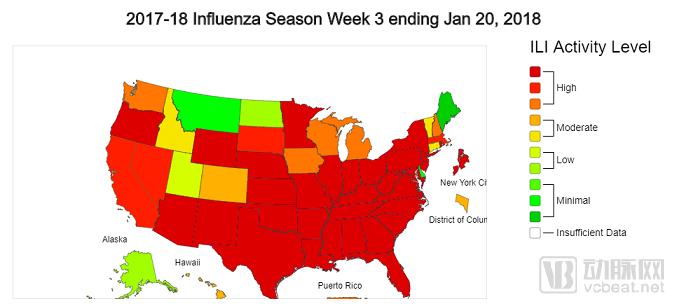 Image source: CDC
It is akin to managing a prison: only after a jailbreak occurs do people learn which inmates were involved.
Even if prison administrators can predict an inmate’s likelihood of escaping based on their behavior, they cannot convict the inmate before the event occurs solely due to a high probability of escape. For this same reason, few medical companies prepare large stockpiles of influenza vaccines before a flu outbreak occurs.
Is there a one-and-done solution to free humanity from the threat of various influenza viruses? So far, the answer is no, but some continue to strive for this utopian ideal. Austrian startup Vacthera is focusing on developing a universal flu vaccine, aiming to seize business opportunities in this dangerous yet lucrative field.
The company is just one of many entities engaged in immunotherapy and epidemic prediction. This trend stems from the development of artificial intelligence and the aggregation of data. The advent of new technologies has offered hope: although influenza strains cannot be eradicated, precise predictions and more potent vaccines can still eliminate influenza-related mortality.
Data Tracking and Integration
As the foundation of prediction, the quality of mathematical models depends on the data used by scientists, and the composition of this data is constantly changing. Human responses to influenza during seasonal transitions evolve over time, as viruses develop defense mechanisms to counteract the human immune system. Therefore, the richness and timeliness of data are crucial.
The richness of data depends on the timing of its acquisition. Prior to the onset of the influenza season, patients may carry mutated strains of the influenza virus; however, this does not necessarily mean that the ensuing outbreak will be driven by the same strains currently carried by these patients. Clinical data themselves have inherent limitations, as not all patients seek medical care, and not all infected individuals exhibit influenza-like symptoms. The most critical issue is the incompleteness of the data. Given the vast diversity of influenza viruses and the high mutation rate of Influenza A viruses, making accurate predictions poses significant challenges.
In November 2015, 23 leading authorities in biology convened at the Smithsonian Institution in Washington, D.C., to formulate an ambitious plan to map, store, and disseminate the genetic information of most life forms. This massive undertaking requires collaborative sequencing efforts by sequencing institutions across various countries. To circumvent bureaucratic obstacles, a viable solution is to utilize blockchain technology for storing gene sequences, thereby establishing a bioinformatics database.
Since influenza surveillance is not yet routine in most countries’ monitoring systems, making viral surveillance data and genomic sequencing databases publicly available can help researchers improve the accuracy of their predictions. For example, sharing data from the Southern Hemisphere’s flu season can assist professionals in the Northern Hemisphere in understanding how virus strains evolve, thereby enabling better prediction of influenza outbreaks.
In August 2017, Ping An partnered with the Chongqing Center for Disease Control and Prevention (Chongqing CDC) to launch the world’s first influenza prediction model in Chongqing. The team proposed a “micro + macro” disease prediction model that leverages Ping An’s big health and medical data and artificial intelligence technologies, along with routine surveillance data from the Chongqing CDC. By employing advanced AI techniques, the model integrates internet-derived data with clinical data. It is capable of forecasting influenza incidence trends one week in advance and has demonstrated accurate predictive performance during validation.
Dr. Brownstein of Teladoc Health in the United States and his team are also striving to obtain better data. Their latest disease surveillance project, Flu Near You, actively invites patients to participate in surveys. Via the web or mobile app, users complete a brief weekly survey to report their symptoms, and the resulting data are then transformed into an active disease map.
Advancing into Telemedicine
Historically, patient data obtained from the internet was not only limited in scope but also suffered from latency, making it difficult to utilize for analysis. However, this situation is changing. According to statistics from several U.S.-based consumer-facing digital health companies, web traffic for online physician consultations is increasing significantly.
“Over the past month, we have seen a 300% increase in flu-related calls on the American Well platform,” wrote Dr. Sylvia Romm, Chief Medical Officer of telehealth provider American Well, in an email.
Kinsa recently announced the launch of a disease surveillance platform that maps disease spread across China by passively collecting temperature and symptom data through its digital thermometers and associated apps.
The alarming aspect of the peak flu season lies in the staggering number of infections. Hospitals often become overcrowded due to insufficient medical staff to handle the surge of patients. If more people turned to telemedicine, such as accessing healthcare services through the aforementioned platforms, doctors could provide more efficient consultations without the concern of doctor-patient conflicts. Meanwhile, patients could prepare medications in advance based on medical advice, avoid peak treatment periods, and submit their health data to data centers.
The Deepening Frontiers of Immunotherapy
Vaccination is a critical measure for influenza prevention; however, influenza viruses are prone to mutation, and their drug resistance tends to increase over time. According to data from the U.S. Centers for Disease Control and Prevention (CDC) released on February 8, the vaccine efficacy was 67% against the H1N1 strain, 42% against influenza B viruses, and only 25% against the H3N2 strain.
Novel vaccines have been under continuous development, with their core concepts evolving constantly. Traditional immunotherapy stimulates the immune system to produce corresponding antibodies using inactivated viruses targeting specific influenza virus hemagglutinin and neuraminidase. In contrast, the Vaccitech vaccine does not stimulate antibody production; instead, it enhances influenza-specific T cells to kill the virus and prevent its spread within the host.
This vaccine is currently in Phase 2b clinical trials. In the first year of this two-year project, more than 800 individuals aged 65 and older participated in the trial. The study will ultimately involve approximately 2,000 participants and is scheduled to be completed by October 2019. Early clinical studies have confirmed that the vaccine is safe for use in humans.
FluGen, a company based in Madison, Wisconsin, was founded in 2007. In 2017, the U.S. Department of Defense awarded it $14.4 million for vaccine research and development. FluGen has adopted an unconventional approach to developing universal vaccines.
The company genetically engineered a virus that replicates only once in the human body without causing illness. This approach is akin to traditional strategies: if one “contracts the flu” from a vaccine, the likelihood of falling ill the following year is significantly reduced, as the pseudo-virus elicits a robust immune response within the body.
Vacthera is a young Austrian startup that has developed an influenza vaccine based on a principle similar to that of FluGen: researchers remove a specific immunosuppressive protein (NS1) from the virus and administer the modified virus to humans, thereby eliciting a robust immune response. The company believes its product can provide immunity against seasonal influenza viruses for five years.

Transmission Electron Microscopy Image of Influenza Virus Particles (from “A New Era in Influenza Forecasting”)
Influenza Prevention
Whether for influenza forecasting or vaccine development, the key to defeating influenza lies in empowering individuals to become active participants in their own treatment. If patients are sufficiently informed about influenza, they can make appropriate preparations before the flu season arrives, thereby reducing the peak incidence during the height of the outbreak.
Doctorsreport.com is a website and mobile application that allows users to access report data from real doctors across China. Based on the information provided by the website, users can upload their own data, determine whether their local area is affected by influenza viruses, identify the predominant viral strains involved in outbreaks, and learn about corresponding preventive measures.
This is a win-win solution. Through such applications, researchers can gain real-time insights, eliminating the need for cumbersome data entry while enabling the system to more accurately calculate the onset and duration of influenza outbreaks; meanwhile, patients are provided with a basis for decision-making.
Opportunity Here
The War Against Influenza Is a Total War. Based on the 2018 influenza season, researchers had made fairly accurate estimates of the predominant strains responsible for outbreaks, yet these predictions still lacked absolute certainty. Every link in the chain—from researchers and healthcare professionals to patients and their families—as well as the interactions between these stakeholders, requires optimization.
Researchers must expedite the development of vaccines tailored to mutant strains while simultaneously disseminating real-time findings to the public; in turn, the public needs to learn preventive and management measures, as well as adopt new methods for communicating with healthcare professionals.
An increasing number of companies have begun to offer diverse services for public health communication. Although no single application has yet achieved widespread adoption on most people’s smartphones, this does not mean it is impossible. The steadily rising volume of telemedicine visits indicates substantial unmet demand. VCBeat (WeChat ID: vcbeat) has outlined several potential models below.
To advance influenza forecasting, the CDC launched the “Flu Season Prediction Challenge” for the first time during the 2013–2014 flu season, offering a $75,000 prize to the winner. Although no further cash prizes have been awarded since then, forecasting teams have continued to compete, taking pride in most accurately predicting the onset, severity, and peak of the flu season. With technological advancements and ongoing competition among researchers, we are well-positioned to make bolder decisions based on these forecasts.
Within the context of internet-based healthcare, a platform with widespread adoption and high user traffic holds immense business potential. Much like the collaboration between Ping An Insurance and the Chongqing Center for Disease Control and Prevention, governments possess substantial untapped value, including critical data such as weather and temperature that serve as macro-level indicators for regulating influenza forecasting. This model demonstrates significant promise.
Current vaccine efficacy remains low, while the number of patients affected by influenza has reached tens of millions. Many medical startups have participated in vaccine development, with some engaging in speculative activities. Vaccines could be developed more rapidly, as the industry lacks neither patient data nor sufficient computational power to analyze strain evolution. If a blockchain were established on the internet to integrate all relevant data, researchers would be able to overcome current challenges more quickly.
Overall, continuous progress is being made, with new models and products emerging in abundance. Given the sufficiently large market, substantial opportunities await investors to pursue.
References
[1] Dave Muoio.In-Depth: Surging flu is a proving ground for digital health, telemedicine.Feb 2,2018.
[2] Universal Flu Vaccine: Can Biotech Companies Deliver?Nanlyze.Feb 30,2018.
[3] Julie Sherwod.Flu being tracked via crowdsourcing surveillance‘Sickweather’.the Post,Feb 21,2016.
[4] Genomics-Sequencing the world.The Economist.2018;2.
[5] Shu Yumian. A New Era of Influenza Prediction, World Science. 2018-01. ISSN: 1000-0968.
[6] Cai Ke. China's first influenza prediction model established in Chongqing, with Ping An AI supporting disease prediction. Computer & Network. 2017;16. ISSN: 1008-1739.