

Chinese Medical AI Companies Go Global: Tencent, Infervision, Huiying Medical, and Airdoc Lead the Way
At the PyeongChang Winter Olympics, the “Beijing 8 Minutes” performance once again captivated the world, showcasing China’s “New Four Great Inventions”: high-speed rail, Alipay, bike-sharing, and online shopping. Radio telescopes, artificial intelligence, and the aviation industry also made prominent appearances. These emerging technologies are gradually influencing the world.
In the field of medical artificial intelligence, with developments over the past two years, domestic medical AI products have gradually matured, and the Chinese market is largely divided among major companies. To keep pace with advanced technologies in the United States in real time and expand into new markets, Chinese medical AI companies are increasingly venturing overseas. Chinese medical AI firms have established a presence in the United States, Japan, Southeast Asia, India, and Europe. Will Chinese medical AI become a world-changing innovation akin to high-speed rail and Alipay in the coming years? Let us examine how various companies are approaching this challenge.
Tencent and UK-based mobile health company Medopad Reach Strategic Cooperation Intent
VCBeat has learned that in February 2018, Tencent announced a strategic cooperation intention between its Medical AI Lab and the UK-based mobile health company Medopad. The two parties will jointly research the clinical applications of artificial intelligence (AI) technology to provide more intelligent medical diagnosis and healthcare service support for doctors and patients.
Tencent will provide AI technologies and capabilities, integrate Medopad’s mobile health applications, and develop AI-assisted diagnostic systems for clinical decision support, as well as medical consultation and knowledge-based Q&A chatbots. These tools will monitor patient conditions, analyze patient data, and provide decision support for physicians’ diagnoses. In the future, Tencent will further explore in-depth collaboration to support clinical research.
“This collaboration with the UK-based mobile health company Medopad will integrate the strengths of both parties in mobile health and AI technology to create world-class medical AI solutions,” said Ding Ke, Vice President of Tencent. “Meanwhile, Tencent’s ‘domestic + international’ parallel development model for medical AI also helps us draw on the latest cutting-edge technological trends and mature overseas healthcare system models, thereby exploring breakthroughs in leveraging artificial intelligence to improve tiered diagnosis and treatment and enhance the efficiency of medical services in China.”
Medopad is a London-based mobile health company that provides patient monitoring and mHealth solutions to healthcare institutions, pharmaceutical companies, insurance providers, and governments. By leveraging mobile application technologies, it helps physicians enhance their diagnostic capabilities and deliver better patient care.
It is reported that Tencent and Medopad will jointly research the clinical application of AI technology to provide more intelligent medical diagnosis and healthcare support for doctors and patients. Tencent will provide its AI technologies and capabilities, integrate Medopad’s mobile health applications, and develop an AI-powered conversational agent for clinical decision support. This system will monitor patient conditions, analyze patient data, and offer decision-making assistance to physicians in diagnosis. In the future, the two parties will explore deeper collaboration in supporting clinical research.
Voxel Technology: Significant Differences in Product Design and Business Models Between Domestic and International Markets
Ding Xiaowei, founder of Voxel Technology, told VCBeat that the company currently has three R&D teams in the United States: the Los Angeles R&D Center, the Arizona State University R&D Team, and the Silicon Valley Bay Area R&D Team. The total headcount across these teams is nearly 40, all of whom are R&D personnel.
In terms of the market, when VoxelCloud announced its Series A+ financing round in September 2017, it disclosed that the U.S. version of its AI-based coronary enhanced CT analysis product, which was being promoted in China, had obtained FDA clearance in the United States and CE marking in Europe, thereby qualifying for market access.
Ding Xiaowei told VCBeat that VoxelCloud’s development strategy is to design products based on China’s medical needs; if similar demands exist in the U.S. market, the company will enter it after making adjustments based on feedback. In addition to its coronary CTA analysis product line, several other major product lines are undergoing approval by the CFDA.
During the development process, Ding Xiaowei clearly perceived that while there are commonalities in the products required by China and the United States, significant differences also exist. Due to differing healthcare resource structures, Chinese patients tend to directly register for specialist consultations when ill; although the enrollment rate for family physician contracts is high, the habit of seeking initial diagnosis from a family physician has not yet been established. In contrast, patients in the U.S. typically consult with family physicians first. This situation results in domestic products being primarily designed for specialist departments, whereas U.S. products also have opportunities to serve family physicians. Following product development, adjustments are made over a period of 3–6 months in the respective countries.
Furthermore, due to differences in clinical workflows and habits in ordering diagnostic tests, the market dynamics vary between China and the United States. For pulmonary embolism, for instance, most patients with chest pain in the U.S. undergo contrast-enhanced CT of the lungs once other obvious causes have been ruled out. In China, however, there is less reliance on imaging for identifying the causes of chest pain, with greater emphasis placed on alternative methods such as biochemical testing. Consequently, the market for CT-based detection of pulmonary embolism is smaller in China than in the U.S. Similarly, nuclear medicine is not widely adopted in China for cardiovascular assessment, whereas coronary contrast-enhanced CT, which is prevalent in China, sees limited use in the U.S. As a result, the promotion strategies for corresponding products differ significantly between the two countries.
Similar to its development approach in China, Voxel’s product expansion overseas has also involved collaborations with renowned medical or screening institutions to continuously refine its offerings, such as its partnership with Cedars-Sinai Medical Center.
Ding Xiaowei also stated that, in addition to its development in the U.S. market, Voxel Technology is collaborating with ophthalmic device companies in India and Israel. Fundus cameras produced by traditional companies such as Canon are relatively expensive. To surpass these incumbents, emerging startups often integrate intelligent modules into their devices. After coming across reports on Voxel Technology, these companies proactively sought partnerships, enabling Voxel Technology to leverage this opportunity to expand into these new markets.
There are also differences in business models between the U.S. and Chinese markets. For instance, the United States has a relatively mature commercial health insurance system. To reduce costs associated with covering serious illnesses, insurers have an incentive to keep policyholders healthy and detect or manage major diseases at their earliest stages. This dynamic has fostered a market for disease screening and management driven by direct commercial interests, thereby creating room for the development of AI.
When discussing the advantages of developing in the United States, Ding Xiaowei stated that China’s AI boom is still ongoing, resulting in a significant talent shortage and consequently rising labor costs. In comparison, the intensity of talent competition in the U.S. is less severe than in China, which is one of the primary reasons Voxel Technology established its R&D center in the United States.
Infervision: Accelerating the Commercialization of AI Through Global Expansion
Infervision embarked on the development of medical imaging AI in China as early as 2015. Within just two years, by 2017, it had completed its international deployment in the United States, Japan, and Germany. To date, Infervision has achieved relatively breakthrough progress in its international markets. In Japan, one hospital has officially installed and put its system into clinical use. Taking into account the differences in healthcare environments between Germany and the United States, the exploration of various cooperation models demonstrates Infervision’s determination to radiate from China to the global market.
Regarding its development strategy, Infervision told VCBeat that when it initially expanded overseas, it conducted extensive research. Although healthcare systems vary and each country faces competitors from different nationalities, the situation mirrors that of the Chinese market: while capital investment has become a “red ocean,” the business models for sales markets remain a “blue ocean” globally. Infervision’s resource allocation laid the foundation for the establishment of its three overseas branches and paved the way for its subsequent growth.
While it is a global consensus that the United States holds a leading position in the development of deep learning models, Infervision’s current performance indicates that its practical technology implementation has already surpassed that of the U.S. Professor Eliot Siegel, a renowned authority in medical imaging AI from the Radiological Society of North America (RSNA), visited the Department of Radiology at Shanghai Changzheng Hospital during last year’s Chinese Congress of Radiology (CCR). He was impressed by how seamlessly Infervision’s products had been integrated into radiologists’ workflows and stated that China’s medical imaging AI has taken the lead over the United States in terms of “clinical application.” Expanding into the U.S. market represents a strategic move in Infervision’s technological layout, and maintaining a forefront position in AI technology is believed to be the core competency of the medical imaging AI industry.
VCBeat shared insights on the status of the U.S. market while also expressing their concerns. Around the Lunar New Year, the U.S. FDA began approving multiple medical AI products for market entry. Notably, two products from Riverain Technologies cleared the 510(k) pathway and received FDA Class II clearance. This marks a landmark event that can serve as a valuable reference for Chinese products seeking to enter the U.S. market.
Choosing Japan also represents a strategic move rooted in China. As is well known, Japan has a well-established and mature tiered diagnosis and treatment system. Infervision, as the sole provider of AI imaging products to achieve successful implementation within such a healthcare system, has not only drawn significant attention from Japan’s domestic medical industry but is also expected to offer valuable insights for advancing the implementation of tiered diagnosis and treatment in China.
The German division, which started the latest, has only revealed through its marketing department that it hopes to establish a foundation in Germany and gradually expand to other regions in Europe. In-depth research and negotiations are still ongoing, and further information disclosure cannot be ruled out in the near future.
Tumavis: Flourishing Across Hong Kong, Macao and Taiwan, the Americas, Europe, Southeast Asia, and Beyond
Tumashenwei’s global expansion strategy involves first showcasing its capabilities at international conferences such as CVPR and RSNA, and then establishing connections with partners.
According to VCBeat, Tuma Shenwei plans to launch three to five new products annually in the future, rapidly expanding its AI-powered diagnostic coverage to include diseases affecting the central nervous system, liver, pancreas, prostate, gynecological organs, and skeletal system. Meanwhile, the company will strengthen its expansion into overseas markets, including Hong Kong, Macao, and Taiwan regions of China, as well as the Americas, Europe, and Southeast Asia.
The company has established a deep learning R&D team in San Diego, with members hailing from Qualcomm, Google, Kitware, Apple, GE, Siemens, Philips, and other leading firms. It also maintains long-term research collaborations with renowned institutions such as Duke University Hospital and other academic and research organizations.
Huiyi Huiying: Leveraging Channels of Overseas Medical Companies to Enter Healthcare Institutions
Huiyi Huiying is actively expanding its overseas market, with current productsCompletedIt covers countries including Japan, France, Kazakhstan, the United States, India, and Israel. For instance, it has signed a contract with the largest private hospital chain group in Kazakhstan; established cooperation with Japan’s largest cloud PACS company on radiomics platforms; partnered with France’s largest oncology pharmaceutical company; and is jointly developing the U.S. market with an American medical AI company.
Huiyi Huiying primarily employs two strategies to penetrate the market:
First,Participation in Academic Exchanges. For example, Huiyi Huiying has established strategic partnerships with the Asian Oceanian Congress of Radiology, the European Society of Radiology, the Russian Society of Radiologists, and the African Society of Radiology.
Second,Huiyi Huiying is preparing to seek partnerships with the most prestigious medical research institute-level hospitals in each region., such as at Stanford University in the United States, and at medical universities in Japan, Russia, Germany, and other countries.
In the coming period, Huiyi Huiying will not only strengthen cooperation with countries along the “Belt and Road” but also seek more partners worldwide, striving to make medical AI another shining name card for China.
Yitu Technology: Establishes Office in Singapore
On January 23, 2018, Yitu Technology announced the official opening of its first overseas international office in Singapore.
The new office will serve as Yitu Technology’s regional hub for serving customers and partners in Southeast Asia, delivering world-class artificial intelligence technologies and solutions to clients in Southeast Asia, Hong Kong, and Macao, while collaborating with regional partners to jointly build an AI ecosystem in Southeast Asia.
Hong Zhenda, Director of the Infocomm and Media Division at the Singapore Economic Development Board, stated, “Yitu Technology will develop new solutions spanning multiple industry sectors, such as public security, finance, healthcare, and transportation, thereby creating exciting new job opportunities in the field of artificial intelligence.” As for how Yitu Technology’s healthcare solutions will be exported overseas, detailed information is not yet available.
Airdoc: Independent Operations in the U.S., Technology Export to Southeast Asia
Healthcare is inherently specialized. VCBeat has learned that, to better adapt to the local market, Airdoc established an independent team in the United States at its inception. The head of this U.S. team, who serves as the country manager for Airdoc’s U.S. operations, is a former executive at Apple and Microsoft. Currently, Airdoc’s U.S. team has engaged in deep collaborations with numerous top-tier medical institutions in the United States and has achieved significant breakthroughs in microbiome-related research.
Airdoc adopts different strategic approaches for regions with varying levels of AI technological development. For instance, in the United States, Airdoc has chosen to establish an independent company for operations. In other regions, it opts for product export; for example, numerous institutions in Southeast Asia and Africa have already initiated collaborations regarding Airdoc China’s chronic disease screening products.
China’s Medical AI Is Capable, but Lacks a Global Expansion Strategy
In addition to the aforementioned information, Huiyi Huiying, Deepwise, and iFlytek Healthcare are all exploring or planning overseas expansion. Based on publicly available information, due to constraints in company scale and the current developmental limitations of medical AI products, these companies lack detailed plans for international market entry. Most have not elevated such efforts to the level of corporate strategy; rather, their overseas presence is primarily driven by existing resources abroad, prompting opportunistic market positioning.
VCBeat once in the "Comparison of the Healthcare + AI Industries in China, the United States, and Europe: China Leads Globally in Applications Across Multiple Subsectors, but Must Rapidly Catch Up in Talent Reserves and Data Standardization》points out that, in addition to its familiar applications in medical imaging, artificial intelligence can also be utilized in drug discovery, health management, hospital administration, smart medical devices, disease diagnosis and prediction, medical record/literature analysis, and virtual assistants. In many of these areas, China possesses strong competitiveness against international rivals.
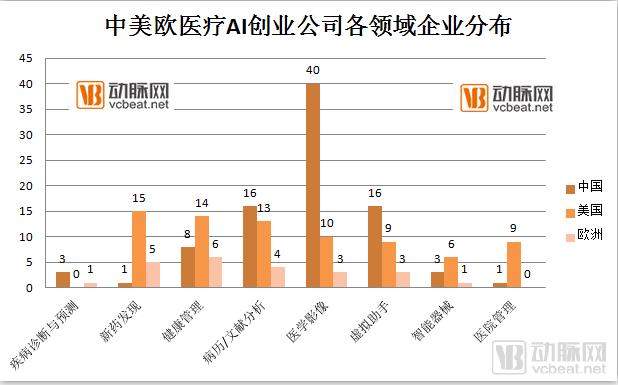
In addition, the state has successively issued various supportive documents to encourage development. In particular, in December 2017, the Ministry of Industry and Information Technology released the “Three-Year Action Plan for Promoting the Development of New-Generation Artificial Intelligence Industry (2018–2020),” which outlined detailed plans for the development of medical AI.
Capital has also provided substantial support to medical AI. According to VCBeat, financing in the medical artificial intelligence sector exceeded RMB 1.7 billion in 2017.
Technology, capital, and policy all provide strong support for medical AI, creating fertile ground for the robust development of artificial intelligence in healthcare in China.
According to VCBeat, several diagnostic products have recently received FDA approval in the United States, such as Cognoa and Viz.AI. VCBeat has learned that in July 2017, the FDA made a decision to classify computer-aided diagnosis (CADx) software for breast imaging as a Class II device and established a new generic device type defined as radiological computer-aided diagnosis (CADx) software for detecting suspicious lesions. This indicates that the FDA is easing the stringency of its approval process for intelligent diagnostic products.
This also presents an opportunity for China to enter foreign markets.
Strengths and opportunities exist; however, through interviews, VCBeat has also learned that many domestic medical AI companies have yet to formulate plans for expanding overseas. With the developments of the past two years, China’s medical AI sector can no longer be considered a blue ocean market. Whether in terms of market development or technology import and export, going global will serve as a strategic advantage to enhance competitiveness.
Despite the competition, overseas markets remain a blue ocean.
VCBeat: In recent months, certain changes have emerged in overseas markets. As Chinese companies expand globally, they may not face direct competition from domestic rivals; however, with growing attention being paid to international markets, their future trajectory remains to be seen. Additionally, the United States is home to several medical AI enterprises. While it remains unclear which side holds the advantage in terms of technology and products, China’s vast data resources provide a distinct edge for Chinese firms, equipping them with the competitiveness to rival their counterparts.
Following the reform and opening-up, foreign pharmaceutical companies and major medical device manufacturers entered the Chinese market with strong momentum. Today, foreign enterprises are present across all sectors of healthcare. As the tide turns, in the era of medical AI, it is time for China to prepare to export its own technologies and products.