

Tencent's 2018 Healthcare Strategy: A Technology-Driven Vision from Pony Ma's NPC Proposal

Ma Huateng, Deputy to the National People's Congress and Chairman and Chief Executive Officer of Tencent Holdings Ltd.
What is the core of Tencent’s healthcare strategy this year? This is a question that the industry almost invariably focuses on each year. The most reliable answer can be found in Ma Huateng’s proposals submitted during the annual Two Sessions.
At the 2018 Two Sessions, Ma Huateng, Chairman and CEO of Tencent Holdings Ltd. and a deputy to the National People's Congress, submitted eight written proposals, including one titled “Proposal on Leveraging Digital Technology to Drive Balanced and Adequate Development of the Healthcare Sector.”
The proposal notes that there are still many challenges to realizing the application of digital technologies in the healthcare sector.Data silos of varying degrees exist among government agencies, between healthcare institutions, and between healthcare institutions and service providers. This hinders the comprehensive digitalization of patient care-seeking behaviors, leaves the value of medical data underexploited, and results in a weak digital foundation for achieving precision medicine, personalized medicine, and comprehensive, full-lifecycle health services.Meanwhile, although the integration of new technologies such as mobile internet, big data, and artificial intelligence with the healthcare industry has yielded initial results, significant barriers remain in terms of policies, standards, regulations, and technology. Furthermore, an effective collaborative innovation mechanism has yet to be established among the government, academic and research institutions, and enterprises.
To drive the development of the healthcare sector with digital technology, Ma Huateng has put forward three targeted recommendations:
I. Accelerate the application of digital technologies to promote the balanced development of medical resources and capabilities.On one hand, underdeveloped medical regions and primary care institutions can take the lead in promoting technologies such as AI-assisted diagnosis. For instance, Tencent’s “Tencent Miying” platform, which integrates medical imaging with artificial intelligence, has already become an auxiliary cancer screening tool for medical institutions. Through AR, VR, live streaming, and other methods, primary care physicians can conduct remote consultations and exchanges with specialists. These measures will effectively alleviate the shortage of medical resources and facilitate the precise decentralization of high-quality medical resources to the grassroots level. On the other hand, online services covering the entire patient journey, secure circulation of electronic medical records and prescriptions based on blockchain technology, cloud-based hospital administration, and intelligent peripheral services will significantly enhance hospitals’ service delivery and management capabilities.
II. Leverage digital technologies to accelerate the promotion of comprehensive, full-cycle health services.It is recommended to leverage digital technologies such as cloud computing and big data as carriers and tools to establish a data-sharing mechanism among health and medical institutions across departments and fields. This will facilitate the standardized collection, integrated sharing, and compliant application of health and medical big data, enhance the precision of management and services, and support the national development of a comprehensive, full-lifecycle population health information platform.
III. Improve the institutional environment and collaborative innovation mechanisms for the application of digital technologies.It is recommended that legislation be enacted to clarify the ownership rights of medical data among various stakeholders, including regulatory authorities, healthcare institutions, market entities, and individual patients. A government-led, multi-stakeholder open innovation platform in the health and medical sector should be established to enhance the sharing of mature technologies and expertise from top-tier experts, address common challenges in integrating digital technologies with the healthcare industry, and lower the technical barriers to the large-scale adoption and promotion of digital technologies.
For comparison, we will2016 and 2017Medical-Related Recommendations Compiled:
2016:
Tiered diagnosis and treatment depend on breaking down hospital “information silos.”"Difficulty in accessing medical care" has long been a vexing issue in China. To address this problem, Ma Huateng suggests that patient information sharing is a crucial condition for implementing tiered diagnosis and treatment. Only by enabling healthcare professionals to promptly access patients’ health status, diagnostic and treatment records, and medication history, and by continuously tracking patients’ health information to provide continuous, integrated medical services, can we establish a tiered diagnosis and treatment system featuring initial consultations at primary care facilities, two-way referrals, and coordinated collaboration between different levels of healthcare institutions. To break down the "information silos" in hospitals, it is essential to fully leverage mobile internet technologies to establish and improve the personal electronic health record system, thereby ensuring the accessibility and interoperability of relevant information.
2017:
Proposal on Vigorously Developing the Digital Economy to Advance the Strategy of Building a Cyber Power.The Significance of Vigorously Developing the Digital Economy and Advancing China into a Cyber Power As of the end of 2016, China’s internet user base reached 731 million, accounting for 54% of the total population, among whom 695 million accessed the internet via mobile phones. Technologies such as mobile internet, cloud computing, and big data have already been integrated with traditional finance,Medical, education, transportation, professional services, and other industries. We should align with this historical trend, fully leverage China’s advantage as the world’s largest single market for the internet, strengthen and expand the digital economy, and implement the strategy of building a cyber powerhouse.
Accelerate the implementation of initiatives to bring internet benefits to the public and support poverty alleviation through digital connectivity, thereby narrowing the digital divide.Developing the digital economy is an important pathway to improving people’s livelihoods and enhancing public service capabilities. It is recommended to aim at increasing public satisfaction and quality of life, focus on raising the level of digital economy benefits for the people, and prioritize advancingHealthcare, the widespread adoption of digital applications in areas such as education and training, employment training, social security, and community services; advancing internet-based poverty alleviation and targeted poverty reduction; promoting cross-regional, cross-departmental, and cross-level coordination of public welfare services; and encouraging the development of integrated urban services with a unified entry point primarily based on mobile internet. Comprehensively enhance the level of public welfare services to achieve digitalization of public welfare services and equalization of urban and rural services.
Two conclusions can be drawn from the above information:
1. Ma Huateng is placing increasingly detailed and significant emphasis on the application of new technologies in the healthcare industry;
2. Data barriers and information silos in the healthcare industry persist.
It is evident that Tencent cannot control the second point; therefore, Ma Huateng can only propose legislation to clarify the ownership rights and relationships among various healthcare stakeholders and establish an open innovation platform led by the government. The key lies in the first point. A careful analysis of Tencent’s healthcare investments in recent years reveals a noticeable shift.
On November 23, 2015, Ma Huateng posed in a similar stance at the same location for photos with three different men. From left to right, they are: Wei Jianfeng, founder of Zhuojian; Li Tiantian, founder of DXY; and Wang Shirui, founder of Medlinker.VCBeat (WeChat ID: vcbeat), after conducting its analysis, compiled the following chart, which has since been widely cited by numerous media outlets and healthcare professionals:
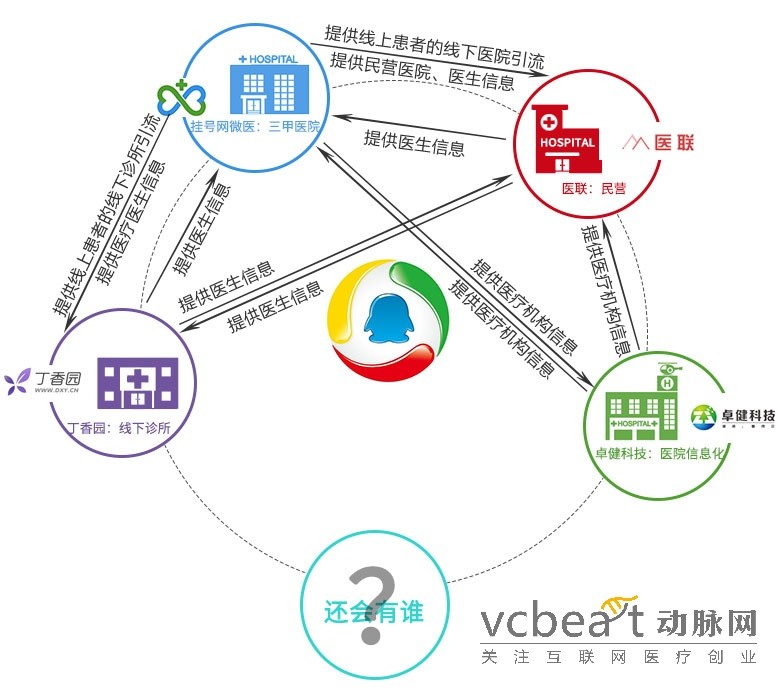
At the time, we concluded that WeDoctor represented the scenario of online consultations, DXY represented the scenario of academic exchange among physicians, Medlinker represented the scenario of professional social networking for doctors, and Zhuojian represented the scenario of hospital digitalization. The common thread among them is connectivity—specifically, Tencent’s effort to connect the three key stakeholders in healthcare: physicians, patients, and hospitals. Looking back at Ma Huateng’s 2016 proposal, isn’t the core of tiered diagnosis and treatment precisely about connectivity? This indicates that Ma Huateng’s proposal was not merely theoretical; he was genuinely taking action to implement his insights.
“Who will be next?” This was the question we pondered at that time. The deduction of this logic was built on connectivity. However, after 2017 and 2018, Tencent began to shift its strategy, moving from supplementing its presence across various service entities in healthcare to driving healthcare innovation through underlying technologies.
In fact, this does not mean that Tencent has moved beyond the realm of connectivity. On the contrary, it represents a higher level of connectivity—transitioning from mere human-to-human interactions to interconnections among different technologies, with data serving as the underlying medium.
One of the outcomes of technological connectivity is the genuine realization of patient-centered integration across the entire continuum of care, from prevention and diagnosis to treatment and rehabilitation; it enables connectivity among various healthcare stakeholders (hospitals, physicians, and patients); and it fosters integration between the healthcare sector and all other industries.
The second outcome is that it prompted Tencent to shift from investment-driven partnerships toward self-sufficiency. This transition is evident in the series of foundational technology platforms developed by Tencent:
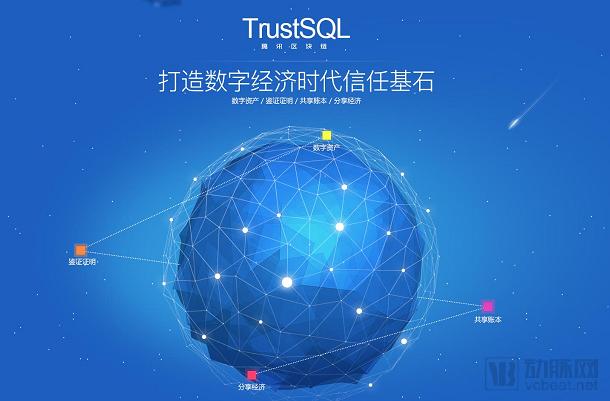
In 2016, Tencent began independently developing its underlying blockchain technology, completed the comprehensive accumulation of this foundational technology in 2017, and successfully entered the commercial application phase. In April 2017, Tencent released the "Blockchain Solution White Paper," and in September of the same year, it became the first company to pass the "Trusted Blockchain Testing Standards" issued by the China Academy of Information and Communications Technology (CAICT). To date, Tencent Blockchain has been applied in multiple sectors, including finance, healthcare, philanthropy, legal services, and logistics.
In May 2017, Tencent announced the appointment of Dr. Yu Dong, a leading expert in speech recognition technology, as Deputy Director of its AI Lab, and established the Tencent AI Lab in Seattle, USA. In an interview with the media, Dr. Yu stated that Tencent’s access to big data sources and real-world AI application scenarios, along with its balanced focus on both AI product development and research, were the primary reasons for his joining the company.

The Tencent AI Lab team comprises over 70 scientists from world-renowned universities and more than 300 experienced application engineers. By collaborating with top-tier global academic institutions and organizations, the team is dedicated to building an integrated “industry-academia-research-application” AI ecosystem. It was on the foundation of Tencent AI Lab that Tencent Miying was subsequently developed.
Therefore, in his proposals for 2017 and 2018, Ma Huateng explicitly highlighted a range of new technologies, including mobile internet, information platforms, cloud computing, big data and artificial intelligence, AR/VR, and the Internet of Things.
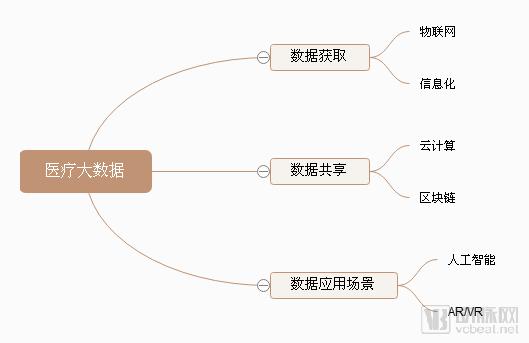
Among these technologies, which one is the top priority? According to VCBeat’s assessment: Big data serves as the connective tissue and represents the greatest challenge in healthcare; therefore, it is inevitably the core. Other technologies are either prerequisites for realizing medical big data or specific application scenarios.
The relationship between these new technologies and medical big data can be simply illustrated by the following figure:
This point can also be observed from Tencent’s major events over the past two years:
In July 2017, Tencent and China Electronics Data initiated a strategic partnership to establish a secure cloud platform for medical big data. The two parties will forge a comprehensive and in-depth collaborative relationship in the field of health and medical big data technology in the future,Jointly promote the integration of health and medical data, clinical decision support, and the development of the health and medical application ecosystem.。
In July 2017, Yilianzhong partnered with Tencent to promote WeChat-based mobile online payment for medical insurance in nearly one hundred hospitals. Under the agreement, both parties will roll out this service nationwide, deepen strategic cooperation in the “Internet + Ecosystem Hospital” initiative, andIn the realm of medical artificial intelligence, both parties will actively explore innovations and work to establish industry payment systems for “Internet + Human Resources and Social Security,” “Internet + Healthcare,” and “Internet + Medical Insurance.”。
In December 2017, Siemens Healthineers and Tencent entered into a partnership to jointly promote the development and application of medical big data and artificial intelligence in the field of medical diagnosis. Both parties will jointly promoteDevelopment and Application of Medical Big Data and Artificial Intelligence in the Field of Medical Diagnosis, thereby enhancing the diagnostic capabilities of medical institutions at all levels.
In February 2018, Tencent and AstraZeneca entered into a strategic partnership for “Healthy China.”Leveraging Big Data to Build China’s First Anti-Counterfeiting Platform for PharmaceuticalsBy joining hands to create an innovative, big data-driven model for combating counterfeit drugs, strengthening intellectual property protection, and fully safeguarding the public’s medication safety and legitimate rights and interests, we have become the first example in China of an internet platform collaborating with pharmaceutical enterprises to fight counterfeit medicines. This initiative will further accelerate the realization of the “Healthy China” goal.
Over the past two years, Tencent has made significant strides in medical big data by partnering with industry giants in healthcare informatics and medical devices. Notably, in the realm of medical payments, WeChat’s health insurance payment service has been implemented in multiple regions—including Guangxi, Shenzhen, Chengdu, Zhengzhou, Shantou, Tongchuan, and Xiamen—after several years of promotion and operation. This enables patients to make payments during clinical visits at hospitals and to purchase medications at pharmacies using WeChat Pay. Meanwhile, numerous other cities across China, such as Xinjiang, Weifang, Jiaxing, Taizhou, Xiamen, Harbin, Nanchang, Shenyang, Yongkang, and Kaifeng, are accelerating their deployment efforts.
Medical payment is undoubtedly a highly sensitive segment within medical big data, as patients’ payment records contain extensive clinical visit information. However, under the current industry landscape, the vast majority of hospitals do not open up their medical data, even though there are no technical barriers for enterprises to achieve this.
Another notable case is Tencent Miying. On August 3, 2017, Tencent officially launched its AI medical imaging product, Tencent Miying. In my view, this product was not merely a bandwagon effort by Tencent, but rather a strategically significant move. Although some industry peers may regard it as somewhat rudimentary, its launch signaled that Tencent was beginning to shift its focus from data acquisition and sharing toward building out data application scenarios.
In February 2018, Tencent further announced its intention to enter into a strategic partnership with Medopad, a UK-based mobile health company. The two parties will jointly research the clinical applications of artificial intelligence (AI) technology to provide physicians and patients with more intelligent medical diagnostic capabilities and healthcare service support.
Tencent’s investment logic in the healthcare sector in recent years also serves as strong evidence of its “connectivity upgrade”:
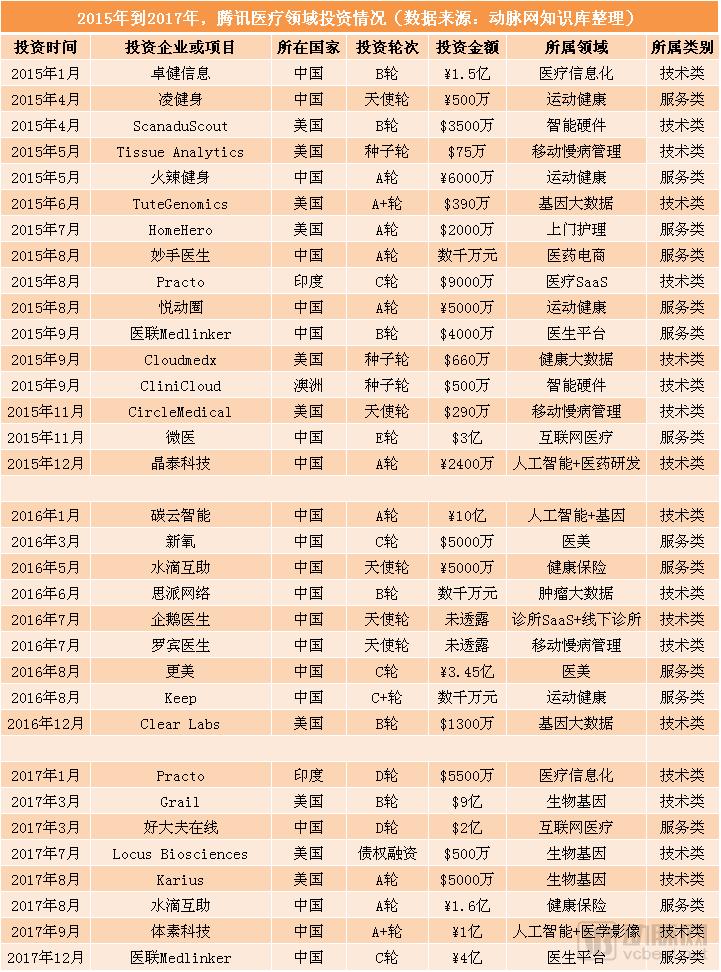
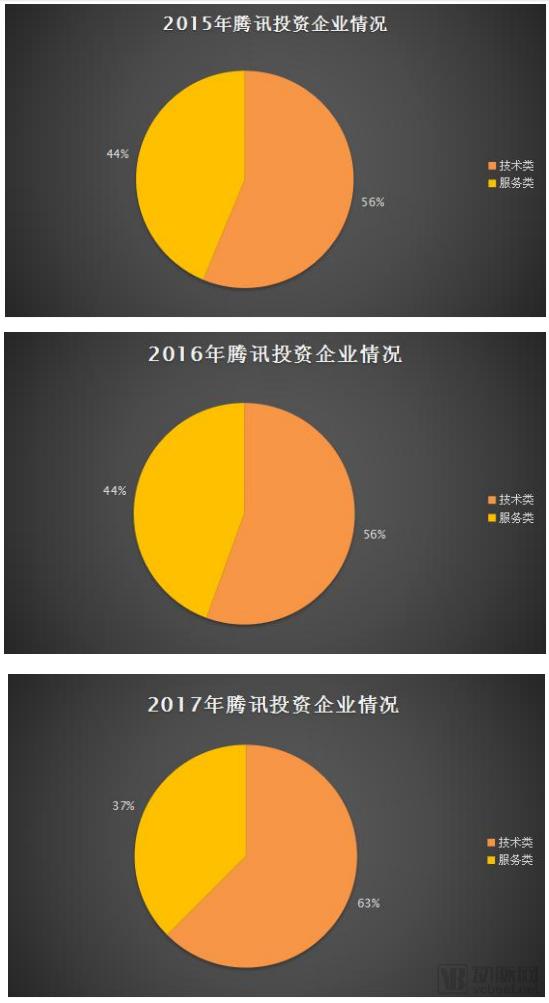
Based on the charts above, it can be concluded that in 2015, Tencent’s investments in the healthcare industry were still in a broad-spectrum phase. It invested in both technology-driven and service-oriented healthcare enterprises domestically and internationally, with no distinct preference between the two categories. In 2016, a year of smooth transition for Tencent, the number of investee companies decreased significantly, while the categories of these companies remained largely unchanged compared to 2015. In 2017, with the total number of investments remaining relatively stable, technology-driven enterprises began to emerge as Tencent’s primary investment targets.
It is foreseeable that in 2018, Tencent’s investments in the healthcare sector will continue to be dominated by technology-driven enterprises (such as those in mobile internet, information platforms, cloud computing, big data and artificial intelligence, AR/VR, and the Internet of Things). Its healthcare strategy will also gradually evolve toward a phase of integrated technological development, built upon the foundation of big data. The signals released by Ma Huateng during this year’s Two Sessions may well mark the beginning of this trend.