

Wang Xiaochuan's Proposal of 'Digital Family Doctor' at the 2018 CPPCC Session: Bridging Healthcare Gaps Through AI and Digital Integration

Wang Xiaochuan, CEO of Sogou and Member of the National Committee of the Chinese People's Political Consultative Conference
On March 3, 2018, during the Two Sessions, Wang Xiaochuan, CEO of Sogou and a first-time member of the National Committee of the Chinese People's Political Consultative Conference (CPPCC), submitted two proposals: “Proposal on Building a New Type of Medical Consortium” and “Proposal on Innovating Incentive Measures for Scientific and Technological Research and Development.”
In “Proposal on Building a New Type of Medical Consortium,” Wang Xiaochuan pointed out that despite the substantial state investment over the nine years since the launch of the new healthcare reform, the problems of “difficulty and high cost in accessing medical care” persist.
Medical consortiums and internet-based healthcare, as beneficial practices in advancing healthcare reform, have achieved certain results but also revealed their respective limitations: medical consortiums have initially facilitated the decentralization of medical resources, yet failed to reach patients extensively; internet-based healthcare has enabled convenient access to medical services for patients, but cannot provide full-cycle health management services.
Therefore, it is recommended to establish a new type of medical consortium that leverages digital technologies to extend high-quality healthcare resources directly to patients, thereby bridging the “last mile” in delivering healthcare benefits. By implementing a three-tier supply model comprising “core tertiary hospitals + primary care institutions + digital family doctors,” this approach can significantly enhance medical efficiency and diagnostic accuracy, effectively promote tiered diagnosis and treatment, ensure that every Chinese household has access to a family doctor, and advance universal health coverage.
Although the preceding paragraph is quite lengthy, it centers on a single focal point: “Digital Family Doctor.” Wang Xiaochuan believes that it represents the last mile for medical consortia to reach users and offers the optimal solution to address the shortage of professional medical resources.
In media interviews, Wang Xiaochuan provided the premise for this judgment:
1. "China's medical resources are unevenly distributed, and the overall supply of medical resources is insufficient."
According to the "National Medical Service Statistics from January to October 2017" released by the National Health and Family Planning Commission, the number of discharged patients from medical and health institutions across China reached 193.214 million in the first ten months of 2017, a year-on-year increase of 7.3%. Among these, hospitals accounted for 150.704 million discharges, while primary healthcare institutions recorded only 33.947 million. Does this mean that only those with severe illnesses go to hospitals? Clearly not. The root cause remains people’s lack of trust in the diagnostic and treatment capabilities of primary healthcare facilities.
2、“Encouraging millions of households to sign up for family doctor services with hospitals is not a practical approach. We believe that digital family doctors should be implemented, leveraging the internet’s advantage in reaching users to improve enrollment rates and coverage.”His underlying message is: When primary care physicians engage in resident contracting and implement a one-to-many management model, issues such as low contract rates and limited coverage are prone to arise.
Data from the 2017 China Health and Family Planning Statistical Yearbook shows that in 2016, there were 1,910,275 licensed physicians (including assistant licensed physicians) in primary healthcare institutions nationwide. Based on a population of 1.3 billion, this implies that each primary care physician would need to sign contracts with over 600 individuals to meet the demand for contracted services.
In fact, even with the assistance of digital tools, each primary care physician reaches their limit after signing up 400 patients. Take the Qingling Street Community Health Service Center in Wuhan, one of the top 100 community health service centers in China, as an example: The center has more than 280 staff members, comprising 21 family doctor teams, with each team consisting of 6 to 7 members. Team members include family doctors, public health physicians, assigned nurses, and public health nurses, each with clearly defined roles.
The family doctor contracting teams at the service center are subject to a mandatory regulation: each team may manage no more than 2,200 individuals (with an average of no more than 367 contracted patients per provider). This threshold is derived from the center’s practical testing; once this number is exceeded, it becomes difficult to ensure the quality of services provided by the team.
So, how exactly should “Digital Family Doctor” be understood?
In a media interview, Wang Xiaochuan stated that digital family doctors leverage internet technologies to perform triage, enabling patients to select appropriate hospitals and departments for examination based on their symptoms before visiting either large or small medical facilities, and even utilizing AI technology for preliminary predictions. However, he also argued that internet companies lack sufficient professionalism in providing medical services, emphasizing that more authoritative products can only be developed through collaborative efforts with healthcare institutions.
From this text, we can extract three keywords:“Patient Stratification,” “AI Prediction,” “Professional Authority”。
Therefore, according to his understanding, the definition of a “Digital Family Doctor” should be: a digital product capable of assisting patients with intelligent triage (based on disease severity, type, and urgency) and providing sufficiently professional medical services.
So, how far can Wang Xiaochuan’s Sogou Mingyi actually go? Out of curiosity, I tried using Sogou Mingyi to search for “stomach pain.”
In the intelligent assistant consultation robot launched by Sogou Mingyi, I assumed the role of a patient with stomach pain. After answering more than 20 questions, I received the following result:
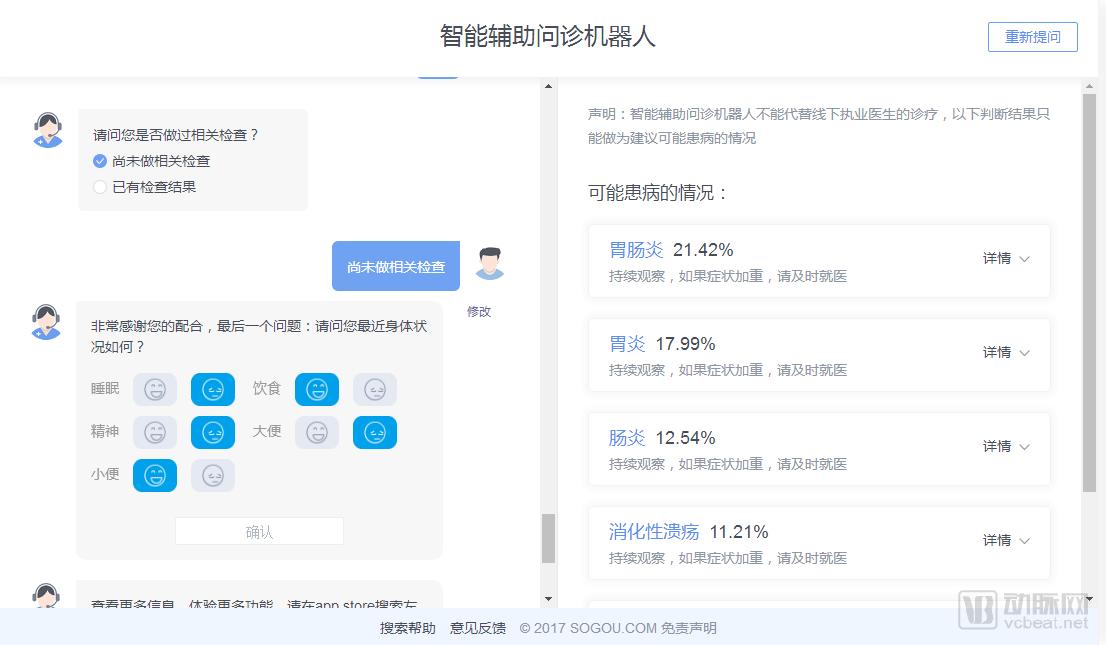
This service constitutes the patient triage and AI components referenced in the “Digital Family Doctor” framework.
In May 2017, Sogou Mingyi launched an AI-powered melanoma recognition service. Users entering terms such as “moles” or “dark spots” into the mobile version of Sogou Search can access the service directly from the search results. After uploading photos on the Airdoc page, Airdoc assists patients in analyzing and diagnosing melanoma.
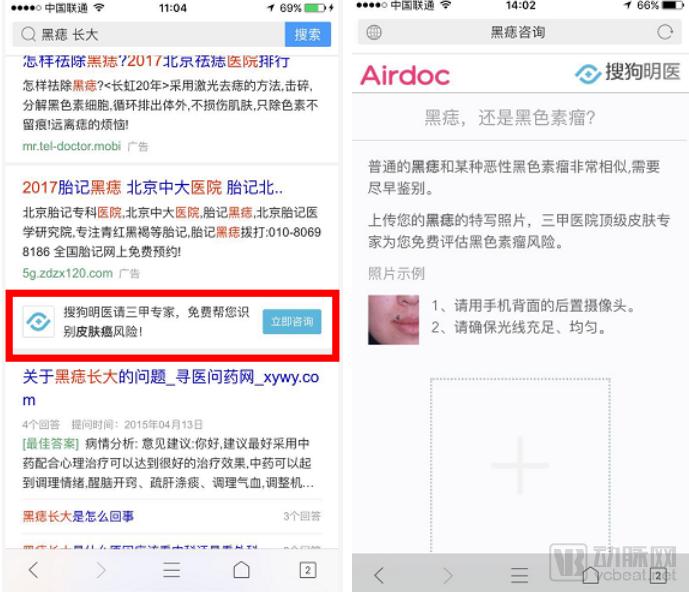
Furthermore, top dermatology experts from the Hospital of Skin Diseases (Institute of Dermatology), Chinese Academy of Medical Sciences and Peking Union Medical College, will review and verify the photo recognition results.
In terms of professionalism and authority, among the search results for stomach pain, we can see that the first encyclopedia entry was promoted as part of the transformation and standardization of traditional Chinese medicine terminology by the National Administration of Traditional Chinese Medicine.
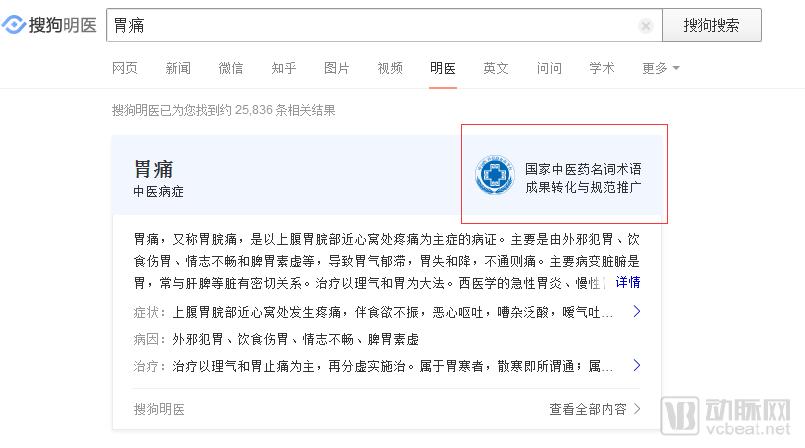
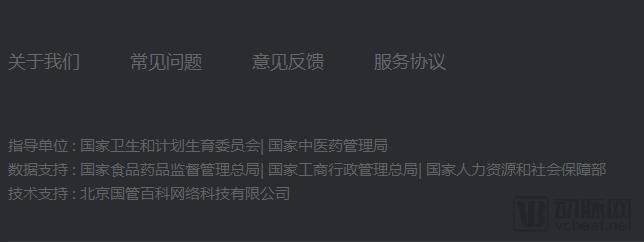
According to the project’s official website, it is guided by the National Health and Family Planning Commission and the State Administration of Traditional Chinese Medicine; therefore, its authority is unquestionable.
Overall, Sogou’s “Digital Family Doctor” remains relatively independent and has not yet engaged in deep collaboration with medical institutions on patient triage and referrals, as Baidu once did. However, according to Wang Xiaochuan’s vision, Sogou Mingyi may partner with medical consortia in the future, leveraging its intelligent triage capabilities to improve the efficiency of primary care at the grassroots level and establish Sogou Mingyi as users’ preferred entry point for diagnosis and treatment.