

Summary of Grassroots Healthcare Issues and Solutions Discussed at the National Two Sessions
At China’s Two Sessions, discussions on primary healthcare were ubiquitous, yielding not only numerous constructive proposals but also candid acknowledgments of the challenges facing the sector. For instance, how can physicians be retained at the primary care level? How should incentive mechanisms for primary care physicians be designed?
Yes, there are numerous challenges in primary healthcare, yet certain regions across China have demonstrated significant improvements. To this end, VCBeat has compiled a summary of primary healthcare issues discussed during the Two Sessions along with proposed solutions, aiming to encourage those who have long been dedicated to frontline primary care.
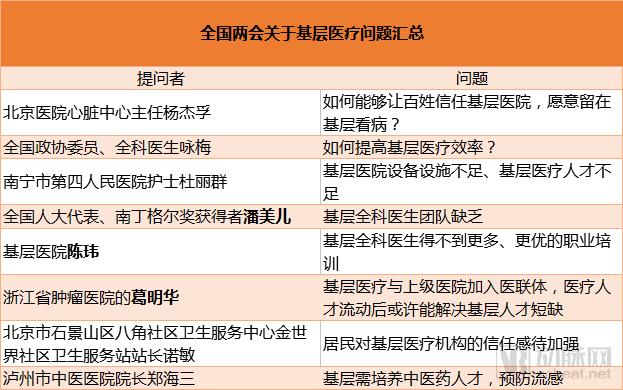
Yang Jiefu, Director of the Heart Center at Beijing Hospital, is a newly elected committee member this year. February 26 marked his last outpatient clinic day before the convening of the Two Sessions. Among the more than 20 patients he saw during the morning session,Yang Jiefu believes that the problems of two-thirds of patients can be completely resolved in communities and primary care hospitals, but in reality, they are all crowded into tertiary A-grade hospitals.
“How can public trust in primary care hospitals be fostered, encouraging patients to seek treatment at the grassroots level?” This question was raised by Yang Jiefu.
In his view, although the State Council issued policies on tiered diagnosis and treatment in 2015 and significant progress has been made in recent years, it still feels that more ambitious steps could be taken, such as increasing investment in both hardware and software at primary care hospitals.
Committee Member Yang Jiefu stated that “strengthening primary care” is the key to promoting tiered diagnosis and treatment, as well as a method for guiding patients to seek medical attention in an orderly manner. “Primary hospitals still lag behind large hospitals in terms of both hardware and software, making it particularly essential to expand and strengthen the primary care workforce.”
At this year's Two Sessions, he will focus on the development of primary-level hospitals and the training of medical personnel to formulate his proposals.
“Community and primary care physicians are the ones most rooted in the grassroots and closest to ordinary citizens, particularly in impoverished agricultural and pastoral areas,” stated Yong Mei, a general practitioner and member of the National Committee of the Chinese People’s Political Consultative Conference (CPPCC), during the Two Sessions.
Yong Mei, a Mongolian chief physician from the Department of General Practice at the Inner Mongolia International Mongolian Medicine Hospital, treats many patients from farming and pastoral communities. Through her extensive medical practice, she has identified two primary factors contributing to poverty caused by seeking medical care: first, the significantly underdeveloped state of primary healthcare infrastructure in remote areas; and second, inadequate health education at the grassroots level, leading patients to neglect treatment, thereby delaying intervention and prolonging the course of disease. “These two factors often result in minor ailments progressing into severe or chronic conditions, which demand substantial physical and financial resources. If the primary breadwinner loses their ability to work, the household’s economic income declines, potentially plunging three to four family members into poverty.”This is why patients seek medical care at higher-level hospitals; although the journey is long, it improves the efficiency of treatment.
"In her view, based on the regions she surveyed, nearly half of the population fell into poverty due to illness. So, from the perspective of healthcare professionals, how can they help these individuals?"
How to Improve the Efficiency of Primary Healthcare? Yong Mei Proposed Suggestions in Two Aspects:
First, strengthen the development of primary healthcare.“On one hand, establish medical technical support between upper- and lower-tier hospitals and strengthen continuing education for primary care physicians. On the other hand, it is recommended to leverage remote medical consultations to address clinical challenges and enhance theoretical learning, thereby standardizing treatment protocols. Thirdly, increase the number of healthcare workers in rural and pastoral areas by improving opportunities for professional development, refining promotion mechanisms, and enhancing compensation packages to boost employment rates among healthcare professionals.”
Second, public science education and outreach are of great importance.“Physicians’ diagnostic guidance for patients is helpful in preventing major chronic diseases. Given that China’s medical resources per capita are extremely limited, it is unrealistic to expect physicians to devote substantial time to each individual patient during outpatient visits. In this context, disease prevention holds greater significance than treatment after onset. The aforementioned measures help reduce gaps in healthcare delivery and ensure targeted, etiologically appropriate treatment, thereby alleviating poverty caused by improper medical care. Finally, a crucial point: healthcare professionals must have a genuine passion for their profession.”
Fang Laiying, a member of the 13th National Committee of the Chinese People’s Political Consultative Conference (CPPCC) and Secretary of the Party Committees of both the Beijing Municipal Health and Family Planning Commission and the Beijing Hospital Administration Authority, believes that in “old revolutionary base areas, ethnic minority regions, border areas, and impoverished areas,” the state could establish special posts with additional allowances and subsidies to enable physicians to work more securely and play a greater role at the grassroots level where medical resources are scarce.
Another newly appointed member of the National Committee of the Chinese People's Political Consultative Conference (CPPCC), Du Liqun, is a nurse from a grassroots hospital—the Fourth People’s Hospital of Nanning. She provides care for patients with HIV/AIDS. In her ordinary role, she has safeguarded the dignity of HIV/AIDS patients and has been working on the front lines of infectious disease prevention and control for more than 30 years.
“As a member of the 13th National Committee of the Chinese People’s Political Consultative Conference (CPPCC), I came to our community to learn about public needs regarding the Healthy China initiative.” To ensure that grassroots aspirations reached a wider audience, Du Liqun conducted surveys in both communities and hospitals prior to the “Two Sessions,” extensively collecting opinions and suggestions.
Additionally,Du Liqun also expressed her aspirations: “It is hoped that greater investment will be made in the equipment and infrastructure of primary-care hospitals, as well as in the training of grassroots medical personnel. More favorable incentives should be introduced to attract talent, encouraging more professionals to engage in the treatment of infectious diseases, thereby enhancing overall comprehensive care capabilities.”
Deputy to the National People's Congress, Florence Nightingale Medal RecipientPan Mei'erbelieves that,Strengthening the Workforce of Primary Care General Practitioners Requires Policy SupportJust like the Zhejiang Provincial Institute of Dermatology and Venereology, where she works, which has encouraged medical staff to work at the grassroots level through policy support in recent years. She stated that there is also preferential treatment for medical personnel who have long been working in leprosy villages. In terms of excellence evaluations, professional titles, and other aspects, preferences are given to the medical staff in leprosy villages so they can work with peace of mind.
National People's Congress Deputy from a Primary Care HospitalChen Wei, this time I am preparing to submit a proposal to the conference on strengthening the workforce of grassroots medical professionals.She believes that more and better vocational training should be provided to primary care general practitioners, offering them greater opportunities for professional development at the grassroots level. For physicians, both compensation and technical expertise are indeed crucial; if their technical skills meet the required standards, they can pursue further technical advancement at higher-level hospitals.
Zhejiang Cancer Hospital'sRepresentative Ge MinghuaIt is believed that,Some regions in Zhejiang Province have already begun promoting county-level medical communities. The next step is to implement unified management through institutional mechanisms, ensuring that medical professionals can be effectively deployed to grassroots levels and have clear pathways for career advancement.Under unified management, physicians from lower-tier hospitals can frequently pursue advanced training at higher-tier hospitals, while physicians from higher-tier hospitals can regularly work at lower-tier facilities on a routine basis, thereby addressing the shortage of physicians at the grassroots level.
Nuo Min, a member of the National Committee of the Chinese People’s Political Consultative Conference (CPPCC) and director of the Jinshijie Community Health Station under the Bajiao Community Health Service Center in Shijingshan District, Beijing, is a general practitioner from the grassroots level. Attending the CPPCC National Committee meeting for the first time this year, she submitted a proposal titled “Enhancing Residents’ Health Literacy and Expanding the Reach of Health Education.” She hopes to extend health education coverage to more young people, thereby preventing chronic diseases and improving the overall health of the population.
The term “health education” mentioned here refers to the popularization and dissemination of health knowledge, covering a range of topics including diet, exercise, mental health, and nutrition. She believes that such education should be integrated into schools’ quality-oriented education programs. Communities and healthcare institutions have two primary functions: providing basic medical care and delivering essential public health services, with a significant portion of the latter dedicated to resident health education. In our daily work, we regularly organize health lectures and other health promotion activities for residents. Additionally, through chronic disease management, we conduct face-to-face health education for patients. All these efforts constitute components of health education.
Drawing from her own practical experience, she introduced the role of primary care general practitioners. General practice is a specialized discipline that is currently subject to many misconceptions; it is often mistakenly believed that general practitioners possess inferior professional competence, knowledge structures, and capabilities. This is not the case. In fact, general practitioners are expected to have a broader knowledge base and even higher requirements, as they must address clinical issues spanning multiple specialties, including internal medicine, surgery, obstetrics and gynecology, and pediatrics.
Many patients seek care at tertiary hospitals whenever health issues arise, often harboring skepticism toward primary care general practitioners. She once encountered a hypertensive patient who had visited numerous specialized hospitals and arrived with significant distrust, even becoming angry. However, she listened attentively to his account, patiently explained his condition, and ultimately earned his sincere gratitude. Today, his entire family is enrolled in the family doctor contracted service program.
“Through this family-based contracting arrangement, we gain a comprehensive understanding of each family member’s health status. Additionally, we provide our contracted patients with access to the ‘Health Connect’ hotline, which remains operational 24 hours a day, allowing them to call for consultation and communication whenever questions or concerns arise.”
In the jurisdiction served by Nuomin, there are over 20,000 residents, with approximately 1,500 having signed up for contracted services. On one hand, trust among community residents in grassroots service stations and general practitioners needs to be strengthened; on the other hand, there is a shortage of personnel. Many qualified general practitioners capable of serving residents have not remained in grassroots positions due to compensation issues.
The Chinese government now places great emphasis on primary healthcare, enabling general practitioners to bring health services closer to home for more community residents. “I look forward to seeing our country continue to thrive over the next five years, with more and better livelihood policies introduced and effectively implemented. Meanwhile, I hope to see positive developments in the training of primary healthcare workers and general practitioners, which will benefit patients’ access to medical care.”
Zheng Haisan, a deputy to the Sichuan Provincial People’s Congress and president of Luzhou Traditional Chinese Medicine (TCM) Hospital, stated that the case of influenza highlights the necessity of strengthening capacity building at grassroots TCM hospitals. “Based on patient visits at our TCM hospital, incomplete statistics show that consultations for upper respiratory tract infections in the past two months increased by more than 80% compared with the same period last year, reflecting the public’s demand for TCM treatments.”
“We must increase the supply of traditional Chinese medicine (TCM) services at the primary care level and establish a four-tier diagnosis and treatment network spanning city, county, township, and village levels to meet the needs of grassroots populations,” said Zheng Haisan. He emphasized that the focus of TCM development should be placed on primary care, with priority given to addressing physician-related issues. “Policy support can be leveraged to encourage medical school graduates to remain in primary care settings, while also resolving licensing issues for experienced TCM practitioners already working at the grassroots level, thereby strengthening the TCM workforce. Community hospitals may also rehire retired senior TCM practitioners to allow them to continue contributing their expertise.”
Zheng Haisan suggests that primary-level traditional Chinese medicine (TCM) hospitals should further enhance their service capabilities, with a particular focus on cultivating TCM clinical thinking among physicians and strengthening the mentorship-based apprenticeship model. Emphasis should be placed on TCM’s “apprenticeship education” to bolster the training of grassroots TCM professionals, thereby meeting public demand for TCM services. “Regarding medical insurance policies, greater support should be extended to TCM, particularly through preferential policy measures for TCM pharmaceuticals and diagnostic and therapeutic services.”
In terms of influenza prevention, Zhang Yong, a member of the Sichuan Provincial Committee of the Chinese People's Political Consultative Conference and Vice President of Neijiang First People's Hospital, believes that it is essential to accelerate the development of specialized disciplines in shortage areas.
“During the recent surge in influenza cases, our hospital reallocated resources from other departments to support the geriatric ward of the Department of Respiratory Medicine and the pediatric ward. However, bed capacity remained insufficient, necessitating the temporary addition of 30 beds to barely cope with the demand,” said Zhang Yong. The concentration of patients with minor illnesses at large hospitals underscores the necessity of strengthening hardware infrastructure at primary healthcare institutions.
“Primary healthcare institutions, especially county-level health centers, should prioritize the development of comprehensive capabilities and disciplinary construction. Efforts should focus on strengthening specialties related to common and frequently occurring diseases at the grassroots level, as well as addressing shortages in critical departments such as pediatrics, obstetrics and gynecology, and respiratory medicine,” suggested Zhang Yong. He emphasized that improving medical service quality through disciplinary development is essential to meeting the public’s healthcare needs. Furthermore, it is crucial to strengthen human resource development in primary healthcare institutions by establishing a scientific talent training system. This will help grassroots physicians achieve ongoing professional fulfillment, encouraging them to remain, take root, and serve at the grassroots level.
“Primary healthcare institutions should also leverage the ‘favorable momentum’ of medical consortia and tiered diagnosis and treatment, drawing on the resources of tertiary A hospitals to obtain comprehensive guidance and support in medical technology, healthcare management, and other areas, thereby accelerating the enhancement of their own capabilities,” said Zhang Yong.