

Six Key Preparations Needed for China to Leverage AI and Achieve U.S.-Level 5-Year Breast Cancer Survival Rates
Breast cancer is the most common malignant tumor in women. The age distribution of breast cancer incidence varies between Eastern and Western countries. In high-incidence regions such as Northern European and North American countries, breast cancer begins to appear around the age of 20, maintaining a rapid upward trend until menopause (ages 45–50). The incidence rate approximately doubles with every 10–20 year increase in age. After menopause, the rise becomes relatively slower, peaking at ages 75–85.
In low-incidence regions such as Asia, the incidence of breast cancer declines slightly after menopause, with the peak onset generally occurring between the ages of 45 and 55. This age distribution pattern persists among Asians even after they migrate to Western countries.
Breast Cancer Survival Rate Can Exceed 85%
Although breast cancer is a form of cancer, it is not a terminal illness; in some regions, it is even referred to as a “chronic disease.” This is because the five-year survival rate for breast cancer in certain parts of the world exceeds 85%, and in some cases, reaches 100%.
In Japan, if hospitals designated as cancer treatment centers fail to achieve a five-year survival rate of over 85% for breast cancer patients post-treatment, it indicates poor performance in breast cancer prevention and control.
In August 2017, the National Cancer Center Japan published statistics on the five-year survival rates of patients diagnosed with cancer in 2008 after receiving treatment. In this study, five hospitals reported a 100% five-year survival rate for cancer treatment; all hospitals achieved rates above 80%, with more than 50% of them exceeding 90%.
The post-treatment survival rate for breast cancer at the National Cancer Center Hospital is 93.7%, at St. Luke's International Hospital it is 96.3%, at the Japanese Foundation for Cancer Research Cancer Institute Ariake Hospital it is 95.1%, at the Saitama Cancer Center it is 94.3%, and at the Aichi Cancer Center Central Hospital it is 98.9%.
In the United States, the overall five-year survival rate for breast cancer is 89%, and the cure rate for patients with early-stage disease reaches 98%.
The incidence of breast cancer in China is rising rapidly, with an annual increase of 3–4%. However, the overall level of treatment remains low, and the five-year survival rate is still below 60%. Nevertheless, certain regions in China have achieved notable success; Shanghai, for example, has demonstrated exceptional outcomes. In 2017, at the 12th Shanghai International Breast Cancer Forum, it was reported that the five-year relative survival rate for breast cancer patients in Shanghai had reached 91.8%, indicating that the vast majority of women diagnosed with breast cancer can now achieve long-term survival.
These data indicate that breast cancer is gradually evolving into a preventable and manageable “chronic disease.” So, how do the United States and Japan prevent and control breast cancer? In light of China’s national conditions, how can we improve the five-year survival rate for breast cancer? VCBeat (WeChat ID: vcbeat) provides a detailed introduction to these questions.
How Did the United States Achieve This?
The American Cancer Society (ACS) 1997 Guidelines for Breast Cancer Screening:
Ages 18–39: Monthly breast self-examination; clinical examination every 3 years;
Ages 40–49: Annual clinical physical examination and mammography;
Annual clinical examination and mammography for individuals aged 50 and above, with monthly breast self-examination. There is no upper age limit for screening cessation.
Subsequently, the American College of Radiology (ACR), the ACS, and the NCI each issued recommendations on breast cancer screening for women, reaching a consensus that initiating screening between the ages of 40 and 49 is appropriate.
For women with high-risk factors for breast cancer, breast cancer screening may begin before the age of 40 under medical guidance. These high-risk factors include: a personal history of breast cancer; pathologically confirmed atypical hyperplasia; two or more breast biopsies yielding benign diagnoses; carriage of hereditary mutations in breast cancer susceptibility genes; and a diagnosis of breast cancer in any first-degree relative (mother, sister, or daughter).
It is worth noting that in the United States, all preventive screenings, including cancer screenings, are fully covered by insurance companies for insured individuals, with no out-of-pocket costs. In contrast, in China, the majority of people must pay for these services themselves, except for a small segment of the population. As a result, many individuals go years without undergoing routine health check-ups, let alone cancer screening. By the time obvious symptoms appear, the disease has almost always progressed to an advanced stage.
In some regions of Japan, the 5-year survival rate even reaches 100%.
Japan’s Approach to Screening for Two Major Cancers in WomenIn Japan, screening for these two cancers is conducted basically every two years. Breast cancer screening is provided free of charge, while cervical cancer screening involves only a minimal fee (with some instances being entirely free). Rather than engaging in intensive public awareness campaigns, the system operates such that once an individual is enrolled in health insurance, the social security department mails free screening vouchers or coupons directly to their home to encourage participation. Hospitals also provide reminders to ensure attendance.
The 5-year survival rate for breast cancer in Shanghai is 91.8%.
Experts from the Shanghai Municipal Center for Disease Control and Prevention have pointed out that the key to improving cancer survival rates lies in early detection, precise diagnosis, standardized treatment, and effective rehabilitation. Historical monitoring data on cancer survival in Shanghai show that over the past 30 years, the survival rate for female breast cancer patients in Shanghai has steadily increased, rising by 10 percentage points every decade. This improvement is attributed to Shanghai’s well-developed medical and public health service systems, high levels of awareness regarding cancer prevention and control among women, and high participation rates in screening programs.
The Breast Cancer Subcommittee of the Women’s Health Care Branch of the Chinese Preventive Medicine Association organized experts to conduct a systematic review of global evidence-based medical literature in relevant fields. Taking into account the characteristics of Chinese breast cancer patients, they developed the “Lifestyle Guidelines for Chinese Breast Cancer Patients,” which were released in February 2017.
Zheng Ying, Chief Physician of the Department of Cancer Prevention and Control at the Shanghai Municipal Center for Disease Control and Prevention, who served as the lead author of this guideline, pointed out that the survival course of breast cancer patients can generally be divided into three stages: the phase of active treatment and rehabilitation, the phase of disease-free survival or stable disease after rehabilitation, and the phase of disease progression and end-of-life.
As the survival outcomes of breast cancer patients improve, the second phase of care is becoming increasingly prolonged and its impact on prognosis more significant. Living within their communities and families, these patients require appropriate rehabilitation guidance to achieve longer survival times and optimal quality of life, while reducing recurrence and metastasis and lowering mortality rates.
Learn from the West's Advanced Techniques
Both the United States and Japan have well-established breast cancer screening systems that have stood the test of time, offering valuable lessons for us to learn from.
First, national education on early screening: whether in the United States and Japan or in Shanghai, China, the concept of early diagnosis and treatment of breast cancer has been deeply ingrained in public consciousness. Conducting national education serves as the cornerstone for implementing early screening initiatives.
Second, through collaboration with commercial insurance providers. Cases from the United States reveal that, driven by the need to enhance profitability, U.S. insurers encourage their clients to undergo early breast cancer screening. This approach helps avoid the high costs associated with later-stage treatment. Compared with voluntary screening, insurer-led reminders and incentives can significantly increase screening rates.
Furthermore, the involvement of commercial insurance will alleviate the pressure on public health insurance. Given that public health insurance funds are already stretched thin, implementing nationwide universal screening is not financially viable under China’s current national conditions.
# Six Preparations Needed for AI-Assisted Screening
In the breast clinic, after taking the medical history, the physician will first perform a physical examination of both breasts. Generally, the physician will recommend combining the physical examination with imaging studies, including mammography and color Doppler ultrasound; breast magnetic resonance imaging (MRI) may also be performed if necessary.
Mammography is the primary method recommended internationally in recent years for breast cancer screening and is also the most accurate method for the initial assessment of breast cancer. It provides clear images and can detect small, early-stage tumors that are not palpable by hand.
When the volume of screenings is high, and the number and capabilities of primary care physicians are insufficient, some recommend using increasingly mature artificial intelligence-assisted diagnostic systems for initial examinations.
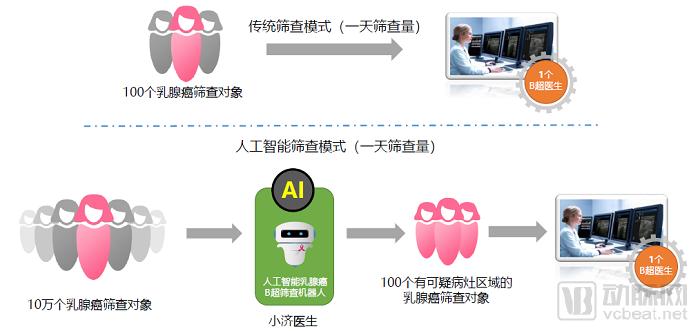
Image Source: Shangyi Cloud
As clearly shown in this figure, with the assistance of AI-powered diagnostic systems, physicians’ screening capacity can increase by a factor of 10,000, reaching 100,000 individuals screened per day. Although this model appears simple, substantial preparatory work is required to implement it.
Zhou Ming, founder of Yibao Technology, told VCBeat that early diagnosis and treatment of breast cancer among age-appropriate women (aged 39–65) have gained widespread acceptance. However, early screening methods remain highly varied, with some even relying on self-examination via mirror observation—a practice that has left many experts exasperated. Mammography and color Doppler ultrasound are the correct screening modalities.
In recent years, the state has procured a large volume of equipment for primary healthcare institutions. However, equipment alone is insufficient; qualified imaging technologists are also required. In primary healthcare settings, nurses or physicians typically assume the role of technologists on a part-time basis. Yet, training them to become fully qualified technologists is not realistic at the current stage. With technological advancements, imaging workstations equipped with artificial intelligence systems can correct irregularities in technologists’ operational procedures, thereby preventing “novice” errors.
Standardized radiographic images are the foundation for subsequent screening.
Zhou Ming also stated that in the United States, nearly all breast cancer screenings are conducted through a combination of computer-aided diagnosis (CAD) technology and physician evaluation. The application of CAD in the field of breast cancer is already mature, machine learning has made significant progress in recent years, and the efficacy of CAD technology has been validated. Health examination institutions may consider adopting these new technologies for screening purposes.
The “Three-Year Action Plan for Promoting the Development of New-Generation Artificial Intelligence Industry (2018–2020)” issued by the Ministry of Industry and Information Technology states that, by 2020, domestically advanced multimodal medical imaging computer-aided diagnosis systems shall achieve a detection rate of over 95% for the aforementioned typical diseases, with a false negative rate below 1% and a false positive rate below 5%.
Even at this level, 100% accuracy cannot be guaranteed. In the event of a missed diagnosis, how should liability be allocated—between the physician and the AI system—and can insurance adequately address the issues arising during this period? Currently, this is one of the non-technical barriers hindering the clinical deployment of AI products.
However, we must also face the fact that doctors themselves may miss diagnoses. Computer-aided diagnosis systems serve only as assistants, but their presence can substantially reduce missed diagnoses.
Zhou Ming stated that the success of screening efforts in the United States is largely attributable to commercial insurance providers offering free screenings to women aged 40 and above. Compared to the high costs of major surgeries required for mid- to late-stage diseases, the cost of early screening is relatively low, and providing free screenings maximizes benefits for insurers. However, China’s commercial insurance market is not yet mature; Yibao Technology has engaged in prolonged negotiations with insurance companies without reaching any conclusive results. Research indicates that many people in China do not undergo screening primarily due to a lack of awareness and financial constraints, as individuals are reluctant to pay out-of-pocket for this specific service.
Yibao Technology is now collaborating with insurance companies to design designated insurance products, thereby driving industry development.
With the involvement of insurance, the widespread adoption of breast cancer screening also hinges on the issue of incentives. Relying solely on government promotion makes it difficult to achieve this goal. Public motivation for screening can be jointly driven by primary care physicians and insurance providers. Insurance companies and the government can offer screening incentives to primary care physicians, similar to the family doctor contract model. Appropriate rewards can be granted once physicians complete a specified number of screenings. This approach enables family doctors to deliver tangible services while generating additional income for them.
Furthermore, trust between primary care physicians and the public is relatively easier to establish. Leveraging primary care physicians for health education can also promote the development of the insurance industry. The widespread adoption of screening can further reduce insurance expenditures. This represents a win-win strategy.
The Expert Committee for the Chinese Guidelines on Breast Cancer Screening, Early Diagnosis, and Early Treatment was established on October 25, 2017, and the “Chinese Guidelines on Breast Cancer Screening, Early Diagnosis, and Early Treatment” will be issued in early 2018. In the era of artificial intelligence, we hope to leverage technology to truly transform breast cancer into a “chronic disease.”