

Hongshu Tech Cuts Hospital Data Integration Costs to One-Tenth with Proprietary Platform, Files IPO Prospectus
“Patient-Centered” New Healthcare Reform: Its Core Is to Improve Patients’ Medical Experience Through Tiered Diagnosis and Treatment, Achieving a “Triple-Win” Outcome of “Public Satisfaction,” “Government Satisfaction,” and “Satisfaction Among Medical Institutions at All Levels.”
To implement tiered diagnosis and treatment, the integration and sharing of medical data have become imperative. Interconnectivity serves as the foundation and prerequisite for tiered diagnosis and treatment; without standardized, comprehensive, and effective medical data support, tiered diagnosis and treatment would merely remain a superficial “castle in the air.”
In addition, data integration is equally indispensable in areas such as physicians’ scientific research and multidisciplinary team (MDT) consultations.
The Four Major Dilemmas of Data Fusion
At present, the integration of hospital data faces four major challenges: cumbersome data retrieval, inconsistent evidence-based data, and lack of standardized procedures for multidisciplinary consultations.
Hospitals have established numerous information systems to support diverse operational applications. These systems—including Hospital Information Systems (HIS), Laboratory Information Systems (LIS), Picture Archiving and Communication Systems (PACS), and Electronic Medical Records (EMR)—store patient-specific data related to diagnosis and treatment, such as personal information, physician orders, clinical progress notes, and examination and test results.
To gain a comprehensive understanding of a patient’s condition, physicians often need to repeatedly access disparate data systems to retrieve the required information. This process is not only cumbersome but also squanders valuable clinical time.
Clinical research is an area that nearly every clinician encounters. Whether for enhancing professional competence or securing promotion, research constitutes a critical task. However, it is currently very challenging for clinicians in China to produce high-quality SCI-indexed papers. Burdened with heavy clinical workloads, physicians lack the time and energy to conduct in-depth scientific investigations.
According to experts, 80% of scientific research conducted by physicians in China is retrospective. To review patients’ historical medical records, doctors often need to retrieve files from the hospital’s medical records department.
In the past, medical records departments predominantly relied on paper-based medical records. These were later replaced by scanned text documents; however, querying these digital files on computers remained time-consuming and labor-intensive. Physicians not only had to review each record individually but also manually extract and compile specific information from every file. Occasionally, data retrieved from the Information Technology Department was unstructured or inconsistent, necessitating re-verification and resulting in duplicate queries. This cumbersome workflow caused physicians to spend a significant amount of time organizing medical records.
In tertiary hospitals, conducting multidisciplinary team (MDT) consultations and teaching activities for complex cases is a critical task. Traditionally, the medical affairs department or attending physicians’ assistants compile consultation materials, and the medical affairs department coordinates specialists from various departments to review these materials on-site at the same time and location, followed by case discussions. However, this process lacks a comprehensive workflow, consumes specialists’ valuable time through on-site document review, and fails to provide effective follow-up and archiving after the consultation.
Telemedicine is a crucial component of the information technology infrastructure for tiered diagnosis and treatment.
Currently, the vast majority of telemedicine services operate through a combination of video conferencing, electronic health record (EHR) systems, and Word documents. This approach makes it extremely cumbersome for attending physicians to organize medical records. Furthermore, during consultation sessions, if physicians require ad-hoc diagnostic and treatment data, they must spend time navigating various operational systems to retrieve the information, thereby impeding the overall progress of the consultation.
The Plight of Traditional Integration Platforms
Integration PlatformThe integration platform is a common solution for addressing hospital data fusion. It effectively consolidates independent hospital application systems, such as HIS, EMR, PACS, LIS, and CIS. Functioning like a “power strip,” it establishes standardized interface protocols; any system compliant with these protocols can be connected, thereby enabling efficient exchange of data across various applications.
As hospital information systems proliferate, various “silo projects” have made information islands the norm. To integrate these “silos,” hospital management has created a “spider web” of interfaces.
In the end, hospitals often find themselves held hostage by health IT vendors. During the integration platform interfacing process, some developers go bankrupt, some vendors refuse to open their APIs, and those capable of developing interface engines charge exorbitant prices...
If a hospital needs to extract data from five different health IT software systems, establishing an integration platform using traditional interface technologies would require paying approximately RMB 100,000 in interface fees to each software vendor. Consequently, the total investment for integration platform projects at many Grade IIIA hospitals exceeds RMB 10 million.
Among these, the National Development and Reform Commission provides fiscal appropriations of approximately RMB 10 million, with hospitals contributing several million more in matching funds. However, district- and county-level hospitals generally find this financial burden unsustainable, forcing them to shy away from such initiatives.
YiShu Cloud: A Data Integration Platform That Requires No Collaboration from IT Vendors
In 2017, a big data company named Hongshu Technology developed a data integration platform called Yishuyun.
Its core product, YiShu Cloud, aggregates all clinical data from a hospital’s existing business systems (such as HIS, LIS, EMR, PACS, and CIS) through heterogeneous integration, without requiring coordination with third-party system vendors or disrupting the normal operation of existing systems.
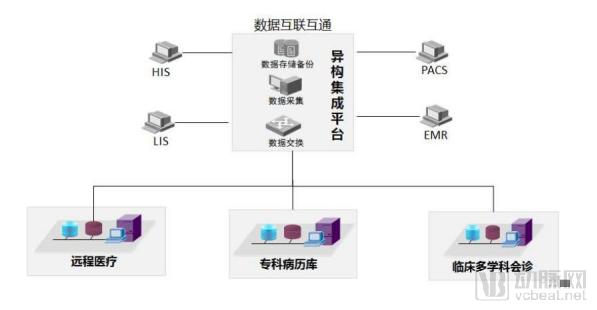
YiShu Cloud’s heterogeneous integration leverages technical means to cleanse, transform, and standardize data from various systems before consolidating it into a data center, thereby enabling interoperability among systems and reducing inter-system coupling. Additionally, it automatically generates standardized data-sharing service interfaces through visualization tools, providing data services to third-party applications.
Xu Yanting, CMO of Hongshu Technology, stated, “Medical data is fragmented. Hongshu Technology aims to consolidate it through organization and standardization. This process of structuring data represents our opportunity.”
Years of research have enabled Hongshu Technology’s team to gain an in-depth understanding of the data structures employed by major health informatics vendors. By standardizing these structures into configuration tables, they have developed dedicated configuration files for each vendor.
During the deployment of Yishuyun, Hongshu Technology typically does not dispatch developers; instead, only one technical service representative is required to be on-site at the hospital. Within approximately two weeks, data integration across the four major systems—HIS, LIS, PACS, and EME—can be completed through configuration tables.
“Typically, the cost of building an integration platform for a large hospital is around RMB 10 million, with the process and cycle often lasting up to six months. However, Hongshu Technology’s product can accomplish this at one-tenth or even lower cost and time,” said Xu Yanting.
Regarding the security and compliance of data integration, Xu Yanting stated, “Although heterogeneous integration does not require any modifications to a hospital’s existing systems or cooperation from various vendors—it only requires the hospital’s IT department to grant access permissions to the databases of each system—this premise is based on the assumption that enterprises have not encrypted the data written into the databases. We do not engage in decryption activities akin to hacking. Therefore, if the data stored in the database is encrypted by the vendor, the vendor’s cooperation is still required for decryption. However, under current circumstances, 99% of mainstream vendors do not encrypt the data content stored in their databases, as this would significantly impair software operational efficiency.”
Make MDT Routine to Improve Doctors’ Clinical and Research Efficiency
Hospital multidisciplinary team (MDT) consultations are generally conducted for patients with complex and difficult-to-diagnose conditions at fixed times each week, constituting low-frequency events. This is because MDT consultations require extensive patient information, and collecting such data for each session consumes a considerable amount of physicians’ time.
Generally, compiling a medical record that meets the requirements for consultation takes physicians at least half a day. This involves copying data from various information systems and organizing and summarizing it.
After adopting Yishu Cloud by Hongshu Technology, physicians can compile a compliant medical record in just two minutes, significantly enhancing work efficiency. Multidisciplinary Team (MDT) consultations, which were previously costly and infrequent in hospitals, have become routine thanks to Yishu Cloud. Patients can receive diagnostic services without constraints of time or location.
In scientific research, Yishu Cloud enables the classification of medical records by department and disease type through its specialized electronic medical record (EMR) repository. This facilitates rapid search and retrieval of relevant records for physicians and eliminates the cumbersome process of accessing disparate business systems via an integrated browsing interface, thereby providing up-to-date data support for evidence-based medicine, scientific research, and teaching.
Furthermore, by leveraging Yishu Cloud to establish a cloud-based platform for remote consultations, hospitals can create a mechanism for division of labor and collaboration within regional tiered diagnosis and treatment systems. This facilitates the vertical flow of medical resources, promotes collaborative linkages between large tertiary hospitals and primary healthcare institutions as well as county-level hospitals, and builds a “tiered diagnosis and treatment system” upon existing medical and health service activities.
Xu Yanting stated, “Within the same medical consortium, imaging studies performed at any hospital are accessible at other member hospitals. This eliminates redundant imaging and duplicate examinations, thereby saving costs for both patients and the state.”
Huaibei City Interconnectivity Project
Huaibei City, Anhui Province, is one of the cities where Hongshu Technology’s Yishuyun has been implemented.
The 2016 Statistical Bulletin on National Economic and Social Development of Huaibei City shows that there were a total of 712 health institutions (including village clinics), 12,204 hospital beds, and 10,845 health technical personnel in Huaibei City. Among them, there were 70 hospitals, 28 township and sub-district health centers, 6 maternal and child health care institutions (centers, stations), 5 centers for disease control and prevention, and 119 clinics, health stations, and medical rooms.
In 2017, driven by the tiered diagnosis and treatment policy, the Huaibei Municipal Health and Family Planning Commission launched an information technology interoperability project. This key construction initiative was implemented in accordance with the overall planning and requirements set forth by the Anhui Provincial Health and Family Planning Commission and the Huaibei Smart City development framework.
Led by the Huaibei Municipal Health and Family Planning Commission, with China Mobile Huaibei Branch responsible for project implementation, and Guanxin Software and Hongshu Technology providing technical support as strategic partners, this initiative adopts a multi-party collaboration model that delivers mutual benefits to all stakeholders.
The project construction primarily encompasses the citywide dedicated network for interconnectivity between health and family planning sectors, the municipal big data center for medical and health services, the development and operation of resident health cards, the municipal population health information platform, the family doctor contract service platform, a security management system, a standards and specifications framework, data integration across eight secondary and tertiary hospitals, and eight key information systems. This is abbreviated as “One Dedicated Network, One Center, One Card, Two Platforms, Two Systems, Eight Integrations, and Eight Applications.”
Currently, the project has established an information system for primary healthcare institutions, a comprehensive management information system for medical institutions, a comprehensive management information system for primary healthcare institutions, an appointment-based diagnosis and treatment system, a two-way referral information system, and a family doctor contract service management system.
Industry Alliances and Business Models
Since its establishment in April 2017, Hongshu Technology’s products have entered markets in Inner Mongolia, Anhui, Shaanxi, Shanxi, Xinjiang, Hebei, Hubei, and other regions within less than a year.
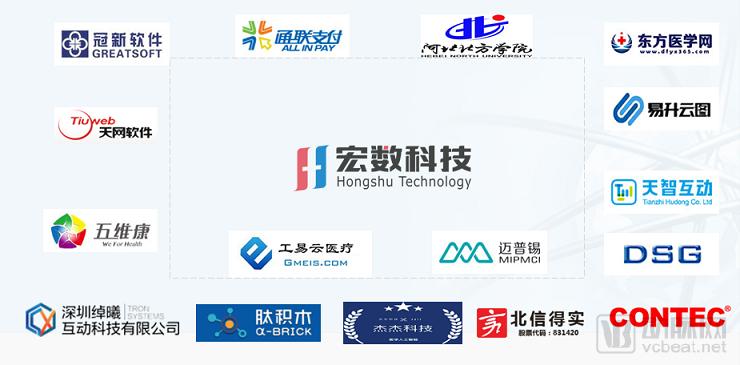
This rapid pace is underpinned by Hongshu Technology’s robust industry alliance. Similar to Guanxin Software, its strategic partners span HIS, LIS, PACS, and EMR vendors, as well as family doctors, all-in-one card solution providers, artificial intelligence enterprises, medical education institutions, management software companies, and research universities.
“Success in a market is never a solo endeavor; the core lies in achieving technical integration through industry collaboration to develop competitive solutions,” said Xu Yanting.
The collaboration between Hongshu Technology and its partners is grounded in technical research, culminating in a comprehensive solution. Xu Yanting stated, “Let professionals handle professional matters. We focus exclusively on our core competencies—data acquisition, processing, and standardization—while the application scenarios for the data will be jointly realized by Hongshu Technology’s partners.”
Conditions for enterprises to join the cooperative alliance: First, both parties’ technologies and products must be complementary and synergistic, including the joint initiation of a research project by their respective expert teams. Second, market exchange shall be implemented. For projects initiated by one enterprise, other members may collaborate in participating when entering the markets where those enterprises operate (following the model of the Huaibei City Interconnectivity Project).
Hongshu Technology’s business model comprises three segments: To C (patients), To B (hospitals), and To G (government agencies). It adopts an annual subscription pricing model, with the average cost per hospital amounting to tens of thousands of yuan per year. Furthermore, it employs a channel distribution model, leveraging local distributors for market promotion.
It is worth noting that Hongshu Technology bundles data acquisition, collection, and processing into a single package, charging only once. Applications such as specialty medical record databases, remote consultations, and two-way referrals are provided free of charge to physicians by Hongshu Technology.
“Many IT companies are only responsible for software sales, which is a one-time transaction. After the sale, they no longer provide operational maintenance, but we are different,” said Xu Yanting.
Currently, Hongshu Technology has a team of over 20 employees, the vast majority of whom are R&D and technical staff. In May 2017, the company secured RMB 5 million in angel funding and is currently seeking Series A financing.