

Magic Leap Secures $461 Million in Series D Funding Led by Saudi Public Investment Fund
According to foreign media reports, augmented reality startup Magic Leap announced that it has secured $461 million in Series D funding, led by Saudi Arabia’s sovereign investment vehicle, the Public Investment Fund. The Public Investment Fund contributed $400 million, with the remaining $61 million coming from other new investors.
Regarding this financing round, Rony Abovitz, CEO of Magic Leap, stated: “The Magic Leap team and I warmly welcome the Public Investment Fund and other new investors to the Magic Leap family. We look forward to embarking on this new journey with our new members, working together to create an astonishing future.”
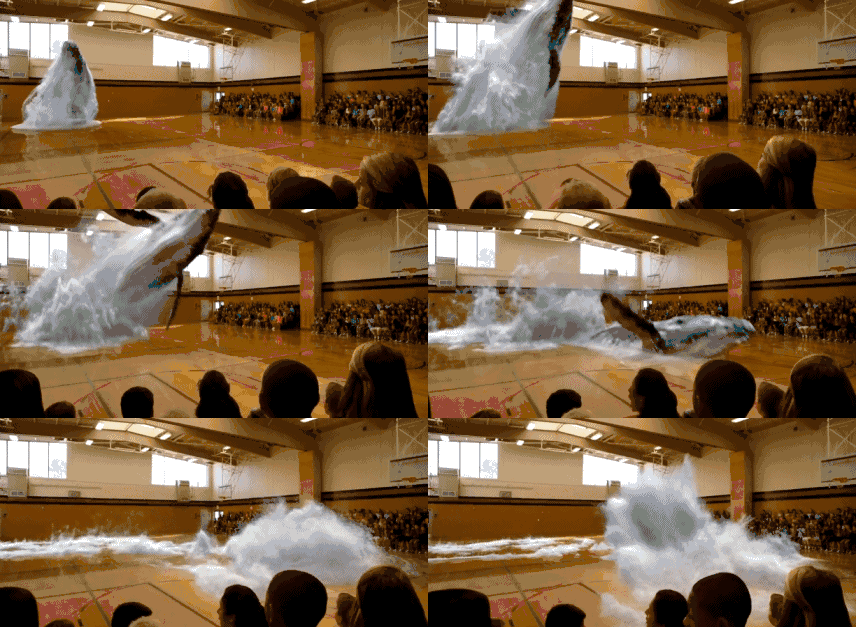
Magic Leap is a world-renowned augmented reality (AR) company. Its shareholders include Google, Alibaba, Qualcomm, Kleiner Perkins, Morgan Stanley, JPMorgan Chase, and Warner Bros., among others. Magic Leap employs digital light field augmented reality technology, which represents the cutting edge of the AR sector, and its R&D capabilities are ranked among the top tier globally. The company’s primary R&D focus is on seamlessly integrating stereoscopic 3D images into real-world environments by transmitting electronic light waves to the eyes and brain, enabling users to directly view and interact with virtual scenes overlaid onto their physical surroundings.
According to VCBeat (WeChat Official Account: vcbeat), Magic Leap is a world-renowned augmented reality (AR) company whose shareholders include Google, Alibaba, Qualcomm, Kleiner Perkins, Morgan Stanley, JPMorgan Chase, and Warner Bros. Magic Leap’s digital light field augmented reality technology represents the cutting edge of the AR sector, and the company’s R&D capabilities are among the most advanced globally. Its primary R&D focus is on seamlessly integrating stereoscopic 3D images into real-world scenes by transmitting electronic light waves to the eyes and brain, enabling users to directly view and interact with virtual overlays within their physical environment.
Major Development History:
In February 2014, it completed a $50 million Series A financing round;
Magic Leap released a video in September 2015 that was “achieved directly using Magic Leap technology,” without adding any special effects.
In October 2014, Magic Leap secured $542 million in Series B funding led by Google, with participation from Qualcomm Ventures, KKR, and Vulcan
Top-tier investment firms such as Capital, KPCB, Andreessen Horowitz, and Obvious Ventures participated in the follow-on investment. Meanwhile, Sundar Pichai, Google’s new CEO, also joined the company’s board of directors.
In March 2015, Magic Leap also released a video of an augmented reality first-person shooter game, but the company did not include similar authenticity disclaimers at that time.
In February 2016, AR startup Magic Leap secured $793.5 million in a new round of financing, with Alibaba and Google participating in the round.
On April 19, 2016, Magic Leap released a 2-minute-and-7-second video titled “A New Morning” on YouTube. The company stated that the footage was shot on April 8 and “did not use visual effects or compositing techniques”;
In August 2016, Yinjiang Shares, a listed company specializing in healthcare informatics, issued a public announcement stating that it had signed an Equity Transfer Agreement with Magic Leap, a world-renowned augmented reality (AR) technology company, investing USD 5 million to acquire 212,766 shares of Magic Leap.
In October 2017, completed a $502 million financing round led by Temasek Holdings of Singapore.
It can be said that, apart from Google’s Google Glass and Microsoft’s HoloLens, Magic Leap is the most closely watched AR glasses manufacturer in the world. However, it has yet to launch any genuine product and was once suspected of being a fraudulent company.
Brian Wallace, CMO of Magic Leap, once stated: “In real life, everything we see is transmitted to the eyes via light waves and then processed by the brain. What we do is transmit electronic light waves to the eyes and computing systems, enabling interaction between these electronic light waves and real-world light waves. We can detect position and orientation in the real world and calculate any discrepancies relative to reality. The brain processes light waves received from the eyes, allowing for seamless interaction with the physical environment. Thus, each time the brain receives these light waves, the experience is highly realistic, with consistent spatial dimensions and angles.”
When it came to the ultimate goal, Brain candidly stated, “Our primary hope is to create a device that empowers creative young people like those here to produce content that today’s technology cannot yet achieve. In the future, virtual and real worlds will be truly integrated, enabling many things that are currently impossible.”
As is well known, in traditional medical education, practical training such as human cadaver dissection and various surgical simulations is costly due to constraints on cadavers, facilities, and other resources. Meanwhile, medical students cannot improve their clinical practical skills by repeatedly performing procedures on patients, given the significant risks associated with clinical practice.
However, the intuitive and experiential nature of virtual reality (VR) can effectively address the aforementioned issues. According to VCBeat, VR applications currently prevalent in medical education include virtual human anatomy, surgical training, virtual laboratories, and virtual hospitals. These applications span categories ranging from content and software to hardware, with some entities engaged in cross-disciplinary R&D. For instance, Oculus has ventured into content, hardware, and software, while Microsoft HoloLens integrates both hardware and software.