

How Much Do We Need to Earn to Love Ourselves? '2018 China Women's Confidence Report' Finds Those Earning RMB 300K–500K Annually Are Most Confident
On March 8, 2018, the SoYoung app and Southern Weekly jointly released the “2018 Report on Chinese Women’s Self-Confidence,” the first quantitative survey to assess self-confidence among individuals in China. The report revealed significant differences in expressions of self-confidence between Chinese and American populations, particularly among women, offering food for thought.
The report, compiled over two months, gathered valid survey responses from 20,235 individuals in China and the United States. The individual self-efficacy index was calculated based on the Self-Efficacy Scale developed by contemporary American psychologist Albert Bandura.
The report shows that women worldwide generally underestimate their abilities and performance, while China’s confidence index lags behind that of the United States. Chinese women’s low self-confidence is influenced by multiple factors, including social interactions, career development, and even marriage, relationships, and childbearing.
On the bright side, even amidst a confidence deficit, they remain committed to striving for change. Surveys indicate that Chinese women are no longer overly reliant on marriage and family; instead, they are actively cultivating greater self-confidence through reading, fitness, makeup, and minimally invasive cosmetic procedures. Notably, half of Chinese respondents allocate more than five times the budget toward building self-confidence compared to their American counterparts.
The full report is divided into three sections: Are We Confident? What Influences Our Confidence? How Will We Enhance Our Confidence? Below are the key findings and interpretations of the report:
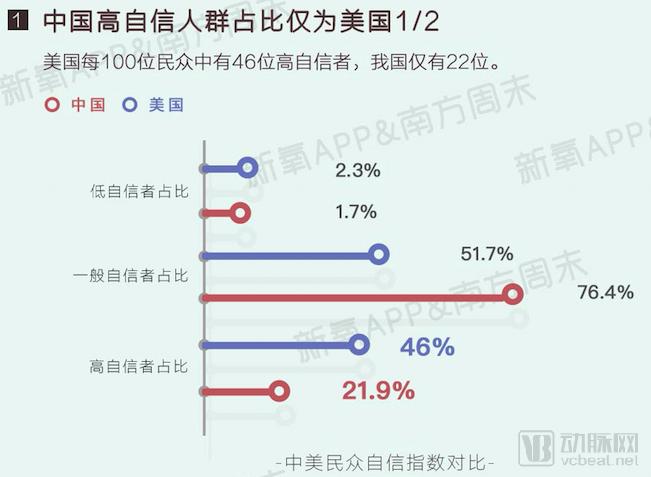
1. The proportion of highly confident individuals in China is only half that of the United States
Surveys show that 46 out of every 100 people in the United States are highly self-confident, compared to only 22 in China. Highly self-confident individuals are those who can learn from their experiences and do not let setbacks affect them.
In China, the public tends to be overly self-critical, failing to fully reap the benefits of their experiences.
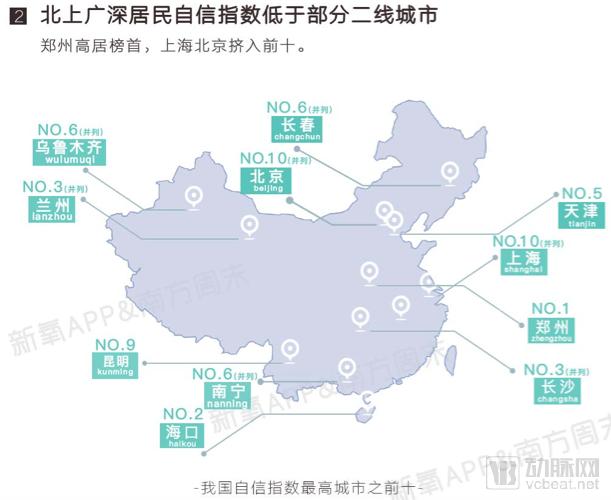
2. Residents of Beijing, Shanghai, Guangzhou, and Shenzhen Have Lower Confidence Index Than Those in Some Second-Tier Cities
Top 10 Chinese Cities with the Highest Confidence Index, Listed in Order: Zhengzhou, Haikou, Changsha, Lanzhou (tied for 3rd), Tianjin, Nanning, Changchun (tied for 6th), Urumqi (tied for 6th), Kunming, Beijing, and Shanghai (tied for 10th).
If we adhere to the traditional definition, classifying Beijing, Shanghai, Guangzhou, and Shenzhen as first-tier cities and provincial capitals as second-tier cities, we observe that the confidence index of residents in Beijing, Shanghai, Guangzhou, and Shenzhen is lower than that of some second-tier cities.
In major cities, the abundance of highly capable individuals and intense life pressures, coupled with plentiful opportunities and significant challenges, take a toll on residents’ sense of self-confidence.
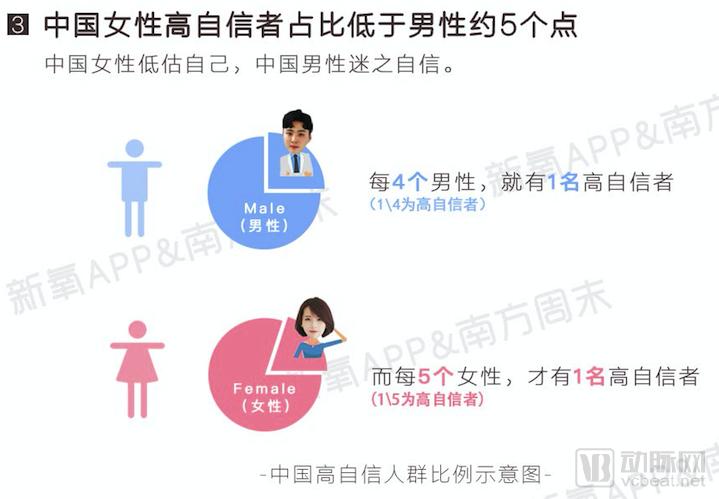
3. The proportion of highly confident Chinese women is approximately 5 percentage points lower than that of men
Survey results indicate that 25% of Chinese men and 20% of Chinese women exhibit high levels of self-confidence. There is a marked gender disparity in this domain, with men displaying unwarranted overconfidence.
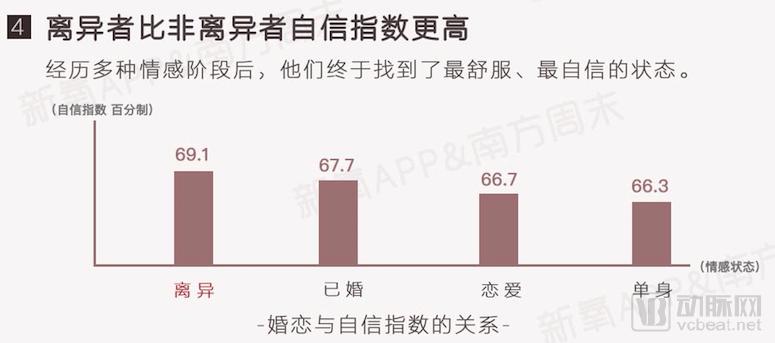
4. Divorced individuals have a higher confidence index than non-divorced individuals
Survey results indicate that among individuals in various marital and relationship statuses, divorced individuals recorded the highest confidence index score of 69.1 (on a 0–100 scale), while single individuals scored the lowest at 66.3. Divorce did not lead to a decline in public self-confidence; on the contrary, after navigating multiple emotional stages, these individuals ultimately attained a state of greater comfort and self-assurance. Meanwhile, societal attitudes toward divorced individuals have become more open and accepting.
According to statistics from the Ministry of Civil Affairs, in the first half of 2017, civil affairs departments and marriage registration agencies at all levels across China legally processed 5.58 million marriage registrations, a 7.5% decrease from the previous year; they also processed 1.856 million divorce registrations, a 10.3% increase from the same period last year. The top five Chinese cities with the highest divorce rates are Beijing, Shanghai, Shenzhen, Guangzhou, and Xiamen.
5. Up to 38.2% of the Chinese population underestimate themselves
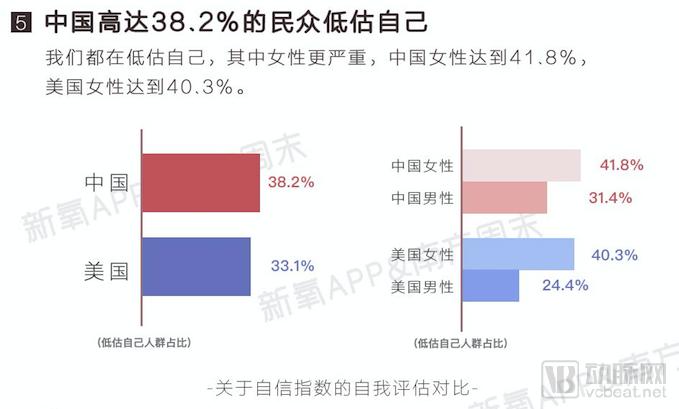
A survey shows that among every 100 Chinese people, 38.2 individuals estimate their self-confidence index to be lower than the value actually measured.
Among them, the tendency to underestimate oneself is more pronounced in women, with 41.8 out of every 100 Chinese women underestimating themselves, compared to 31.4 out of every 100 Chinese men. The gender disparity is significant.
In fact, when faced with success, women tend to attribute it to external factors, such as good luck or assistance from others, whereas men are more inclined to attribute it to their own talent, ability, and skills.
When faced with failure, women tend to attribute it to a lack of personal ability, which further undermines their confidence; in contrast, men are more likely to attribute it to external factors, such as insufficient research or a lack of initial interest.
Thus, over time, women become accustomed to treating themselves harshly, leading colleagues and public opinion to adopt the same perception, thereby creating a distortion. It is recommended that women make adjustments both rationally and emotionally, regularly reminding themselves of this distortion and firmly believing in their own worth.
6. The More Confident You Are, the More Daring You Become to Have Children
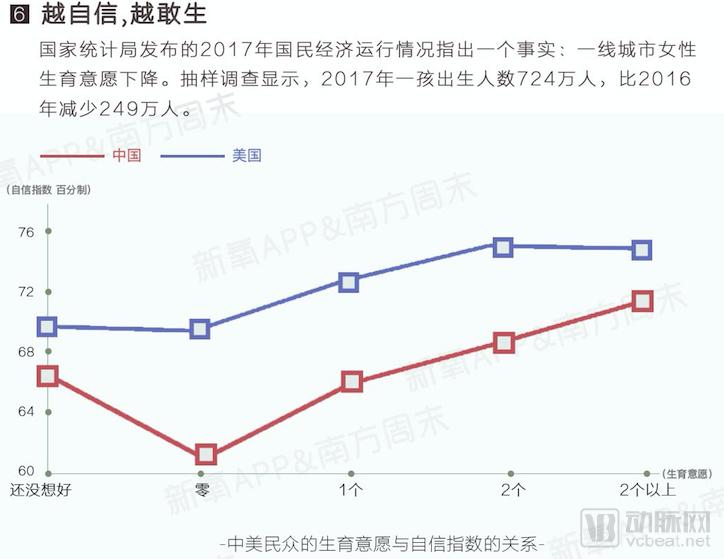
The higher the confidence index among the public, the stronger their willingness to have children. Conversely, in first-tier cities, a lower confidence index is associated with a decline in fertility intentions.
The 2017 National Economic Performance Report released by the National Bureau of Statistics highlights a fact consistent with the findings of this survey: fertility intentions among women in first-tier cities are declining. Sample surveys indicate that the number of first births in 2017 was 7.24 million, a decrease of 2.49 million from 2016. Therefore, it is imperative to prioritize the enhancement of national self-confidence indices, particularly those pertaining to women’s self-confidence.
1. Unlike in the United States, Chinese individuals are more susceptible to the influence of their evaluations.
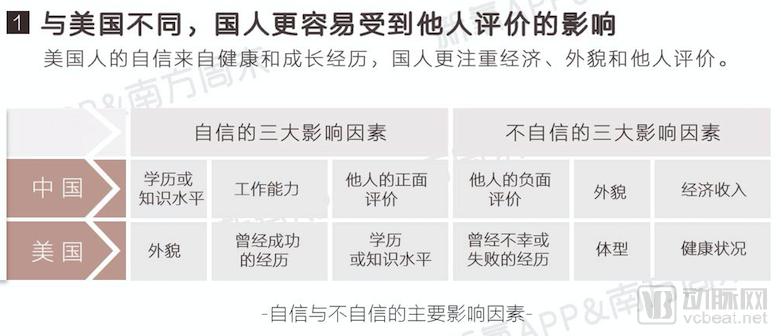
The three major factors contributing to low self-confidence among Chinese people, in descending order of impact, are: negative evaluations from others, physical appearance, and income level. The three major factors contributing to self-confidence among Chinese people, in descending order of impact, are: educational attainment or knowledge level, professional competence, and positive evaluations from others.
This means that in China, a person must first meet the baseline conditions of facing no criticism or blame, having an acceptable appearance, and earning a passable income to establish a foundation for self-confidence; advanced degrees, extensive knowledge, strong capabilities, and high income then serve as additional advantages.
By comparison, in the United States, if an individual has not experienced major failures and maintains a good physique and health status, they possess the foundation for self-confidence; furthermore, physical attractiveness, a track record of success, advanced educational credentials, and high intellectual attainment serve as additional assets.
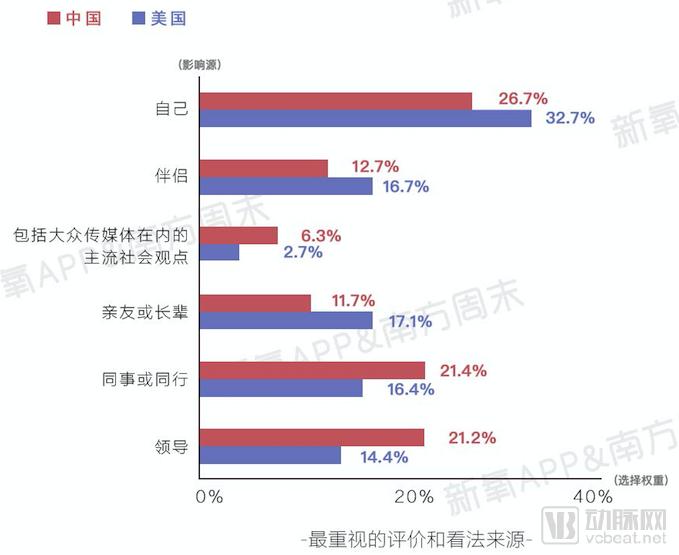
The combined influence of colleagues, peers, and leaders on the Chinese public accounts for 42.6%, surpassing that of self (26.7%) and friends, family, and partners (24.4%).
The combined influence of colleagues, peers, and leaders on the U.S. public accounts for 30.8%, a figure comparable to that of oneself (32.7%) and friends, family, and partners (33.8%).
China is profoundly influenced by others' evaluations and economic income. The United States is minimally influenced by others' evaluations and economic income.
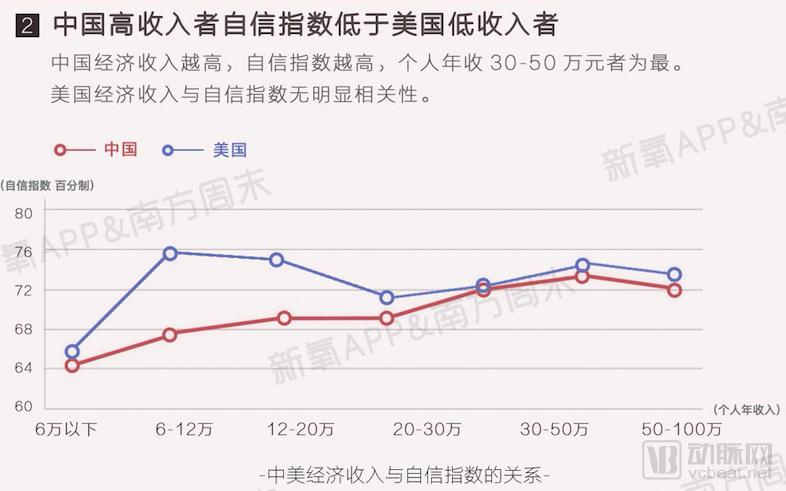
2. Confidence Index of High-Income Individuals in China Lower Than That of Low-Income Individuals in the United States
In China, economic income is positively correlated with the confidence index, with individuals earning an annual income of 300,000 to 500,000 yuan exhibiting the highest levels. In the United States, there is no significant correlation between economic income and the confidence index.
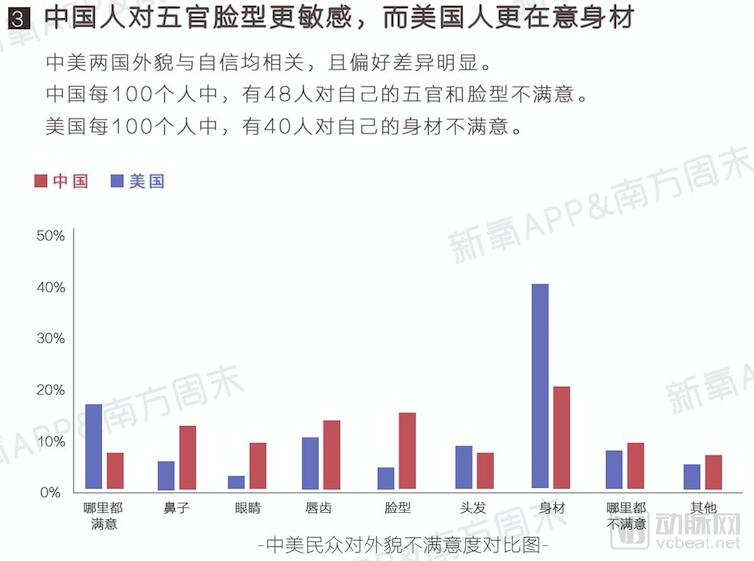
3. Chinese people are more sensitive to facial features and face shape, while Americans pay more attention to body figure
Both China and the United States show correlations between appearance and self-confidence, with significant differences in preferences. In China, 48 out of every 100 people are dissatisfied with their facial features and face shape. In the United States, 40 out of every 100 people are dissatisfied with their body shape.
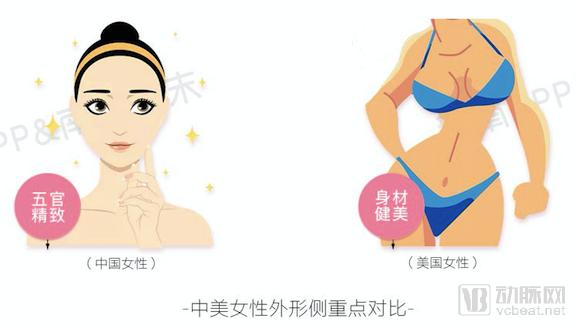
According to the "New Oxygen 2017 White Paper on the Medical Aesthetics Industry," Chinese women prioritize refined facial features in plastic surgery, while Americans pursue a fit and toned physique.
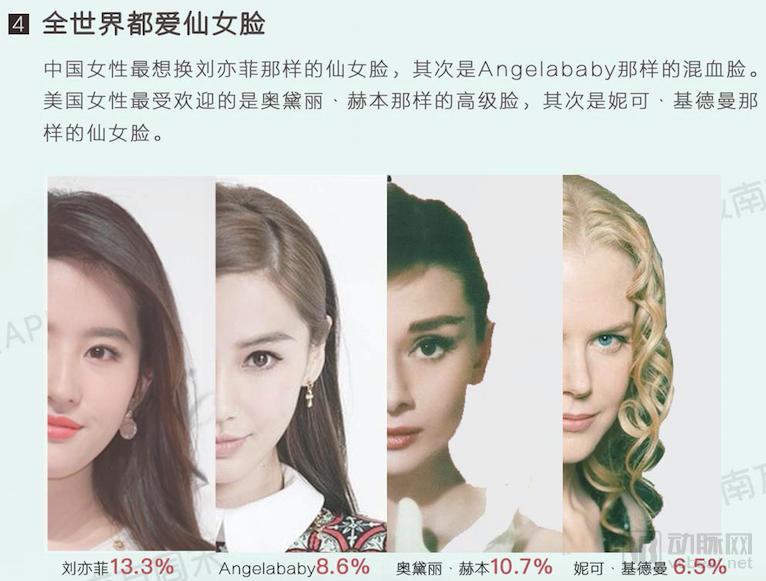
4. The World Loves the "Fairy Face"
According to a survey, Chinese women most favor the "fairy-like face," with 13.3 out of every 100 individuals aspiring to possess such a look akin to Liu Yifei's. The term "fairy-like face" originated from Miss Young, referring to facial features and an aura that exude calmness and a sense of aloofness.
Miss Young is the persona of So-Young’s official WeChat account. In 2017, the account’s articles garnered 380 million views, ranking 22nd on Newrank.cn—second only to government and major media accounts—and making it China’s top corporate official WeChat account. The term “Fairy Face” instantly became one of the year’s most popular beauty trends. In the United States, the “Fairy Face,” characterized by its poised elegance and air of aloofness, has also gained popularity.
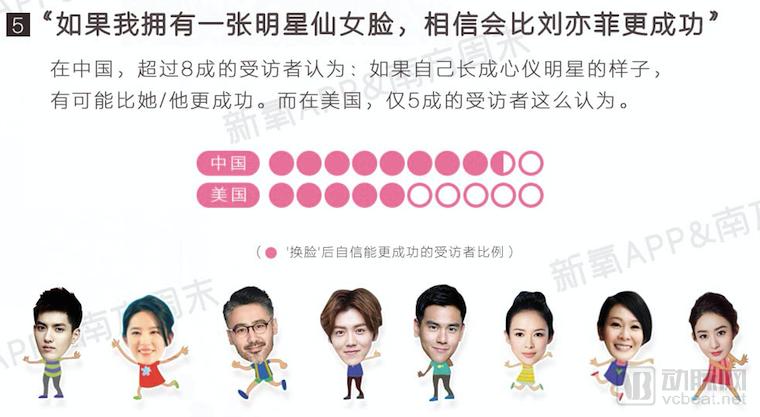
5. “If I had a celebrity fairy-like face, I believe I would be more successful than Liu Yifei.”
Interestingly, more than 80% of Chinese people believe that if they looked like their favorite celebrity, they could potentially be more successful than him or her. In the United States, only 50% of respondents hold this view.
This further illustrates the cognitive differences between the Chinese and American publics. The underlying mindset of the Chinese public is that individuals are already working hard enough, and differing initial conditions inevitably influence outcomes. In contrast, the American public places greater emphasis on equality of opportunity, often viewing the impact of physical appearance on success as non-decisive.
Cognitive differences are reflected in behavior. According to the statistics from the "2017 New Oxygen Medical Aesthetics Industry White Paper": 14 million people in China have enhanced their appearance through medical aesthetics, with women accounting for 90% of this group. The growth rate of China's medical aesthetics market reached 42%, which is six times the global average.
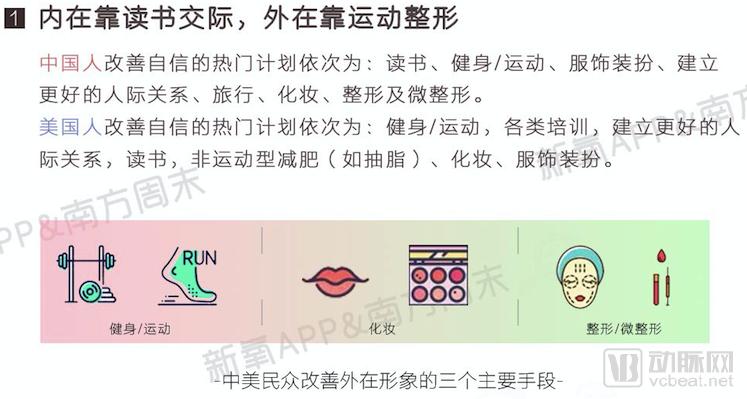
1. Inner cultivation through reading and socializing; outer enhancement through exercise and cosmetic procedures
Among the popular programs for enhancing self-confidence in China and the United States, there is significant overlap. After excluding duplicates, we find that programs available in China but not in the U.S. include travel, cosmetic surgery, and minimally invasive cosmetic procedures. Programs available in the U.S. but not in China include various training courses and non-exercise-based weight loss methods (such as liposuction).
It is foreseeable that China’s tourism and minimally invasive aesthetic medicine sectors are currently driven by rapid growth momentum. On one hand, Chinese citizens are eager to travel abroad and explore the world; on the other, they seek to present a more refined version of themselves to the global community.
Based on projections from the U.S. market, China’s training sector—particularly adult education—is poised for substantial growth in the future.
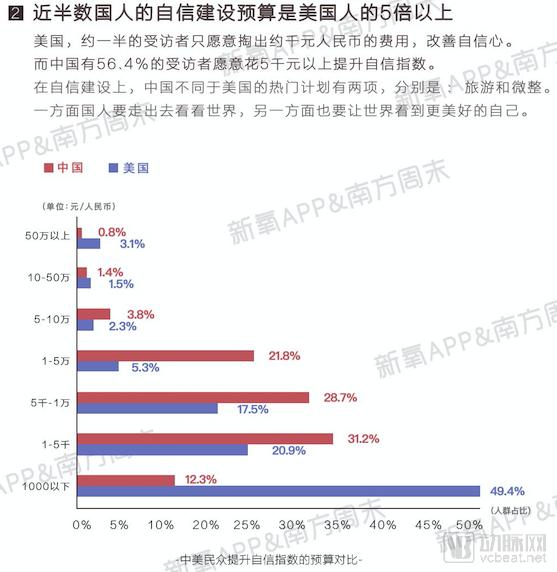
2. Nearly half of Chinese people have a confidence-building budget more than five times that of Americans
According to publicly available statistical data, in 2016, China's per capita GDP was $8,123, while that of the United States was $57,638, meaning China's figure was one-seventh of the U.S. level.
According to this survey, approximately half of the U.S. population is largely unwilling to spend money on enhancing self-confidence. In contrast, 56.4% of Chinese respondents are willing to spend more than 5,000 yuan to boost their self-confidence index.
Returning to the first question posed at the beginning of this report: Are we confident? While we believe we have worked hard and made significant efforts, we are not fully satisfied with the outcomes, and thus, we lack confidence.
Although underestimating oneself is a global issue, this phenomenon is more pronounced in China. Encouragingly, the Chinese public, particularly Chinese women, are taking and planning to take a series of proactive measures to improve this situation.
Finally, on this special day, here is a quote from the film *Forever Young* for Chinese women: “Have faith in your own worth. Love what you love, do what you do, follow your heart, and ask not of west or east.”
Founded in 2013, New Oxygen operates “New Oxygen APP,” a leading global social e-commerce platform for aesthetic medicine and minimally invasive procedures. Its business spans 351 cities across five countries: China, South Korea, Singapore, Japan, and Thailand. In 2017, the platform’s annual online transaction volume exceeded RMB 6 billion, driving over RMB 15 billion in output value for the medical aesthetics industry, with a year-on-year growth rate of 300%. By the end of 2017, New Oxygen completed its D-1 financing round of RMB 400 million and has since begun expanding into consumer healthcare and the broader beauty industry.