

Teladoc's Rapid Growth Unpacked: Scaling Remote Care Through Strategic Acquisitions

Teladoc
Telemedicine Service Provider
On February 27, 2018, Teladoc, the U.S. telehealth unicorn, released its 2017 annual report. For the fiscal year ended December 31, 2017, Teladoc reported strong revenue growth, with full-year revenue reaching $233 million, an 89% increase from the $123.2 million recorded in the previous fiscal year. However, its net loss widened year over year to $106.8 million, with an EBITDA loss of $70.4 million. Compared to the net loss of $74.2 million and EBITDA loss of $62.8 million in the same period last year, these figures represent increases of 44% and 12%, respectively. Following the earnings release, Teladoc’s stock (NYSE: TDOC) closed at $37.30, down 3% from the day’s opening price of $38.35, but quickly rebounded to close at $40.10 the next day.
Founded in 2002, Teladoc is the first and currently largest telemedicine platform in the United States. It went public on the New York Stock Exchange in 2015 under the ticker symbol TDOC. As a benchmark for internet healthcare in the U.S., Teladoc serves as a reference model for many Chinese internet healthcare companies. The platform enables users to consult physicians anytime (24/7) and anywhere via mobile devices, the internet, video calls, and telephone. Although there are significant differences in policy and market conditions between China and the United States regarding mobile health, vigorously developing telemedicine has become a key focus of China’s future healthcare reforms.
At the second plenary session of the First Session of the 13th National People’s Congress on March 9, Li Bin, Vice Chairperson of the National Committee of the Chinese People’s Political Consultative Conference and former Director of the National Health and Family Planning Commission, stated: “In particular, we should leverage the role of telemedicine, which is a key focus area of the ‘Internet Plus’ initiative. By using the internet to connect the high-quality resources of major national hospitals with grassroots and county-level hospitals, we can enable people to access specialists from top-tier hospitals right at their doorstep.”
As the largest telehealth company in the United States, Teladoc’s operational metrics warrant close examination. To this end, VCBeat (WeChat ID: vcbeat) has tracked and summarized Teladoc’s business activities in recent years, hoping to provide valuable insights for our readers.
What is Teladoc's primary business model?
Founded in Dallas, Texas, in 2002, Teladoc is the first telemedicine company in the United States. It was established by Dr. Byron Brooks, a former NASA flight surgeon, and serial entrepreneur Michael Gorton. In 2005, Michael Gorton, then serving as CEO, officially launched “TelaDoc Medical Services” at the Consumer-Directed Healthcare Conference in Chicago. Patients could access this telephonic consultation program by calling a “1-800” number to seek medical advice from physicians, who would return their calls within three hours; the average response time at that period was 30 to 40 minutes. In addition to charging $35 per telephone consultation, Teladoc also offered free phone consultations. Beyond providing remote medical advice, physicians would sometimes prescribe medications directly. Upon patient request, Teladoc would contact the designated pharmacy to submit the prescription.
According to industry surveys, 70%–75% of non-emergency medical incidents can be resolved via telephone. In certain special circumstances (such as in sparsely populated areas), telemedicine is even the only option. This thus became the impetus for the founding of Teladoc. Meanwhile, the pricing of $35 per consultation was fully affordable for the more than 45 million Americans who lacked health insurance at the time. Teladoc emerged as an effective solution, saving both time and costs; patients could register online at any time and seek consultations via phone or email, with access to services activated on the same day as registration.
Such convenient medical assistance services naturally gained user favor, and Teladoc’s user base quickly saw substantial growth.
By the end of 2007, Teladoc had amassed one million members and began serving as a vendor for large enterprises, providing services to their employees;
In 2008, Teladoc received angel investment;
On December 3, 2009, Teladoc secured $9 million in funding led by HLM Venture Partners.
After years of development, it has grown into the largest telehealth services provider in the United States. More remarkably, on July 1, 2015, it was listed on the New York Stock Exchange, becoming the world’s first publicly traded online consultation company. Its stock price reached $19, raising $758 million in capital, and its market capitalization surged to $620 million.
At the time of its IPO, Teladoc already had more than 1,100 board-certified physicians and healthcare professionals, providing users with telemedicine services anytime, anywhere via phone, internet, video, and mobile devices.
Teladoc’s pricing model primarily consists of two approaches. The first, and predominant, approach is a subscription-based model, where users pay a fixed monthly fee for unlimited consultations. This model mainly targets enterprises, which purchase it as an additional benefit for their employees, family members, or other beneficiaries. Currently, Teladoc serves more than 10,000 corporate clients, including over 300 Fortune 1000 companies. These large clients have helped Teladoc reach a total membership base of 23.2 million, generating $197.5 million in revenue. This constitutes Teladoc’s most significant revenue stream, accounting for 85% of its total income. The second approach is a pay-per-visit model, primarily aimed at individual, non-corporate customers.
Of course, not every consultation incurs a fee; free consultations may also be offered depending on the nature of the inquiry. In 2017, there were over 1.46 million consultations in total, with an average paid consultation rate of 54.25%, generating $35.8 million in revenue.
Rapid Growth in 2017, but Losses Persist
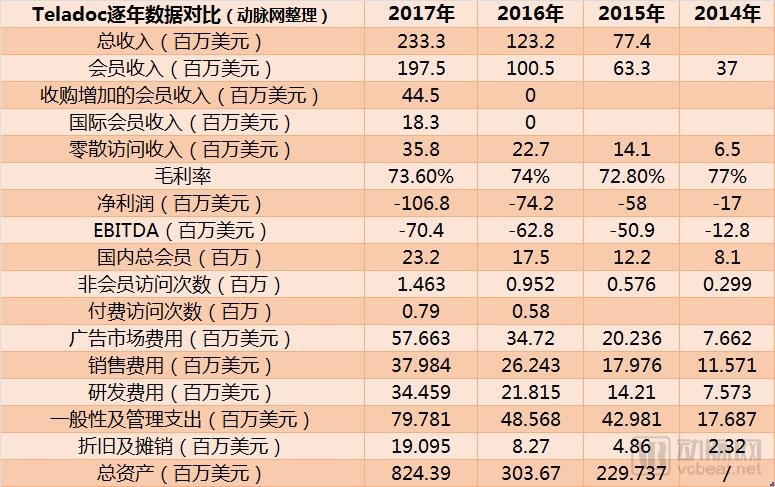
A comparison of Teladoc’s financial reports in recent years clearly reveals a significant growth momentum. In terms of annual growth, its total revenue reached $233.3 million in 2017, representing a year-over-year increase of 89% compared to 2016. By contrast, the annual revenues for 2016 and 2015 were $123.2 million and $77.4 million, respectively, with a year-over-year growth rate of 59% in 2016 relative to 2015. The gross profit margin for the full year was 73.6%, slightly lower than the 74% recorded in the previous year.
Among these, membership revenue was the primary driver of growth. In 2017, the number of domestic members in China reached 23.2 million, representing a 32% year-over-year increase from 17.5 million in the previous year. Membership revenue amounted to $197.5 million, marking a substantial 97% increase from $100.5 million in the prior year, which was the fastest growth rate since Teladoc’s initial public offering (IPO). Previously, the highest growth rate had been recorded in 2015, the year of its IPO, when revenue reached $63.3 million, a 71% year-over-year increase from $37 million in the preceding year.
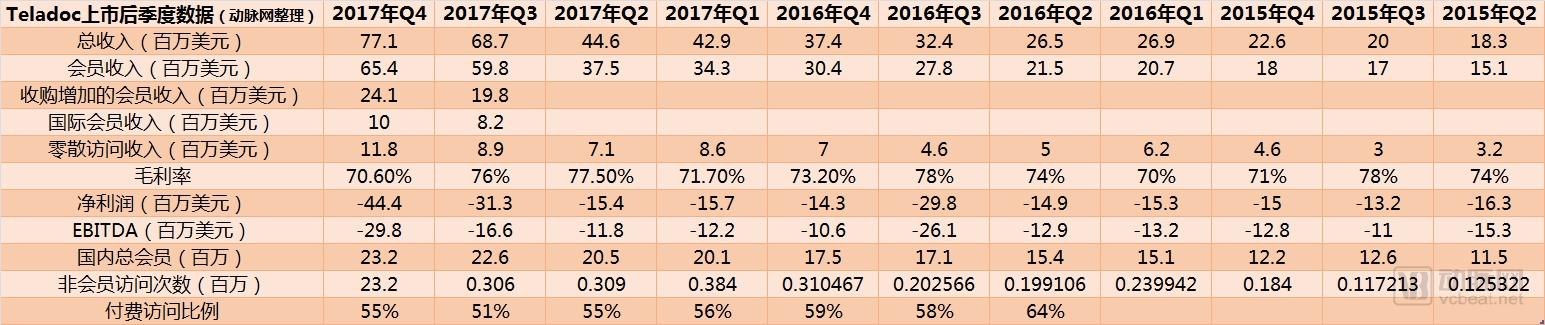
However, a careful analysis reveals that the exceptionally high growth rate of membership revenue in 2017 was closely tied to an acquisition made by Teladoc that year. On July 21, 2017, Teladoc acquired Best Doctors, a remote consultation platform, for a total consideration of $440 million, comprising $375 million in cash and $65 million in equity. This marked Teladoc’s largest acquisition since its inception. The acquisition contributed $44.5 million in annual membership revenue to Teladoc, including $18.3 million in global revenue.
Excluding the revenue generated from this acquisition, Teladoc’s original membership system produced $153 million in membership revenue, representing a 52% year-over-year increase from the $100.5 million recorded in the previous year. This growth rate is comparable to the 59% year-over-year increase in membership revenue observed in 2016 relative to 2015. Objectively speaking, an annual growth rate exceeding 50% remains quite substantial.
After years of practice, Teladoc believes that the B2B2C distribution strategy is the best way to provide telemedicine services to consumers or members. On the business side, Teladoc partners with more than 10,000 corporate employers, health plans, health systems, and other entities, which have purchased Teladoc’s telemedicine services for a total of 23.2 million members. Its employer clients include more than 300 Fortune 1000 companies and industry leaders such as Boeing, Facebook, HP, Dell, Microsoft, Bank of America, T-Mobile, Accenture, and Citibank; it also serves over 35 health insurance plans and more than 200 healthcare system clients.
In the TOC sector, Teladoc also saw substantial growth in 2017. The company recorded 1.463 million visits for the year, a 54% increase from the 952,000 visits in 2016; revenue reached $35.8 million, up 58% from $22.7 million in 2016. While these growth rates were largely consistent with those of the previous year, they still fell short of the peak levels achieved in 2015, the year of its IPO, when Teladoc’s direct-to-consumer visit volume and related revenue surged by 116% and 92%, respectively. Meanwhile, paid visits accounted for 54% of all direct-to-consumer visits in 2017, down from 61% in 2016.
Despite rapid revenue growth, Teladoc has yet to achieve profitability. On the contrary, its net losses have widened year over year. In 2017, the company reported a net loss of $106.8 million, representing a 44% increase from the $74.2 million loss in 2016. However, its EBITDA loss, excluding amortization and depreciation, amounted to only $70.4 million, a modest 12% increase from the previous year’s $62.8 million.
An analysis of specific expenses in the financial statements reveals that, in terms of their respective proportions, Teladoc’s top three expenditures in 2017 were: general and administrative expenses, which totaled $79.78 million for the year, representing a 64% quarter-on-quarter increase; advertising and marketing expenses, amounting to $57.66 million for the year, a 66% quarter-on-quarter increase; and sales expenses, reaching $37.98 million for the year, up 45% quarter-on-quarter. The substantial rise in general and administrative expenses is reasonable given the occurrence of mergers and acquisitions.
With the acquisition completed, this expense is expected to decline in the future. Given that telemedicine remains an emerging sector, advertising and marketing expenditures are still indispensable at this stage, and these costs are projected to continue rising. As for sales expenses, a month-over-month increase of less than 50%, compared with a revenue growth of over 50% quarter-over-quarter, represents a respectable performance.
Despite widening losses, Teladoc currently maintains a relatively healthy financial position, with $120 million in cash and bonds. These operational metrics have bolstered Teladoc’s confidence in its future outlook. According to the company’s 2018 guidance disclosed in its financial report, full-year revenue is projected to reach $350–$360 million, while the EBITDA loss is expected to narrow significantly to $27–$30 million. Adjusted EBITDA is anticipated to turn profitable for the first time on an annual basis, estimated at $7–$10 million. In fact, Teladoc already achieved positive adjusted EBITDA for the first time in Q4 2017.
Why Has Teladoc Achieved Such Rapid Growth? There Are Three Main Reasons:
I. Can Resolve Most Issues: Nationwide Telemedicine Legislation Enacted
According to data from the U.S. Centers for Disease Control and Prevention (CDC), there are 1.25 billion outpatient visits annually in the United States, including primary care, hospital emergency departments, and other outpatient services. It is estimated that approximately one-third of these visits, or 417 million, could be addressed through telemedicine. Based on data from the Agency for Healthcare Research and Quality (AHRQ), there are approximately 168 million outpatient-based behavioral health visits in the United States each year, of which 80%, or 134.4 million, could be resolved via telehealth services. In total, these two categories represent a market potential of approximately 585 million telehealth consultations. Furthermore, according to statistics from various associations such as the American Cancer Society and the Epilepsy Foundation, there is an additional market opportunity for 5.1 million annual consultations with specialists for critical illnesses.
Prior to this, certain state governments in the United States had enacted legislation requiring physicians to conduct an in-person consultation with patients before providing telemedicine services. The Texas Medical Board, where Teladoc is based, adopted such an amendment to prescription rules regarding telemedicine in 2010, prompting Teladoc to file a lawsuit in 2015. After two years of protracted litigation, on May 27, 2017, Texas Governor Greg Abbott signed into law the telemedicine legislation (namely Senate Bill SB1107 and House Bill HB2697), which repealed the requirement that physicians could only provide telemedicine services after an in-person encounter with patients. Texas was the last of the 50 U.S. states to abolish this regulation, thereby removing barriers to the development of telemedicine.
II. Significant Cost Savings
A 2016 study prepared for IHS Markit by the Association of American Medical Colleges found that the growth rate of physician demand continues to outpace supply, leading to a total shortage of up to 94,700 doctors by 2025, including a shortfall of approximately 36,000 primary care physicians. According to data from the National Association of Community Health Centers, 62 million people annually fail to receive appropriate primary care due to this physician shortage. Meanwhile, outpatient efficiency within the U.S. healthcare system is remarkably low, posing significant challenges in terms of cost and quality of care. Under these circumstances, many patients may forgo seeking medical attention altogether or instead turn directly to emergency departments or urgent care clinics, resulting in exorbitant costs and inefficient treatment. The heavy reliance of U.S. patients on emergency services has further strained emergency departments. These issues not only compromise patient health but also impact health insurers and employers, who ultimately bear all or part of the associated costs.
According to Teladoc’s statistics, its Teladoc platform saves an average of $46 per visit for general care and $472 per Medicare-covered claim. When including the recently acquired Best Doctors, the savings are even greater—averaging up to $116,000 per critical care case and $36,000 per specialist diagnosis.
3. Can effectively increase physicians' income
In the United States, physicians’ incomes and service capacity are declining due to reimbursement cuts and increasing administrative burdens. These factors have led to physician dissatisfaction and adversely affected their willingness to provide medical services. According to Medscape’s “2014 Physician Compensation Report,” 50% of physicians felt they were not fairly compensated, and 42% stated they would not choose medicine as a career again. Consequently, dissatisfied with reduced income, 44% of physicians have decided to gradually reduce their patient load, work part-time, seek non-clinical roles, or retire early. The emergence of Teladoc has the potential to change this situation.
For physicians, the income boost from joining Teladoc serves as a powerful incentive. According to a 2013 report by Becker's Healthcare, physicians registered on the Teladoc platform earned an average of $150 per hour, which is 50% higher than the average hourly income of $99 for other full-time physicians. As a result, Teladoc physicians can reap substantial additional annual earnings of $100,000.
Therefore, telemedicine not only has significant room for growth in terms of visit volume but also enables patients to receive more timely treatment, reduces healthcare costs, and increases physicians’ income. These factors currently present Teladoc with opportunities for sustained growth.
Telemedicine in the United States has seen significant development in recent years. In addition to Teladoc, star teleconsultation companies such as American Well and Doctor on Demand have also emerged.
Among them, American Well, founded in 2006, is a star player in this field alongside Teladoc. It secured $10 million in Series A financing in 2009; by 2012, the total amount raised in its Series A round had reached $37 million. In 2014, it raised a total of $81 million in its Series C financing round. Currently, the platform has recorded 147 million visits and provides services to more than 55 health insurance plans and over 70 healthcare institutions.
Doctor on Demand, often referred to as the “Uber of healthcare,” was founded in 2012 and secured a $3 million seed funding round in 2013 from Venrock, Andreessen Horowitz (a16z), and Google Ventures. In 2014, it completed a $21 million Series A financing round led by Venrock, Shasta Ventures, and Richard Branson. Nevertheless, its scale remains significantly smaller than that of Teladoc.
The telemedicine market’s enormous growth potential is also one of the primary reasons it attracts significant investment. According to a report by Teladoc, there are 16.8 million behavior-based diagnostic visits annually in the United States, 80% of which can be conducted via telehealth consultations. At an average price of $89 per visit, this represents a substantial market valued at $12 billion.
As for outpatient care, there are approximately 1.25 billion visits annually, 33% of which can be conducted via telemedicine. At a unit price of $40, the total annual market size reaches $17 billion. The figure becomes even more substantial when expert consultations are included. Across the United States, there are an average of 5.1 million cases per year requiring diagnostic opinions from top-tier specialists. At an average cost of $5,500 per consultation, the total market value for expert opinions amounts to $28 billion. Consequently, the overall market size for telemedicine totals $57 billion. Currently, even Teladoc, the company with the largest market share, has captured less than 1% of this market, indicating that the potential for telemedicine is immense.
The Future of Teladoc
Teladoc’s past success has been driven by several key strategies, with the continuous improvement of user service satisfaction being one of the primary reasons for its rapid growth. Even during its busiest month in 2017, the average response time per visit was only 9 minutes and 43 seconds, an improvement from the previous year’s average of 11 minutes and 11 seconds. This marks a dramatic difference from the initial average response time of 30–40 minutes at the company’s inception, achieving a member satisfaction rate as high as 95%.
When it comes to members, retaining existing members and acquiring new ones is undoubtedly Teladoc’s top priority—after all, 85% of its revenue comes from large enterprise clients. In 2016, more than 220 of Teladoc’s large enterprise clients were Fortune 1000 companies. Despite the significant challenges in acquisition, Teladoc achieved a breakthrough in 2017, increasing this number to over 300. Although difficult, achieving strong growth by acquiring new large enterprise clients is far from impossible.
In its 2018 outlook, Teladoc also unveiled a vision to expand its membership base to 24 million. The company is also allocating additional marketing resources to its sales channels targeting small and medium-sized enterprises (SMEs) to increase its penetration in the SME market. Furthermore, Teladoc intends to deepen its penetration into the provider market, particularly among hospitals and physician groups.
Expanding service offerings through mergers and acquisitions or organic development is also a key strategic direction for Teladoc’s future. Currently, Teladoc provides diagnosis and treatment for various conditions, including upper respiratory infections, urinary tract infections, sinusitis, and dermatological disorders, while also offering mental health services for anxiety and depression delivered by healthcare professionals.
Teladoc plans to leverage its highly scalable platform to expand into new clinical specialties, such as chronic disease management for conditions like diabetes, with a particular focus on growing its dermatology, smoking cessation, sexual health, and psychiatry services. With the completion of its acquisition of Best Doctors, Teladoc has also gained access to Best Doctors’ global medical resources, including more than 50,000 physicians covering over 450 conditions, including serious illnesses such as cancer.
Meanwhile, Best Doctor’s previously acquired IBM Watson for Oncology AI solution has also been brought under the Teladoc umbrella, enabling it to provide second-opinion cancer diagnosis services to its users. This move completes Teladoc’s product portfolio: Teladoc serves general outpatient care, while Best Doctor delivers premium value-added services, thereby achieving comprehensive coverage across both mass-market and high-end customer segments.
Emerging mobile internet and biomedical devices will also be a key focus for the company in the future. According to statistics, 80% of Americans under the age of 50 own internet-connected smartphones, a trend Teladoc has certainly not overlooked. Its mobile app has achieved over one million downloads in a short period, while additional channels, including social networks, have provided it with broader distribution and promotional avenues. Teladoc also plans to launch wearable biochemical devices to better integrate its services into its ecosystem and enhance customer stickiness.
Through the acquisition of Best Doctors, Teladoc has also realized its vision for internationalization—Best Doctors contributed $18.3 million in global revenue to the company in 2017. Leveraging this global physician network, combined with Teladoc’s rich base of large corporate clients (many Fortune 1000 companies are multinational corporations), Teladoc’s path to globalization should not be overly challenging. By serving the global employees of these key accounts, Teladoc can implement its international expansion strategy in a gradual and systematic manner. However, policies and acceptance levels regarding telemedicine vary across different regions worldwide, requiring the company to remain patient in this regard.
Judging from Teladoc’s development history, it is a company that particularly favors mergers and acquisitions (M&A) as a growth strategy—from 2013 to 2017, Teladoc made significant M&A investments every year. Although it has just completed the largest acquisition in its history, once financing is secured, it is expected to make another major move in 2018.
Teladoc's Acquisition History
Since its inception, Teladoc has completed multiple acquisitions during its growth trajectory, leveraging these strategic purchases to expand its platform, service offerings, and sales capabilities.
Pre-launch
In August 2013, Teladoc acquired Consult A Doctor for $16.6 million in cash.
In May 2014, Teladoc acquired AmeriDoc for $17.2 million. Both Consult A Doctor and AmeriDoc specialized in providing telehealth solutions to small and medium-sized enterprises (SMEs) through distributor channels. This acquisition created new distribution opportunities and expanded Teladoc’s sales revenue.
In January 2015, Teladoc completed its acquisition of BetterHelp, a consumer-facing health service provider, for $3.5 million in cash and a $1 million promissory note. Teladoc committed to paying BetterHelp an annual fee each year for the next four years. This acquisition helped Teladoc expand its services in the direct-to-consumer and behavioral health segments.
On June 17, 2015, Teladoc completed its acquisition of Stat Health Services Inc. (StatDoc) for a total consideration of $30.1 million, comprising $13.3 million in cash and $16.8 million in common stock. StatDoc is a telehealth provider specializing in managed care systems and self-insured clients.
Post-marketing
On July 31, 2015, Teladoc acquired certain assets from Gateway to enable the sale of Teladoc’s services through other third parties.
On July 1, 2016, Teladoc acquired HealthiestYou for a total consideration of $151.5 million, comprising $43.2 million in cash and $103.8 million in common stock. HealthiestYou is a leading telehealth technology platform for the small and mid-sized employer market, providing end users with web- and mobile-based telehealth services.
HealthiestYou’s solutions include 24/7 access to physicians via phone, email, and video conferencing, provide users with a location-based directory of healthcare providers, and allow them to look up provider ratings, reviews, and background information. HealthiestYou can compare prices for more than 5,000 medications across over 100,000 pharmaceutical companies, and offers customizable personalized reminders to help users obtain optimal care.
On June 19, 2017, Teladoc announced the acquisition of Best Doctors, an online medical consultation service platform, for $375 million in cash and $65 million in equity. This marks the largest acquisition by Teladoc since its establishment in 2002. The primary objectives of the acquisition are to expand Teladoc’s capacity to provide telemedicine services for complex chronic diseases and to enhance its international presence.