

Nebula Genomics Files IPO Prospectus: Pioneering the Future of Genomic Data Markets with Blockchain Technology
In 2001, the cost of sequencing the first human genome was $3 billion, whereas today, this price has dropped to $1,000. Technological advancements have created substantial profit opportunities for healthcare stakeholders. According to a rough estimate by MIT’s Enigma, the future value of the genomics market is projected to range between $10 billion and $50 billion.
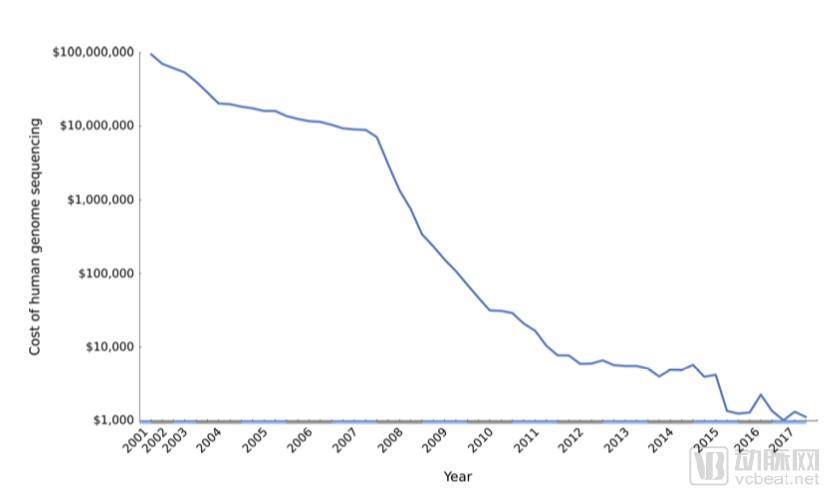
Genetic Testing Costs (Source: Nebula Genomics White Paper)
The sharp decline in the cost of genetic testing has brought unprecedented development opportunities to precision medicine. Through genetic testing, doctors can determine whether you are at a higher risk of developing cancer or Alzheimer's disease. In the future, people will no longer pass on sorrow due to suffering from certain genetic diseases, but instead discuss the new life brought by genetic testing—avoiding the onset of certain high-probability diseases through continuous proactive care.
Opportunities always come with challenges. The relatively high cost of sequencing, increasingly severe data privacy concerns, and cumbersome genetic data are all obstacles that must be overcome to advance precision medicine and data trading, thereby constraining the development of new business models in the genomics industry.
Geneticists at Harvard University naturally recognized the undercurrents in the field of genetics, leading Dr. Dennis Grishin, graduate student Kamal Obbad, and geneticist George Church to co-found Nebula Genomics.
Nebula Genomics plans to sequence your genome for $1,000, provide you with genetic test results, protect these results using blockchain technology, and allow you to do whatever you wish with your data.
George Church, a co-founder of Nebula, is a dual member of the U.S. National Academy of Sciences and the National Academy of Engineering, and currently serves as a professor at Harvard University and the Massachusetts Institute of Technology. Dr. Church has published more than 400 academic papers and holds 95 patents.
In 1984, he developed the first direct genome sequencing technology, which played a pivotal role in advancing the Human Genome Project. In 2005, he co-launched the Personal Genome Project.
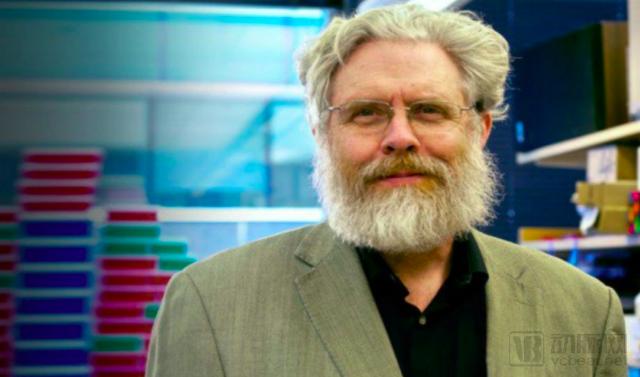
Geneticist George Church
Professor George Church believes that individuals can derive economic benefits from their genomic data, which, for instance, plays a highly positive role in informing reproductive decisions. In the long term, sequencing can facilitate the development of therapeutic interventions aimed at improving quality of life.
“Why haven’t people obtained their genomic sequences? How is Nebula Genomics changing this situation? Currently, the cost of genetic testing and concerns about privacy have led to skepticism toward this technology (genome sequencing). Even as prices decline, most people still fail to see its value. Nebula enables us to reach a critical mass of individuals to disseminate new concepts. We have been awaiting a true technological tipping point, and now it has arrived.”
Dr. Dennis Grishin, a researcher at Harvard University, and graduate student Kamal Obbad are the other two founders of Nebula Genomics. Other members include: Mirza Cifric, Co-founder and CEO of Veritas Genetics; Joe Urgo, Founder of the leading Ethereum project consulting firms District0x and Sourcerers.io; and D.A. Wallach, a recording artist, songwriter, investor, actor, and essayist.
D.A. Wallach has served as an investor and advisor to companies such as SpaceX, Ripple, Emulate, and Spotify, and is the founder of Inevitable Ventures; his music has been featured in the film La La Land.
The entire team is like the name Nebula itself—a constellation of stars. What kind of nebula will such a perfect team create?
Human genetic information is 99.9% identical. However, this remaining 0.1% difference encompasses more than 4 million genetic variations. These genetic variations are the source of the differences we observe between individuals, including physical traits, personality characteristics, and disease predispositions.
Through personal genome sequencing, we can uncover hidden information about our bodies. This information can help us make optimal decisions regarding health-related issues, including family planning, personalized dietary plans, and exercise regimens. We are entering an era of more precise and personalized medicine, where people are no longer merely seeking treatment after falling ill but are shifting toward preventive care.
Genomic datasets can also be used to identify associations between genetic variants and diseases. These associations can help pharmaceutical companies design drugs targeting specific genes. In the future, gene-guided drug development will yield therapies that are more personalized and targeted.
Nebula has found that researchers, pharmaceutical companies, and biotechnology firms are constrained by issues such as insufficient genomic data volume, uncertain phenotypic data quality, and inefficient data collection. Their growing concerns about the resources required to process large-scale genomic data are not unfounded, as the entire industry is undergoing transformation.
Generally, when purchasing phenotypic data, buyers need to focus on three key aspects. First, data purchasers are typically not interested in random datasets; rather, they seek genomic data from individuals with specific phenotypes (such as those with particular diseases). Second, individuals who share their genomic data must also be willing to provide corresponding phenotypic data, as genomic data cannot fully realize its potential without phenotypic data for comparison. Third, the quality of phenotypic data is often inconsistent, as these data are usually sourced from intermediaries such as direct-to-consumer genetic testing companies, which collect information through patient self-reporting.
Consequently, buyers face the following challenges: First, data acquisition systems lack automation. Contract signing, payment processing, and data transmission all require manual intervention, resulting in significant inefficiency. Second, genomic and phenotypic data obtained from different sources typically originate from disparate databases and are encoded in varying data formats, making standardization a time-consuming process. Third, the presence of intermediaries prevents buyers from communicating directly with data providers; as a result, data purchased through intermediaries often contains substantial amounts of information that is irrelevant to the buyers’ needs.
It is estimated that by March 2025, the genomes of 100 million to 2 billion individuals will have been sequenced. This will give rise to three challenges, each concealing immeasurable benefits.
1. Substantial disk space is required to store large-scale genomic data.
2. Network transmission speed will limit data sharing.
3. The processing and analysis of genomic big data are projected to consume trillions of CPU hours.
Nebula Genomics aims to address the challenges of genomic big data by reducing the cost of personal genome sequencing, strengthening genomic data protection, and enabling buyers to access valid genomic data. Nebula Genomics believes that these goals can be achieved through the integration of decentralization, cryptography, and blockchain technology.
Nebula Network will enable data buyers to obtain genomic data directly from data owners, bypassing intermediaries. This will allow data owners to derive revenue from data buyers, and Nebula Network also plans to provide subsidies to data buyers. Reducing sequencing costs will accelerate the growth of genomic data.
Data owners will store their genomic data privately and control access to it. Shared data will be protected through zero-trust, encrypted computing. Data owners will remain anonymous, while the identities of data buyers must be fully transparent. Meanwhile, the Nebula blockchain will permanently store all data transaction records to ensure data security.
Nebula Network will aggregate genomic data from individuals and genomic databases, thereby addressing the issue of fragmented genomic data. Data buyers can communicate directly with data sellers, and the absence of intermediaries ensures that the acquired data is more valuable. Furthermore, Nebula will provide standardized data formats to facilitate data management. The entire transaction process is executed via smart contracts, which significantly reduces time compared to traditional transactions.
The information content of the human genome is approximately 3 billion base pairs (3G). In practical analysis, when factors such as environmental influences are incorporated, individual data volumes exceed terabytes (TB). Integrating data across different time points, this global dataset—characterized by growth outpacing Moore’s Law, real-time computing, and frequent sampling—places higher demands on computational, storage, and network infrastructure. Nebula Genomics achieves high-speed file transfer through decentralized data storage, flexible utilization of computational resources, and efficient data encoding. It is well-prepared for the impending data explosion.
Decentralized private data storage helps address the issue of genomic data fragmentation. The founders of Nebula Genomics, who have participated in the Harvard Personal Genome Project and the operations of Veritas Genetics, bring extensive experience to the table. They are well-positioned to propose effective solutions for establishing compatibility across independent datasets. Data standardization will enable data buyers to curate a wide variety of data procurement strategies, resulting in significant cost savings.
On the Nebula Network, personal data is protected through multiple mechanisms:
1. Data owners privately store their personal genomic and phenotypic data and retain control over the data.
2. Nebula uses Intel Software Guard Extensions (SGX) and homomorphic encryption to encrypt shared data and perform secure analysis. Data purchasers never view personal genomic data in plaintext.
3. When sharing data and processing payments, the data owner remains pseudonymous. The Nebula Network address exists as an encrypted identifier unrelated to any personal information.
4. Data buyers must participate in transactions with full identity transparency and undergo verification through Nebula Genomics. All data transaction records will be stored on the Nebula blockchain.
Nebula Genomics has also introduced a token mechanism but has not yet conducted an ICO. Throughout its business operations, the primary functions of Nebula Tokens are incentive and circulation.
Companies can use fiat currency to purchase tokens from Nebula Genomics, and then use these tokens to buy specific data sets that patients wish to sell. In turn, patients can use the tokens to pay for genomic sequencing.
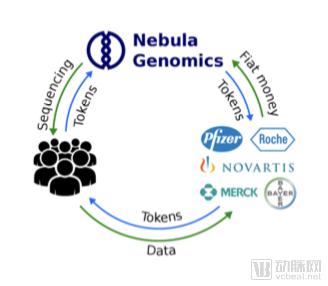
Nebula Token Circulation Mechanism
The cost of gene sequencing is the driving force behind the entire Nebula ecosystem. A decline in gene sequencing costs will drive more consumers to undergo gene sequencing, enabling the Nebula database to acquire more genetic data.
For enterprises, the expansion of a database signifies an increase in its intrinsic value. This rising value stimulates corporate purchasing demand, which in turn further drives database growth, creating a closed-loop cycle.
For consumers, a comprehensive genetic database will enable researchers to provide more profound insights, helping consumers better understand their own conditions. This increasing utility will attract more consumers to participate in genetic sequencing, thereby enriching the genetic database and creating another closed loop.
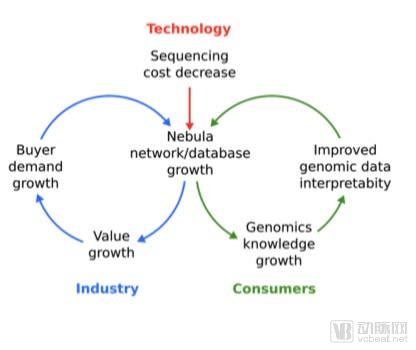
Nebula Genomics' Development Model
Through continuous iteration, Nebula Genomics will become increasingly comprehensive, and the entire value chain will grow in value.
Judging from Nebula Genomics’ operational model, a batch of tokens is required at the outset to drive system operations. Therefore, once the technology matures in the future, the project may conduct an Initial Coin Offering (ICO) to ensure the normal functioning of the entire blockchain ecosystem.
Nebula’s partners include Varitas Genomics and Enigma. The latter is a privacy protocol for blockchain services pioneered by the Massachusetts Institute of Technology (MIT); its Catalyst product forecasts stock market trends and helps investors build portfolios.
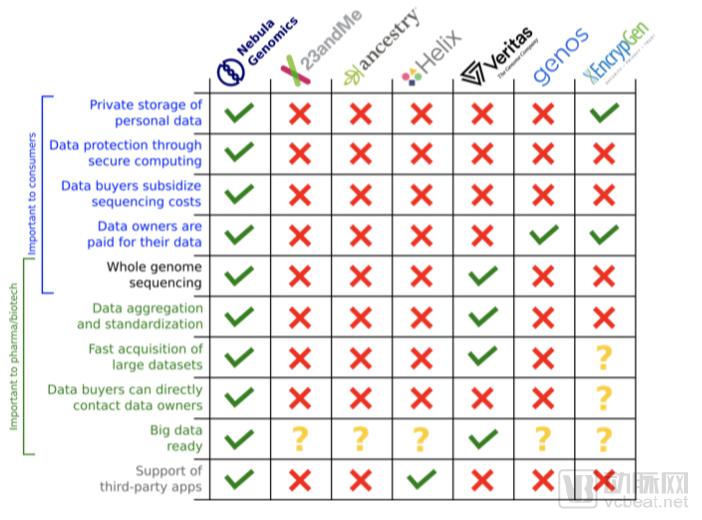
Nebula’s competitors are equally formidable, including pioneers in the genetic testing field such as 23andMe and Ancestry. However, Nebula boasts features that traditional companies lack, including private data storage, secure computation protection, compensation for data buyers, user control over data, whole-genome sequencing, data standardization, machine learning, and support for third-party software. Therefore, if Nebula can develop the blockchain outlined in its whitepaper, it will be well-positioned to compete with these industry giants.
Genetic testing influences not only individual medical decisions but also financial planning. Individuals who learn through genetic testing that they are at elevated risk for cancer are more likely to purchase cancer-related insurance, leading to adverse selection. Conversely, insurers may use genetic testing results to determine whether to accept an applicant’s coverage request, thereby securing substantial profits while undermining their social role.
Regulatory authorities in some countries, such as Germany, have classified the direct-to-consumer sale of genetic testing as illegal. However, this has not prevented Germans from traveling to unregulated countries to undergo genetic testing. Therefore, this remains an unavoidable and critical issue in the field of genetic testing.
With legislative safeguards in place, the traceability and tamper-resistance of blockchain technology can effectively address this issue. For instance, laws could mandate that consumers use digital currencies for payment when undergoing genetic testing, thereby avoiding the aforementioned problems.
Given the inherent advantages of traceability and tamper-resistance, blockchain technology may lead to unexpected developments in the field of genomics. The Nebula Genomics project has the potential to reshape the current landscape of the genetic testing market.
References:
1. http://fortune.com/2018/02/09/blockchain-genetic-testing-nebula/
2. https://futurism.com/nebula-genomics-rent-genetic-information/
3. https://www.cnbc.com/2018/02/08/harvard-genetics-pioneer-will-monetize-dna-with-digital-currency.html
4. https://www.theguardian.com/science/2018/feb/18/professor-george-church-nebula-genomics-interview
5. https://medium.com/neodotlife/blockchains-and-genomics-32fc64fbb8f0
6. NEBULA GENOMICS whitepaper
7. Yang Mengjie, Yang Yuhui, Guo Yuhang, et al. Research on the Current Development Status of Precision Medicine in the Era of Big Data[J]. China Digital Medicine, 2017, 12(9): 27-29.