

Enigma: Pioneering Privacy-Preserving Blockchain Solutions for the Future of Healthcare

enigma BioTech
In-ear Detection Wearable Device Developer
How Far Is Blockchain Really From the Healthcare Industry? It Remains an Enigma to This Day.
Companies worldwide have leveraged the blockchain concept to raise capital, ranging from powerful enterprises aiming to disrupt the global landscape through blockchain technology, to countless speculators seeking exorbitant profits by hyping the concept. To distinguish between high-quality and inferior ventures, investors must gain a clear understanding of blockchain’s future.
This is a powerful technology, but it remains in its infancy. First, blockchain has broad application scenarios and requires substantial R&D investment, yet much of the technology remains impractical. Second, computational speeds on the blockchain are slow and prohibitively expensive. Most critically, all data on the chain is visible to everyone. Due to these issues, most data must still be stored in centralized databases.
This means that,“Distributed applications” are either not truly distributed, or they cannot scale and cannot handle any sensitive data.. These factors severely limit the utility of blockchain.
Resolving the tension between data sharing and privacy, while uncovering the latent value of data, presents both a challenge and an opportunity for internet-based healthcare. Although implementing a centralized database (cloud storage) may be technically simpler—a domain often monopolized by large enterprises, making it difficult for startups to enter—distributed networks employing privacy-maximizing algorithms can process data in the most secure manner. Such approaches are clearly more aligned with societal ethical standards and regulatory requirements, including the HIPAA Act and other legal frameworks.
To address the aforementioned issues, enigma BioTech was established.
The Enigma Protocol is part of MIT’s OPAL—EAST (Open Algorithms with Fairness, Accountability, Security, and Transparency). The system employs two core cryptographic constructs: secret sharing and multi-party computation (MPC).
Secret Sharing refers to the process of “splitting” a given data item into multiple ciphertext fragments (known as “shares”), which are then stored separately. When a user attempts to access the data, any individual ciphertext fragment appears as garbled text. To retrieve the complete data, it is necessary to obtain a minimum or “threshold” number of ciphertext fragments and combine them using reverse cryptographic computation. For example, in the military domain, certain critical commands require the unlocking of two out of three keys before the command (such as missile activation) can be executed.
The second cryptographic construct adopted by Enigma is Multi-Party Computation (MPC). MPC schemes aim to address scenarios where a group of entities needs to share certain common outputs (e.g., computational results) without compromising the privacy of their individual data items. For example, a group of patients collaborates to calculate their average blood pressure; if the raw blood pressure data of any single patient is excluded, the result will change.
The white paper “Blockchain and Health IT: Algorithms, Privacy, and Data” elaborates on OPAL/Enigma, a platform designed to ensure the security, confidentiality, integrity, and availability of PMI data. This solution was proposed in response to former U.S. President Obama’s 2015 speech on “Precision Medicine.”
The OPAL/Enigma system is divided into three components: a data repository, crypto infrastructure, and Blockchain, as shown in the figure below:
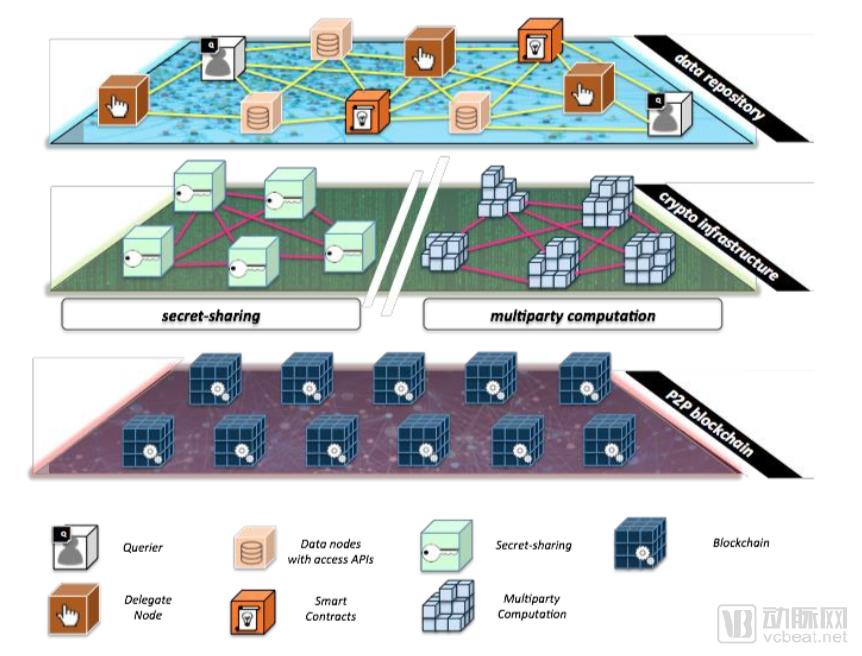
The project's data repository is a distributed data storage structure built on a peer-to-peer (P2P) network. Data is encrypted within the repository, ensuring that raw data is not released after the program execution concludes.
This database is bound to specific smart contracts that require users to present authorized digital identity credentials for access. During the access process, the system generates auditable yet immutable records on the blockchain, such as a password-distributed ledger or a permissioned blockchain.
The encryption algorithms of OPAL/Enigma are built upon P2P networks and blockchain technology. Enigma simultaneously employs two cryptographic constructs—secret sharing and secure multi-party computation (MPC)—to safeguard data security during data exchange between OPAL and QCS (Distributed Control Systems).
The Enigma system integrates MPC and secret sharing at the peer-to-peer network layer. The combination of these three computational paradigms—secret sharing, MPC, and P2P nodes—offers new possibilities for addressing current data privacy challenges and meeting the needs of organizations to store or process large volumes of data.
Within the OPAL/Enigma platform, blockchain primarily serves a control function, creating a secure and equitable environment for the storage and analysis of medical information, while ensuring that the entire query process is traceable and auditable. The query smart contracts provided by OPAL are capable of resolving the conflict between data sharing and privacy.
If a user needs to query data, identity authentication is performed via the Query Smart Contract (QSC). The data distributed across various nodes is then aggregated at the query node and decrypted to generate the complete dataset. Since the information stored on each node is meaningless ciphertext prior to aggregation, nodes hold the data but cannot access its content, thereby ensuring the privacy of information storage.
The query smart contract encodes the querier’s authorization requirements and records them on the blockchain via contractual stipulations. After expert review, this smart contract can be securely digitally signed, and the query records are stored on blockchain nodes to ensure traceability.
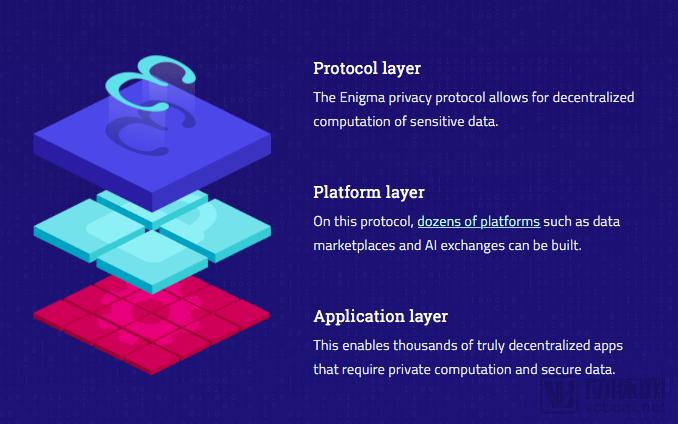
Currently, Enigma is a privacy protocol that can exist at the underlying layer of blockchain.
Enigma addresses blockchain scalability (the aforementioned case represents a form of blockchain scaling) and privacy issues (by employing the aforementioned encryption methods). Enigma’s “secret contracts” enable data to be processed by nodes within the Enigma network—whereas data cannot normally be processed directly on the blockchain—while maintaining confidentiality. Through this innovative architecture, the Enigma team has developed a series of truly decentralized and secure solutions for building innovative applications on the blockchain.
Catalyst is the first application built on the Enigma protocol. It is a revolutionary platform driving data-driven investment and research. Targeting users such as fund traders, cryptocurrency investors, and data managers, Catalyst enables them to share and organize data, thereby facilitating the development of profitable, data-driven investment strategies.
To protect traders' technical intellectual property, users can view traders' portfolios but not the specific strategy designs. Users can obtain accurate expected return rates based on official or other users' trading records, and can operate without needing extensive investment knowledge.
Melonport is also positioned as a digital currency asset management platform, with a current market capitalization of $47 million and an already launched application. The company regards Enigma as its primary competitor, but the Enigma team does not share this view. Enigma is built upon a mature data marketplace, whereas Melonport is still in the early stages of developing its own. Furthermore, unlike Melonport’s token, the Enigma token does not suffer from inflation.
Assuming that all individuals' medical and health data have been entered into Electronic Health Records (EHR), a market will inevitably emerge to meet the demand of various enterprises for different types of patient data.
If an individual or enterprise sells data to a third party, that third party can resell the purchased data. This cycle would gradually cause the entire market to collapse, as information continuously depreciates in value through repeated resale.
The Enigma team believes that only by employing privacy-preserving computation—thereby addressing the issue of data resale—can data providers in data markets retain true usage rights to their data. In response to these challenges, the Enigma team launched a distributed data market.
Enigma’s distributed data marketplace is still in the testing phase. The data marketplace allows individuals, companies, and organizations to contribute data, which users of the system can then subscribe to and utilize. Blockchain serves as the network’s controller, while the off-chain network handles all other operations.
According to estimates from Enigma’s official website, addressing the issue of genomic data trading could generate $10 billion to $50 billion in value.
Currently, gene sequencing companies have created a marketplace where users’ genomic data is sold to pharmaceutical companies. When users agree to the terms and conditions of such services, they transfer all rights to their genomic data to the gene sequencing company. Pharmaceutical companies then purchase this data to research associations between the genome and specific diseases.
However, such an industrial chain clearly has flaws. Due to the lack of communication channels between users and pharmaceutical companies, they are unable to incorporate patient habits (such as dietary habits, smoking, and alcohol consumption) into their analysis.
Meanwhile, the core concept of blockchain is to eliminate intermediaries in the transaction process, thereby enabling direct business interactions. If a decentralized code repository could be established, pharmaceutical companies would be able to conduct drug research more effectively, and users would also generate greater income.
Castilla, a Peruvian entrepreneur residing in São Paulo, Brazil, had the idea of an “Amazon Codebase” long ago.
The philosophy behind this codebase is to use blockchain to establish a bioinformatics database that aggregates biological data from the Amazon Basin.
Researchers further analyzed the commercial value of the Amazon River by tracking the flow of this biological information, such as who was using it and for what purposes.
Privacy and sharing of medical data have long been a perennial issue in internet healthcare. As the medical data industry has yet to mature, this should ideally be a research competition among scholars driven by practice and theoretical thinking; however, it remains mired in competition over medical data, with machine learning startups still needing to navigate lengthy non-disclosure agreements (NDAs) alongside healthcare providers.
If these NDAs could be transformed into smart contracts, healthcare institutions would be able to sell such data to machine learning startups or researchers.
Smart contracts come with built-in standardization features, ensuring data consistency. The transaction process naturally becomes a process of unifying medical data, thereby inherently addressing the current lack of standardization in Electronic Health Records (EHR).
Blockchain holds immense potential, but due to excessive hype, ICOs—originally intended for pre-selling services—have become traps, and the technology once poised to disrupt the internet has been reduced to a tool for speculators to raise quick money.
Blockchain itself requires upgrades, and it also needs more teams like Enigma to tackle technical challenges and leverage existing platforms to develop more dApps (existing dApps such as CryptoKitties are essentially speculative tools) to enrich the blockchain market, address scalability and privacy issues, shift from speculation to real-world utility, and unlock the true potential of blockchain.
References:
1. Shrier A A, Chang A, Diakun-thibault N, et al. Blockchain and Health IT: Algorithms, Privacy, and Data[C]//ONC/NIST Use of Blockchain for Healthcare and Research Workshop. Gaithersburg, Maryland, United States: ONC/NIST. August,8,2016.
2. Zyskind G, Nathan O, Pentland A. Enigma: Decentralized computation platform with guaranteed privacy[J]. arXiv preprint arXiv:1506.03471, 2015.
3.https://blog.enigma.co/why-enigmas-privacy-protocol-will-power-our-decentralized-future-aedb8c9ee2f6
4. https://blog.enigma.co/sneak-peek-enigma-data-marketplace-a25ff911e616
5.https://baijiahao.baidu.com/s?id=1591709373872465390&wfr=spider&for=pc
6.https://blog.enigma.co/we-are-launching-the-enigma-data-marketplace-a7d251ce0bfd
7. http://www.qukuaiwang.com.cn/news/2521.html
8. Jiang Yiquan, Ma Jinping. Obama Launches the Precision Medicine Initiative [D]. 2015.
9. Yang Mengjie, Yang Yuhui, Guo Yuhang. Research on the Current Development Status of Precision Medicine in the Era of Big Data[J]. China Digital Medicine, 2017, 12(9): 27-29.
10. Xi Lixian. Design and Implementation of the Biomedical Computing Platform CSF-OPAL [D]. Jilin University, 2011.