

Medicalchain and Groves Forge First Blockchain-Based Healthcare Payment Platform Following Successful $24M ICO
Medicalchain, a blockchain startup, gained significant attention following its initial coin offering (ICO) in early February this year. The company launched its ICO on February 1 and nearly immediately reached its $24 million cap. In March, Medicalchain partnered with the UK-based healthcare group Groves to establish a new blockchain platform, enabling 30,000 users of Groves Medical Centers to make payments using cryptocurrencies.
Medicalchain continues to forge ahead, relentlessly tackling the challenges facing electronic health information in the current stage.
Medicalchain aims to build a platform that supports the development of other digital health applications, which will be driven by health data and secured through smart contracts. This platform can address the various shortcomings of electronic health records at the current stage.
At present, a large number of electronic health records lack interoperability, and patients lose control over their data once they provide it to providers. If patients need to access their medical records, they usually have to apply to their service providers and pay related administrative fees.
If patients consent to providing their data to Medicalchain, Medicalchain will provide nodes for data storage free of charge. Once this is completed, patients can use the Medicalchain application to decide whether to grant access, without incurring any additional administrative fees. If patients lose access to their data or need to send a copy of the original data, Medicalchain also offers a free download service.
By leveraging data-compliant storage nodes and borderless blockchain technology, users can carry their health records with them while traveling. As telemedicine enables consultations with clinicians across different countries, healthcare services are becoming borderless—a development particularly beneficial for frequent business travelers and international tourists.
Medical errors are the third leading cause of patient death, with millions of people worldwide dying from medical errors each year. The most common cause of medical errors is physicians’ lack of access to complete patient information; missing data may include critical medical history that cannot be overlooked. Such information may reside in other databases or may have already been destroyed.
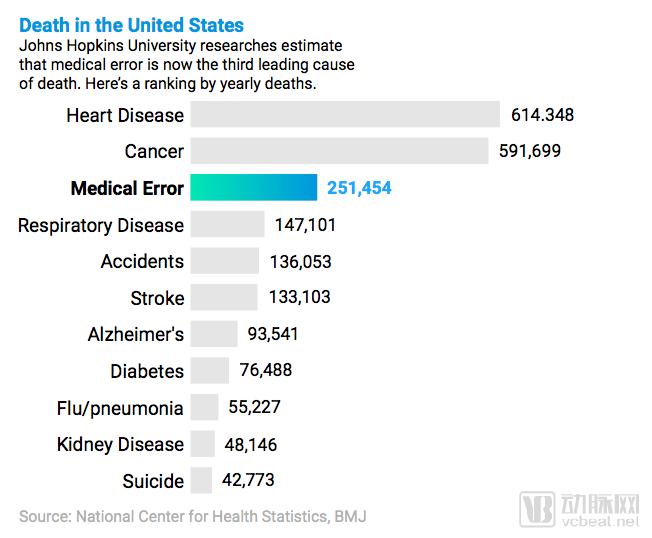
Causes of Death by Disease in the United States, 2016 (Source: Medicalchain White Paper)
Once healthcare data is recorded on the blockchain, Medicalchain can securely and comprehensively store patients’ personal information; patients can more easily access their own records; and physicians can access patient information across hospitals, regions, and even national borders. All of this will reduce deaths caused by medical errors.
By leveraging data-compliant storage nodes and borderless blockchain technology, users can carry their medical records with them while traveling. As telemedicine enables patients to consult with clinicians in other countries, healthcare services are becoming increasingly borderless. This is particularly beneficial for frequent business travelers and international tourists who wish to avoid the inconvenience of transferring their health records to new healthcare providers.
Current centralized data storage methods suffer from inadequate security and lack of standardized formats. Systems operate slowly, are rigid, and lack transparency. When claims arise, patients rely on their health plans to determine their out-of-pocket costs.
This process requires the negotiation of various complex agreements and the retrieval of electronic health records from multiple disparate systems; consequently, completing the entire claims process takes three to five weeks. By 2018, billing-related (BIR) costs are projected to reach $315 billion.
On average, the price of patient health information on the black market is ten times that of credit card numbers. Hospitals have naturally become primary targets for hackers, while traditional storage services struggle to ensure data security.
In fact, data breaches occur more frequently in the healthcare industry than in any other sector. Consequently, the insurance industry suffers significantly from data security issues and information asymmetry. The Federal Bureau of Investigation estimates that annual insurance fraud amounts to approximately $40 million.
Medicalchain can encode various complex protocols into smart contracts. In the event of an insurance claim, the smart contract automatically processes compensation based on the type of incident and the amount involved. This programmatic design also prevents patients from committing insurance fraud, thereby eliminating fraudulent activities.
Medicalchain is attempting to develop a dual-blockchain architecture: the first blockchain, built on Hyperledger Fabric, is used to control user access to health records; the second blockchain, powered by an ERC-20 token on Ethereum, serves as the foundation for all applications and services on the Medicalchain platform.
Hyperledger Fabric is a type of permissioned, private blockchain where only authenticated doctors and pharmacists are granted access. Patients can control who accesses their information, the scope of the content accessed, and the duration of such access.
From a social and legal perspective, medical information is typically highly sensitive. Therefore, closed blockchains such as Hyperledger Fabric help preserve the necessary privacy required for such applications.
Dr. Abdullah Albeyatti is the CEO and founder of Medicalchain, as well as a renowned physician. His time spent within the NHS left a profound impression on him. In his professional practice, he deeply felt the inefficiencies of the healthcare system and the poor communication between doctors and patients. Consequently, he came to recognize that blockchain might be the only means to address these prevailing issues.
Mo Tayeb, co-founder of Medicalchain, previously led the growth of morethan.com, one of the UK’s largest personal insurance companies. During this period, Mo built and developed a system to reduce online fraud, saving the company over £40 million.
Currently, the Medicalchain team comprises a total of 22 members, including a range of physicians and medical experts, as well as IT professionals and developers. Six of them have experience working in the NHS, and each member possesses strong professional expertise.
Dr. Abdullah Albeyatti’s prior experience with the NHS has facilitated collaboration between Medicalchain and the NHS. Currently, only a small number of NHS hospitals are piloting Medicalchain’s digital system, but as the technology advances, the number of such collaborations is sure to grow rapidly.
In 2017, University Hospital Lewisham and Queen Elizabeth Hospital began using Medicalchain’s technology.
Medicalchain now boasts an impressive roster of partners, including Hyperledger, Coinsilium, the Linux Foundation, and the NHS.
Blockchain applications remain immature, and the credibility of future valuations is insufficient; therefore, only a handful of enterprises have leveraged blockchain technology to enter the healthcare sector. Currently, other companies attempting to build blockchain-based healthcare ecosystems include MediBloc and Medishares.
Medishares is a decentralized, open-source mutual assurance contract market built on Ethereum, designed and developed by the Medishares Foundation, a non-profit organization based in Singapore. The company had originally planned to conduct an Initial Coin Offering (ICO) in China on September 8, 2017. However, following joint regulatory intervention by seven Chinese government ministries that classified ICOs as suspected illegal fundraising, the offering was fully suspended in September 2017 due to changes in the legal landscape.
MediBloc is a blockchain-based healthcare ecosystem that launched with the South Korean and Chinese markets as its starting points and has conducted three initial coin offerings (ICOs). The third ICO commenced on November 27, 2017, and concluded on December 15, 2017. This round presold tokens worth $300 million, achieving 71% of its target upon completion. To date, the token remains non-tradable.
In contrast, Medicalchain’s ICO proceeded very smoothly. Although the preparation for this ICO was insufficient, the company almost immediately reached its $24 million ICO cap after launching on February 1. Investors’ recognition of Medicalchain’s ICO affirmed its strength.
Medicalchain excels at leveraging the advantages of media. Its team frequently engages with users and answers their questions through YouTube and Twitter. It has now established a robust user community, with up to 200,000 members.
In early March, Medicalchain partnered with the UK-based healthcare group Groves. Following the launch of its medical blockchain, nearly 30,000 patients were able to make payments using cryptocurrencies at four medical centers under Groves. This made Groves the first healthcare institution to adopt blockchain technology and accept cryptocurrency payments.
This pilot project is the first application developed under the Hyperchanger blockchain initiative, built on the Medicalchain platform. The platform enables patients to manage their healthcare services via blockchain technology and provides them with flexible telemedicine solutions.
This project will be launched in July 2018. Groves will create a free wallet for registered patients to store and manage their health records. The newly established platform will incentivize patients to use MedTokens, the cryptocurrency issued by Medicalchain, to pay for services such as telemedicine.
The complete Medicalchain platform is scheduled to launch in 2019. If this blockchain can resolve the aforementioned issues as described and gain acceptance among patients and institutions, its value will be immeasurable.
Judging from the recent ICO, observers can clearly see the hype surrounding blockchain concepts, but Medicalchain possesses its own solid fundamentals. After Medicalchain’s initial coin offering concluded, the price of its Medtokens surged, delivering a tenfold return to investors (with an individual participation cap of $5,000 in the ICO). Reportedly, Medicalchain’s ICO was the fastest fundraising event in the history of public cryptocurrency offerings.
Whether Medicalchain can continue to write its legendary story remains to be seen.
References:
1. Medicalchain whitepaper.2018.1
2. http://www.pcpop.com/doc/4/4455/4455377.shtml
3. http://news.chinabyte.com/45/14299045.shtml
4. https://medicalchain.com/zh/team/
5. https://icodrops.com/medibloc/
6. http://www.cngold.com.cn/zjs/20180123d1898n205728954.html
7.https://cryptoslate.com/introduction-medicalchain-blockchain-electronic-health-records/
8. https://icodrops.com/medicalchain/
9. https://youronlinerevenue.com/is-medicalchain-a-good-investment/