

Chuanghui Medical Files IPO Prospectus: Pioneering AI-Driven Tuberculosis Screening in Detention Facilities
A few days ago, news that Professor Kang Zhang, a Chinese-American scientist, had published his latest medical AI achievements in the journal Cell went viral on WeChat Moments. This paper once again demonstrates that AI-assisted imaging diagnosis for disease screening has been thoroughly validated in academia, with practical applications gradually being implemented both in China and abroad.
There are numerous medical AI startups in China, but most focus on addressing cancer through CT imaging or pathology. After conducting market research, Hangzhou Chuanghui Medical chose to leverage DR (Digital Radiography) imaging, starting with tuberculosis screening in correctional facilities to improve disease screening for key populations. VCBeat (WeChat ID: vcbeat) has provided follow-up coverage on this initiative.

There Is Both a Market and Demand for Early Screening in Key Populations
According to the World Health Organization (WHO) “Global Tuberculosis Report 2017,” tuberculosis is the ninth leading cause of death worldwide. In 2016, there were 10.4 million new cases of tuberculosis globally, and 1.7 million people died from the disease, making tuberculosis the leading cause of death among infectious diseases.
As an infectious disease, tuberculosis has also drawn significant attention from deputies to the Two Sessions. At the First Session of the 12th Hunan Provincial Committee of the Chinese People's Political Consultative Conference (CPPCC), Bai Liqiong, a member of the Hunan Provincial CPPCC Committee, Standing Committee Member of the Hunan Provincial Committee of the Chinese Peasants and Workers Democratic Party, Deputy Director of the Hunan Provincial Institute for Tuberculosis Prevention and Control, and Vice President of Hunan Chest Hospital, proposed including tuberculosis screening for new students in school entry medical examinations in the fiscal budget.
Bai Liqiong stated that China is the third highest-burden country for tuberculosis (TB), with over 900,000 reported TB cases annually. Hunan Province is a high-incidence region for TB, reporting more than 50,000 cases of active pulmonary tuberculosis each year, ranking fourth nationwide in terms of reported case numbers. Students are a high-risk population for TB; between 2011 and 2015, there were 32 clustered TB outbreaks in schools across China. In Hunan Province, nearly 1,500 student cases of pulmonary tuberculosis are reported annually.
In August 2017, dozens of students from Class 364, a key senior-year class at Taojiang County No. 4 Middle School in Hunan Province, contracted tuberculosis. However, this cluster outbreak of tuberculosis on campus did not come to public attention until October 22, when a student exposed the incident on Weibo. Following the exposure, the parties involved issued contradictory statements and shifted blame onto one another, turning the incident into a Rashomon-style controversy centered on the question, “Who exactly delayed and covered up the outbreak?”
As of November 2017, 29 confirmed cases and 5 suspected cases of pulmonary tuberculosis had been identified, with 38 individuals receiving preventive medication.
The occurrence of clustered tuberculosis outbreaks in schools not only affects the physical and mental health and academic performance of infected students, but also has adverse impacts on their families, school teaching order, and social stability. Bai Liqiong introduced that tuberculosis prevention and control in schools has become the top priority of current TB prevention and treatment efforts. Tuberculosis screening for new entrants is the primary barrier in preventing student tuberculosis and a key measure to curb tuberculosis epidemics in schools.。
Tuberculosis is caused by bacteria (Mycobacterium tuberculosis) that frequently infect the lungs, and approximately one-quarter of the global population has latent tuberculosis infection. Therefore, it is essential to conduct entry screening for students in high schools and institutions of higher education. Both the "13th Five-Year National Tuberculosis Prevention and Control Plan" and the "Specifications for Tuberculosis Prevention and Control in Schools (2017 Edition)" explicitly require tuberculosis screening for newly enrolled students entering schools and kindergartens.
Liang Xiaoxia, founder of Hangzhou Chuanghui Medicine, believes that tuberculosis is a highly contagious and severely destructive disease.To achieve the World Health Organization’s 2030 target of reducing the global tuberculosis mortality rate by 90%, priority should be given to periodic screening and prevention among key populations, as well as the treatment of multidrug-resistant pulmonary tuberculosis.
Imaging examination is an important screening tool for the diagnosis of pulmonary tuberculosis. In late 2017, the National Health and Family Planning Commission issued industry standards for the diagnosis and classification of pulmonary tuberculosis., the Diagnostic Criteria for Pulmonary Tuberculosis (WS 288-2017) clearly states: cases presenting with chest imaging features characteristic of pulmonary tuberculosis are classified as suspected pulmonary tuberculosis cases; those concurrently exhibiting clinical symptoms are designated as clinically diagnosed cases, with etiological and pathological findings serving as the basis for confirmed diagnosis.
"Notice of the General Office of the State Council on Issuing the National Tuberculosis Prevention and Control Plan for the 13th Five-Year Plan Period" describes key populations as follows: Conduct active screening among key populations, and incorporate tuberculosis screening into health examination programs for school entrants, individuals entering regulatory facilities (such as prisons, detention centers, administrative detention facilities, custody and education centers, compulsory isolation drug rehabilitation centers, and compulsory medical treatment facilities), and migrant populations.
Among these, the job responsibilities for regulatory agencies are as follows:: The Ministry of Public Security and the Ministry of Justice shall, in conjunction with the National Health and Family Planning Commission, carry out tuberculosis screening and treatment management for detainees in prisons, detention houses, administrative detention centers, custody and education centers, compulsory isolation drug rehabilitation centers, and compulsory medical treatment facilities; incorporate tuberculosis prevention and control knowledge into the job training and education programs for correctional officers and medical personnel in these facilities, as well as into the intake and daily education curricula for detainees.
Liang Xiaoxia told VCBeat,For key populations, the focus of prevention and control efforts in schools and correctional facilities lies in entry examinations (upon enrollment or incarceration), periodic health check-ups for students (or inmates), and screening of close contacts. Among these, the health check-ups conducted during schooling (or incarceration) are periodic, generally performed once a year. These efforts are carried out with professional guidance from local Centers for Disease Control and Prevention (CDCs) and provincial-level prison hospitals, funded by special national fiscal appropriations, and implemented in collaboration with social forces.. Chuanghui Medicine uses regular health check-ups in correctional facilities as its entry point into the industry, gradually expanding to school-based health examinations, and provides efficient and accurate tools and services for the prevention and diagnosis of tuberculosis among key populations.
DR is a routine examination method
The diagnostic criteria for pulmonary tuberculosis clearly specify two primary approaches for diagnosis: chest imaging and laboratory testing. Laboratory testing encompasses bacteriological, pathological, and immunological examinations.
Currently, in the regular health examinations for key populations, PPD skin tests are primarily used for students under 15 years of age in schools. For students aged 15 and above, as well as school staff, chest imaging screening is recommended. In correctional facilities, screenings are mainly conducted using mobile health examination vehicles equipped with digital radiography (DR) devices.
Regarding the product’s positioning in chest DR, Liang Xiaoxia stated that chest DR imaging is one of the primary applications of digital radiography (DR). Chest DR primarily addresses pulmonary conditions, including pneumonia, pulmonary nodules, and pulmonary tuberculosis, while also enabling the diagnosis of certain cardiac disorders such as cardiomegaly. Currently, Chuanghui Medical’s diagnostic focus is on pulmonary tuberculosis, with ongoing development of diagnostic capabilities for pulmonary nodules, common pneumonia, and cardiomegaly.
Furthermore, given China’s current national conditions, digital radiography (DR) offers a high cost-effectiveness ratio and is widely installed, making it a routine modality in health screenings. Meanwhile, due to the characteristics of locations where key populations are concentrated, mobile health screening vehicles equipped with DR systems possess incomparable advantages in terms of disease detection scope, convenience, cost-effectiveness, and accuracy.
The product is largely mature, and template cases are currently being established.
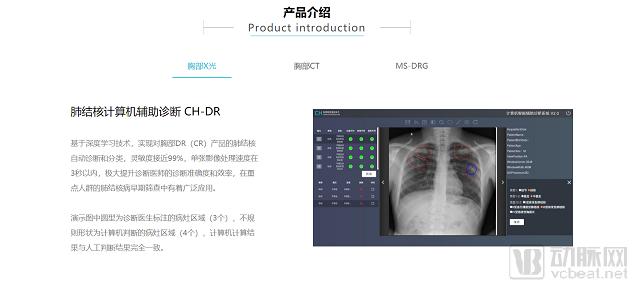
According to Liang Xiaoxia, Hangzhou Chuanghui Medical’s products are already capable of automated diagnosis using DR data. With current computing power, the system can rapidly and accurately annotate tuberculosis regions and classify tuberculosis types on a single DR image within three seconds.
In the previous phase, hybrid simulation testing of application scenarios (mixing 500 untrained DR cases with 9,500 healthy DR samples) yielded a current product sensitivity of 99.3% (based on learning from approximately 3,300 pulmonary tuberculosis DR cases) and a specificity with a false positive rate of around 16%. The next phase aims to reduce the false positive rate to below 5%. The product continues to undergo optimization as computational power increases.
Furthermore, in addition to automated tuberculosis diagnosis, Chuanghui Medical’s products incorporate features for physician correction and feedback on computer-generated results, as well as a physician-led annotation toolbar. Physicians can amend erroneous diagnostic outputs, and the model periodically undergoes retraining on misclassified cases to further enhance its performance.
According to Liang Xiaoxia, Chuanghui Medical’s current partner hospital is a provincial-level prison hospital. The hospital is responsible for tuberculosis screening among incarcerated individuals. Starting each year in March or April and lasting approximately six months, this initiative involves extensive image interpretation, placing an immense workload on the diagnostic physicians.
Given the unique nature of the patients they regularly treat and the heavy workload, hospitals have an urgent desire to leverage artificial intelligence technology to enhance operational efficiency and clinical diagnostic and treatment capabilities. . The research project on the application of AI in tuberculosis screening, jointly applied for by Chuanghui Medicine and its partner hospitals, has also been approved by the health authorities.
Liang Xiaoxia stated that the company’s products, deployed on mobile health examination vehicles, can rapidly diagnose acquired chest X-rays and generate template reports, with physicians reviewing and signing off on cases based on the AI screening results.
Early screening in correctional facilities constitutes the first step of the business model, aiming to efficiently and accurately support tuberculosis prevention and control efforts at partner hospitals and promote this model to prison hospitals in other provinces and municipalities.
The second step will gradually expand into the education sector, working in conjunction with disease control and prevention agencies to reduce the risk of tuberculosis outbreaks in schools. According to 2017 statistics from the National Bureau of Statistics of China, approximately 18 million new students enroll in high schools and universities each year, while teaching and administrative staff at all levels total 14.83 million.
Step 3 will involve active screening for tuberculosis in key provinces, remote areas, among migrant populations, and within priority enterprises.。
Four Major Competitive Advantages
Currently, although the domestic medical AI market in China remains a blue ocean, the relevant sectors have become quite crowded. Chuanghui Medicine chose to establish its company and enter this sector in August 2017, bringing its own unique strengths to the table.
Liang Xiaoxia stated that Chuanghui Medicine possesses the following advantages:
First,Chuanghui Medical is a domestic startup focused on DR diagnosis of pulmonary tuberculosis.Most domestic companies have started with pulmonary nodules in lung CT scans. Although tuberculosis has a certain temporal pattern in terms of fatality, it is highly contagious. The government continues to allocate funds for its prevention and control, indicating real-world application scenarios. In addition, the Global Fund’s aid to China for tuberculosis prevention and control expired in 2013, and the Chinese government has been continuously increasing its investment in domestic tuberculosis prevention and control efforts. As a country with a large population and a high burden of tuberculosis, China stands to benefit significantly from the efficient use of funds to carry out prevention and control work among key populations.
Second,Since last September, Chuanghui Medical has accumulated nearly 10,000 sets of digital radiography (DR) data for pulmonary tuberculosis, along with corresponding case records and follow-up data, and has completed data annotation in collaboration with partner hospitals.. In China, cases of pulmonary tuberculosis detected via digital radiography (DR) are relatively dispersed. Our partner hospitals have accumulated a substantial number of cases through routine health examinations in correctional facilities. By leveraging the annotation system developed by Chuanghui Medical, we have completed large-scale case annotation and model training, achieving industry-leading sensitivity and specificity.
Third,Chuanghui Medicine believes that application scenarios for AI in healthcare are more critical than algorithms and data; therefore, it has entered the market for periodic screening of key populations in tuberculosis prevention and diagnosis.In China, the large population of key target groups, high work intensity, and monotonous, repetitive diagnostic tasks create an ideal scenario for AI applications. Furthermore, when integrated with mobile health examination vehicles, this approach offers significant advantages in proactive screening programs, particularly in remote areas with limited transportation infrastructure and unique logistical challenges.
Fourth,Excellent corporate startup team.Co-founders Liang Xiaoxia and Zhang Ruizhi were undergraduate classmates in Biomedical Engineering at Huazhong University of Science and Technology. They later pursued graduate studies in France and the United States, respectively. Upon returning to China, they have long been engaged in product research and development as well as sales within the healthcare industry.
March 24 this year marks the 23rd World Tuberculosis Day. Chuanghui Medicine aims to provide advanced preventive diagnostic tools and work together with governments, research institutions, and healthcare organizations to advance the prevention and control of tuberculosis.
Currently, Chuanghui Medicine is seeking a new round of financing.