

AI in Medical Imaging Emerges as Capital Favorite: Who Will Get the First Bite of the Cake?
On March 19, another financing deal in the AI healthcare sector was announced: Infervision secured RMB 300 million in a new round of funding from investors including Xianghe Capital, Shangcheng Fund, Yuansheng Capital, Sequoia Capital, and Qiming Venture Partners. This marks Infervision’s fourth round of financing within two years, following its RMB 12.5 million angel round in February 2016. Infervision stated that the new funds will be continuously invested in the research and development, production, and international marketing of its AI medical imaging products.
Data shows that from 2013 to 2017, the AI healthcare industry in China secured a total of 241 domestic financing rounds. Currently, Chinese capital is primarily invested in four sectors: virtual assistants, medical imaging, medical robots, and intelligent health management. Among these, medical imaging has emerged as the most capital-intensive sector, accounting for the highest share at 31% and ranking first.
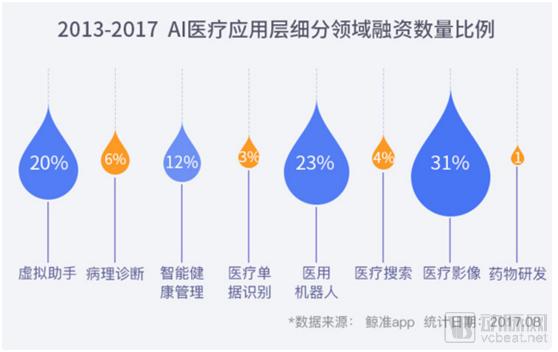
Capital Accelerates Its Inflow into AI Medical Imaging
“AI + Medical Imaging” is considered by many industry insiders to be the sector most likely to achieve commercialization first, with its financing amounts continuously setting new records. Notably, several significant funding rounds were concentrated in May and the second half of last year. In May 2017, Yitu Technology announced the completion of a C-round financing of RMB 380 million, led by Hillhouse Capital Group, with participation from Yunfeng Fund, Sequoia Capital, Gaorong Capital, and ZhenFund. In September 2017, Infervision announced the completion of a B-round financing of RMB 120 million, led by Qiming Venture Partners, with co-investment from Genesis Capital and Sequoia China. In October 2017, Huiyi Huiying announced the completion of a B-round financing amounting to “hundreds of millions of RMB,” with investors including Datai Capital and others. In December 2017, TomoDeep secured RMB 200 million in B-round financing, with investors including SoftBank China, Chende Capital, ZhenFund, and two other investment institutions.
In addition to highly specialized AI healthcare companies, the moves of internet giants are becoming increasingly prominent. In August 2017, Tencent launched its first AI medical product, “Miying,” primarily applied to early screening for esophageal cancer. Giants such as Alibaba and Baidu have also been actively deploying resources in AI healthcare, and their entry may directly influence the future landscape of this sector.
From Product to Market: A Race Against Time
For startups, time is often more critical than capital. In the healthcare industry, market positioning should be established during the product research and development phase. Although the products of these AI companies have not yet achieved full commercial implementation, they have already secured collaborations with hospitals both in China and abroad.
Taking lung nodule screening products as an example, according to data released by Infervision, as of February 2018, Infervision AI had provided auxiliary diagnosis for nearly 450,000 patients. Representative hospitals include Peking Union Medical College Hospital and Shanghai Changzheng Hospital. In the international market, Infervision has established three overseas branches in the United States, Japan, and Germany.
According to publicly available data from Huiyi Huiying, its image interpretation volume has exceeded one million. The company has integrated with more than 500 primary-care hospitals and over 200 top-tier Grade 3A hospitals.
Tumashenwei’s AI products have undergone multi-center data testing at numerous Grade A tertiary hospitals in Beijing, Shanghai, and Guangzhou, achieving a detection rate of 96.5%, and are currently integrated into more than 100 hospitals across China. The company has established R&D teams in Beijing, Suzhou, Shanghai, and San Diego (USA), and maintains long-term scientific research collaborations with multiple internationally renowned institutions, including Duke University Hospital.
It is worth noting that,Tumavis’s AI product is the only solution that strictly adheres to the NCCN Guidelines (the Clinical Practice Guidelines for Various Malignant Tumors, annually released by the National Comprehensive Cancer Network and widely recognized and followed by clinicians worldwide), providing support throughout the entire process of nodule detection, management, decision-making, and research. It is also the only product capable of offering benign-malignant analysis in lung cancer screening.. To date, it has provided diagnosis and full-chain health management for pulmonary nodules to over 900,000 patients.
As AI-powered medical imaging attracts capital interest, it also faces intensified competition and a heightened risk of being marginalized or acquired by industry giants. With the continued advancement of artificial intelligence technologies, various AI products are gradually reaching commercial viability. It is believed that truly professional AI enterprises that meet market demands will be the first to reap the rewards in the AI healthcare market.