

Alipay Announces Full Integration with Pharmacies, Offering Precision Marketing and Credit Loans
VCBeat (WeChat ID: vcbeat) has learned that on March 20, at the Ant Open Day pharmaceutical industry special session held in Qingdao, Ant Financial announced it would integrate and open up multi-dimensional capabilities—including marketing, finance, and credit—to the pharmacy industry.
Leveraging Internet Capabilities to Address Industry Pain Points
According to data from the China Food and Drug Administration (CFDA), there are currently 5,609 pharmaceutical chain enterprises in China, operating 220,000 pharmacies. According to Xiao Ran, General Manager of the Innovation and Intelligence Division at Ant Financial, the vast majority of these pharmacies support Alipay payments. “Our new initiative aims to open up multi-dimensional capabilities to the pharmacy industry, enabling deeper integration and providing greater support.”
Contrary to the common perception of pharmacies as mere “medicine sellers,” the product offerings of pharmacies in China have become increasingly diverse. According to a report by the renowned consulting firm BCG, with the advancement of comprehensive reforms separating medical services from pharmaceutical sales in China, prescription drug sales are increasingly being diverted to pharmacies. Today, pharmacy operations encompass a wide range of categories, including prescription drugs, over-the-counter (OTC) medications, health supplements, and cosmeceuticals, with their business model becoming progressively akin to that of the fast-moving consumer goods (FMCG) industry.
Currently, small and medium-sized chain pharmacies account for approximately 70% of China’s pharmacy market. In contrast to the fast-moving consumer goods (FMCG) industry, many of these pharmacies suffer from severely outdated marketing systems, still relying on 1980s-era tactics such as distributing flyers and placing newspaper advertisements. Their sales reach is largely confined to a three-kilometer radius, making their revenue highly vulnerable to external factors. In terms of inventory management, they rely on rough estimates based on experience, which frequently results in slow-moving stock and lost customers due to out-of-stock situations.
Xiao Ran noted that while products sold in pharmacies have their unique characteristics, retail capabilities common to the industry—such as membership programs and marketing—remain highly valuable in the pharmacy sector. “Traditional pharmacies generally lack a systematic marketing management framework. This gap can now be addressed by integrating with Alipay’s membership system. Once integrated, pharmacies gain access to user profiles and demographic tags, enabling scientific management of product assortment and inventory levels.”
Additionally, multiple pressures—including competition from large corporations, prolonged reimbursement cycles for medical insurance, rising rents, and capital shortages for store expansion—have made the need for loans and diversified revenue streams extremely urgent for small and medium-sized pharmacies.
Xiaoran stated that Ant Financial will provide fully automated, non-manual credit loans to small and medium-sized chain pharmacies to alleviate the difficulty of obtaining financing. Furthermore, by integrating with Zhima Credit, users with strong credit profiles can rent medical devices without paying a deposit. This approach not only reduces the financial burden on consumers but also enables retailers to increase revenue through flexible rent-to-own models.
Simcere Zaikang Chain Pharmacies was among the first pharmacy chains to join the Alipay membership system. A representative from its marketing department stated that by pushing discount coupons to customers through the Alipay membership platform, the current online coupon redemption rate has reached 40%, which is double the offline redemption rate.
Alibaba Health, a sister company, once launched the “Shared Pharmacist” initiative.
Alibaba has long been involved in the pharmaceutical retail sector. Not long ago, Alibaba Health, a sister company of Ant Financial, launched its “Shared Pharmacist” initiative, opening up its platform to provide third-party online pharmacist consultation services for community pharmacies. This enables offline pharmacies to offer consumers third-party pharmaceutical care consultations even when they face a shortage of in-house pharmacists.
Liu Hongbin, Head of Customer Experience at Alibaba Health, stated that Alibaba Health is currently providing third-party “Shared Pharmacist” services free of charge to owners of community pharmacies. Staff at offline pharmacies can consult licensed pharmacists online through the “Shared Pharmacist” portal in the Alibaba Health “Medicine Procurement” app, thereby helping brick-and-mortar stores promptly address customers’ medication-related inquiries.
It is reported that the platform currently has over 3,000 pharmacists holding national professional practice certifications, providing online consultation services to customers daily from 8:30 AM to midnight. Alibaba Health determines compensation based on the volume and quality of consultation services, with some licensed pharmacists earning nearly RMB 10,000 per month.
For pharmacies, Alibaba Health’s open shared pharmacist service can help improve service quality. This is particularly beneficial for small pharmacies in third- and fourth-tier cities and towns, where offline customers receive neutral, authoritative medication guidance and advice from a third party, thereby enhancing customer affinity and trust in the pharmacy.
Alibaba Has Fully Entered the Healthcare Industry
Jack Ma once stated that the next person to surpass him would certainly emerge from the health industry. He established the “Double H Strategy” for the group—Happiness & Health. Guided by this philosophy, multiple companies within the Alibaba ecosystem have made strategic inroads into the healthcare sector, including AliHealth, the flagship platform for big health; Ant Financial; Alibaba Cloud; and Yunfeng Capital.
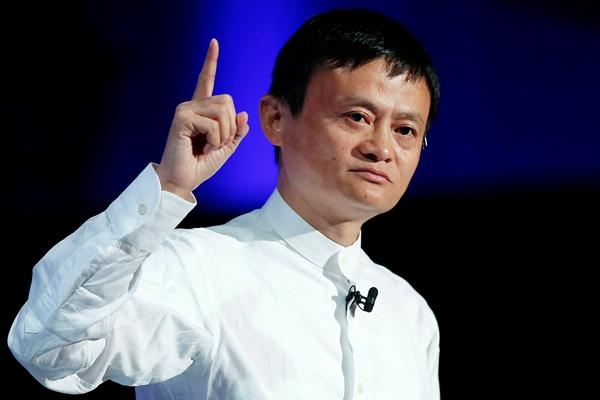
Jack Ma: The Next Person to Surpass Him Will Certainly Emerge from the Health Industry
Alibaba Health
In 2014, Alibaba Group, in partnership with Yunfeng Capital, made a strategic investment in the Hong Kong-listed CITIC 21 Century, acquiring more than half of its shares and establishing the flagship platform Ali Health. Over the three-plus years since its inception, Ali Health has gradually adjusted its business model, ultimately forming a business portfolio encompassing pharmaceutical e-commerce, smart healthcare, product traceability, and health management. Centered on these core pillars, Ali Health has undertaken numerous initiatives in recent years, including:
February 2018: Alibaba Health “Joins Forces” with AstraZeneca to Co-create a New Model of Smart Healthcare Services
On February 2, AstraZeneca, one of the top ten pharmaceutical companies worldwide, signed a strategic cooperation memorandum with AliHealth, a subsidiary of Alibaba Group, in Shanghai. Driven by new technologies such as the internet, artificial intelligence, and the Internet of Things (IoT), the two parties will jointly create new models of healthcare services to benefit more patients in China.
October 2017: Alibaba Health Partners with Three Prestigious Hospitals in East China to Explore AI Collaboration
At the Smart Healthcare Special Session of the Apsara Conference on October 13, Alibaba Health unveiled its latest advancements for the first time, announcing separate agreements with three hospitals—the First Affiliated Hospital, Zhejiang University School of Medicine (hereinafter referred to as “Zhejiang University First Affiliated Hospital”), the Second Affiliated Hospital, Zhejiang University School of Medicine (hereinafter referred to as “Zhejiang University Second Affiliated Hospital”), and Xinhua Hospital Affiliated to Shanghai Jiao Tong University School of Medicine (hereinafter referred to as “Shanghai Xinhua Hospital”)—to accelerate the implementation of smart healthcare solutions.
August 2017: Ali Health Launches Changzhou Blockchain Medical Consortium
On August 17, 2017, Alibaba Health announced a pilot project with Changzhou City to integrate medical consortia with blockchain technology. Alibaba Health has applied cutting-edge blockchain technology to the underlying technical architecture of Changzhou’s medical consortium system, achieving data interoperability among certain local medical institutions.
July 2017: Alibaba Health Officially Launches the “Doctor You” AI System
On July 11, 2017, Alibaba Health and Wanliyun jointly demonstrated a real-world scenario of human-AI collaborative remote diagnosis: “Doctor You,” the medical AI developed by Alibaba Health, integrates medical knowledge with artificial intelligence technology to automatically identify and flag suspicious nodules. This innovation enhances physicians’ work efficiency, reduces misdiagnosis and missed diagnosis rates, and effectively alleviates their workload.
Over the past year, “Doctor You” has continuously performed deep learning analysis of medical images for various diseases around the clock, leveraging big data technology. Currently, Alibaba Health’s CT pulmonary nodule detection engine has reached a world-class level in both performance and cloud service capabilities.
Ant Financial
Ant Financial is primarily building an open healthcare platform, aiming to become the infrastructure for the internet healthcare sector. All solutions corresponding to mature services will be fully opened to partners, including payment, security, data, as well as Ant Financial’s proprietary credit and anti-fraud capabilities. Partners can leverage these open capabilities to jointly create innovative and differentiated solutions.
As early as 2014, Alipay launched its “Future Hospital” initiative, formally entering the healthcare sector through an open-platform approach. The initiative comprises three phases. The first phase assists hospitals in establishing mobile healthcare systems by leveraging Alipay’s mobile platform capabilities, payment and financial solutions, and data analytics. In collaboration with various Independent Software Vendors (ISVs), it works with hospitals to build patient-centric smart healthcare platforms. This enables end-to-end mobile healthcare services—covering appointment registration, waiting room management, in-hospital navigation, payment, report retrieval, and doctor-patient interaction—thereby enhancing the overall patient experience.
Phase II aims to activate the entire healthcare service ecosystem. By aligning with the advancement of healthcare reforms, it enables all processes—including electronic prescribing, local medication delivery, patient referral, real-time medical insurance reimbursement, and real-time commercial insurance claims—to be completed online via the internet, thereby revitalizing the broader social healthcare ecosystem.
The third phase involves the joint development of a big data-based health management platform. By leveraging cloud computing capabilities and collaborating with wearable device manufacturers, healthcare institutions, and government health departments, we will jointly establish this platform to facilitate a shift from treatment to prevention.
In May 2017, Alipay, under Ant Financial, announced the launch of a one-stop “Medical Services” platform for individual users. In addition to integrating existing services such as appointment registration and clinical visits, the platform enables users to access 15 health management services, including health consultations, health information, maternal and child care services, and health-related financial products. This marks the entry of the “Future Hospital” initiative into its 3.0 phase.
Alibaba Cloud
In addition to its medical cloud services, Alibaba Cloud has launched a medical AI product called ET Medical Brain. Leveraging deep learning technology, it trains machines to perform specific tasks using massive datasets as examples. In simple terms, it enables computers to learn from case data to help physicians enhance their clinical expertise.
Yunfeng Capital
Yunfeng Capital primarily invests in the healthcare sector, with its portfolio including Wanli Cloud, GPC Baiyunshan, BGI Tech, and Haodf.com.
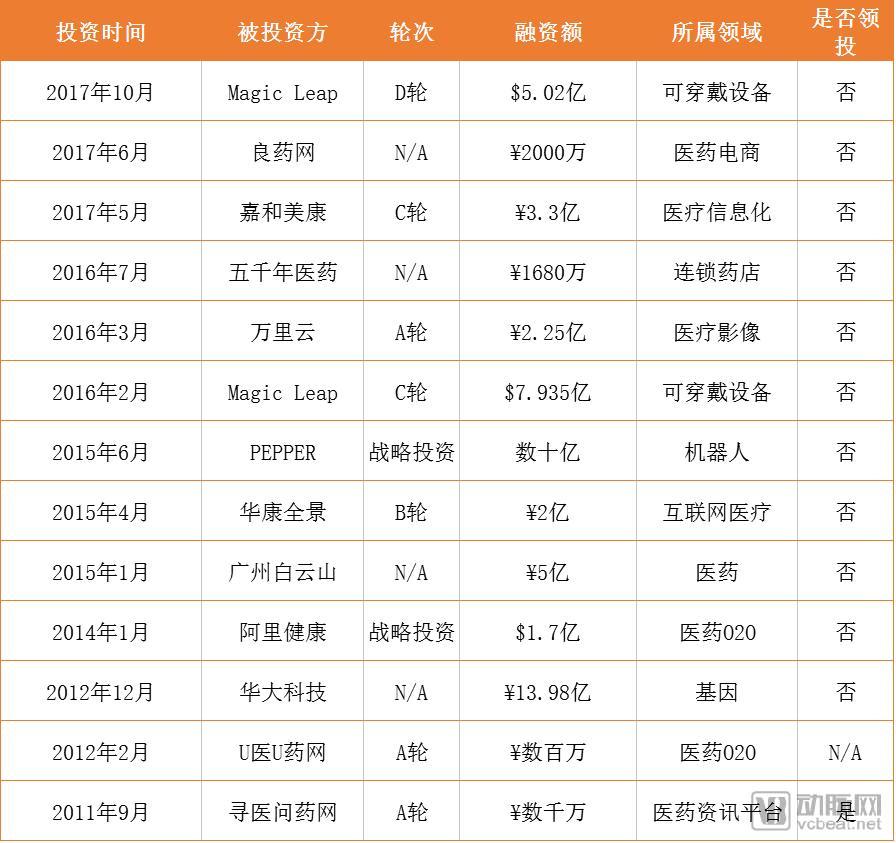
On March 12, iKang Healthcare Group, a leading private health checkup provider, announced that it had received an acquisition proposal from Yunfeng Capital and Alibaba Group. The proposed purchase price is $20 per American Depositary Share (ADS), or $40 per ordinary share. Industry observers noted that with Yunfeng Capital’s involvement, Jack Ma could integrate iKang into Alibaba’s existing healthcare ecosystem, thereby strengthening its strategic footprint in the medical and health sector.
With both physical entities and the support of internet technologies and tools, Alibaba’s investment layout in the healthcare sector is not to be underestimated and may significantly influence the future trajectory of the medical industry. Mr. Ma’s blueprint for the big health ecosystem is highly anticipated.