

Eight Key Highlights of the New Public Hospital Reform Regulations
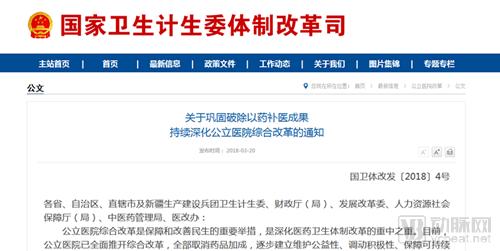
Reforms of public hospitals have never ceased. On March 20, the website of the National Health and Family Planning Commission released the “Notice on Consolidating the Achievements in Abolishing Drug Markup-Based Hospital Funding and Continuously Deepening the Comprehensive Reform of Public Hospitals” (hereinafter referred to as the “Notice”), which introduced a series of new measures to consolidate reform outcomes and further deepen reforms. The following key points warrant our particular attention:
All regions shall conduct phased summaries and evaluations of the comprehensive elimination of drug markups, carry out thorough and in-depth analyses of public hospital operations, assess whether the reform outcomes meet expectations, and ensure that the effectiveness of the reforms is clearly verified.
The central government continued to allocate funds from 2018 to 2020 to support the comprehensive reform of county-level and urban public hospitals. The evaluation and assessment of the effectiveness of public hospital reforms were carried out on an ongoing basis. Special subsidy funds for the comprehensive reform of public hospitals were distributed based on assessment results, with preferential allocation to populous counties and national-level poverty-stricken counties. Rewards and subsidies were granted to localities that demonstrated genuine efforts and achieved significant reform outcomes, while subsidy funds were reduced for localities with lagging reform progress.
Public hospitals at all levels and of all categories shall strictly provide services in accordance with their designated functional roles, and link the implementation of these functional roles and reform and development indicators reflecting public welfare nature to fiscal subsidies, medical insurance payments, compensation levels, total performance-based wage budgets, as well as the remuneration, appointment, removal, rewards, and penalties of hospital directors.
In 2018, hospitals under the administration of the National Health and Family Planning Commission and the National Administration of Traditional Chinese Medicine, along with 20% of public hospitals at Level II and above nationwide and 10% of privately run non-profit hospitals, completed the formulation of their articles of association. A performance assessment and evaluation mechanism for public hospitals oriented toward public welfare was established, and supervision of medical service quality and safety was strengthened.
Governments at all levels shall fully implement funding commitments for public hospitals in accordance with regional health planning, covering capital construction and equipment procurement, development of key disciplines, personnel training, expenses for retired personnel as stipulated by national regulations, and subsidies for policy-related losses. Special subsidies shall be provided for public health tasks undertaken by public hospitals, and funding shall be guaranteed for public services designated by the government, including emergency medical treatment, disaster relief, foreign aid, agricultural support, border region support, and paired assistance between urban and rural hospitals. Preferential funding policies shall be implemented for specialized hospitals, such as traditional Chinese medicine hospitals (ethnic medicine hospitals), infectious disease hospitals, psychiatric hospitals, occupational disease prevention and treatment hospitals, obstetrics and gynecology hospitals, children's hospitals, and rehabilitation hospitals.
In 2018, efforts will continue to curb unreasonable growth in medical expenses, gradually aligning the growth of medical costs with national economic development. Each locality shall scientifically set annual targets for controlling medical expense growth based on recent socioeconomic development and medical cost trends at the provincial, prefectural, and county levels. These targets shall be decomposed step by step to prefectures, counties (cities, districts, and divisions), avoiding a “one-size-fits-all” approach. In line with the functional positioning of public hospitals at all levels and types, their service provision, and the requirements for establishing a tiered diagnosis and treatment system, cost-control indicators shall be further broken down and assigned to each individual hospital, again avoiding a “one-size-fits-all” approach. Hospitals under the administration of the National Health and Family Planning Commission and the State Administration of Traditional Chinese Medicine shall be included in the local medical expense control framework.
Comprehensively implement a diversified, composite health insurance payment system with disease-based payment as the focal point. In 2018, the state uniformly identified more than 100 disease categories and provided guidance to localities for their implementation. Advance pilot programs for Diagnosis-Related Group (DRG) payment, and improve various other payment methods such as capitation and per-diem payments. Explore payment models suited to the characteristics of Traditional Chinese Medicine (TCM) services, and encourage the provision and use of appropriate TCM services. Establish an incentive and risk-sharing mechanism based on the principle of “retaining surpluses and sharing reasonable deficits,” thereby enhancing public hospitals’ motivation for self-management and cost control.
From 2018 to 2020, a new round of the Action Plan for Improving Medical Services was implemented to continuously enhance patients’ sense of gain in accessing healthcare. The promotion of medical service models such as appointment-based diagnosis and treatment, telemedicine, day surgery, and day chemotherapy was accelerated to improve the efficiency of medical services. Efforts were made to advance the construction of multidisciplinary collaborative care models, including Chest Pain Centers, Stroke Centers, and Trauma Centers, thereby ensuring seamless emergency green channels between pre-hospital and in-hospital care. Innovation in traditional Chinese medicine (TCM) diagnosis and treatment models was continued to optimize TCM services. Information technology was fully leveraged to facilitate the inquiry, push notification, and mutual recognition of examination and test results, while services such as mobile payment, bedside settlement for discharged patients, and point-of-care settlement for outpatients were introduced to make healthcare access more convenient and efficient for patients.
Designate a number of demonstration hospitals for the modern hospital management system to promote its broader implementation through pilot initiatives. All regions should actively carry out provincial-level demonstration work and increase support for national- and provincial-level demonstration areas and hospitals. Based on the evaluation and assessment results of the comprehensive reform of public hospitals, establish a mechanism for withdrawing demonstration status; demonstration areas and hospitals with slow reform progress or stagnant work shall be required to make corrections within a specified time limit, and those failing to implement adequate corrective measures shall have their demonstration status revoked.
Attached original text:
Notice on Consolidating the Achievements in Abolishing the Practice of Subsidizing Hospitals with Drug Profits and Continuously Deepening the Comprehensive Reform of Public Hospitals
No. 4 [2018] of the National Health Commission’s Document on System Reform
Health and Family Planning Commissions, Finance Departments (Bureaus), Development and Reform Commissions, Human Resources and Social Security Departments (Bureaus), Administrations of Traditional Chinese Medicine, and Offices of Healthcare System Reform of all provinces, autonomous regions, municipalities directly under the Central Government, and the Xinjiang Production and Construction Corps:
Comprehensive reform of public hospitals is a crucial measure to safeguard and improve people's livelihoods, and it constitutes the top priority in deepening the reform of the medical and healthcare system. Currently, comprehensive reforms have been fully rolled out in public hospitals, with all markups on drug prices abolished. A new operational mechanism is being gradually established to uphold public welfare, incentivize proactive engagement, and ensure sustainability, yielding significant phased achievements. However, the comprehensive reform of public hospitals is a complex systematic project involving profound adjustments to vested interests, and it still faces certain difficulties and challenges. In particular, the new operational mechanism for public hospitals needs to be consolidated and improved, coordination among the "three medical sectors" (medical care, health insurance, and pharmaceuticals) requires strengthening, reforms in key areas and critical links need to be deepened, and the motivation of medical personnel needs to be further stimulated. To fully implement the spirit of the 19th National Congress of the Communist Party of China, adhere to a people-centered approach focused on health and a problem-oriented strategy, completely eliminate the practice of subsidizing medical services with drug profits, and improve the modern hospital management system, the following notice is hereby issued regarding efforts to consolidate reform outcomes and continue to deepen reforms:
I. Consolidate and Improve the New Compensation Mechanism for Public Hospitals
All regions shall conduct phased summaries and evaluations of the complete elimination of drug markups, carry out comprehensive and in-depth analyses of the operational status of public hospitals, verify whether the reform outcomes meet expectations, and ensure that the effectiveness of the reforms is clearly demonstrated. For the reasonable revenue reductions incurred by public hospitals due to the elimination of drug markups, strict adherence shall be maintained to the compensation channels and proportions specified in the local comprehensive reform implementation plans for public hospitals, thereby achieving a smooth transition from the old to the new mechanisms and ensuring the sound operation of public hospitals. In light of the various reform policies outlined in the implementation plans, regions with inadequate implementation shall identify underlying causes, adopt targeted measures, and complete rectifications within specified timeframes. By the end of April 2018, all regions shall submit their summary evaluation reports and rectification measures to the State Council’s Office of Healthcare Reform. By the end of August 2018, all rectification measures shall be fully implemented.
To consolidate the achievements in abolishing the practice of subsidizing medical services with drug profits, the central government continued to allocate funds from 2018 to 2020 to support the comprehensive reform of public hospitals at the county and urban levels. The evaluation and assessment of the effectiveness of public hospital reforms were carried out on an ongoing basis. Special subsidy funds for the comprehensive reform of public hospitals were allocated based on assessment results, with preferential treatment given to counties with large populations and nationally designated impoverished counties. Reward subsidies were provided to localities that demonstrated genuine efforts and achieved significant reform outcomes, while subsidy funds were reduced for localities where reform progress lagged behind. When allocating subsidy funds, local authorities must take into full consideration the completion status of relevant evaluation and assessment indicators for public hospitals. Local governments at all levels should continue to increase their financial support for the comprehensive reform of public hospitals.
II. Fully Implement the Planning of the Medical Service System
All regions must strictly adhere to healthcare service system planning and resource allocation standards, rationally determine the number and scale of public hospitals, strengthen the binding force of planning, establish a high-quality, efficient, and vertically integrated healthcare service system, and promote the development of the tiered diagnosis and treatment system. Public hospitals at all levels and of all types must provide services in strict accordance with their functional positioning, linking the implementation of functional positioning and the achievement of public welfare-oriented reform and development indicators with fiscal subsidies, health insurance payments, compensation levels, total performance-based pay, as well as the remuneration, appointment, removal, rewards, and penalties of hospital directors. The establishment, renovation, and expansion of public hospitals, the increase in bed capacity, and the procurement of large-scale medical equipment, regardless of funding sources, must undergo strict approval, standardized management, and enhanced accountability in accordance with the requirements and procedures of regional health planning.
III. Improve the Modern Hospital Management System
Implement the “Guiding Opinions of the General Office of the State Council on Establishing a Modern Hospital Management System” (Guo Ban Fa [2017] No. 67), with all provinces formulating specific implementation plans by the end of July 2018. Strengthen Party leadership and Party building in public hospitals to ensure the correct direction of reform and development. Aimed at establishing a new operational mechanism for public hospitals that upholds public welfare, mobilizes enthusiasm, and ensures sustainability, and at improving a governance mechanism featuring coordinated, checks-and-balances, and mutually reinforcing decision-making, execution, and supervision, focus on effectively implementing the government’s lists of responsibilities and powers for sponsoring and regulating public hospitals, as well as the list of autonomous rights for public hospital operation and management. In 2018, hospitals directly under the National Health and Family Planning Commission and the National Administration of Traditional Chinese Medicine, along with 20% of public hospitals at secondary level and above nationwide and 10% of privately run non-profit hospitals, shall complete the formulation of their charters. Establish a performance assessment and evaluation mechanism for public hospitals oriented toward public welfare, and strengthen supervision of medical service quality and safety. Severely crack down on commercial bribery in pharmaceutical procurement and distribution, and resolutely rectify unethical practices in pharmaceutical procurement, distribution, and medical services.
IV. Fully Implement Government Investment Responsibilities
Governments at all levels shall fully implement funding commitments for public hospitals that align with regional health planning, covering capital construction, equipment procurement, development of key disciplines, personnel training, expenses for retired personnel in accordance with national regulations, and subsidies for policy-related losses. Special subsidies shall be provided for public health tasks undertaken by public hospitals, and funding shall be guaranteed for public services designated by the government, including emergency medical treatment, disaster relief, foreign aid, agricultural support, border region support, and paired assistance between urban and rural hospitals. Preferential funding policies shall be implemented for specialized hospitals, such as traditional Chinese medicine hospitals (ethnic medicine hospitals), infectious disease hospitals, psychiatric hospitals, occupational disease prevention and treatment hospitals, maternity hospitals, children’s hospitals, and rehabilitation hospitals.
V. Continuously Control the Unreasonable Growth of Medical Expenses
In 2018, efforts will continue to curb the unreasonable growth of medical expenses, gradually achieving coordination between the growth of medical costs and national economic development. Each locality shall scientifically set annual targets for controlling the growth of medical expenses, based on recent socioeconomic development and medical cost growth trends at the provincial, prefectural, and county levels. These targets shall be decomposed step by step to each prefecture-level city, county (city, district, and division), avoiding a “one-size-fits-all” approach. In light of the functional positioning of public hospitals at all levels and types, their service provision, and the requirements for establishing a tiered diagnosis and treatment system, cost-control indicators shall be further broken down and assigned to each individual hospital, again avoiding a “one-size-fits-all” approach. Hospitals under the direct administration of the National Health and Family Planning Commission and the State Administration of Traditional Chinese Medicine shall be included in the local medical expense control framework.
VI. Continuously Deepen Reforms in Key Areas and Critical Links
Continue to implement the “Implementation Opinions of the General Office of the State Council on Comprehensively Promoting Comprehensive Reform of County-Level Public Hospitals” (Guo Ban Fa [2015] No. 33) and the “Guiding Opinions of the General Office of the State Council on Pilot Comprehensive Reform of Urban Public Hospitals” (Guo Ban Fa [2015] No. 38), further enhancing the systematic, holistic, and coordinated nature of the reforms. In 2018, the proportion of pharmaceutical expenditures (excluding traditional Chinese medicine decoction pieces) in public hospitals nationwide, and the cost of sanitary materials consumed per RMB 100 of medical revenue (excluding drug revenue), continued to decline overall compared with the previous year. Meanwhile, the proportion of medical service revenue (excluding revenue from drugs, consumables, examinations, and laboratory tests) in total medical revenue continued to rise overall compared with the previous year.
(1) Deepen the reform of medical service pricing.Implement policies on medical service price reform. Building on the earlier removal of drug markups and concurrent adjustments to medical service prices, create fiscal space by standardizing clinical practices and reducing expenditures on drugs and consumables, thereby further optimizing and adjusting medical service prices. Ensure effective coordination with policies on health insurance payment, cost containment, and tiered diagnosis and treatment, so as to guarantee the sound operation of healthcare institutions, the affordability of health insurance funds, and no overall increase in the financial burden on the public. By 2020, gradually establish a dynamic price adjustment mechanism based on changes in costs and revenue structures, and basically rationalize the relative price relationships among medical services. Deepen reforms of medical service pricing methods, and further expand the scope and number of services covered by case-based payments and per-service-unit payments. Optimize and standardize existing medical service price items, accelerate the review and approval of new medical service price items, and promote the research, development, and application of new medical technologies. For high-value medical consumables of the same type with minimal quality differences and similar prices, explore their inclusion in bundled medical service payments and establish uniform medical service prices.
(II) Solidly advance the reform of medical insurance payment methods.Implement the "Guiding Opinions of the General Office of the State Council on Further Deepening the Reform of Basic Medical Insurance Payment Methods" (Guo Ban Fa [2017] No. 55), establish and continuously improve a medical insurance payment system that aligns with national conditions and the characteristics of medical services. Comprehensively promote a diversified and composite medical insurance payment method with a focus on diagnosis-related group (DRG) or disease-based payment; in 2018, the state uniformly identified more than 100 disease categories to guide local implementation. Advance pilot programs for Diagnosis-Related Group (DRG) payment, and refine other payment methods such as capitation and per-diem payments. Explore payment models suited to the characteristics of traditional Chinese medicine (TCM) services, encouraging the provision and use of appropriate TCM services. Establish an incentive and risk-sharing mechanism based on the principle of "retaining surpluses and sharing reasonable deficits," thereby enhancing public hospitals' motivation for self-management and cost control.
(3) Continuously deepen reforms in the field of pharmaceuticals and medical consumables.Implement policies to reform and improve drug production, distribution, and usage; adopt classified procurement for pharmaceuticals; and encourage cross-regional joint procurement as well as joint procurement by specialized hospitals. In 2018, all provinces must fully implement the “Two-Invoice System” for drug purchasing and sales, and promote data sharing, interconnection of clues regarding illegal activities, mutual recognition of regulatory standards, and mutual acceptance of enforcement outcomes. Implement centralized classified procurement for high-value medical consumables, and gradually extend the “Two-Invoice System” to their purchasing and sales. Establish and improve the supply guarantee system and mechanisms for shortage drugs to better meet clinical needs for rational medication.
(4) Expand the pilot program for reforming the compensation system in public hospitals.In accordance with the requirements set forth in the “Guiding Opinions on Launching Pilot Programs for Salary System Reform in Public Hospitals” (Ren She Bu Fa [2017] No. 10) and the “Notice on Expanding Pilot Programs for Salary System Reform in Public Hospitals” (Ren She Bu Fa [2017] No. 92), jointly issued by the Ministry of Human Resources and Social Security, the Ministry of Finance, the National Health and Family Planning Commission, and the State Administration of Traditional Chinese Medicine, we shall actively advance the pilot work. This effort aims to lay the foundation for exploring the establishment of a public hospital salary system that aligns with the characteristics of China’s healthcare industry and reflects knowledge-based value orientation, thereby stimulating the enthusiasm, initiative, and creativity of medical personnel and promoting the development of public hospitals.
VII. Comprehensively Implement Convenient and Beneficial Services for the Public
From 2018 to 2020, a new round of the Action Plan for Improving Medical Services was implemented to continuously enhance patients’ sense of gain in accessing healthcare. The promotion of service models such as appointment-based diagnosis and treatment, telemedicine, day surgery, and day chemotherapy was accelerated to improve the efficiency of medical services. Efforts were made to advance the construction of multidisciplinary collaborative diagnosis and treatment models, including Chest Pain Centers, Stroke Centers, and Trauma Centers, thereby ensuring smooth green channels for emergency care both pre-hospital and in-hospital. Innovation in Traditional Chinese Medicine (TCM) diagnosis and treatment models was continued to optimize TCM services. Information technology was fully leveraged to facilitate the inquiry, push notification, and mutual recognition of examination and test results, while introducing services such as mobile payment, bedside settlement for discharged patients, and point-of-care settlement for outpatients, making healthcare access more convenient and efficient for patients. Relying on regional population health information platforms, the role of information technologies such as the internet, big data, and artificial intelligence was utilized to bridge information gaps between medical institutions, achieve sharing of medical cards and diagnostic and treatment information, and form integrated medical services within medical consortia, thereby allowing information to flow more freely while reducing the need for patients to make multiple visits.
VIII. Strengthen Demonstration and Guidance
National demonstration cities, counties (cities, districts, and banners) for the comprehensive reform of public hospitals shall intensify their reform efforts, taking the lead in piloting initiatives and achieving breakthroughs in key areas and critical links. A number of demonstration hospitals shall be designated for the modern hospital management system to promote its establishment across the board through point-to-area expansion. All localities shall actively carry out provincial-level demonstration work and increase support for national- and provincial-level demonstration regions and hospitals. Based on the evaluation and assessment results of the comprehensive reform of public hospitals, a withdrawal mechanism for demonstration status shall be established; demonstration regions and hospitals with slow progress or stagnant work shall be required to make corrections within a specified time limit, and those failing to implement adequate corrective measures shall have their demonstration status revoked.
National Health and Family Planning Commission, Ministry of Finance
National Development and Reform Commission Ministry of Human Resources and Social Security
National Administration of Traditional Chinese Medicine Office of the State Council Leading Group for Healthcare Reform
March 5, 2018