

Huiying Medical Imaging Unveils Global Strategy Following Fourth Funding Round and IPO Filing
Since the launch of the “Belt and Road” Initiative, exchanges between China and other countries have become increasingly frequent.
On March 5, 2018, the 2018 Government Work Report explicitly proposed implementing a big data development initiative, strengthening the research and application of next-generation artificial intelligence, and advancing the “Internet Plus” strategy across multiple sectors, including healthcare and elderly care.
Over the past two years, as China’s medical AI technologies and products have gradually matured, some Chinese companies have begun to showcase their technical prowess internationally in pursuit of global expansion. To this end, VCBeat interviewed Li Kai, Head of Overseas Operations at Huiyi Huiying, to gain insights into the company’s current overseas development status, challenges, and strategic plans.
The Right Time for Overseas Expansion
![(T`3W{MAW(]OC$G83W[`U_N.png](https://cdn.vcbeat.top/upload/image/07/03/22/42/1521704531366663.png)
After more than two years of development, China’s medical AI market has made significant progress, particularly in the field of radiological imaging. Several companies, such as Huiyi Huiying, have completed Series B or Series B+ financing rounds, and multiple products are already being deployed in healthcare institutions.
In contrast, in overseas markets such as Israel, the United States, and the United Kingdom, most medical AI startups emerged in 2013–2014, two years earlier than their Chinese counterparts, with some benchmark companies having been established for five years. However, investment and financing activities in this sector are relatively less active than in China. Although foreign countries do not hold advantages over China in terms of data volume, market size, policy support, and application potential.
However, the pace of AI development abroad is also rapid, particularly among European and American enterprises. Their technological proficiency is already high, and some products are quite mature. The overlap with the development focus of Chinese companies is limited: Europe and the United States have made significant strides in new drug discovery, medical imaging, and electronic health records, while China has demonstrated particular prominence in medical imaging and radiomics.
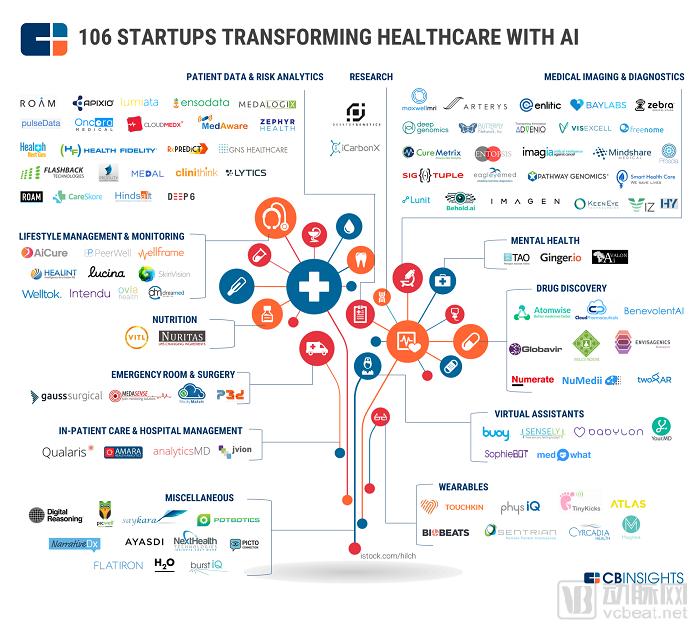
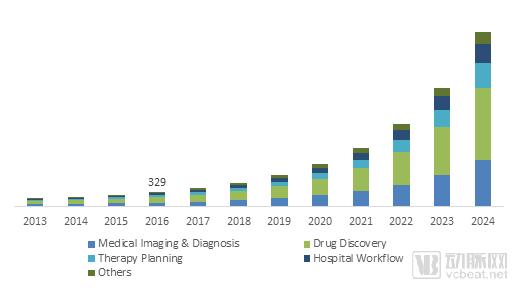
Imaging Diagnosis Accounts for an Increasingly Large Proportion
Li Kai told VCBeat that although there are some excellent medical AI companies in developed regions, many medical institutions have not yet had the opportunity to use these products due to regulatory policies. Moreover, no industry giants have emerged yet, which provides an opportunity for Huiyi Huiying to enter the market.
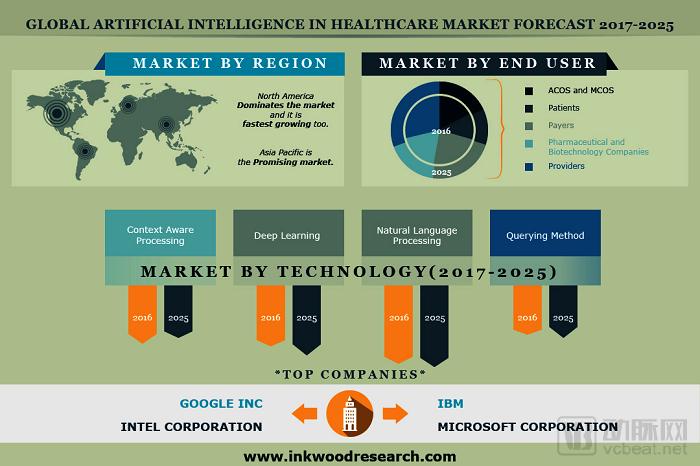
Global Medical AI Market Forecast
In underdeveloped regions or areas with scarce medical AI research, local healthcare institutions and health IT companies are highly interested in medical AI products. Due to the absence of local medical AI firms, they look to companies like Huiyi Huiying to help enhance the diagnostic and treatment capabilities of general physicians.
Diverse Development Models Across Different Regions
According to Li Kai, Huiyi Huiying’s expansion into overseas markets is primarily aimed at learning from leading international companies, collaborating with them to develop the global market, and introducing their advanced expertise and technologies to China.
United Imaging Systems employs two primary strategies to penetrate the market:
First,Participate in Academic Exchanges. For instance, Huiyi Huiying has established strategic partnerships with the Asian Oceanian Congress of Radiology, the European Society of Radiology, the Russian Association of Radiologists, and the African Society of Radiology.
Second,United Imaging Systems is preparing to identify and partner with the most prestigious medical research institute-level hospitals in each region., such as at Stanford University in the United States, and at medical universities in Japan, Russia, Germany, and other countries.
Throughout its development, United Imaging Systems has adopted different growth strategies tailored to various partners and regions.
First, leverage complementary strengths with leading local medical AI enterprises.
Li Kai told VCBeat,AI modules are typically designed around specific disease categories, with each company developing products based on its own capabilities. However, due to limited scale, most companies can only cover a dozen or so diseases. Rather than competing against one another, it is more beneficial for all parties to collaborate and jointly explore overseas markets.. Additionally, Huiyi Huiying will also assist these companies in conducting market research to determine whether their products meet the demands of the Chinese market.
Overall, Huiyi Huiying leverages overseas companies’ distribution channels to penetrate medical institutions, while these overseas companies enhance their product competitiveness by incorporating Huiyi Huiying’s solutions, thereby achieving a win-win outcome.
Second, provide customized products for customers
When expanding into underdeveloped markets along the “Belt and Road” routes, Huiyi Huiying tailors its product offerings to local conditions. In regions with robust health IT infrastructure, the company directly deploys AI-assisted diagnostic systems. In areas with limited digital foundations, it first introduces digital film solutions or imaging cloud services to help enhance the foundational capabilities of local hospitals.
During its development, Huiyi Huiying discovered that some regions lacked even the most basic medical equipment. In response, the company chose to negotiate with domestic device manufacturers to empower their equipment with artificial intelligence technology, delivering comprehensive integrated solutions. Li Kai emphasized that in recent years, large-scale medical devices manufactured in China have demonstrated significant advantages in both product performance and pricing. Through software-hardware collaboration, this approach not only enhances mutual competitiveness but also fundamentally addresses the scarcity of medical resources in underdeveloped regions along the “Belt and Road.”
Differences in certification and medical processes are the primary development challenges.
Overseas expansion has not been smooth sailing; Li Kai stated that differences in certification and medical procedures are the primary challenges in development.
1. Certification IssuesObtaining approval from government authorities is a prerequisite for market entry. Due to the current lack of experience and guidelines in certifying medical artificial intelligence (AI) across various countries, certification remains challenging. However, the recent FDA approval of several medical AI products is undoubtedly positive news for the industry. In expanding its overseas business, Huiyi Huiying conducts independent reviews for universal certification standards such as those of the FDA and CE. For non-universal certifications, such as those required in Japan and Brazil, Huiyi Huiying opts to collaborate with local partners to facilitate the certification process, thereby accelerating regulatory approval.
Second, physicians in each country employ different methods and procedures.To enter the market, Huiyi Huiying must strive to localize its platform. This involves translating product interfaces into local languages and arranging training to ensure high-quality maintenance, a process that requires significant time and manpower.
Currently, Huiyi Huiying’s products are available in Japan, France, Kazakhstan, the United States, India, Israel, and other countries. For instance, the company has signed a contract with the largest private hospital chain group in Kazakhstan; established collaboration with Japan’s largest cloud PACS provider on a radiomics platform; partnered with France’s leading oncology pharmaceutical company; and is jointly developing the U.S. market with an American medical AI company.
In the coming period, in addition to strengthening cooperation with countries along the “Belt and Road” initiative, Huiyi Huiying will seek more partners worldwide, striving to make medical AI another shining calling card for China.