

Medical Blockchain Report: Health Insurance Enterprises Lead in Implementation, Genomics Remains a Domestic Void
Blockchain was originally the foundation of the cryptocurrency Bitcoin. In scenarios where blockchain is integrated with practical applications, the majority are finance-related. “Transactions” on the Bitcoin blockchain represent financial transactions: records of transferring a specific amount of Bitcoin from one account to another. Anyone can verify which account holds specific Bitcoin by examining transactions on the public blockchain using appropriate software tools.
The financial sector’s inherent demands for data ledger integrity, security, and privacy protection align naturally with blockchain technology. In the healthcare field, there are also numerous application scenarios where blockchain can be leveraged. Recent media reports have highlighted the growing momentum of blockchain adoption in finance, while claiming that progress in the healthcare sector has been relatively slow. However, Winkelspecht points out that the healthcare industry was among the earliest adopters of blockchain technology.
In the healthcare sector, what information can be stored on blockchain to ensure security? The “transaction” component of healthcare includes records of specific events related to medical services provided, such as patient medical records, as well as internal hospital data, equipment exchange information, pharmaceutical distribution data, and health insurance contract details. These are critical pieces of information that require high levels of security and must remain tamper-proof. Healthcare institutions face challenges in securely sharing data across different platforms. Establishing robust data collaboration among healthcare providers helps further improve diagnostic accuracy, enhance treatment outcomes, and reduce healthcare costs. Based on blockchain technology, participants in the healthcare industry chain can share network access permissions without compromising data security and integrity.
The healthcare sector generates vast amounts of medical data, including patient chief complaints, vital signs, test results, medical history, disease diagnoses, prescriptions, medications, and surgical records. Although the digitization of these data has been largely completed, efforts in data sharing and data protection remain inadequate. Blockchain technology can help better utilize and safeguard this healthcare data.
After publishing a series of articles on blockchain technology, VCBeat has completed the collection and statistical analysis of enterprise data in the healthcare sector and released the “Healthcare Blockchain Industry Report.”
The full table of contents for the “Medical Blockchain Industry Report” is as follows. The complete report comprises 30,000 words, followed by excerpts from selected sections.
I. The core of blockchain is the establishment of trust relationships on the Internet
The essence of blockchain is a distributed chain-based database.
II. Components of Blockchain: “Blocks” and “Chain”
Block Structure
Chain Structure
III. Distributed Storage Ensures Data Consistency
Distributed Storage Is the Primary Driver of Decentralization
Each node is in an equal relationship.
From Decentralization to Weak Centralization
IV. Asymmetric Encryption Enables Identity Authentication and Resolves Trust Issues
Hash Algorithms Generate Blockchain Digests
What Is Asymmetric Encryption?
Asymmetric Encryption Solves the Authentication Problem in Blockchain
The Significance of Asymmetric Encryption in Healthcare Applications
Creating Secure and Trustworthy Care Records
Record the patient's consent
V. Smart Contracts Enable the Gradual Implementation of Blockchain Technology
Features of Smart Contracts
How Smart Contracts Work
Ethereum and Smart Contracts
Application Cases of Smart Contracts in the Healthcare Sector
VI. Consensus Mechanisms of Blockchain
VII. Practical Applications of Blockchain in Healthcare Systems
Applications of Blockchain Across Various Fields
Three Forms of Blockchain
Issues in the Practical Implementation of Blockchain Applications
Eight Practical Applications of Blockchain in the Healthcare Industry
VIII. Analysis of Domestic and International Healthcare Blockchain Enterprises
List of 62 Medical Blockchain Enterprises in China and Overseas
Medical blockchain companies mainly emerged between 2015 and 2017.
The Largest Number of Enterprises Developing Blockchain Infrastructure Technologies
Enterprises focusing on medical blockchain are often accompanied by ICOs
Health Insurance Companies Have the Fastest Product Launch Speed
Blockchain Genomics Companies Are Primarily Distributed Overseas
IX. Case Studies of Enterprises in Eight Major Healthcare Blockchain Sectors
VCBeat analyzed how enterprises apply blockchain in the healthcare sector and their ecosystem models, summarizing eight primary ways in which blockchain is integrated with healthcare.
1. Healthcare Data
Healthcare data falls into two categories: electronic medical records and disease data from formal clinical care, and health data collected via smart devices. These two types of data differ in terms of confidentiality and usage patterns, leading to distinct blockchain implementation models.
If medical records are viewed as a ledger, they were traditionally held by individual hospitals. Each hospital or health system maintains its own central institution to record, store, and transmit health data. Traditional centralized storage facilities have been considered the optimal approach for storing and processing such data. Although this model offers numerous advantages, it also has drawbacks.
Centralized storage is vulnerable to data loss, tampering, and attacks. According to data from the U.S. Department of Health and Human Services, 112 million medical records were compromised in 2015 due to hacking or IT incidents. In 2016, it was estimated that one-third of patients would become victims of data breaches. Blockchain’s public/private key access mechanism and distributed data storage have established a new paradigm for securing healthcare information.
The prevalence of traditional centralized architectures has also led to the widespread emergence of information silos in today’s healthcare sector. Only with the aid of blockchain technology can these information silos be broken down. The core of blockchain technology lies in its decentralized architecture, whereas the healthcare industry currently operates under a centralized system; therefore, inherent conflicts between the two are inevitable.
Moreover, patients do not have control over their own data, making it impossible for them to access their medical records and history. This creates significant obstacles when seeking medical care, as physicians are unable to obtain a comprehensive understanding of the patient’s medical history.
Now, if blockchain technology can be used to store health records and test data, a historical database of personal medical records will be established. Blockchain applications allow individuals and patients to take control of their own information. Diagnostic judgments, imaging, electrocardiograms (ECGs), sleep patterns, blood glucose levels, and other test data can all be retrieved and recorded on the blockchain. Whether for medical consultations or personal health planning, historical data will be available for use, with the true ownership of this data resting in the hands of the patients themselves, rather than any specific hospital or third-party institution. In the field of medical data,
Even when blockchain is used to store and record healthcare data, numerous challenges arise. The first issue is data bloat. Healthcare data is voluminous; if fully published on-chain, it would result in excessively large data blocks. Secondly, healthcare data requires privacy and confidentiality. On public blockchains like Bitcoin, where the ledger is visible to everyone, additional methods must be employed to encrypt and protect the data.
To address these two issues, the prevailing solution in most projects is to adopt a dual-data architecture. One component consists of raw medical data stored in an intranet database, while the other comprises a blockchain-based distributed database. This system integrates blockchain with Fast Healthcare Interoperability Resources (FHIR) API interfaces, restricting data output to only the summary information and event indices required for smart contract execution.
For example, if updated medical data triggers the execution of an insurance claim via a smart contract, the clinical care details associated with each claim can be stored as reference addresses on the blockchain while being served through FHIR-compliant APIs. Specifically, URL links to the clinical information are stored on the blockchain rather than the actual clinical medical data. Authorized users can then access the ultimate raw database through these addresses. This approach minimizes the sharing of sensitive data among nodes while still achieving interoperability and leveraging the advantages of blockchain technology.
In the field of health data, with improvements in living standards and a rise in the number of patients with chronic diseases, users have stronger demands for health management. Effective health management enables proactive disease prevention. As the health management process takes place outside hospital settings, data collection and vital signs monitoring rely on various smart hardware devices.
Health management operates within users' home and office environments, assessing health status and providing behavioral guidance by collecting monitoring data from wearable devices or other home-based testing equipment. Since personal health data is less sensitive and less centralized than medical data, it is more suitable for on-chain storage.
In this application scenario, smart contracts will be utilized for healthcare identification. In the event of an emergency, they can trigger alerts for potential critical health conditions and transmit relevant information to clinicians and family members. Additionally, these smart contracts can leverage health prevention resources to establish a locally accessible community health initiative.
The project offers numerous benefits to participants, such as organizing activities that promote individual or group health; leveraging IoT tracking to develop personalized preventive healthcare plans; managing care plans for acute and chronic conditions; providing monitoring programs tailored for the elderly; and handling emergencies while enhancing emergency medical care.
2. Genomic Data
Genomic data represents another domain in healthcare characterized by an extremely large volume of data, which is currently stored by third-party institutions. Genomic data holds significant value and provides substantial guidance for personal disease prevention, assessment of genetic disorders, and overall health status. Managing user genomic data via blockchain can facilitate the management of such data for contributors.
Users retain control over access to their genomic data, as well as the right to share or sell it. With user authorization, pharmaceutical companies, hospitals, and research institutions can access users’ genomic data from the blockchain. In return, users receive informational guidance on disease prevention, physical health status, personalized medication recommendations, and healthy lifestyle practices.
3. Medical Insurance
In the health insurance sector, patients, healthcare institutions, and insurers form a triangular relationship. Inefficiencies and service complexities are prevalent in every interaction. Multi-layered insurance intermediaries add unnecessary costs, while outdated information systems incur high labor and management expenses.
For insurance service providers, insurance costs are high, particularly administrative costs. Significant resources are devoted to contract execution and management, database maintenance, payment and collection processing, claims verification, and documentation review. Data show that in 2018, U.S. billing and insurance-related (BIR) activity costs will reach $315 billion, representing an increase of more than 100% compared with 2007.
For patients, most individuals and their families are filled with uncertainty and fear when facing medical bills and third-party reimbursement processes, while the complexity of insurance claims makes the procedure lengthy. Meanwhile, malicious frauds such as sales misrepresentation and insurance scams may also exist in insurance practices due to information asymmetry.
For healthcare institutions, a considerable amount of time each year is also spent on insurance reimbursement processes, organizing medical records, and undergoing audits by insurance service providers and government authorities.
Currently, small-amount medical insurance claims typically require policyholders to pay medical expenses to hospitals upfront and then obtain the relevant expense documentation from the hospitals. Subsequently, policyholders submit these documents to insurers to file claims and receive reimbursement. This time-consuming system exists because insurers cannot immediately access medical data due to concerns over data breaches. Immutable blockchain platforms can provide better and more secure data services.
Claims payment and adjudication is a highly complex process involving substantial administrative overhead and manual workflows to verify that all stakeholders comply with the agreed-upon terms in contracts. The vast majority of claims are not complex and can be processed through a fully automated workflow using relatively simple logic.
Blockchain technology distributes data records across the blockchain, ensuring the integrity and immutability of insurance data, thereby preventing contractual disputes. The process continues automatically even without a payment request from the policyholder. Since hospital medical expense details and insurance contracts are verified automatically, claim payments are processed in the same manner.
Blockchain platforms established between insurance companies and hospitals will enhance process efficiency and reduce payment processing time. Hospital staff can verify policyholders’ insurance information through a shared ledger with insurers. Insurance companies receive relevant documents automatically transmitted by hospitals and subsequently disburse claims to policyholders. The entire insurance sector is inherently well-suited for blockchain technology, with health insurance representing the most extensively applied, diverse, and complex category within this domain.
4. Healthcare Professional Identity Authentication
Globally, the world is facing a shortage of qualified healthcare professionals. Generally, the professional identity of a healthcare worker comprises a complex set of data points, including their medical educational background and nationally certified medical practice credentials, among other information.
The reliability of healthcare professionals’ identities and credentials is a primary factor in ensuring patient safety and high-quality care. However, verifying the identities and credentials of healthcare personnel involves numerous stakeholders, is time-consuming and costly, and imposes additional financial strain on an already overburdened healthcare system.
5. Drug Anti-Counterfeiting
According to estimates by the U.S. Department of Commerce, the global market for counterfeit drugs is valued between $7.5 billion and $200 billion, with this illicit activity causing more than 100,000 deaths worldwide. A 2016 report by the European Union Intellectual Property Office estimated that counterfeit medicines cause annual losses of €10.2 billion to the EU pharmaceutical sector. This results in a 4.4% loss rate in legitimate pharmaceutical sales, directly eliminating 37,700 jobs within the pharmaceutical industry in the EU alone.
Current solutions track pharmaceutical logistics and verify authenticity using QR codes, RFID tags, or SMS notifications; however, these methods do not effectively prevent counterfeit drugs from entering the supply chain. Given the unique characteristics of pharmaceutical manufacturing, blockchain technology can be applied to production, sales, and related processes, integrating drug traceability and authentication into market supervision frameworks. When purchasing medications, consumers can share and upload personal data to transparently document the transaction, which is then cross-referenced with blockchain records to ensure drug legitimacy while meeting regulatory requirements.
Blockchain technology enables the recording of all logistics-related information and channel distribution data for pharmaceuticals in an immutable manner, thereby plugging supply chain loopholes and addressing the long-standing problem of counterfeit drugs. Furthermore, in the event of cargo interruption or loss, the data stored on the ledger provides all parties with a rapid means to trace shipments and identify the last entity that handled the goods.
6. Healthcare Supply Chain Finance
In the field of supply chain finance, blockchain has found its niche, and the medical supply chain is also experiencing new development in the era of “blockchain+.” For hospitals, the primary expenditure is procurement, including the purchase of medical equipment and pharmaceuticals. Around these two product categories, two distinct financial models have emerged: financial leasing and supply chain finance. Supply chain finance primarily revolves around the pharmaceutical distribution segment.
Blockchain technology provides oversight for the trusted transaction and management of accounts receivable, end-to-end traceability of transactions, and cross-institutional interoperability and mutual benefit. Meanwhile, practical applications can be expanded into areas such as equipment financial leasing, supply chain factoring, and pharmaceutical product traceability.
7. Clinical Trials
An article published in the Journal of Health Economics in 2016 reported that pharmaceutical companies spent over a decade and $2.6 billion to bring a single drug to market. This demonstrates that the costs, efforts, and time required for drug development are difficult to quantify. A significant portion of these costs stems from overly complex multi-institutional administrative and clinical trial management issues. Leveraging blockchain technology can facilitate the review and management of experimental data derived from multiple trial sites and patients, thereby reducing the costs associated with multicenter clinical trials.
8. Surgical Record
Medical records documenting surgical procedures are critically important; however, instances of tampered operative records have occurred in certain medical malpractice cases, and difficulties in presenting evidence and assigning liability frequently arise even in civil litigation. Blockchain technology can capture complete surgical records, and its immutability enables healthcare institutions to identify specific liable parties based on these records in the aftermath of medical incidents.
Healthcare blockchain companies were primarily founded between 2015 and 2017.
We have compiled statistics on a total of 22 domestic and 40 international companies involved in medical blockchain operations, describing the development of medical blockchain technology and these enterprises from perspectives such as their business models and corporate backgrounds.
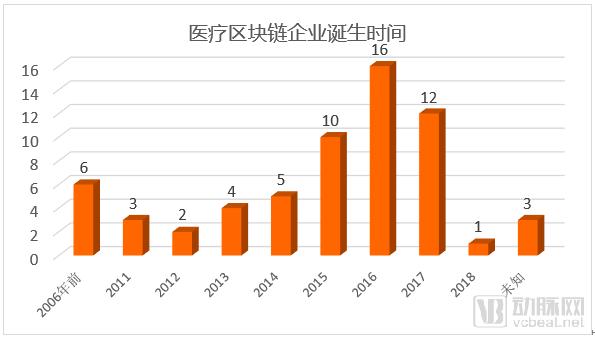
As blockchain is a relatively emerging technology, companies with blockchain as their core business have mostly been established within the past two years, with the majority founded between 2015 and 2017. Enterprises established during 2015–2016 were primarily focused on developing underlying blockchain technologies. Blockchain companies dedicated exclusively to healthcare emerged mainly in 2017, as this was when blockchain technology began to be gradually implemented in industry-specific applications, leading to the appearance of concrete projects in fields such as finance, healthcare, and insurance.
Domestic enterprises have been quick to adopt blockchain technology, covering a wide range of healthcare subsectors, with a significant number of companies engaged in foundational technology development.
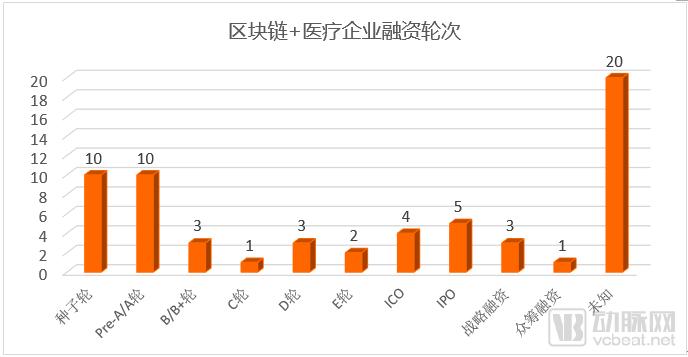
An analysis of corporate financing rounds reveals that a significant number of medical blockchain enterprises lack clear disclosures regarding their investment and financing information. Among those that have made such disclosures, the majority are at the seed or angel round stage. Companies that have progressed beyond Series C financing often secured funding based on their other business operations and have only recently entered the blockchain sector; this is particularly true for large enterprises that have already completed an initial public offering (IPO), such as IBM, Philips, and Nokia. These industry giants are keen to capitalize on emerging technological trends and are often more willing than small and medium-sized startups to engage with new technologies at an early stage to build up their technical reserves.
Notably, within the blockchain healthcare sector, four companies have conducted Initial Coin Offerings (ICOs), which are analogous to Initial Public Offerings (IPOs). ICO represents a specialized fundraising mechanism for blockchain enterprises, as these entities typically issue digital currencies or tokens—digital financial instruments inherent to blockchain technology. Since these digital assets hold market value and can be exchanged for fiat currencies, they help cover project development costs. However, as ICOs are illegal in China, all such enterprises operate overseas.
The Largest Number of Enterprises Developing Blockchain Infrastructure Technologies
We investigated the industry background of blockchain-plus-healthcare enterprises. Based on thematic categories, we classified them into the following domains.
1. Blockchain Technology Development Enterprises: Blockchain technology companies leverage their capabilities in IT development, cloud services, and more to offer blockchain-related services (BaaS, Blockchain-as-a-Service) to enterprise clients, including healthcare institutions.
2. Healthcare IT Companies: Former participants in the healthcare information technology sector have begun to develop blockchain-related services, offering clients more comprehensive blockchain solutions.
3. Healthcare Blockchain Enterprises: Startups in the healthcare blockchain sector, confined to the medical industry, with dedicated development focused on blockchain technology.
4. Insurance: Medical insurance service providers.
5. Blockchain Genomics: Companies Using Blockchain Technology in the Field of Genetics.
6. Healthcare Institutions: Healthcare institutions develop and apply blockchain technology to optimize traditional IT business processes, upgrade IT systems, and enhance healthcare operations.
7. Telecommunications: Companies in the telecommunications industry.
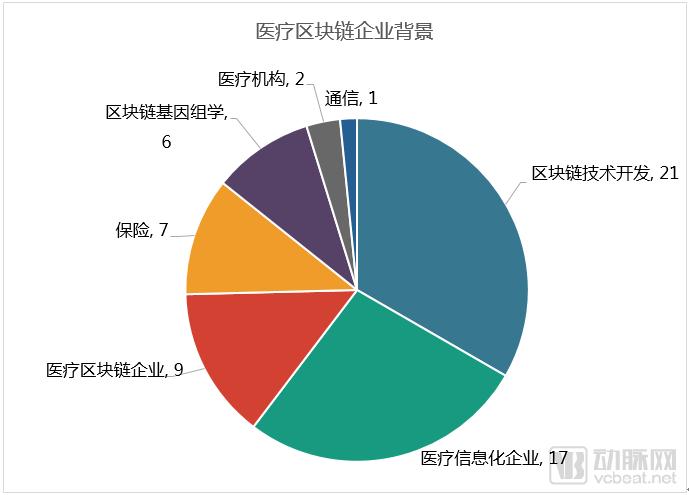
We have found that among these medical blockchain enterprises, the most numerous are those developing underlying blockchain technologies. Most of them entered the healthcare sector without prior background in the medical industry. These companies primarily focus on the development of core blockchain infrastructure and offer products tailored to various industry application scenarios, providing outsourcing or collaborative services. Healthcare applications represent just one of the outsourcing services these firms can deliver. Consequently, descriptions of their business logic, implementation methods within the healthcare sector, and blockchain data storage models tend to be rather vague.
The second largest group consists of companies originally from the healthcare informatics sector.
The products previously offered by such companies are precisely the centralized medical data storage systems that blockchain technology aims to disrupt. Under the influence of blockchain, they have begun to engage in the development of blockchain-based solutions, seeking to gain a first-mover advantage in the emerging decentralized era.
Because these enterprises have a clear understanding of the structure, sources, and flow of medical data, they are better able to design blockchain–healthcare data integration models that align with real-world application scenarios. According to research by VCBeat, although the overall pace of product deployment for blockchain applications in healthcare data has been less than ideal, companies with a background in healthcare informatics enjoy smoother communication with medical institutions and maintain an edge in R&D progress. In 2017, most companies were still in the R&D phase; by 2018, they had begun pilot implementations of the technology in hospitals. However, due to the sensitivity of medical data, significant obstacles remain before blockchain-based solutions can be fully deployed in practice.
Companies focusing on healthcare blockchain are often associated with ICOs.
Ranking third are medical blockchain enterprises. How do they differ from blockchain infrastructure technology developers (BaaS) and healthcare IT companies? The distinctions among these three types of enterprises may be difficult to grasp based on their names alone. In layman’s terms, blockchain infrastructure technology developers focus on underlying technology R&D and outsourced solutions, often crossing industry boundaries. Healthcare IT companies initially operated without blockchain technology, first developing healthcare information systems before later incorporating blockchain. In contrast, medical blockchain enterprises specialize in blockchain technology but limit their applications exclusively to the healthcare sector.
Medical blockchain companies are often newly established within the past two years, and their founding teams possess strong technical expertise in blockchain. Companies specializing in blockchain technology development provide technical services, while medical informatics companies and medical blockchain companies are responsible for implementing specific solutions. Medical blockchain companies typically operate in narrow business scenarios, have clear conceptualizations of business models within the healthcare sector, and are frequently associated with Initial Coin Offerings (ICOs).
Health insurance companies have the fastest product implementation speed.
We have collected data on seven blockchain-based medical insurance enterprises, representing the fastest avenue for the implementation of blockchain technology in healthcare scenarios. The five domestic companies all entered the blockchain insurance space by adopting the same model of crowdfunding for critical illnesses.
Insurance and blockchain are the most compatible sectors. The medical data volume required by healthcare institutions for critical illness crowdfunding models is manageable, and the insurance claims process is relatively straightforward. In traditional crowdfunding models, the verification of medical record authenticity is prone to exploitation; therefore, blockchain technology is needed to verify authenticity, ensure data integrity, and preserve evidence.
Blockchain Genomics Companies Are Primarily Located Overseas
The volume of genetic data in the field of genomics is immense, and three foreign companies have already begun to engage in the development of related technologies. The motivations and objectives of these enterprises are nearly identical: to transfer genetic data from institutions to the hands of users. Users can sell their genomic data via blockchain, while research organizations or companies can purchase large volumes of genomic data through blockchain, thereby facilitating the advancement of related research.
Among these companies, most founders are professionals in the fields of genetics or biology. For instance, one of the founders of Nebula Genomics is George Church, known as the “Father of Synthetic Biology,” the inventor of next-generation sequencing, and an early proponent of CRISPR technology. Two of the founders of Luna DNA are former executives at Illumina.
Healthcare + Blockchain Application Scenarios
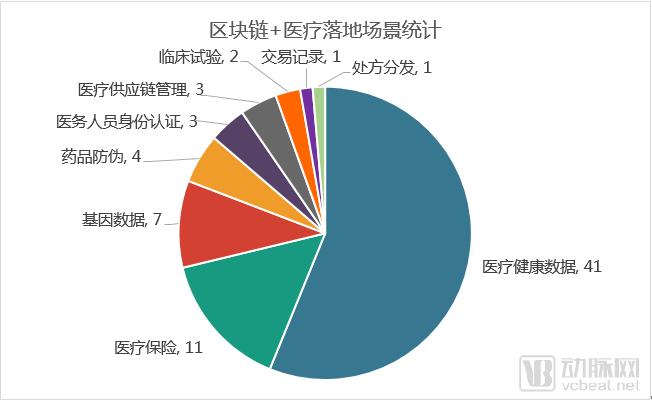
In the healthcare industry, the most prevalent application of blockchain technology is the use of distributed ledgers for recording health and medical data, with 41 companies involved in this space. This is because electronic medical records (EMRs) currently represent the segment with the most significant pain points, the easiest path to monetization, and the largest market share within healthcare informatization. Similar to the analysis of practical implementation scenarios for AI in healthcare, where medical imaging has become a highly competitive "red ocean" for artificial intelligence, health and medical data has emerged as the "red ocean" for blockchain-enabled healthcare solutions.
Eleven companies are participating in the medical insurance program. As previously analyzed, the integration of insurance and blockchain yields relatively straightforward outcomes, with smart claims processing significantly reducing costs.
Genetic data trading ranks third, with seven participating companies, all of which are overseas enterprises. They share a consistent approach: returning genetic data from medical institutions to individuals, thereby enabling the on-chain buying and selling of personal genetic data. Pharmaceutical companies and institutions requiring such genetic data can purchase it using tokens.
Other application scenarios involve limited enterprise participation, making these areas a blue ocean for blockchain-plus-healthcare applications. Fields such as pharmaceutical anti-counterfeiting and healthcare supply chain management feature clear business models, well-defined payers and participants, and strong demand for data authenticity and traceability. Companies seeking to explore blockchain applications in healthcare may consider establishing a presence in these sectors.
Scan the QR code below to become an official VCBeat member and gain access to the full version of the "Medical Blockchain Industry Report." Gain insights into blockchain technology and the strategic positioning of medical blockchain enterprises within the industry. Additionally, over the next year, you will enjoy unrestricted access to comprehensive industry trend reports, timely updates on global investment and financing activities, a complete database of healthcare companies, and extensive resource-matching opportunities.

Scan the QR code to become a VCBeat member