

Five Key Traits of Startups That Raised Over $100M in Just a Few Years | Featuring 39 High-Growth Companies
During the growth trajectory of startups, two extreme phenomena are observed: some companies toil for years only to secure meager seed funding, while others manage to raise substantial capital across multiple rounds within a few years and achieve rapid growth. According to Crunchbase data, many companies founded in 2015 or later have already secured over $100 million in financing.
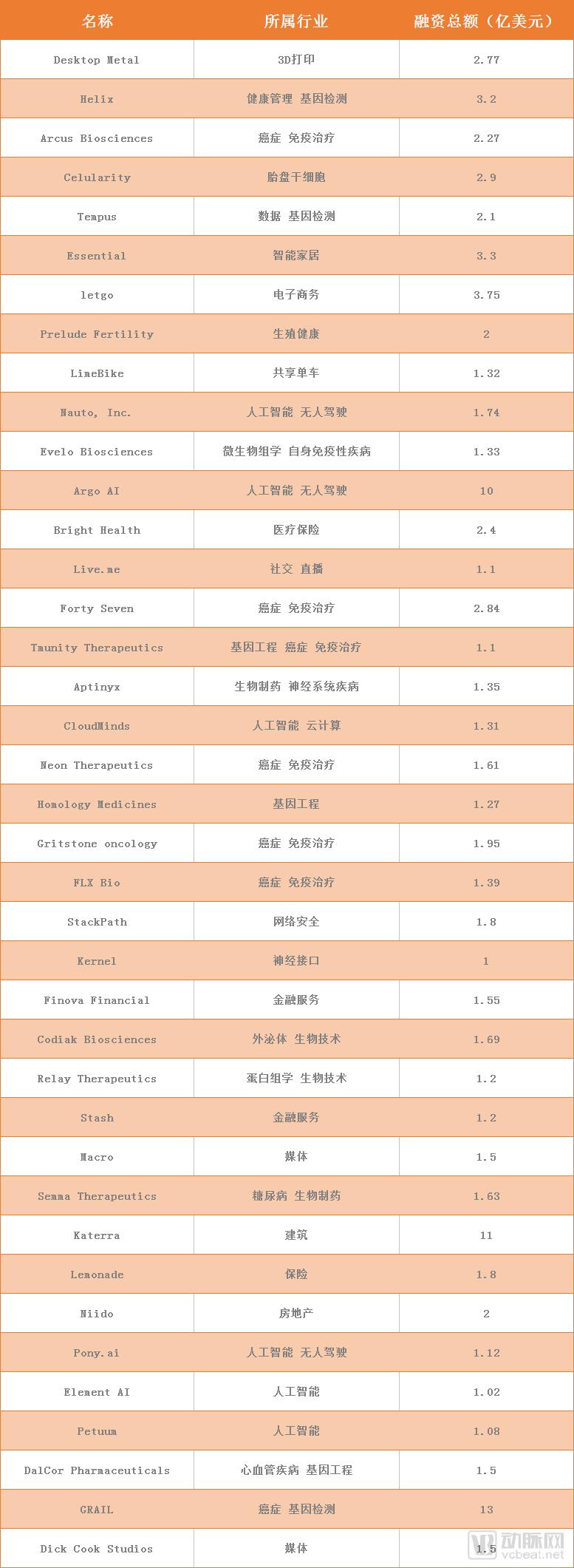
The following list comprises 39 companies we have selected as fast-growing enterprises this year (hereinafter referred to as the “Fast Companies” list). These companies span various industries, including autonomous driving, insurance, and oncology immunotherapy. While there appears to be no definitive formula for becoming one of these Fast Companies, an analysis of this cohort reveals certain commonalities among them.
Feature 1: Focus on Cancer Immunotherapy

For years, cancer immunotherapy has remained a hotbed for investment. By developing novel therapeutic technologies that harness patients’ own immune systems to destroy tumor cells, these companies have delivered satisfactory results in both clinical trials and investment returns.
Precisely for this reason, capital investment enthusiasm for tumor immunotherapy has not cooled over time. Among the most favored fast-growing companies, at least seven are engaged in immunotherapy research: Tmunity Therapeutics, Neon Therapeutics, Gritstone Oncology, Forty Seven, Arcus Biosciences, and FLX Bio—each of which has secured at least $100 million in financing within three years.
Additionally, there is a company called Celularity, which specializes in embryonic stem cell therapies and is also conducting applied research in tumor immunotherapy. Founded in 2016, the company has raised a total of $290 million in financing to date.
Not only immunotherapy, but the entire field of oncology research has become a hot spot for investment. We can see that oncology-related projects account for approximately one-quarter of the list. The primary investors in this sector are traditional venture capital firms, with participation also observed from corporate and charitable investors.
In addition to capital inflows, the field of tumor immunotherapy has also seen significant exits. For instance, in January 2018, the tumor immunotherapy company Juno was acquired by pharmaceutical giant Celgene, with the total value of the transaction reaching $9 billion. Five years prior, this Seattle-based company was established with venture capital support and went public two years later, achieving a valuation of several billion dollars at that time.
Feature 2: A Renowned Founder

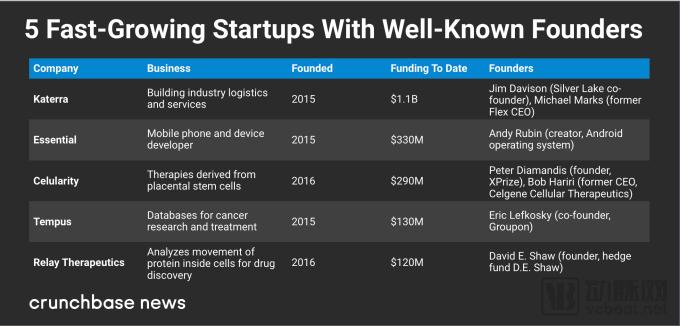
If a company’s founder is already a highly successful entrepreneur or enjoys significant renown within the industry, the company’s fundraising and development processes will be considerably easier, as seen with Katerra and Essential.
In January 2018, Katerra secured up to $865 million in financing led by SoftBank. The ability to secure such a substantial amount of funding was largely attributable to the company’s founders. Michael Marks, one of the founders, previously served as CEO of Flex, one of the world’s largest electronics manufacturing services providers. The other founder, Jim Davison, co-founded Silver Lake in its early years, the largest technology-focused leveraged buyout firm.
Essential is a startup engaged in the manufacturing of mobile phones and devices. The company was founded by Andy Rubin, former Vice President of Engineering at Google and the lead developer of the Android operating system. After leaving Google, Rubin established the company, which secured $330 million in investment within less than two years.
Below are the companies on the Fast Company list that were founded by well-known entrepreneurs:
Feature 3: The Autonomous Driving Industry

Talent Shortage in the Autonomous Driving Industry: Even Large Automakers Are Vying for Talent. Moreover, For Large Companies with Skilled Talent Needs, Tech-Savvy Startups Have Become Their Targets.
We identified three autonomous driving startups on the Fast Company list: Argo AI, Pony.ai, and Nauto. Among them, Pittsburgh-based Argo AI secured the most funding, receiving a $1 billion investment from Ford.
In addition to Argo AI, other companies have also secured substantial funding: Pony.ai, founded by Lou Tiancheng, raised $112 million in its Series A financing round in January; the company has built a platform that integrates autonomous vehicle sensors, software, cameras, and other technologies. Nauto, an AI-powered technology company specializing in connected camera solutions, recently completed a $175 million financing round.
Feature 4: Biotechnology Companies with Technology Platforms

Biotechnology companies are highly representative on this list, accounting for half of the entries. It is almost certain that biotech firms with proprietary technology platforms are in high demand.
Celularity, mentioned earlier, is a biotechnology company engaged in embryonic stem cell therapy research. It possesses its own technology platform capable of addressing areas ranging from tumor immunology to tendon repair. Similar examples include Grail, which secured $1.3 billion in financing within two years for cancer diagnostics; and Evelo Biosciences, a biotech company developing therapeutics based on microbiomics, which raised nearly $133 million over three years....
Despite the ongoing challenges faced by clinical trial and R&D companies, technology platforms have unlocked greater business possibilities for these firms, thereby enhancing their likelihood of success. Consequently, biotechnology companies equipped with such technology platforms are increasingly sought after by investors.
Feature 5: Engaging with ARCH Venture, SoftBank, and Celgene

By examining the investors behind these companies, we can observe that some of them have been very active.
Unsurprisingly, SoftBank bore the brunt. 2017 was a banner year for SoftBank. The company invested $10 billion to establish the Vision Fund, which is currently the world’s largest technology-focused fund. Additionally, five companies on Fast Company’s list are portfolio investments of SoftBank.
Likewise, companies in the biotechnology sector cannot afford to be unaware of ARCH Venture Partners, four of whose portfolio companies have made the list.
It is quite surprising to see Celgene on the list of active investors. In addition to being one of the largest acquirers of mature companies, it is also a significant strategic investor. The company has invested in four firms on the list, among which Celularity represents another expansion by Celgene into the stem cell field.
Where Will Future Fast Companies Come From?
In the 2018 list, we can see two insurance companies: Lemonade and Bright Health. In recent years, the insurance industry has been an active sector for early-stage deals in North America, and it is possible that high-caliber, influential companies will secure substantial funding in the future.
Furthermore, the biotechnology sector is likely to remain the most heavily represented among companies on the fast-growing list. Human demand for healthcare is continuous, and many diseases still lack effective treatments or require better therapeutic solutions. Since biotechnology research aims to address these unmet needs, investment in this field is expected to remain robust.