

BAT's Overseas Healthcare Investment Landscape: Tencent Backs 14 Early-Stage Startups, Baidu Makes 3 Bets, Alibaba Treads Lightly
As the three most successful companies in China’s internet sector, BAT has leveraged its sophisticated financial strategies and substantial resource reserves to expand aggressively across the domestic internet landscape, aiming to build its own “ecological empire.” Data shows that 80% of the top 30 new elites in China’s internet industry are backed by BAT.
As globalization accelerates, the BAT companies (Baidu, Alibaba, and Tencent) have begun to expand into international markets, with overseas investment serving as a key strategic priority. In terms of investment logic, Baidu and Alibaba adhere to their core strategic lines: the former favors artificial intelligence and autonomous driving, while the latter focuses on consumer sectors such as clothing, food, housing, and transportation. In contrast, Tencent has fully adopted an “investment banking” model, collaborating with top-tier global investment firms such as Sequoia Capital, Y Combinator, and NEA to pursue a diversified investment portfolio, with healthcare startups representing a major focus area.
VCBeat (WeChat ID: vcbeat) has mapped out the overseas healthcare investment strategies of BAT, focusing on their investment logic and subsequent moves.
Baidu Prioritizes Technology, Alibaba Focuses on Consumer Entertainment, and Tencent Has Extensive Reach
BAT’s overseas investments have continued their robust momentum seen in China. According to Crunchbase data, in 2017, Baidu made six overseas investments, Alibaba ten, and Tencent twenty.
Among them, Tencent has the broadest investment scope, with investments spanning the United States, Canada, Germany, Thailand, India, and other regions, covering sectors such as artificial intelligence, culture and entertainment, finance, e-commerce, and healthcare. Alibaba primarily focuses its investments on Southeast Asia, mainly in the fields of e-commerce and new retail. Baidu’s investment efforts are chiefly directed toward the United States, with a focus on enterprise services and artificial intelligence.
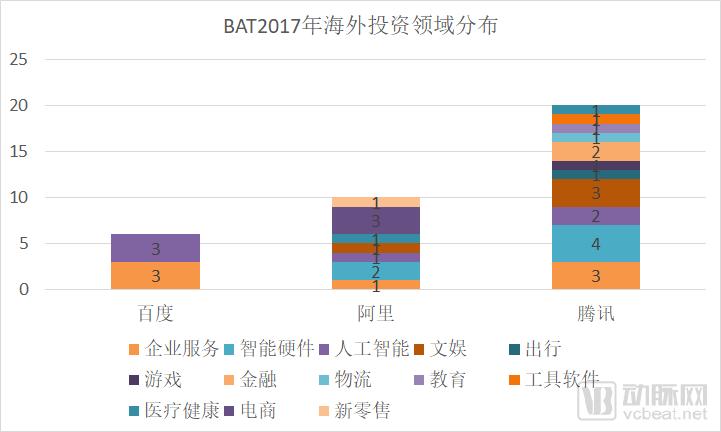
The 2017 investment data of BAT also reveals the differing development strategies of the three companies. Baidu, founded and built on technology, has recently announced its “All-in AI” strategy, seeking to acquire cutting-edge technologies in this field through investments to lay the foundation for future growth. Alibaba, which started with e-commerce, focuses its core business on the consumer sector. In recent years, it has prioritized “Big Entertainment” and “New Retail,” a strategic approach that extends to its overseas investments as well.
The core keyword of Tencent’s development is “connection,” encompassing connections between people, between people and information, and between businesses and consumers. Following the implementation of its “open” strategy, Tencent has primarily pursued emerging opportunities (“windfalls”) through investment partnerships or by providing traffic gateways. As a result, Tencent boasts the broadest reach and has entered the widest array of industry sectors.
Overview of BAT's Overseas Healthcare Investments
Baidu has not been active in overseas investments, particularly in the healthcare sector. However, since the beginning of 2018, Baidu has made three healthcare investments outside mainland China. Alibaba invested last year in a diabetes management company based in Taiwan, China, and a genomics company in Hong Kong, China.
Tencent began its expansion into the overseas healthcare sector in 2015, cumulatively investing in 14 projects primarily located in the United States. These investments span multiple fields, including smart hardware, medical big data, genomics, and telemedicine. The majority of these are early-stage projects, with relatively modest investment scales.
BAT Overseas Healthcare Investment Data
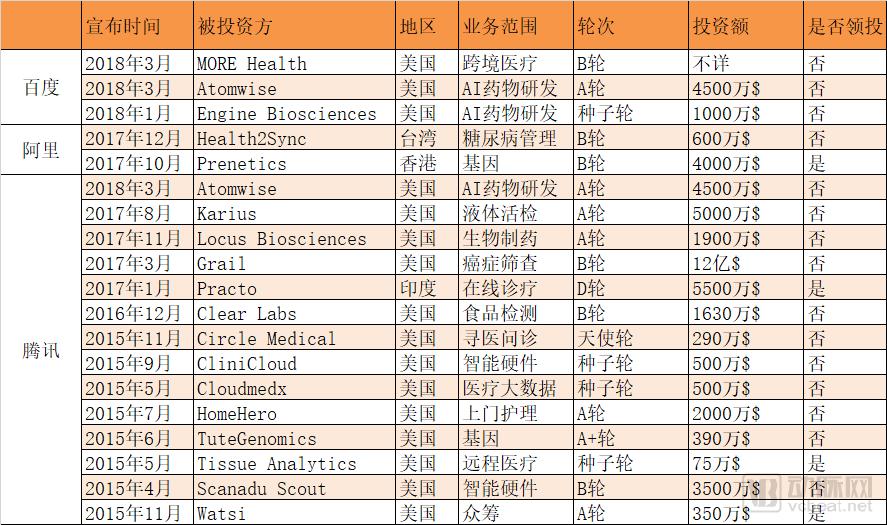
Data sources: Crunchbase, VCBeat
Interestingly, Baidu and Tencent jointly invested in the AI drug discovery company Atomwise this March, marking their only overlap in overseas healthcare investments.
Atomwise’s primary research focus is leveraging artificial intelligence to accelerate compound screening and facilitate new drug discovery. Founded in 2012, the company has raised over $51 million in funding to date. Atomwise aims to reduce the financial costs and time researchers spend on identifying drug compounds, with more than 50 R&D projects currently underway. The company collaborates with major pharmaceutical firms, biotechnology companies, and university research laboratories to expedite the discovery of novel drug candidates for neurological disorders, cancer, and other diseases.
Baidu has also invested in another AI-driven drug discovery company, Engine Biosciences. Founded in 2015 by a founding team from the United States and Singapore, the startup currently employs a large number of professionals in both biological R&D and artificial intelligence. By integrating these two disciplines, the company aims to develop more high-quality novel drugs and contribute to the treatment of major diseases. On January 31, 2018, Engine Biosciences announced the completion of its seed funding round, with investors including WuXi AppTec, Baidu, and Danhua Capital (DHVC).
Baidu has also invested in MORE Health, a cross-border healthcare company founded in 2013. The company provides users with global services including video consultations, international prescription drug delivery, cross-border medical care, and consulting and diagnostic advice, covering fields such as oncology, neurology, cardiology, and pediatrics. Previously, it secured Series A financing from NEA Capital. In March of this year, NEA Capital and Baidu jointly participated in its Series B investment round.
In October 2017, Alibaba led the $40 million Series B financing round for Prenetics, a Hong Kong-based genetic testing startup founded in 2009. The company primarily leverages genetic technology to provide health support to users; by analyzing simple saliva samples, it enables individuals to understand their genetic information and adjust their daily diet and lifestyle habits accordingly. In addition to genetic testing, Prenetics offers services such as prevention of hereditary health conditions and drug allergy screening. This investment was made through the Alibaba Entrepreneurs Fund, a non-profit organization dedicated to supporting companies that contribute to the Alibaba ecosystem.
Furthermore, Ant Financial and Yunfeng Capital have not been observed to have made investments in overseas healthcare projects.
Tencent’s Diversified Expansion in Overseas Healthcare
The above provides a brief overview of Baidu and Alibaba’s overseas healthcare investments. Given Tencent’s extensive portfolio of invested projects, it is discussed separately.
Tencent has invested in a total of 14 overseas healthcare projects. Its earliest investments date back to 2015, with eight projects that year, one in 2016, four in 2017, and one in 2018.
The primary project locations are in the United States, with one in India (Practo). The projects span areas such as AI-driven drug discovery, biopharmaceuticals, cancer screening, genomics, and Internet-plus healthcare. Tencent mostly entered these projects at Series A or earlier stages, participating in three seed funding rounds. The average financing amount for these projects is in the tens of millions of US dollars, with Tencent primarily acting as a co-investor.
Below, we introduce some representative overseas healthcare companies in which Tencent has invested.
Grail
Grail is the only “unicorn” among overseas healthcare projects in which Tencent has invested. On March 1, 2018, foreign media reported that Grail planned to launch an initial public offering (IPO) in Hong Kong, aiming to raise $500 million.
Grail was founded in 2016 by Illumina, the global leader in gene sequencing, and is dedicated to developing blood-based cancer screening technologies. Last May, Grail merged with Cirina, a biotechnology company founded by Professor Dennis Lo of The Chinese University of Hong Kong.
In June 2017, Grail announced its latest research findings, stating that, based on clinical trial data, specific blood tests could detect low levels of DNA mutations associated with tumors. The company subsequently indicated that its first product would be launched in 2018, capable of screening for a class of cancers located in the upper throat and behind the nasal cavity.
Since its inception, Grail has been highly sought after by investors, having completed three rounds of financing with a total amount reaching $1.3 billion. Existing investors include prominent investment firms and pharmaceutical companies such as Bill Gates, Bezos Expeditions (the personal venture capital fund of Amazon founder Jeff Bezos), Tencent Holdings, Bristol-Myers Squibb, Celgene, Johnson & Johnson Innovation, and Merck.
Practo
Practo is known as the “Indian Chunyu Yisheng.” Founded in 2008, the company primarily offers two types of services. On one hand, it provides consumer-centric online medical search services, enabling patients to find appropriate doctors and schedule appointments through the Practo platform, as well as book health check-ups, order medications, and access health information. On the other hand, it offers a SaaS product for healthcare institutions and physicians called Practo Ray, which facilitates online management of scheduling, pharmaceutical inventory, and medical billing, thereby helping healthcare institutions enhance patient care experiences and improve operational efficiency. Practo has since expanded its business to Indonesia, the Philippines, Brazil, and other regions.
Tencent took notice of the company in 2015, leading its $90 million Series C funding round. In January 2017, Tencent again led Practo’s $55 million Series D financing. According to Crunchbase data, Practo has completed five rounds of funding to date, with total capital raised reaching $234 million.
In January 2018, Practo partnered with India’s ICICI Lombard General Insurance Company to launch the “Trinity” service for individual users. Customers of ICICI Lombard can select doctors and clinics through the Practo platform and enjoy cashless, paperless medical consultations.
Karius
Infectious diseases are a leading cause of death worldwide and represent a significant area of unmet medical needs, a market that Karius targets. Founded in 2014 by Mickey Kertesz, Steve Quake, Tim Blauwkamp, and others, Karius developed a novel blood test capable of rapidly detecting bacterial, viral, and eukaryotic pathogens in the bloodstream.
Karius currently offers two product lines: the Digital Culture™ Test and the Mycobacterium chimaera DNA Sequencing Test. The Digital Culture™ Test helps physicians determine effective treatment regimens by detecting pathogens in patients’ blood. Its indications include sepsis, endocarditis, myelitis, and conditions caused by pathogens that are difficult to culture and detect in laboratory settings.
The Mycobacterium chimaera DNA Sequencing Test can detect Mycobacterium chimaera (M. chimaera) in blood samples. M. chimaera is widely present in the environment; when medical devices become contaminated, the pathogen can enter the human body via aerosols, causing infections in immunocompromised individuals, such as postoperative patients. Multiple studies have identified contaminated heater-cooler units (HCUs) as the source of M. chimaera infections in patients undergoing cardiac surgery. The Karius test enables results to be obtained within one day, facilitating the assessment of infection risk.
According to foreign media reports, Karius sells the above products to healthcare institutions and laboratories at a price of $2,000. Although more expensive than traditional testing products, Karius offers better performance and faster turnaround times. Its value is particularly pronounced for patients who test negative for infections using other methods.
Since its inception, Karius has completed seed and Series A financing rounds, raising a total of $55 million. Tencent participated in the Series A round but did not lead the investment.
HomeHero
HomeHero is a non-medical in-home care provider, similar to China’s “Nurse to Home,” helping families find and access in-home nursing services. Its core model relies on employing hundreds of healthcare professionals who can be deployed according to user needs. According to its official website, HomeHero is now the largest in-home service provider in California, having delivered over 1 million hours of care to thousands of households.
Population aging has laid the foundation for HomeHero’s development. Since 2000, the U.S. population aged 65 and older has been steadily increasing, creating opportunities for growth in home care services for seniors. Data shows that approximately 500,000 people join the “65+ club” each year. According to projections by the U.S. Census Bureau, individuals aged 65 and older will account for around 20% of the total U.S. population by 2030. This trend signifies substantial market opportunities for providing in-home services to the elderly.
HomeHero has completed three rounds of financing, with a total amount raised of $23 million. Tencent participated in its Series A round, which raised $20 million and was led by Graham Holdings, with Tencent and others following on.
Scanadu
Scanadu, founded in 2011, is a developer of portable medical devices. In 2013, the company launched its flagship product, the Scanadu Scout. This small, circular device houses an independent operating system and integrates sensors such as a gyroscope, electrodes, light-emitting diodes (LEDs), and an accelerometer. By placing the device against the forehead for 10 seconds, the accompanying app displays various physiological metrics, including pulse rate, heart rate, cardiac electrical signals, body temperature, heart rate variability, and blood oxygen saturation.
Inspired by the tricorder from Star Trek, the Scanadu Scout was praised by Tesla founder Elon Musk as “the product the world needs” after he experienced it.
In addition, the company is developing a home urine test kit called “Scanadu Urine,” designed to allow individuals to assess various health conditions by measuring chemical levels in urine samples. Correspondingly, the test results can be displayed and stored within the Scanadu app. Currently, Scanadu is pursuing FDA approval to bring this product to market.
CliniCloud
CliniCloud, founded in 2014, is a company specializing in smart home medical hardware. It has currently launched a product called the CliniCloud Medical Kit, which includes a smart stethoscope and a thermometer, priced at $149.
The integrated infrared thermometer enables non-contact body temperature measurement, while the stethoscope operates in a traditional wired mode, connecting to a smartphone via a high-fidelity data cable. Both temperature readings and auscultation data can be stored and shared on the cloud, allowing users to conveniently monitor their health at home and share the information with physicians for medical advice.
Clear Labs
Clear Labs, founded in 2014, is a food testing company that employs a range of analytical methods to assess food composition, genetically modified organisms (GMOs), and microbial content, providing these services to agricultural producers, food manufacturers, and laboratories.
In December 2016, Clear Labs announced the completion of a $13 million Series B financing round, led by Wing Venture Capital with participation from Tencent and others. To date, Clear Labs has raised a total of $24.5 million.
Tencent’s Healthcare Strategy: Seamless “Connection” Across the Big Health Industry Chain
Compared with its overseas investments, Tencent has been more active in the Chinese market, covering a wider range of sectors and investing in a greater number of healthcare companies. Among these portfolio companies, some have secured multiple rounds of financing from Tencent, such as XtalPi, Medlinker, and WeDoctor, indicating Tencent’s strong momentum in continuous incubation.
Moreover, Tencent has “personally entered the fray,” with initiatives such as WeChat Smart Pharmacy, TengAi Doctor, Penguin Doctor, WeSure, and Tencent Miying representing its in-depth expansion into the healthcare sector.
Tencent's Domestic Healthcare Investment Data:
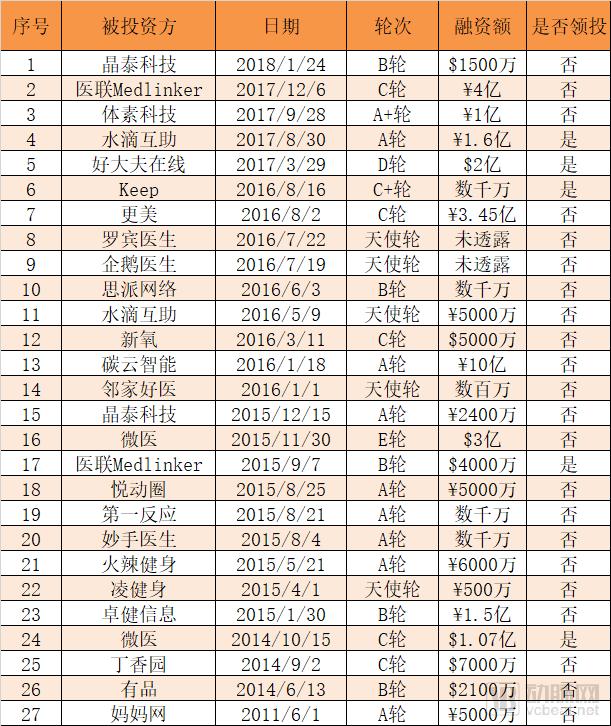
Data source: VCBeat · VBInsight
From a strategic layout perspective, Tencent aims to establish an integrated online-to-offline (O2O) healthcare ecosystem. This comprehensive value chain encompasses online services such as physician consultation, health management, and chronic disease rehabilitation, as well as offline offerings including clinics, pharmaceutical O2O services, insurance, and fitness programs. Its target stakeholders include patients, physicians, medical institutions, insurers, and pharmacies. The core distinguishing feature is Tencent’s ambition to break down information silos and achieve seamless integration across all segments of the broader health industry, with “connectivity” serving as the key keyword.
This platform-centric approach is closely tied to Tencent’s “DNA.” Its core competitiveness lies in social networking. By leveraging the user base, relationship chains, and platform advantages of its social networks, there are abundant application scenarios across the big health industry chain. Focusing on the core factor of “people” enables the identification of the commercial value of “connectivity.” Doctor communities, medical AI, and prescription-sharing platforms are all tools designed to facilitate such connectivity.
Examining Tencent’s healthcare investments both domestically and abroad, it is difficult to conclude that the company intends to “adapt Western models for Chinese use” or replicate overseas innovation paradigms within China. In essence, Tencent has evolved into an “investment bank,” with a strategic mindset focused on identifying high-quality business models and companies, regardless of whether they are located in China or abroad. This logic holds true for the BAT group (Baidu, Alibaba, and Tencent) as a whole: investment decisions are driven primarily by “value,” while any synergy with domestic operations is often incidental. Conversely, even if some investments fail, such setbacks involving a few start-ups would not significantly impact BAT, given their substantial scale.
It should be clear that innovation in the healthcare sector is akin to a “long march,” making it difficult to achieve disruption in the short term, particularly in the realm of “Internet + Healthcare.” BAT’s platform-based entry has essentially been a process of continuous “trial and error.” Only through ongoing strategic alliances and collaborations can they identify high-quality innovation models that are definitively accepted by the market, ultimately integrating them into their existing business systems to drive sustained growth.