

Five Models of Prescription Outflow: Strategic Layouts of Shanghai Pharmaceuticals, CSPC, and Sinopharm Grand Pharmacy
Benefiting from the continued advancement of the "separation of prescribing and dispensing" policy, the outflow of prescriptions is on the verge of a full-scale surge.
The outflow of prescriptions is, in essence, a process of redistributing profits from pharmaceutical sales, naturally attracting various market players to compete. Centered on prescription outflow, pharmaceutical manufacturers, distributors, and retailers have made numerous attempts and begun to aggressively expand their market share.
VCBeat (WeChat ID: vcbeat) summarizes five major models of prescription outflow. We have selected case studies from Shanghai Pharmaceuticals, Jointown Pharmaceutical Group, and Guoda Drugstore to provide an in-depth analysis of the business models for prescription outflow.
Prescription Outflow Must Overcome “Three Major Obstacles”
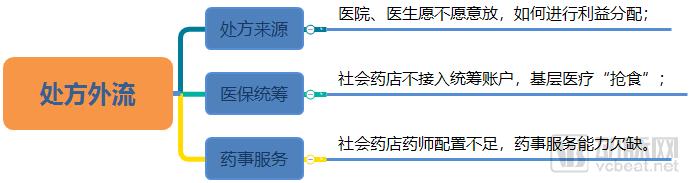
The business model of prescription outflow is actually very easy to understand: it involves shifting the sales of prescription drugs, which originally took place within hospitals, to outside settings, with distribution companies or community pharmacies taking on the responsibility of selling these medications. However, there are still several challenges that need to be overcome in practical implementation. We have summarized three key points:
Issue with the Source of the Prescription.Prescriptions can only be issued by physicians, who practice in hospitals that derive revenue from drug sales. To facilitate the external fulfillment of prescriptions, the primary challenge is addressing the willingness of both hospitals and physicians to participate. Key considerations include whether physicians and hospitals are willing to release prescriptions, whether such release would lead to a decline in their revenue, and if so, whether subsidies are needed and at what level. For institutions seeking to capture outsourced prescriptions, the practical dilemma is whether to partner with hospitals or with physicians. Partnering with physicians cannot bypass hospitals, nor can partnering with hospitals bypass physicians; thus, the interests of all three parties must be balanced.
Issues with Medical Insurance Pooling.Currently, the pooled fund account of the basic medical insurance system is not open to retail pharmacies. This means that medication purchases at pharmacies can only be made using the individual account portion of medical insurance. Once the balance in the individual account is exhausted, patients must purchase medications at hospitals if they wish to seek reimbursement. Given the existing financial constraints on the medical insurance fund, it will take some time before the pooled fund account is extended to social pharmacies.Furthermore, primary healthcare institutions accept both individual and pooled fund accounts for medical insurance settlements, offering a reimbursement rate approximately 10% higher than that of pharmacies. As the National Essential Medicines System improves, restrictions on medication prescribing at the primary care level are relaxed, and the tiered diagnosis and treatment system is more rigorously implemented, patient visits to primary healthcare institutions are expected to increase. This will lead to more prescription opportunities, with a greater volume of prescriptions for common diseases and chronic disease refills being issued at the primary care level. Consequently, this trend will help divert some of the prescription outflow and reduce the reliance on pharmaceutical retail channels.
Issues with Pharmaceutical Care Service Capabilities in Community Pharmacies.The primary recipients of outpatient prescription outflow are community pharmacies. A key consideration is whether these pharmacies have the capacity to effectively manage the influx of prescriptions. For prescription medications, patients often require counseling on contraindications and drug interaction guidelines. Previously, hospital pharmacists, with their professional backgrounds and extensive experience, ensured medication safety. In contrast, retail pharmacies face a shortage of licensed pharmacists and are plagued by issues such as certificate leasing and "phantom pharmacists." This deficiency in pharmaceutical care capabilities may compromise patient medication safety.
Of course, the above considerations are relatively extreme. In practice, solutions may include establishing information interoperability between hospitals and community pharmacies, allowing hospital prescriptions to be directly issued to community pharmacies; or utilizing third-party prescription sharing platforms that connect multiple hospitals and pharmacies to dynamically match patients’ needs.
Regarding the issue of pooled medical insurance funds, consideration should first be given to extending outpatient pooling coverage for chronic diseases. This approach would facilitate medication access for patients without exacerbating the deficit in the medical insurance fund. Additionally, requirements can be imposed on participating pharmacies, such as compliance with Good Supply Practice (GSP) standards, adherence to ethical and standardized business operations, and a clean record free of adverse events. The scope of medical insurance coverage should be gradually expanded to better meet residents’ needs for medical care and medication procurement.
Regarding pharmaceutical care services, the industry has already undertaken numerous explorations, such as “shared pharmacists,” “online pharmacists,” and “pharmacy-clinic” models. These initiatives leverage information technology tools to enhance pharmacists’ work efficiency or provide alternative solutions, thereby optimizing the utilization of high-quality pharmacist resources and ensuring safe medication use for patients.
The outflow of prescriptions involves the revenue of hospitals and physicians, pharmaceutical companies’ market strategies, the operational structure of distribution enterprises, the market size of pharmacies, patients’ medication safety, and changes in drug distribution channels. It is a systemic issue where one change can affect the entire system. The aforementioned challenges are prominent phenomena during implementation. Achieving “separation of prescribing from dispensing” and facilitating “prescription outflow” are intricately linked to the management of medical insurance fund utilization, the formulation of healthcare policies, adjustments to medical service pricing, hospital compensation structures, and patients’ habits regarding medical consultations and medication purchases, making breakthroughs difficult to achieve.
Shanghai Pharmaceuticals: DTP Pharmacies + Electronic Prescription Circulation
With regard to experience in handling outpatient prescription outflow, Shanghai Pharmaceuticals is the top recommendation. As a distribution giant, it began laying out its prescription outflow business early on, primarily focusing on pharmaceutical distribution and retail channels.
The pharmaceutical distribution segment is "pharmacy trusteeship,"As of the end of 2017, Shanghai Pharmaceuticals had a total of 226 hospital pharmacies under its management, with 97 newly added.
The primary layout of the pharmaceutical retail sector consists of three components: retail chain pharmacies, hospital-adjacent pharmacies, and DTP (Direct-to-Patient) pharmacies. As of the end of 2017, Shanghai Pharmaceuticals operated 54 hospital-adjacent pharmacies, with 14 newly added.
DTP business is the biggest highlight of Shanghai Pharma's retail business.Following the acquisition of Cardinal Health, Shanghai Pharma has become the undisputed leader in China's DTP (Direct-to-Patient) business, with more than 70 DTP pharmacies.
DTP (Direct-to-Patient) business refers to the direct delivery of high-value medications, whereby pharmaceutical manufacturers distribute these drugs directly to designated retail pharmacies for sale, yielding higher commercial margins. In terms of revenue, a DTP pharmacy can generate up to RMB 20 million annually, which is dozens of times that of a conventional pharmacy. However, the DTP model relies more heavily on resource alignment with pharmaceutical companies and requires superior pharmaceutical care capabilities.
In 2015, Shanghai Pharmaceuticals established Shangyao Cloud Health to develop an “Internet+” new retail business platform for prescription drugs, while also integrating its DTP (Direct-to-Patient) operations. The core model of Shangyao Cloud Health involves connecting with hospital Hospital Information Systems (HIS) to enable online routing of hospital prescriptions and offline delivery. According to its official data,In 2017 alone, it connected with 214 medical institutions at all levels and processed over 2 million electronic prescriptions.
Shanghai Pharma is also actively participating in Shanghai’s community comprehensive reform prescription extension project, facilitating tiered diagnosis and treatment, and has currently covered 146 community hospitals and health service centers in Shanghai.
In 2017, Shanghai Pharmaceuticals also signed a strategic cooperation agreement with Tencent, initially forming a closed-loop value chain for the new retail of prescription drugs, covering prescription acquisition and management, fulfillment and delivery, and value-added prescription services.
Value-Added Prescription Services: Shanghai Pharmaceuticals has attempted to provide innovative medical payment solutions for individuals, partnering with AstraZeneca to launch a financial installment plan for Tagrisso® to alleviate the short-term cash payment burden on patients' families; in collaboration with Bristol Myers Squibb, it implemented China’s first “pay-for-performance” innovative efficacy insurance program.
Jointown: Online Distribution + Smart Pharmacy
Jointown is the fourth-largest pharmaceutical distribution company in the industry and the largest privately owned pharmaceutical distributor in China. Amid the trend of prescription outflow, it has also undertaken trials and explorations.
In February 2016, Jointown Pharmaceutical Group announced that it had received an approval letter from the Hubei Provincial Food and Drug Administration. To encourage modern pharmaceutical logistics enterprises to participate in the separation of prescribing and dispensing under the new healthcare reform, and to explore e-commerce sales and regulatory models for prescription drugs, the Provincial FDA approved its wholly-owned subsidiaryHaoyaoshi Pharmacy Chain Co., Ltd. has launched a pilot program for the remote sale and delivery of select medications from the outpatient pharmacy of Wuhan Central Hospital, and is authorized to process related payments online.
In July 2016, Jointown Pharmaceutical Group entered into a strategic partnership for smart services with the Mengchao Hepatobiliary Hospital of Fujian Medical University. Jointown will develop a medical consumables supply chain management platform and a pharmaceutical supply chain management platform for the hospital.
The construction of the drug supply chain management platform includes:
1) Jointown is responsible for building a pharmaceutical supply chain management platform that interfaces with the hospital,The platform integrates with the hospital's HIS system to transmit prescription information and provide medication supply services to patients;
2) In accordance with the principles of medication adherence, hospitals can manage patients with chronic diseases through a chronic disease management system following the initial consultation;
3) The supply chain management platform operates through retail pharmacies licensed for pharmaceutical distribution. These pharmacies must be constructed and managed in strict compliance with Good Supply Practice (GSP) standards, integrate with Jointown’s warehouse management information system, and employ advanced logistics technologies and equipment—such as automated storage racks, electronic shelf labels, barcodes, and wireless handheld terminals—to implement refined bin location management andBatch number tracking for sold pharmaceuticals;
4) Jointown shall bear responsibility for the operational management and quality safety of partner pharmacies, ensuring that all sold pharmaceutical products comply with relevant national laws and regulations;
5) In order to better serve patients, improve the level of clinical pharmacy services, and optimize pharmaceutical care for patients with liver disease, Jointown Pharmaceutical Group Co., Ltd. and its authorized subsidiaries mayEngage hospital clinical pharmacists to provide clinical pharmacy services at partner pharmacies.
The above constitutes a comprehensive prescription outflow model: pharmaceutical distribution companies establish prescription information platforms to interface with hospital prescription data, collaborate with retail pharmacies, supply medications to these pharmacies, and assume responsibility for drug quality and safety. Meanwhile, to enhance the management standards of retail pharmacies, hospital pharmacists may be engaged to practice at these locations. This approach addresses both the source of outsourced prescriptions and pharmaceutical care service issues. According to Jointown Pharmaceutical Group, this model inaugurates a new paradigm integrating the separation of prescribing and dispensing, smart pharmacies, and internet-based services.
Guoda Pharmacy: Hospital-Adjacent Stores + DTP Pharmacies
In the pharmaceutical retail sector, Guoda Drugstore, a subsidiary of Sinopharm Accord, is the largest pharmaceutical retailer in China by sales volume and one of the few companies in the country with a nationwide direct-operated drug retail network. Guoda Drugstore’s retail chain spans 19 provinces, autonomous regions, and municipalities directly under the central government, covering nearly 70 large and medium-sized cities.Established a pharmacy network covering the coastal city clusters of East, North, and South China, gradually expanding into the Northwest, Central Plains, and inland city clusters, with sales volume exceeding RMB 10 billion.
Hospital-Adjacent Stores: Guoda Pharmacy’s Beachhead for Capturing Outflowing PrescriptionsAs of the end of 2017, Guoda Pharmacy operated a total of 253 stores located near hospitals. In 2017, Guoda Pharmacy added 53 such stores (28 of which were enrolled in the medical insurance program), with 16 of these hospital-adjacent stores achieving cumulative profitability.
DTP pharmacies are also a key focus of Guoda Drugstore’s strategic layout. At the end of 2016, Guoda Drugstore operated 16 DTP pharmacy stores; it added 24 new stores in 2017, bringing the total to 40. In 2017, Guoda Drugstore’s DTP sales revenue reached RMB 1.22 billion, representing a year-on-year increase of 20.33%. Calculated as RMB 1.22 billion divided by 40 stores,Guoda Pharmacy’s DTP business generated up to RMB 30.5 million in single-store output.
The core competitiveness of Sinopharm Accord/Grand Pharmaceutical in laying out the prescription outflow business lies in:
1) A nationwide retail network and a comprehensive pharmaceutical distribution network;
2) Extensive product portfolio: Guoda Pharmacy carries nearly 120,000 SKUs, meeting the demand for prescription outflow;
3) A comprehensive logistics and distribution system has been established, featuring a national logistics center in Shanghai and 23 provincial- and municipal-level distribution centers, forming a network that covers all stores nationwide;
4) Subsidiaries under Guoda Pharmacy generally demonstrate strong capabilities in securing medical insurance designations, with a high proportion of sales derived from medical insurance reimbursements, resulting in stable operations;
5) Other factors, such as shareholder background—backed by Sinopharm Group—and compliant operations, have also laid the foundation for the sustained development of Guoda Drugstore.
Prescription Outflow Draws Various “Players” into the Competitive Arena
In terms of policy, the outflow of prescriptions corresponds to the separation of medical services from pharmaceutical sales. In recent years, several major policies have been introduced to promote this separation, aiming to break the interest chain between public hospitals and medical staff on one hand, and drug and consumable manufacturers on the other, thereby curbing unreasonable increases in drug prices.
Review of Policies on the Separation of Medical Services and Drug Sales Over the Years
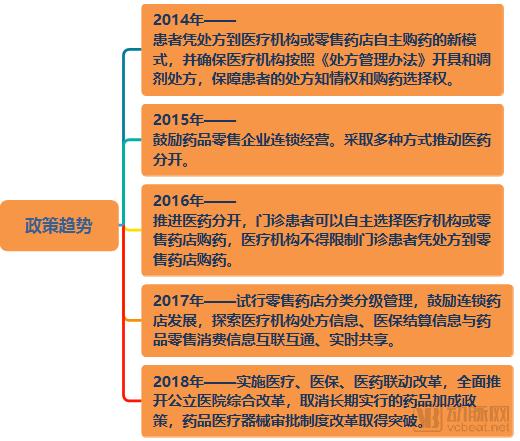
From local pilot programs, it is evident that Xi’an, Chengdu, and Chongqing have all issued policies to trial “electronic prescriptions” in retail pharmacies. These cities have adopted an approach involving integration with medical institutions, implementing computerized networking to obtain electronic prescriptions from healthcare providers via information systems, verifying the authenticity of the prescriptions, and thereby ensuring medication safety.
The outflow of prescriptions is essentially a process of redistributing profits from drug sales, naturally attracting various market players to compete. In addition to the aforementioned examples, this includes internet giants such as Alibaba, Tencent, and JD.com, as well as small and medium-sized pharmaceutical distribution companies.
Alibaba Health
In January 2016, Wuhan Central Hospital partnered with Alibaba Health’s Online Hospital. After patients scheduled consultations through Alibaba Health’s Online Hospital, electronic prescriptions were issued and fulfilled via distribution by Jointown Pharmaceutical Group.
JD.com
In March 2016, the People's Government of Zibo City in Shandong Province, JD.com Group, and Xinhua Pharmaceutical signed a tripartite cooperation agreement. Under this agreement, JD.com would build the “Zibo Medical Prescription Circulation Information Platform” for the Zibo Municipal Health and Family Planning Commission. Public pilot hospitals in Zibo City would submit prescriptions to the platform, enabling patients to conveniently purchase medications at Xinhua Grand Pharmacy using electronic prescriptions.
Tencent
Tencent has long been strategically positioned in the pharmaceutical retail sector. In August 2015, WeChat unveiled its “WeChat Smart Pharmacy” solution, providing an “Internet Plus” action guide for the pharmaceutical retail industry to address the pain points of traditional pharmacies. The solution encompasses online pharmacist consultations, member profiles, medication reminders, and marketing campaigns, as well as offline shopping assistance and WeChat Pay services.
In May 2017, Tencent, Liuzhou Workers’ Hospital, and Liuzhou Pharmaceutical Co., Ltd. signed a cooperation agreement to pilot “out-of-hospital prescription circulation.” Leveraging the WeChat official account of Liuzhou Workers’ Hospital, patients can receive electronic prescriptions issued by physicians directly on the platform after consultation, and then purchase medications at designated retail pharmacies by scanning a QR code.
Baiyang Intelligent Technology
In November 2017, the Wuzhou Municipal Health and Family Planning Commission of Guangxi partnered with Yifuzhen, a subsidiary of Baiyang Intelligent Technology, to initiate the establishment of a city-wide prescription information sharing system. More than 20 secondary-and-above hospitals and over 100 pharmacies across the city were integrated into the prescription information sharing platform. Subsequently, both parties will continue their collaboration to build a medical insurance pooled retail settlement platform and a centralized drug procurement platform.
Other ventures include Yifangda, a prescription information sharing platform, and Akang Health, with its cloud pharmacy warehouse. Numerous pharmaceutical distribution and retail enterprises have also entered the market by establishing stores near hospitals and DTP (Direct-to-Patient) pharmacies to capture prescriptions flowing out of hospitals.
We have summarized five major models for accommodating prescription outflow:
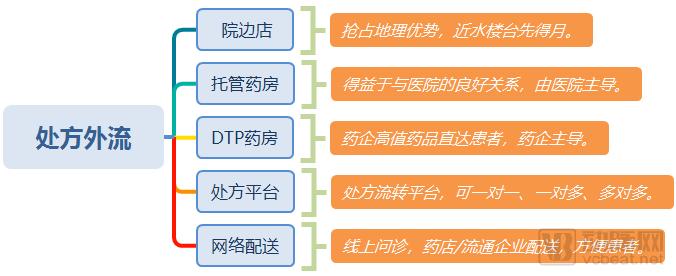
From the perspective of policy evolution trends, the separation of prescribing and dispensing will continue to advance, making the outflow of prescriptions an irreversible trend. Retail pharmacies and integrated wholesale-retail enterprises, which have long been at the forefront of pharmaceutical distribution and retail, possess extensive experience in pharmaceutical distribution, logistics, and pharmaceutical care services; they will be the first to benefit from prescription outflow. Other entities, such as Direct-to-Patient (DTP) pharmacies, electronic prescription circulation platforms, and online delivery services, are concomitant phenomena of prescription outflow and also present significant development opportunities.