

Sino-Korean Aesthetic Reports 2017 Financial Results: Revenue of RMB 633 Million and Net Profit of RMB 31 Million, with Nanjing Medical University Friendship Hospital as Core Revenue Driver
VCBeat (WeChat ID: vcbeat) has learned that Huahan Plastic Surgery, a leading and benchmark medical aesthetics enterprise in the Nanjing region, recently released its 2017 annual report. The company achieved an operating revenue of RMB 633 million in 2017, representing a year-on-year increase of 16.72%. Its net profit amounted to RMB 30.99 million, a 46.09% increase compared to the same period of the previous year. Among these,Plastic surgery accounts for 67.49%, cosmetic dermatology for 29.84%, and dentistry for 2.67%.。
From a regional perspective,Nanjing Medical University Friendship Hospital remains the primary component of revenue., with revenue increasing by 19% compared to the previous period. The Jiangsu Province region accounted for 62.53% of total revenue.
It has been learned that Huahan owns Nanjing Medical University Friendship Plastic Surgery Hospital, Sichuan Yuehao Medical Beauty Hospital, Beijing Huahan Medical Beauty Hospital, Qingdao Huahan Plastic Surgery Hospital, Changsha Huahan Huamei Medical Beauty Hospital, and Nanjing Huahan Qizhi Medical Beauty Hospital.130 Doctors(covering departments such as plastic surgery, dermatology, and dentistry, including 8 Korean physicians and 29 physicians at the associate chief level or above) and 188 nursing staff.
According to the announcement,The reasons for the significant increase in the company's operating revenue are:
1. The revenue of the subsidiary hospitals, including Nanjing Youyi Hospital, Qingdao Hospital, and Nanjing Huahan Qizhi Hospital, all achieved varying degrees of growth in this period. Among them, Nanjing Youyi Hospital’s revenue increased by RMB 42.05 million, accounting for 46% of the total revenue growth;
2. The year-on-year performance growth of Nanjing Huahan Qizhi, acquired in March 2016, amounted to RMB 45.89 million, of which RMB 29.90 million was attributable to the consolidation period difference from January to March.
The significant increase in net profit is attributable to the growth in operating profit.The growth in operating profit was mainly influenced by two factors:
1. The revenue and profit scales of three profitable hospitals—Nanjing Friendship Hospital, Qingdao Huahan, and Nanjing Huahan Qizhi—expanded;
2. The operating losses of the three previously unprofitable hospitals—Changsha Huahan Huamei, Beijing Huahan, and Sichuan Yuehao—were curtailed and reduced. In 2017, these three hospitals implemented effective improvements in internal operational standards and external business strategies, tailored to local market conditions and their respective operational realities, which directly drove growth in current-period revenue and operating profit. 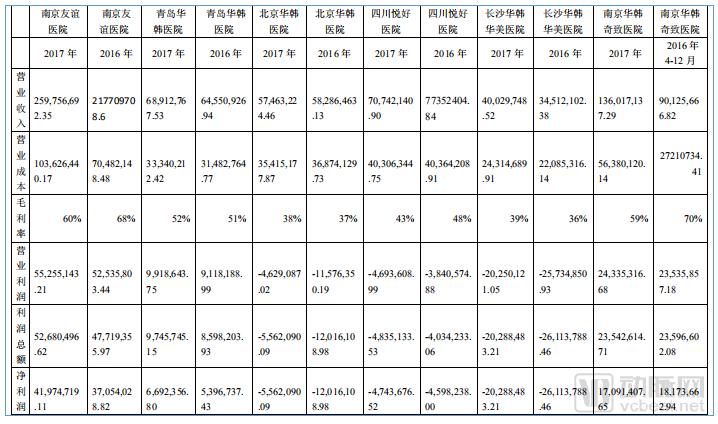
Revenue Performance of Huahan’s Various Hospitals
Private hospitals in China hold the majority share of the country’s medical aesthetics market. Benefiting from the future growth potential and rapid expansion of the medical aesthetics industry, coupled with the state’s policy openness and encouragement in the healthcare services sector, private hospitals continue to grow and improve rapidly. In particular, attention from the capital market will provide a significant boost to the development of companies with standardized governance within the industry and accelerate the process of industry consolidation.
Furthermore, China’s consumer sector is undergoing a comprehensive upgrade. The two key sectors driving industry growth—medical consumption and beauty consumption—remain robust. The medical aesthetics industry has maintained a rapid development trajectory, with increases in the number of consumers, frequency of purchases, and per capita spending.
Consumer acceptance of and spending penetration in medical aesthetics continue to rise. The trend toward the “cosmeticization” of these services remains unchanged, with the industry still following the development trajectory previously seen in the medical aesthetics markets of South Korea and Taiwan, China.
Both the supply and market demand in the medical aesthetics industry have grown, while competition has begun to diversify. The scale effect is becoming more pronounced, with chain institutions of a certain scale demonstrating greater competitiveness compared to independently or dispersely operated single-location clinics. The following are some observable trends:
1. Industry regulation will become more comprehensive and stringent, while industry self-discipline will steadily improve;
2. The operation of medical institutions is becoming increasingly standardized and transparent;
3. Fragmented, small-scale specialized hospitals are beginning to evolve toward intensification, large-scale operations, and chain-based models;
4. Management of medical institutions is becoming more specialized;
5. Increase in the number of medical service items;
6. The overall medical technical level of the industry is steadily improving;
7. Consumers’ level of expertise is gradually increasing, and their consumption behavior is becoming more rational.
The report shows that Huahan's core competitiveness is mainly reflected in the following aspects:
1. Scientific Research
One project funded by the Jiangsu Provincial Natural Science Foundation and one key project funded by the Nanjing Medical University Science and Technology Development Fund are currently underway. Four experimental studies have been conducted, focusing on topics such as stem cell-mediated promotion of wound healing and inhibition of skin aging. A total of nine new technologies and projects, approved by the Ethics Committee and Academic Committee, have been implemented.
2. Teaching
In 2017, hospitals affiliated with Huahan supervised the completion of master’s thesis defenses for two graduate students; six additional master’s candidates were undergoing training; two visiting scholars and sixteen interns were trained; and the hospitals fulfilled 342 teaching hours for two universities, including Nanjing Medical University.
3. Academic Achievements
As of the end of 2017, the hospitals affiliated with our company had published a total of 158 papers, including 14 SCI-indexed articles, and obtained 21 medical patent grants.
4. Academic Exchange
In 2017, Huahan hosted major academic conferences, including the 2017 Nanjing Stop of the Lecture Tour by the Aesthetic Technology Lecturer Group of the Aesthetic Medicine Branch of the Chinese Medical Association, and the First Summit on Quality Management in Plastic and Aesthetic Hospitals & Senior Forum on JCI International Hospital Management Standards; conducted live surgical demonstrations at the 8th Editorial Board Conference of the Chinese Journal of Aesthetic and Plastic Surgery (2017 Shenyang, Asian Aesthetic Plastic Surgery Summit); and participated in 217 person-times at international and domestic academic conferences, such as the 17th International Society of Craniofacial Surgery Biennial Congress.
5. Academic Influence
Twenty-eight presentations were delivered as invited speakers at the American Society of Plastic Surgeons (ASPS Aesthetic 2017), the Korean Society of Plastic and Reconstructive Surgeons (PRS KOREA 2017, KSPRS Meeting 2017), the 16th National Academic Conference of the Plastic Surgery Branch of the Chinese Medical Association, the 14th Annual Academic Conference on Medical Aesthetics of the Chinese Medical Association, the 14th Congress of the Chinese Association of Plastics and Aesthetic Surgeons, the 8th Jiangsu Provincial Academic Conference on Medical Aesthetics and Cosmetology, and the First Summit on Quality Management in Plastic and Aesthetic Surgery Hospitals & the Senior Forum on JCI International Hospital Management Standards. A total of 68 appointments were held by members in various academic roles within international and domestic professional societies and journals, including deputy group leaders, vice chairpersons, editorial board members, reviewers, committee members, and lecturers. Six individuals received awards such as Outstanding Editorial Board Member and Outstanding Author from the Chinese Journal of Aesthetic and Plastic Surgery, Excellence Award in Teaching Ward Round Competition of Nanjing Medical University, and Outstanding Teacher Award.
6. Discipline Development
Department of Plastic Surgery, Nanjing Medical University Friendship Plastic Surgery Hospital, was designated as a key discipline under the 13th Five-Year Plan of Nanjing Medical University and retained its position in the Top 100 List of Technological Influence of Chinese Hospitals released by the Chinese Academy of Medical Sciences, climbing 19 places in the rankings.