

Unnamed Penguin's CEO Zou Xiaoliang: 'Winner-Takes-All in the Internet Era, Yet Success Still Hinges on Understanding Human Needs'
VCBeat (WeChat ID: vcbeat) has learned that the “One Belt, One Road, One Academy” International Forum and the 9th Zhengshang Academy Entrepreneurs Conference, jointly hosted by Zhengshang Academy and Weiming Penguin, were successfully held at the Boya Hotel of Peking University. At this forum, Zou Xiaoliang, Founder and CEO of Weiming Penguin, delivered an inspiring speech titled “Capturing All in One Net.” He presented unique perspectives, such as the three Internet models that lead to a winner-takes-all outcome in the Internet era—network effects, scale synergy effects, and technological leadership. He elaborated on how Weiming Penguin leverages Internet tools to support the development of pharmaceutical companies within existing traditional models, creating value for these enterprises and empowering both upstream and downstream partners. He emphasized that, in the current era, corporate business models should primarily be designed from the perspective of “managing people.” Below are selected excerpts from the speech “Capturing All in One Net”:

Zou Xiaoliang, Founder & CEO of Weiming Penguin
I. Network Effects
Network effects do not depend on whether users themselves adopt a product, but rather on whether those around them do. Furthermore, they can generate collective value.
Representative companies: Facebook, Tencent-WeChat
Corporate Case Study: Among the many critical stages in WeChat’s development, importing mobile phone contacts into the app was a key driver of its explosive growth. At that time, mobile carriers did not allow apps to access phone contacts. After extensive negotiations and strategic maneuvering, Tencent made a revolutionary decision: enabling users to import their mobile contacts to establish connections with WeChat friends. Thus, mobile contacts represented the social graph. Combined with the initial social graph leveraged from QQ, WeChat had already secured an absolute advantage in user base through network effects.
II. Scale Synergies
In 2003, EachNet commanded a 95% share of China’s entire e-commerce market. At that time, China had only 5 million internet users, compared to nearly one billion today. Therefore, the user base of 5 million in 2003 was not comparable in scale to the current one billion. By the end of 2003, Taobao emerged and engaged in fierce competition with EachNet. In response, Taobao adopted a three-pronged strategy targeted at EachNet’s business model:
Taobao vs. eBay
1. eBay prohibited communication between buyers and sellers, while Taobao introduced WangWang to encourage such interactions;
2. eBay charges fees, while Taobao is free. All sellers using Taobao are exempt from fees;
3. eBay’s auction model prioritizes listings that are closer to their expiration time, displaying them more prominently. Taobao operates in the opposite manner: users see the most recently listed products first, ensuring immediate exposure for new arrivals.
Synergy is not about scale, but about workforce efficiency. Tencent and Alibaba generate annual net profits per employee of RMB 1.07 million and RMB 1.10 million, respectively. Therefore, if a company claims to have 1,000 employees but incurs substantial losses, this does not reflect high workforce efficiency; it merely indicates a large organizational scale.
As exemplified by the representative enterprises of the following three types of effects, once they have acquired a user base and achieved scale, they can mobilize resources within a three-kilometer radius, across the same city, nationwide, or even globally. This capability enhances warehouse efficiency, capital efficiency, and labor productivity.
The Three-Kilometer Effect: Meituan and Ele.me
Same-City Effect: 58.com
Global Impact: Alibaba, JD.com, Amazon
III. Technological Leadership
Representative companies: Baidu, Google
The hallmark of such companies is their ability to harvest massive datasets and leverage machine learning algorithms. Consequently, their core competitiveness lies in advanced algorithms and computational power, which enhance data precision, significantly save human labor time, and improve operational efficiency.
Corporate Case Study: Google’s AlphaGo, leveraging the principles of “deep learning” and trained on millions of game records from human Go experts, competed against Lee Sedol, a 9-dan professional Go player and world champion, in March 2016. AlphaGo won the match with a final score of 4–1, becoming the first artificial intelligence program to defeat a professional human Go player. By harnessing powerful data-learning capabilities, Google propelled artificial intelligence to a new level through its absolute technological leadership.
The Core of the Internet Era
Managing "People"
A company's value depends on the number of users utilizing its products.
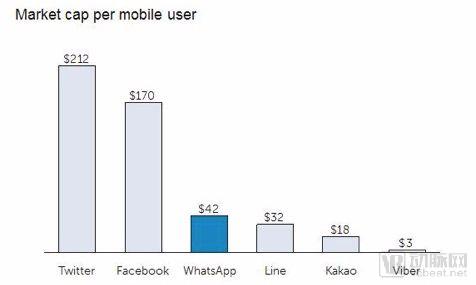
Corporate Case Study: In 2012, Facebook acquired Instagram for $1 billion, despite the latter having only 13 employees and being in operation for just a year and a half. In the second half of 2012, Facebook also acquired WhatsApp for $19 billion, a company with fewer than 50 employees.
As shown in the figure below, each Facebook user is valued at $170, while each WhatsApp user is valued at $42. With WhatsApp acquired for $19 billion, the per-user valuation gap stands at $128. This instantly elevates the per-user market value of WhatsApp—acquired by Facebook at $42 per user—to $170, resulting in a substantial increase in market capitalization.
Traditional Enterprises’ Rational Utilization of “Internet Plus”
Leveraging internet tools to enhance the development of enterprises based on existing traditional models, creating value for businesses and empowering upstream and downstream partners.
Representative Enterprise: Weiming Penguin. Weiming Penguin seamlessly connects upstream and downstream partners through internet technology, enabling timely, efficient, and accurate information transmission without geographical or temporal constraints. Leveraging accumulated transaction data, the company conducts big data analytics, such as transaction volume forecasting, to better assist upstream enterprises in work planning. By effectively controlling key nodes and information, it reduces intermediate links, thereby facilitating more efficient allocation of resources and capital.
Corporate Case Study: A traditional pharmaceutical manufacturer in Shandong reduced its invoicing staff to three and increased its overall profit margin by 20% after adopting internet-based tools developed by Weiming Penguin, significantly improving efficiency and reducing costs.
Three sets of numbers: 6, 150, 5
6: Six Degrees of Separation—Any individual can be connected to any other through a chain of acquaintances within six layers. With diligence, you can always identify key benefactors in your personal and professional life, thereby uncovering limitless business opportunities.
150: Dunbar's Number, the limit of human social capacity is 150 people, representing the breadth of one's network and how to effectively manage these relationships.
5: A person's wealth, knowledge, and character are the average of those of the five people closest to them.
Whether it is the network effects, scale synergies, technological leadership, or the scale and efficiency of the internet mentioned above, all are ultimately driven by people. Moreover, China is projected to become the world’s largest economy by GDP between 2025 and 2030, a shift that harbors immense business opportunities. We must actively engage with the outside world, foster greater exchange, and proactively identify these opportunities, thereby enriching our lives and making them more fulfilling.