

Airdoc Secures Hundreds of Millions in Series B Funding Led by Fosun with Sogou Participation, Files IPO Prospectus

Airdoc
Retinal Imaging Artificial Intelligence Field Product Developer
Smart Image Algorithms Identify Over 30 Chronic Diseases
Training data is sourced from top-tier medical institutions worldwide.
Empowering Primary Care Hospitals in Chronic Disease Screening and Tiered Diagnosis and Treatment
Proposed Large-Scale Replication of Application Scenarios and Business Models
On April 2, VCBeat learned that Airdoc, a leading artificial intelligence (AI) enterprise in the healthcare sector, announced the completion of its Series B financing round amounting to hundreds of millions of RMB, led by Fosun and with additional investment from Sogou. The three parties will jointly explore more effective pathways for integrating AI into the healthcare industry. Meanwhile, Airdoc announced it would continue to advance, in collaboration with Fosun and Sogou, an intelligent prevention and control system for chronic diseases featuring deep online-offline integration. The funds raised in this round will be primarily allocated to in-depth research and development of core products, expansion of coverage within the tiered diagnosis and treatment network, and market development.
After three years of research and development, the Airdoc team has launched an AI-based chronic disease identification system. Leveraging Airdoc’s retinal recognition algorithm, the system can identify over 30 types of chronic conditions, including systemic complications such as diabetes, hypertension, arteriosclerosis, and optic nerve diseases, as well as common ophthalmic disorders like high myopia and age-related macular degeneration.
To ensure high academic standards and robust R&D outcomes, Airdoc has collected millions of medical images from the world’s leading medical institutions. Under the guidance of medical experts, it has built multi-layer convolutional neural networks for disease spectrum screening. Each sample’s data annotation undergoes independent labeling by multiple top industry experts, followed by cross-quality control, thereby ensuring rigor in both the process and the results.
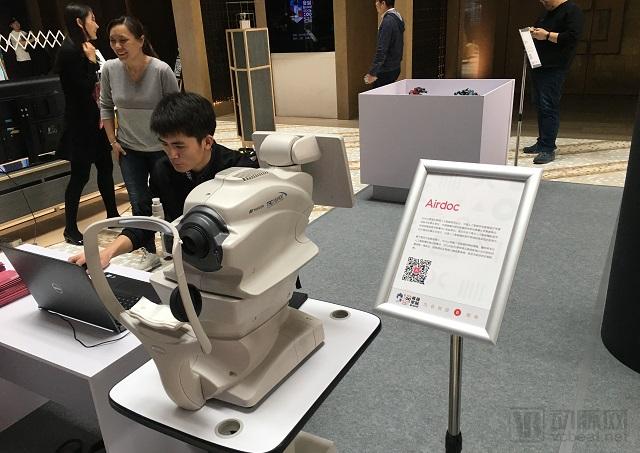
Airdoc is among the earlier enterprises to embark on industrialization in the field of medical artificial intelligence and has achieved substantial results. Zhang Dalei stated, “Airdoc’s AI-based medical imaging recognition technology has become an indispensable component of daily operations at hundreds of healthcare institutions across China and the United States in recent years. Every day, more than 100,000 primary-care physicians use Airdoc Ask as an auxiliary tool. We have initially established a viable AI-driven business model for the healthcare industry. Moving forward, our deep integration with Fosun and Sogou will help leverage the respective industrial strengths of all parties to jointly build a new era of comprehensive, patient- and provider-centered health.”
Airdoc’s Commercial Closed-Loop Continues to Advance
Zhang Dalei told VCBeat that Airdoc primarily focuses on scenarios and areas not covered by doctors. Airdoc’s online consultation decision-support system and its offline auxiliary analysis system for primary healthcare institutions serve a large number of users daily. Over the past three years, Airdoc’s imaging analysis system has conducted large-scale chronic disease screening in multiple provinces and municipalities, including Beijing, Shanghai, Hainan, Jiangsu, Hebei, and Anhui, providing analytical recommendations to tens of thousands of people each day.
Upon the completion of this round of financing, Airdoc will extensively replicate its successfully piloted application scenarios and business models. Building on its existing product portfolio, the company will forge comprehensive industrial synergies with pharmaceutical firms, insurance companies, and health management enterprises to accelerate the large-scale adoption of AI technologies in the healthcare sector.
Zhang Dalei, Founder and CEO, stated that the in-depth collaboration with Fosun and Sogou is based on all parties’ strong endorsement of the Healthy China strategy and their shared understanding of the healthcare industry landscape. Within the entire medical system, user value is primarily generated in prevention, diagnosis, treatment, and follow-up care; however, segments outside of diagnosis are precisely where China’s foundation remains relatively weak. Airdoc’s experience in the U.S. market has shown that those paying for AI-driven healthcare solutions are often not hospitals or physicians, but rather insurance companies, pharmacies, and pharmaceutical firms. Therefore, Airdoc’s business closed loop is built upon the participation of payers, establishing a comprehensive online-to-offline ecosystem.
Airdoc Submits Its First Class III Medical AI Offline Server to the CFDA for Inspection
Recently, Airdoc submitted its first Class III medical AI server in China to the China Food and Drug Administration (CFDA) for inspection. Unlike the traditional CFDA Class II registration approval for remote image transmission in radiology reading, the CFDA has actively responded to national strategic initiatives by applying the highest-level testing standards and initiating inspection for Airdoc’s Class III product upon its initial submission of a medical AI device. This move marks a milestone in the industry, demonstrating the Chinese regulatory authorities’ strong commitment to public health, their support for medical artificial intelligence products, and the maturity and robustness of the CFDA’s inspection system.
Zhang Dalei told VCBeat that Airdoc has been in constant communication with relevant government authorities, which have made significant and effective efforts in this regard. Some medical AI products were recently approved in the United States; leveraging their extensive experience in approving a large number of computer-aided detection (CAD) products during the last century, U.S. regulatory agencies were able to rapidly classify these medical AI products. Although the China Food and Drug Administration (CFDA) was established later than the U.S. Food and Drug Administration (FDA) and had less accumulated experience in CAD product approvals, the CFDA responded promptly after receiving Airdoc’s application. It quickly established an objective, fair, and sustainable testing system, demonstrating impressive professionalism.
Zhang Dalei stated that Airdoc participated in the early establishment of databases for relevant disease categories, and its products have been validated through clinical trials involving millions of subjects. The company is highly confident in obtaining Class III medical device certification from the CFDA and is committed to working with regulatory authorities to make positive contributions to industry standardization.
Chen Qiyu, Executive Director and Co-President of Fosun International, stated, “Fosun places great emphasis on the organic integration of new technologies with its business operations. While pursuing independent research and development, we are also actively investing in promising new technologies. We are particularly drawn to Airdoc’s chronic disease screening system for its high technological sophistication and the vast potential it holds in out-of-hospital settings. By integrating Airdoc’s screening technology with Fosun’s products, services, and healthcare ecosystem, we aim to explore the most efficient model for AI implementation, thereby making a tangible contribution to the Healthy China strategy.”
Sogou is also an investor in Airdoc’s Series A round. Wang Xiaochuan, CEO of Sogou, stated, “We are delighted to have participated in two funding rounds for Airdoc. Like Sogou, Airdoc is committed to advancing the practical application of medical AI. The year before last, Sogou launched its healthcare platform, ‘Sogou Mingyi,’ to provide users with authoritative and reliable medical information services. Leveraging AI technology, the platform performs initial triage based on users’ descriptions of their symptoms. We are highly optimistic about Airdoc’s AI-assisted diagnostic system and its broad range of application scenarios. We believe that deep collaboration between our two companies will accelerate the development of medical AI products that benefit everyone.”
Life Capital served as the exclusive financial advisor for this round of financing.
About Airdoc
Airdoc, established in 2015, is a leading artificial intelligence enterprise in the medical field, with branches in multiple cities across China and the United States. In recognition of Airdoc’s pioneering work in medical AI, research outcomes from its collaborative experts were honored as NIH Paper of the Year. The company has been appointed as the Secretariat Unit of the Smart Healthcare Professional Committee under the Chinese Association for Artificial Intelligence and as a Standing Committee Member Unit of the Mobile Health Branch of the China Health Promotion and Education Association. As one of the first companies worldwide to clinically deploy deep learning-based auxiliary diagnostic systems, Airdoc has participated in drafting domestic and international standards and specifications for medical AI. It also serves as the operating entity for the Ministry of Science and Technology’s STI Center for Intelligent Medical Imaging, making significant contributions to the establishment of management mechanisms for health and medical big data.
About Fosun
Fosun is rooted in China, deeply cultivating the sectors of health, happiness, and prosperity. By leveraging technology leadership and continuous innovation, Fosun intelligently creates a C2M (Customer-to-Maker) happiness ecosystem, delivering high-quality products and services to family customers worldwide. Founded in 1992, Fosun International was listed on the Main Board of The Stock Exchange of Hong Kong in 2007 (00656.HK). As of December 31, 2017, Fosun’s total assets exceeded RMB 530 billion.