

How Kangmei Pharmaceutical Built a RMB 100 Billion White Horse Stock: An Analysis of Its Integrated Traditional Chinese Medicine Industrial Chain Business Model
"White-Horse Stock Business Card"
Company Full Name: Kangmei Pharmaceutical Co.,Ltd
Registered Address: Kangmei Traditional Chinese Medicine City, Jieshen Road, Puning City, Guangdong Province
Company Abbreviation: Kangmei Pharmaceutical
Corporate Legal Representative: Ma Xingtian
Established in: 1997
Listing Date: 2001-03-19
Operating Revenue: RMB 19.515 billion (2017 Q3)
Net Profit: RMB 3.151 billion (2017 Q3)
Total Market Cap: 111.224 billion (2018-03-30)
Starting from the trade of Chinese herbal medicines, Kangmei Pharmaceutical Co., Ltd. has grown into one of the leading enterprises in China's traditional Chinese medicine (TCM) industry after more than 20 years of development. It now boasts the most complete business chain, the richest resources, and the strongest integration capabilities in the sector, establishing an integrated TCM industrial chain business model with distinctive "Kangmei characteristics."
Which critical junctures did Kangmei Pharmaceutical hit, what actions did it take at each stage of its development, and what lessons can be drawn? VCBeat (WeChat ID: vcbeat) plans to analyze Kangmei Pharmaceutical’s growth trajectory based on its annual reports.
Five-Year Growth Peak
Annual report data shows that since its listing, Kangmei Pharmaceutical Co., Ltd. has experienced two growth peaks in five-year cycles. These two growth peaks have propelled Kangmei Pharmaceutical to the status of a “carrier” in the traditional Chinese medicine industry, with a market capitalization of over RMB 100 billion, revenue exceeding RMB 20 billion, and net profit surpassing RMB 3 billion.
Kangmei Pharmaceutical Co., Ltd: Revenue, Revenue Growth Rate, and Net Profit Data (2001–2016)
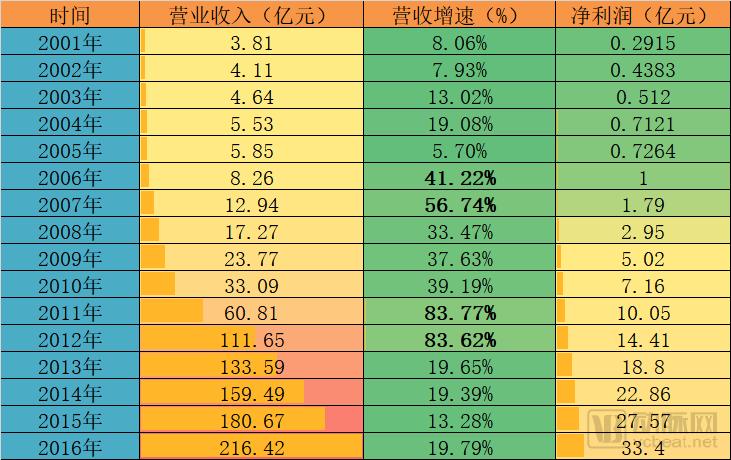
Kangmei Pharmaceutical Co., Ltd.’s first peak in growth occurred between 2006 and 2007, with revenue growth rates of 41.22% in 2006 and 56.74% in 2007. In 2007, its annual revenue surpassed RMB 1 billion for the first time, just five years after its initial public offering.
Looking back, Kangmei Pharmaceutical Co., Ltd. had already completed multiple investment and preparatory plans between 2003 and 2004, including:
- Commercial land in Zhanlong Town, Puning City (budgeted investment: RMB 44.5 million)
- Provincial Engineering Technology Research and Development Center for Traditional Chinese Medicine Decoction Pieces Renovation Project (Planned Investment: RMB 22.05 Million)
l Production workshop for traditional Chinese medicine decoction pieces (planned investment: RMB 8.01 million)
l TCM Decoction Pieces Distribution Center (planned investment: RMB 23.88 million)
l Pharmaceutical warehousing land (planned investment of RMB 4.71 million)
l Reserved land for chemical pharmaceutical production base (planned investment: RMB 4.2 million)
l Land for the Phase II Project of Traditional Chinese Medicine Decoction Pieces (planned investment: RMB 56 million).
The aforementioned investment projects, totaling approximately RMB 163 million, were completed by Kangmei Pharmaceutical Co., Ltd. in phases from 2003 to 2005. The company’s investment amounts for 2003, 2004, and 2005 were RMB 48.63 million, RMB 150 million, and RMB 23.08 million, respectively, amounting to a total of approximately RMB 222 million.
In addition, the construction projects promised by Kangmei Pharmaceutical Co., Ltd. during its IPO in 2001 have been completed successively, including four production lines for chemical drug active pharmaceutical ingredients (APIs) and formulations, with a total investment of approximately RMB 220 million.
The above data indicates that, following its listing, Kangmei Pharmaceutical Co., Ltd. successively invested approximately RMB 442 million in production line construction, as well as in projects for the traditional Chinese medicine decoction pieces workshop and warehousing facilities.
After all investments were fully in place, performance began to materialize in 2006. Thus, it can be explained that the first wave of growth for Kangmei Pharmaceutical Co., Ltd. stemmed from the “afterglow” of its IPO.
During the first round of performance growth, the Chinese herbal decoction pieces business recorded the fastest growth rate. In 2004, Kangmei Pharmaceutical’s revenue from Chinese herbal decoction pieces amounted to RMB 159 million, accounting for 28.74% of its total operating revenue. The segment saw year-on-year growth of 10.66% in 2005, 33.44% in 2006, and 49.23% in 2007, with revenue reaching RMB 350 million in 2007.
During the same period, Kangmei Pharmaceutical’s other flagship products, including Peining, Luoxinping, Kangmeinuosha, and Kangmeilile, also delivered strong performance.
Amid rapid performance growth, Kangmei Pharmaceutical Co.,Ltd has launched its next round of fundraising and development plan.
In 2006 and 2007, Kangmei Pharmaceutical completed two rounds of private placements to raise capital, amounting to RMB 485 million in 2006 and RMB 1.023 billion in 2007, for a total of approximately RMB 1.5 billion.
In 2008, Kangmei Pharmaceutical Co., Ltd. issued RMB 900 million in bonds with detachable warrants (along with 166.5 million warrant certificates); in 2009, the warrants were exercised, raising approximately RMB 890 million in additional capital.
The aforementioned fundraising plan raised approximately RMB 3.3 billion for Kangmei Pharmaceutical Co., Ltd. These funds were allocated to the Traditional Chinese Medicine (TCM) Logistics and Distribution Center project (with a planned investment of RMB 1 billion) and to supplement working capital, as certain fundraising proceeds were subject to usage restrictions and could not be used for project construction.
During this period, the projects initiated by Kangmei Pharmaceutical Co., Ltd. included:
l Kangmei Traditional Chinese Medicine Hospital Project (planned investment of RMB 600 million)
l Kangmei Beijing Traditional Chinese Medicine Production Base (Planned Investment: RMB 300 Million)
l Chengdu TCM Decoction Pieces Production Base (Planned Investment: RMB 221 Million)
l Shenzhen Office Building Project (Planned Investment: RMB 180 Million)
l Information Network Upgrade and E-commerce Platform (Planned Investment: RMB 80 Million)
l Jilin Ginseng Industrial Park Base Project (Planned Investment: RMB 400 Million)
- Bozhou Huatuo International Traditional Chinese Medicine City (planned investment of 150 million yuan), etc.
These projects were largely completed by 2010 or earlier, with performance gains gradually realized thereafter. Consequently, Kangmei Pharmaceutical ushered in its second peak of growth during 2011–2012, achieving annual revenue growth rates exceeding 83% for two consecutive years and surpassing RMB 10 billion in revenue in 2012.
During Kangmei Pharmaceutical Co., Ltd.'s second peak growth period, the rapid expansion of its traditional Chinese medicine (TCM) materials trading segment served as the primary driver. For instance, in 2010, revenue from TCM materials trading reached RMB 1.328 billion, representing a 60% year-on-year increase. This segment accounted for more than one-third of total revenue and achieved a profit margin of 44.17%, which was higher than that of other business segments.
Herein, we conclude that Kangmei Pharmaceutical Co., Ltd.’s second peak of growth stemmed from its sustained investment in the trade of traditional Chinese medicine (TCM) decoction pieces and raw medicinal materials. The company progressively strengthened its upstream production bases for TCM raw materials, established a midstream trading platform, and built a downstream logistics, warehousing, and distribution network, thereby forming an integrated system and business network for the production, sales, and transportation of TCM raw materials.
During the same period, Kangmei Pharmaceutical Co., Ltd. completed the acquisition of 100% equity interests in Shanghai Meifeng Food Co., Ltd. and Shanghai Jinxiang Food Co., Ltd. in 2009, thereby initiating its strategic layout in the food and health supplement sectors.
Following its second phase of growth, Kangmei Pharmaceutical Co., Ltd. continued to leverage its status as a listed company to raise capital for expansion. In 2011, Kangmei completed a rights issue raising RMB 3.436 billion and concurrently issued corporate bonds worth RMB 2.487 billion to repay bank loans and supplement working capital. In the subsequent years, Kangmei maintained annual investments exceeding RMB 1 billion, further building capacity to enhance its traditional Chinese medicine (TCM) materials trading and TCM decoction pieces businesses.
From a five-year cycle perspective, investments made in 2011 and thereafter will gradually translate into financial performance, with Kangmei Pharmaceutical’s third peak of earnings growth expected to occur in 2017–2018.
Six Major Business Segments Featuring Resource Synergy and Complementary Advantages
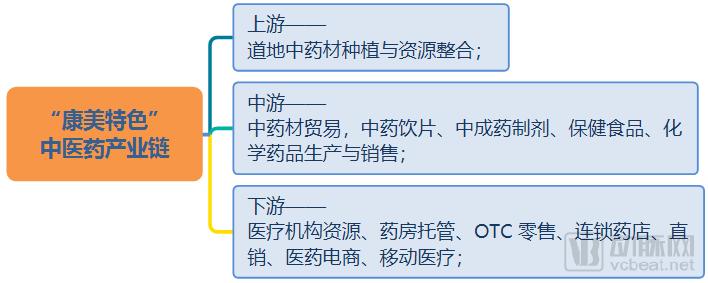
Currently, Kangmei Pharmaceutical Co., Ltd. centers its operations on Chinese herbal materials and prepared slices of Chinese crude drugs. Its business system encompasses upstream cultivation of authentic Chinese herbal materials and resource integration; midstream operations including professional markets for Chinese herbal materials, trading in these materials, production and sales of prepared slices of Chinese crude drugs, proprietary Chinese medicines, health supplements, and chemical pharmaceuticals, as well as modern pharmaceutical logistics systems; and downstream comprehensive, multi-tiered marketing networks integrating medical institution resources, pharmacy trusteeship, OTC retail, chain pharmacies, direct sales, pharmaceutical e-commerce, and mobile healthcare.
Ø Chinese Herbal Decoction Pieces: Kangmei Pharmaceutical’s Chinese herbal decoction pieces business holds a leading position in the industry, ranking first in production and sales volume. This business segment serves hospitals and has established long-term cooperative relationships with over 2,000 medical institutions.
Ø Traditional Chinese Medicine (TCM) Materials Trade: The company gradually initiated its TCM materials trading business in 2006, which has since evolved into one of its core operations. In recent years, the company has continuously expanded and refined its specialized TCM materials markets across key regions nationwide, while also establishing the Kangmei TCM Materials Bulk Trading Platform (Kangmei e-Medicine Valley), an online B2B e-commerce platform for bulk transactions of TCM materials.
Ø Health Supplements: Launched in late 2009. In 2013, Xin Kai He Food was established to prioritize the development of health supplements based on the concept of "medicine and food homology" and green food products, serving as an enhancement and complement to the broader big health industry, while also promoting new marketing channels such as e-commerce and direct sales. Currently, this segment generates approximately RMB 2 billion in revenue.
Ø Pharmacy Trusteeship: Operating and managing hospital pharmacies, and selling traditional Chinese medicine decoction pieces and pharmaceuticals through these entrusted pharmacies. According to Kangmei Pharmaceutical’s 2017 semi-annual report, it had entrusted management of over 100 hospital pharmacies across China.
Ø Smart Pharmacy: Online, real-time transmission and collection of patient prescriptions are achieved through direct integration with hospital HIS systems, while patients can also upload prescriptions independently. Offline, the “Kangmei Urban Central Pharmacy” provides patients with dispensing services for traditional Chinese medicine (TCM) decoction pieces and both TCM and Western patent medicines, along with TCM decoction and home delivery services. The primary footprint covers key cities including Beijing, Shanghai, Guangzhou, Shenzhen, and Chengdu.
Ø Hospital Operations: Built Kangmei Hospital independently, and successively acquired and integrated multiple local public hospitals to accumulate expertise in hospital management. By leveraging services such as pharmacy trusteeship, extended supply chain solutions, “Smart Pharmacy,” and “Online Hospital,” the company bridged the demands of both business (B-end) and consumer (C-end) markets, thereby driving the sales of traditional Chinese medicine (TCM) decoction pieces and TCM medicinal materials.
Dual-Track Development of Traditional Chinese Medicine and Medical Services
Kangmei Pharmaceutical’s six major business segments can essentially be summarized into two core pillars: Traditional Chinese Medicine (TCM) and medical healthcare services. From the perspectives of policy, market, and corporate strategy, Kangmei Pharmaceutical is well-positioned to capitalize on significant growth opportunities. Below, we will focus on discussing the competitive advantages of Kangmei’s core businesses.
"Chinese Herbal Pieces"
Chinese herbal decoction pieces refer to the finished products obtained through specialized processing and preparation of raw Chinese herbal materials under the guidance of Traditional Chinese Medicine (TCM) theory, which can be directly used in clinical practice. Positioned in the midstream of the TCM industrial chain, Chinese herbal decoction pieces constitute the most critical segment of the entire TCM industry.
According to data from the Ministry of Industry and Information Technology, the Chinese herbal medicine decoction pieces processing sub-industry achieved main business revenue of RMB 104.788 billion in the first half of 2017, a year-on-year increase of 21.33%, and realized a total profit of RMB 7.361 billion, a year-on-year increase of 22.78%. Over the past decade, the market size of Chinese herbal medicine decoction pieces has maintained a growth rate of approximately 20–30%.
However, due to low market entry barriers, the traditional Chinese medicine (TCM) decoction piece processing industry is characterized by a large number of small and fragmented enterprises, resulting in very low market concentration. According to data from the National Bureau of Statistics, there are more than 1,000 TCM decoction piece processing enterprises above the designated size. As the national leader, Kangmei Pharmaceutical Co., Ltd. reported revenue of RMB 2.7 billion from its TCM decoction piece business in the first half of 2017, accounting for only about 2.6% of the industry total.
Standardization is a key focus for the sustainable development of the traditional Chinese medicine (TCM) decoction pieces industry. In recent years, the state has introduced multiple policies to guide the standardized development of TCM decoction pieces, such as the Pilot Program for the Construction of a Traceability System in the Circulation of TCM Materials, the Notice on Further Strengthening the Management of TCM Materials, and the Guidelines for the Construction of National TCM Material Logistics Bases. These initiatives aim to establish long-term, dynamic standards for TCM decoction pieces.
Meanwhile, the state has been continuously strengthening the regulation of traditional Chinese medicine (TCM) decoction pieces. Information released by the China Food and Drug Administration (CFDA) on sampling inspections, unannounced inspections, and public exposure reveals that dozens of TCM decoction piece manufacturers are added to the “blacklist” almost every week due to failed product quality tests.
Kangmei Pharmaceutical has taken the lead in the standardization of processed Chinese herbal slices, pioneering the implementation of small-package processing and color-code management. The company has participated in the formulation of multiple national and provincial standards for the processing and quality of herbal slices, as well as classification standards for Chinese medicinal materials. It is recognized as a National Technological Innovation Demonstration Enterprise and remains the only intelligent manufacturing pilot demonstration enterprise in the processed Chinese herbal slices sector.
Benefiting from policies such as the exclusion from centralized drug procurement, the retention of markups, and exemption from the drug revenue ratio cap, the volume of traditional Chinese medicine (TCM) decoction pieces in the hospital market can continue to expand. Kangmei Pharmaceutical Co., Ltd. boasts high standardization, extensive network coverage, and production capacity advantages in its TCM decoction pieces business. Poised to capitalize on these favorable market conditions, this segment is expected to maintain robust growth.
Trade of Traditional Chinese Medicinal Materials
In the trade of traditional Chinese medicinal materials, Kangmei Pharmaceutical Co., Ltd. has fully leveraged the geographical advantages of the Puning Professional Market for Traditional Chinese Medicinal Materials to gradually develop its trading business since 2006.
In recent years, Kangmei has continuously expanded and refined its layout of specialized traditional Chinese medicine (TCM) herbal markets in key regions across China. Through independent construction and strategic acquisitions, it has established specialized TCM herbal markets and the Kangmei TCM City in Bozhou (Anhui), Puning (Guangdong), Yushu (Qinghai), Yulin (Guangxi), Xining (Qinghai), and Longxi (Gansu). This has secured Kangmei’s leading position and resource advantages in the physical trading of TCM herbs. By fully integrating logistics and warehousing resources, Kangmei has rolled out a nationwide logistics network centered around major TCM herb production, distribution, and trading hubs, thereby building a modern pharmaceutical logistics system. In the first half of 2017, Kangmei’s TCM herbal trade segment generated revenue of RMB 3.805 billion.
It is also worth noting the subsequent development of Kangmei e-Yaogu, the traditional Chinese medicine (TCM) materials e-commerce platform. By integrating logistics and warehousing resources, Kangmei TCM Network has established a modern pharmaceutical logistics and distribution system. To date, it has set up more than 30 modern pharmaceutical warehousing and logistics centers across China, including in Beijing, Northeast China, Shanghai, Puning, and Sichuan, as well as over 380 secondary service outlets covering major TCM material production regions nationwide.
Kangmei TCM Network has also launched an “Agricultural Inputs” section to connect with upstream herb growers, providing them with market information on seeds and seedlings, pesticides and fertilizers, and machinery and equipment, thereby facilitating the procurement of relevant resources. In the future, with the infusion of Kangmei’s offline resources, Kangmei TCM Network is poised to become an authoritative e-commerce platform in the field of traditional Chinese medicine and gradually generate revenue.
Smart Pharmacy
Smart Pharmacy, pioneered by Kangmei Pharmaceutical Co., Ltd., began pilot programs in 2015 in cities such as Guangzhou, Shenzhen, Shanghai, and Beijing. Its model involves interfacing with the Hospital Information Systems (HIS) of major hospitals and social medical institutions to obtain electronic prescriptions, conduct professional prescription reviews, and provide patients with one-stop comprehensive pharmaceutical services, including medication dispensing, decoction of herbal pieces, home delivery, and medication consultation.
Smart pharmacies have achieved a win-win outcome for hospitals, patients, and enterprises. For hospitals, they reduce the costs associated with dispensing and decocting medications in outpatient pharmacies, thereby enhancing operational efficiency. For patients, they eliminate the time burden of decocting herbal medicines, facilitating medication adherence. For Kangmei Pharmaceutical Co., Ltd., they strengthen hospitals’ reliance on its supply of traditional Chinese medicine (TCM) decoction pieces and boost sales volume.
As of June 2017, Kangmei Smart Pharmacy had reached a daily peak of 20,000 prescriptions, with a cumulative total of 2.5 million prescriptions processed. It served approximately 16,000 outpatient physicians and around 1 million patients.
Kangmei stated that it will increase capital investment in its "Smart Pharmacy" initiative, comprehensively and rapidly advancing its implementation at target institutions in five key cities: Guangzhou, Beijing, Shanghai, Shenzhen, and Chengdu. Meanwhile, the company will actively initiate the establishment of central pharmacies in additional cities such as Chongqing and Xiamen, gradually forming urban cluster-based central pharmacies to maintain its first-mover advantage and swiftly solidify its leading position in the mobile healthcare services sector.
Medical Services
Leveraging its resources and accumulated capital in the traditional Chinese medicine (TCM) business, Kangmei Pharmaceutical Co., Ltd. began to enter the medical services sector through self-construction, acquisitions, and joint operations, extending its reach downstream in the pharmaceutical industry.
In June 2013, Kangmei Pharmaceutical Co., Ltd. self-built the Puning Kangmei Hospital, with a cumulative investment of nearly RMB 1 billion. The hospital was planned and designed in accordance with the standards for Grade III Class A hospitals, covering an area of over 100 mu, including more than 50 mu for medical facilities. The gross floor area for medical use is nearly 120,000 square meters, with an initial capacity of 500 beds.
In April 2016, Kangmei invested in the Meihekou Central Hospital to explore a new model of cooperative healthcare delivery. In December 2016, Kangmei signed a strategic cooperation agreement with the People’s Government of Rongchang District, Chongqing Municipality, and the Rongchang Traditional Chinese Medicine (TCM) Hospital. The three parties will invest RMB 1 billion to jointly establish the Kangmei Rongchang TCM Hospital in accordance with the standards for tertiary hospitals, with Kangmei holding an 80% stake. In January 2017, Kangmei acquired a 90.27% equity interest in the Kaiyuan Central Hospital, a Grade II Class A general hospital that reported medical service revenue of RMB 129 million in 2016.
Kangmei’s sustained investment in hospital operations aligns with recent policy directives encouraging social capital to establish medical institutions and participate in the reform of public hospitals. Meanwhile, these hospitals can serve as showcase models for Kangmei’s integration of healthcare service resources, providing a foundation for the company to continuously explore healthcare service operation models. From a business perspective, these hospitals will also become stable demanders of Kangmei’s TCM decoction pieces and medicinal materials, thereby creating room for its performance growth.
Kangmei’s healthcare service portfolio also includes “Kangmei Health Cloud,” an integrated “Internet + Healthcare” platform that consolidates services such as online hospitals, smart elderly care, and intelligent devices for chronic disease management.
In addition, Kangmei has invested in businesses such as health think tanks, financial leasing, health insurance, and community health centers, comprehensively laying out its medical services. It aims to build a “Big Health + Big Platform + Big Data + Big Service” system.
Self-Drive and Leveraging External Resources
In summary, this section has reviewed Kangmei Pharmaceutical’s development trajectory over the past two decades, along with the status of its major business lines. Kangmei’s rapid growth can be attributed to multiple factors, such as the continuous policy support for traditional Chinese medicine (TCM) and the expanding market size of the TCM industry.
More importantly, Kangmei Pharmaceutical Co., Ltd. demonstrates both “self-driven” capabilities and the ability to “leverage external resources.” Its “self-driven” approach is reflected in the continuous optimization of its industrial chain layout for traditional Chinese medicine (TCM)-related businesses, spanning from medicinal herbs to trading and prepared decoction pieces, thereby securing control over upstream sources, establishing standards, and building comprehensive systems. Its strategy of “leveraging external resources” is evident in its continual utilization of the listed company platform to secure sustained capital reserves from the capital market, which are then invested in project construction, thus skillfully harnessing market forces to drive its own development.
"In a sense, as long as the operators maintain a firm grasp on trends in the pharmaceutical industry and shifts in the capital market, Kangmei Pharmaceutical Co.,Ltd may well be invincible."