

BurstIQ, the Only Profitable Healthcare Blockchain Company, Files IPO Prospectus After Processing 25 Billion Data Points in 12 Months

BurstIQ
Enterprise-Level Blockchain Medical Data Company
We are in the era of big data, yet we remain trapped among data silos.
What are you doing? What are your personal interests? How is your physical condition? Companies want to obtain this data, and researchers want to study it. They are constantly seeking new methods to collect more data every day.
Hackers are well aware of its value: one-quarter of global security vulnerabilities are related to the healthcare industry. They have created a black market worth billions of dollars for trading health data, imposing an equivalent economic burden on healthcare service providers.
However, as the owners of the data, we cannot access it, do not understand it, and cannot control who uses it.
This constitutes the most pressing issue at present: as a valuable asset, data is often hoarded by enterprises as private property. However, compared to industry-wide databases, the value of such single-source data is negligible, and it carries an ever-present risk of leakage.
BurstIQ, founded in 2015, aims to address the problem of data silos without violating HIPAA regulations, while expanding users’ currently incomplete control over their own data, ultimately establishing a blockchain-based data sharing platform. It has been recognized by CB Insights as one of the top artificial intelligence companies in the healthcare sector.
Over the past two years, BurstIQ has gradually evolved into a fully operational platform with sustainable revenue streams, multiple large enterprise clients, and hundreds of thousands of users.
BurstIQ Platform Leverages Blockchain and AI to Consolidate Data from Diverse Sources into a Single Database. In Its First 12 Months of Operation, BurstIQ Processed a Total of 25 Billion Data Points.
BurstIQ envisioned a complete ecosystem from the outset, with blockchain serving as the pathway that connects this ecosystem, integrating isolated data sources into a unified whole.
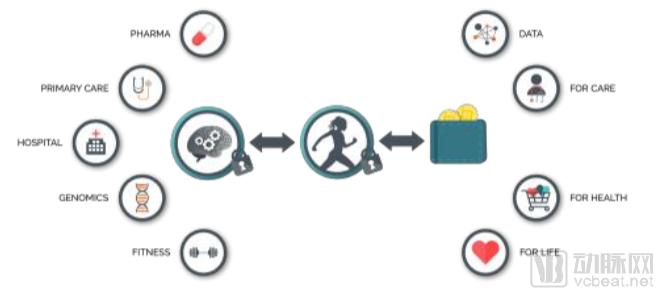
In this ecosystem, BurstIQ will establish a LifeGraph account for every individual in the world. With this account, users can access all their health data through a single platform and retain absolute control over it, thereby disrupting the current paradigm of user data ownership.
BurstIQ enables users to access and control not only medical data (EMR) but also genetic/molecular diagnostic data, behavioral health data, pharmacy data, fitness data, nutritional data, and more. Users have the right to share or sell their data under appropriate circumstances.
Users can share their medical history with healthcare providers using HealthWallet. For example, when a user changes healthcare providers, BurstIQ will retain the service records of both the previous and new providers in HealthWallet. Additionally, users can freely grant others access to their complete medical history.
The BurstIQ platform helps enterprises quickly identify suitable customers. For instance, a company may offer precision medicine testing for biomarkers associated with ovarian cancer progression. They might wish to market this service to women with a family history of ovarian cancer. By leveraging the BurstIQ platform, the company can directly reach users who meet these criteria. This approach significantly improves conversion rates, reduces marketing costs, and enables “personalized” healthcare services for customers.
By leveraging BurstIQ’s deep learning capabilities and smart contracts, insurance companies can design more rational insurance policies while preventing insurance fraud. Biotechnology and pharmaceutical companies now have more convenient access to clinical data, enabling them to identify and engage with participants in genomics and proteomics studies more rapidly.
The BurstIQ platform consists of three distinct service layers: the Secure Data Grid, LifeGraph, and Ecosystem.
A true universal health data platform must feature end-to-end data access management, secure data storage, an unambiguous chain of custody, and advanced data security technologies. Only by meeting these criteria can a platform ensure the privacy and security of personal information.
BurstIQ believes that data at rest is at risk, while data in motion ensures security. Therefore, BurstIQ leverages cryptographic technologies and proprietary protection schemes to ensure data remains constantly in motion and encrypts every layer within the blockchain system.
Traditional blockchains face scalability issues. The TPS of a blockchain is inherently constrained by the block structure itself. Representative blockchains such as Bitcoin require 10 minutes or longer to confirm transactions, with a TPS of only 7 transactions per second.
BurstIQ blockchain can achieve a TPS of 10,000 transactions per second. Meanwhile, its consensus mechanism incorporates both Proof of Work (PoW) and Delegated Proof of Stake (DPoS), which helps reduce the energy consumption required to operate the chain to some extent.
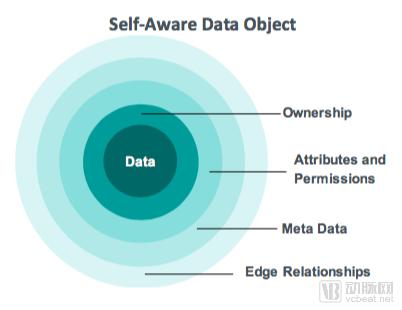
LifeGraph is the core of the entire BurstIQ platform, used to create a relationship graph of authenticated data objects (i.e., an individual’s health data). Data usage permissions, security, and value attributes are embedded into the repository of each data object.
Establishing platform sovereignty and corresponding smart contracts requires a robust mechanism as a prerequisite. To meet this need, LifeGraph creates a unique health identity for each individual, which safeguards personal identity across different user repositories while facilitating smart contract execution.
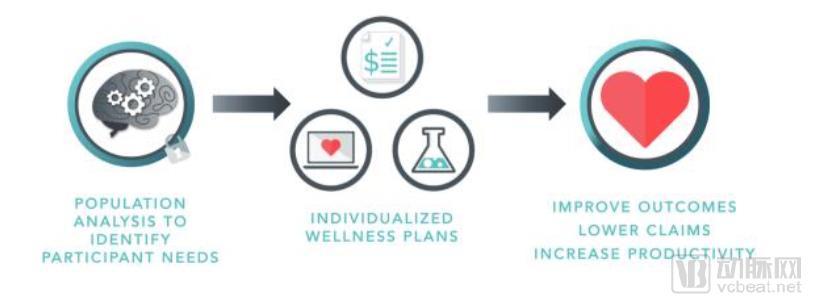
The BurstIQ platform includes a specially built platform service layer to facilitate external enterprises in leveraging underlying data and technology to develop third-party products and services. These service layers can provide highly diverse solutions, such as deep learning, business analytics, blockchain management, and clinical research.
Enterprises and individuals can collaborate to help businesses design new care models, test research hypotheses, and optimize business operations.
Application developers can use various protocols (e.g., REST, FHIR, SDK, CLI) to develop programs directly on the platform.
Through these applications, BurstIQ can build a complete closed-loop community, at which point it will realize its maximum value.
Frank Ricotta, Founder and CEO of BurstIQ, brings 30 years of corporate management experience and holds multiple patents in the fields of cybersecurity and machine intelligence. A former U.S. Air Force serviceman, he earned a Bachelor of Science in Computer Science from the U.S. Air Force Academy and a Master of Business Administration from Saint Mary’s University.
Co-founder Brian Jackson participated in the development of the BurstIQ platform. He is an expert in enterprise security and enterprise cloud infrastructure platforms, and has authored multiple books. Prior to joining BurstIQ, Brian led Cloud Engineering, which provided consulting services to enterprises in the healthcare sector.
Tyson Henry has developed many key technologies for the BurstIQ platform. His products and services span various industries, with clients including the Air Force Weather Agency.
Financing Status
On November 14, 2017, BurstIQ announced the first mainstream OEM blockchain data ledger integration for Intermountain Healthcare and its strategic partner Empiric Health. Utah-based healthcare giant Intermountain Healthcare has reduced costs by more than $90 million using Empiric’s technology (formerly known as ProComp).
Previously, BurstIQ launched a private funding round at the 2018 World Economic Forum in Davos, Switzerland, with a target of raising $20 million. Following the event, Millennium Blockchain invested $5 million in BurstIQ.
Regarding this investment, Enzo Villani, Chairman of Millennium Blockchain, stated, “There are currently few blockchain companies, and even fewer use cases for blockchain in the healthcare industry. At this stage, BurstIQ is the only profitable blockchain healthcare enterprise. We are very pleased to support the company’s development.”
As of March 2017, BurstIQ had raised a total of RMB 34.91 million in funding.
Many domestic blockchain companies, including CloudNest Intelligent Connection, Boundary Intelligence, and MoLian Technology, are engaged in work similar to that of BurstIQ. The development history of BurstIQ can serve as an excellent case study for assisting the operations of domestic blockchain enterprises.