

XinHai Navigation Transitions from Product Sales to Psychological Services Amid 80% Market Share and Over 10,000 Institutional Partnerships
As early as 2016, President Xi Jinping proposed at the National Conference on Health and Wellness to strengthen fundamental research on mental health issues, conduct effective public education on mental health knowledge and psychological disorders, and regulate the development of mental health services such as psychotherapy and psychological counseling.
The Outline of the 13th Five-Year Plan for National Economic and Social Development also explicitly proposed strengthening mental health services. Furthermore, the Healthy China 2030 Planning Outline, issued in 2016, further required the enhancement of the construction and standardized management of the mental health service system.
As a result, local governments and various departments have actively explored mental health services within their respective jurisdictions or sectors in recent years, laying the foundation for the market-oriented development of mental healthcare.
Although top-level design has shifted its focus from physical health to mental health, the foundation of China’s mental health industry remains relatively weak, whether viewed from the perspective of the public healthcare system or the entry of private capital. Consequently, strengthening mental health services currently faces numerous challenges.
Chen Wei, CEO of Xin Hai Navigation Education Technology Co., Ltd., believes that although the mental health education market is supported and promoted by policies, it is ultimately driven more by market forces. His story, spanning from a Peking University faculty member to an entrepreneur, dates back to 2004.
The Market Requires Support from Utility Software
Chen Wei formerly served as Deputy Director of the Jinqiu Psychological Research Center at Peking University, where he engaged in psychological counseling. In 2004, the highly publicized Ma Jiajue incident drew nationwide attention to the mental health issues of university students.
At that time, psychological education in universities relied solely on a few courses or lectures on mental health, along with manual assessment and intervention by counselors; there was no tool-based software for screening psychological disorders available in the market.
To address this gap, Chen Wei and his team developed a software suite for group psychological assessment and counseling at that time, enabling comprehensive mental health screenings for students. They also pioneered the establishment of standards for psychological records, which subsequently became the industry-wide standard in the field of mental health.
At a lecture hosted by the Ministry of Education, Chen Wei presented to representatives from various universities on how his newly developed psychological assessment system could efficiently evaluate students’ mental health status. “Many schools expressed immediate interest in procuring the system. Recognizing the widespread demand, we decided to establish a company dedicated to promoting the software.”
Thus, in 2004, XinHai Navigation was established, initiating market-oriented and standardized operations. In the same year that XinHai Software was launched, it received orders from 160 universities and 235 primary and secondary schools across China, led by the Psychological Counseling Center of Tsinghua University and the Psychological Counseling Center of Harbin Institute of Technology.
With the rapid development of the economy and society, the number of individuals with psychological and behavioral abnormalities and common mental disorders in China has been increasing year by year, resulting in a substantial demand for mental health services.
In January 2017, the former National Health and Family Planning Commission issued the "Guiding Opinions on Strengthening Mental Health Services," which put forward requirements for comprehensively strengthening mental health education for children and adolescents. For higher education institutions, it pointed out that colleges and universities should actively offer mental health education courses and carry out mental health education activities; attach importance to enhancing college students' psychological adjustment capabilities, maintaining good adaptability, emphasizing suicide prevention, and conducting psychological crisis intervention; at the same time, pay attention to mental health services for special groups such as incarcerated individuals.
Mental health services span across various industries and sectors. It is crucial to extend these services to all aspects of society, provide comprehensive support to diverse populations, and establish a sound service system.
Chen Wei believes that although policy serves as a driving force, the mental health education market is fundamentally demand-driven.
The market's pain points are reflected in two aspects: First, universities face significant challenges in managing students with suicidal tendencies or other psychological disorders, while student mental health has a critical impact on the institutions' educational and teaching operations.
Second, there is a shortage of psychology professionals. According to relevant statistical data, China’s population of 1.3 billion has only over 20,000 psychiatrists, among whom fewer than 1,000 are engaged in clinical psychological counseling and psychotherapy.
“Schools are unable to address the psychological issues of the majority of students on a large scale; therefore, better supportive tools are needed to leverage technology for crisis intervention among college students,” said Chen Wei.
Market Share Exceeds 80%
Xinhai Navigation's products are primarily divided into two parts: hardware and software.
One category comprises hardware products designed for the establishment of psychological counseling rooms, such as hardware systems for self-help psychological services, somatic acoustic pulse feedback relaxation systems for stress relief and relaxation, intelligent shouting catharsis systems for emotional release, and EEG analysis systems for cognitive assessment and training.
These hardware facilities constitute the “Psychological Internet of Things.” On one hand, they meet the demands of modern psychological counseling through intelligent functionalities, enhancing the engagement and usability of counseling rooms and, to some extent, shedding the stereotypical image of being dull and inaccessible. On the other hand, these hardware products provide tangible, traceable data on counseling and treatment, thereby establishing a more evidence-based foundation for mental health practices.
Another category comprises software products in which XinHai Navigation has consistently maintained a technological leadership advantage. The core product among these is a big data platform primarily focused on suicide prevention. Suicide incidents resulting from psychological crises represent the most significant risk and challenge in the mental health industry, posing consequences that are unbearable for any organization, institution, or family, and thus are vigorously avoided.
Suicide intervention is itself a systematic and complex discipline. How to scientifically and precisely identify individuals at high risk of suicidal behavior, how to prevent further post-crisis losses through appropriate information and public opinion guidance, and how to conserve human and material resources in psychological screening by adopting the most efficient approaches—all these aspects constitute critical knowledge within the management of psychological crisis intervention.
Regarding the target population of the big data platform for suicide prevention, CEO Chen Wei believes that universities have a pressing need for suicide prevention, and XinHai Navigation’s years of accumulated psychological data and experience are also centered in higher education institutions. Thus, the “University Student Suicide Risk Assessment and Psychological Counseling Management System,” specifically designed to assess suicide risk among college students, was developed.
The vision of transforming suicide intervention in universities and colleges into a data-driven, controllable protocol was realized by Chen Wei and his XinHai Navigation team through a decade of dedicated effort. He stated, “We spent seven years developing such a system and then commissioned the Department of Psychology at Peking University, as an independent third-party professional institution, to evaluate its reliability and validity (i.e., accuracy and consistency).”
Example of Psychological Assessment for the Suicide Risk Assessment and Crisis Intervention System (Image provided by XinHai Navigation)
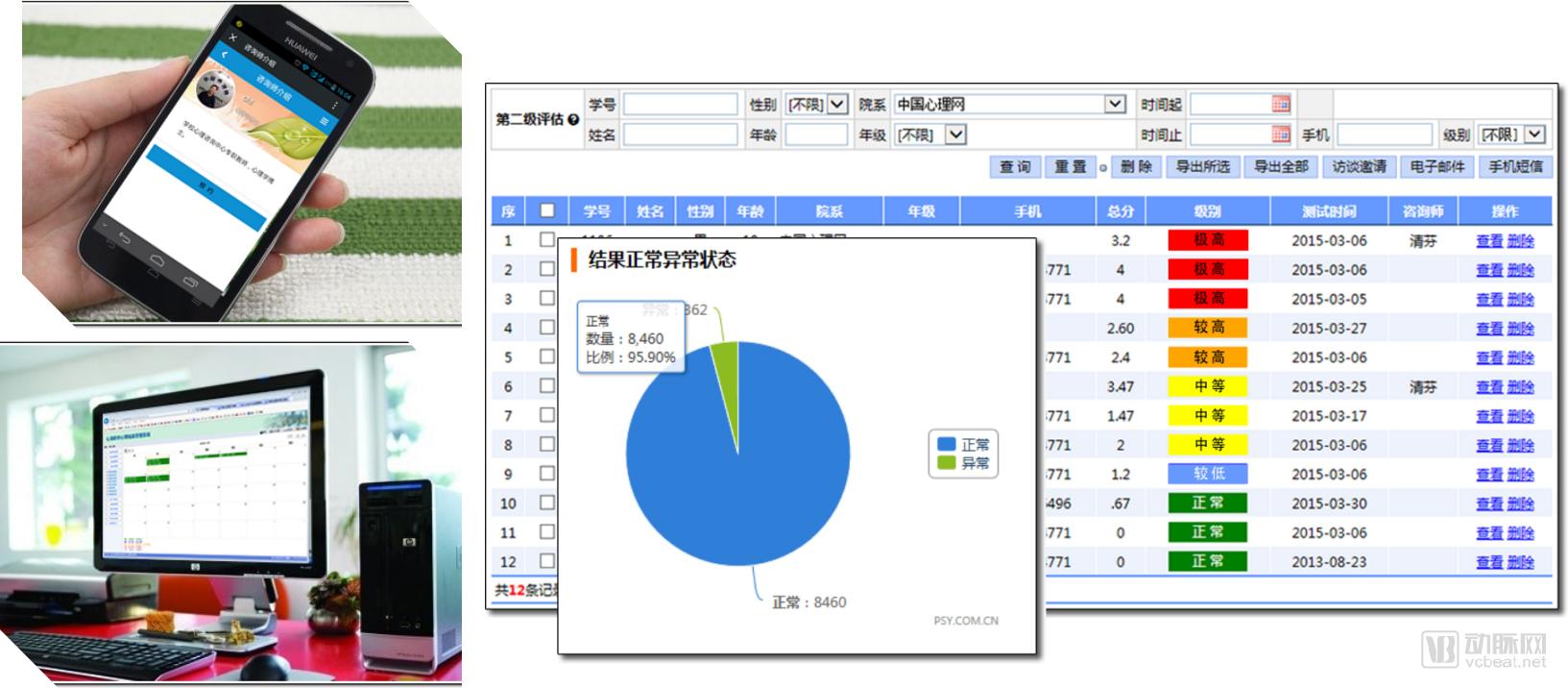
Like many psychological assessments, this software primarily collects information through student responses to questions. The questions cover various factors associated with suicide risk, including personality traits, depressive status, social support, childhood trauma experiences, and family history of psychiatric disorders and suicide. For students identified as having potential suicide risk, the system automatically conducts a further assessment to determine whether there is an immediate risk of suicide.
Upon completion of the assessment, the software can automatically generate an analytical report, screen for students exhibiting tendencies toward dangerous behaviors such as suicide within a defined scope, and provide corresponding psychological counseling plans. It also offers emergency response recommendations for suicide incidents that have already occurred.
Furthermore, in 2016, the CCBT (Computerized Cognitive Behavioral Therapy) system, jointly developed by XinHai Navigation and leading psychologists in China, was officially launched on the market. In light of the more than 27 million individuals suffering from depression in China, Chen Wei believes that intelligent psychotherapeutic products can address common psychological issues such as depression, anxiety, obsessive-compulsive disorder, and insomnia, thereby helping to alleviate the current shortage of mental health professionals in the country.
The R&D team behind XinHai Navigation boasts formidable strength, collaborating with prestigious universities and research institutes—including the Institute of Psychology at the Chinese Academy of Sciences, Tsinghua University’s Psychological Counseling Center, and Peking University’s School of Psychological and Cognitive Sciences—as well as clinical institutions such as Nanjing Brain Hospital, Shanghai Mental Health Center, and Southern Medical University, to jointly develop intelligent products.
After 14 years of dedicated operation in the mental health education market, Xin Hai Navigation was officially listed on the National Equities Exchange and Quotations (NEEQ) on February 20, 2017, entering the capital market and becoming the first publicly traded company in China’s psychological technology sector.
According to Chen Wei, the company’s early clients were primarily major universities, later expanding to primary and secondary schools. Currently, the company’s products are being used by over 1,000 universities and more than 8,000 primary and secondary schools across China, covering 20 million university students and 50 million primary and secondary school students. Due to the scarcity of similar products in the early stages, XinHai Navigation’s software system became the target of “single-source procurement” for many schools. In the market for psychological assessments of college freshmen in China, XinHai Software holds a market share exceeding 80%.
In addition to schools, XinHai Navigation also collaborates with over 500 B-end clients, including public security bureaus, the military, prisons, enterprises, and government agencies.
Transitioning from Psychological Product Sales to Third-Party Psychological Services
Chen Wei stated that Xin Hai Navigation’s current business model comprises two main avenues: first, the sale of software and hardware products required for establishing psychological counseling centers; and second, serving as a third-party service provider to undertake psychological crisis intervention tasks for institutions such as schools, government agencies, and enterprises.
From the perspective of XinHai Navigation’s business model, revenue from the sale of software and hardware products accounts for a significant proportion. Therefore, a key transformation currently underway for XinHai Navigation is shifting from a model centered on the sale of psychological products to one operating as a third-party psychological service provider.
Third-party psychological services, as referred to here, can be illustrated by the following example: In the event of a student suicide at a school, improper handling by the school administration may result in significant liability. Therefore, XinHai Navigation assembles professional teams to assist schools in managing crisis incidents, minimizing harm through both early prevention and post-incident intervention. In this process, XinHai Navigation primarily serves as a “professional management agency” for addressing psychological crises.
For example, large enterprises and public institutions inevitably have a certain population at potential risk of suicide. However, due to traditional perceptions and workplace norms, these organizations are often unable to conduct internal mental health screening and maintenance through their own in-house counselors. As independent third-party professional psychological service providers, external agencies are better positioned to gain client trust and effectively address these issues.
Chen Wei explained that if a company continues to generate revenue solely from product sales, it must constantly iterate its products to maintain a technological edge. Moreover, since sales revenue is one-time in nature, with low repurchase rates and a lack of recurring income, transformation is imperative. When discussing the fundamental reason for this shift, he stated, “The essence of the mental health industry lies in solving problems through services; products are merely tools.”
Establish a Big Data Platform for Mental Health and Build a Mental Health Industrial Park
In the same year XinHai Navigation was established, its subsidiary “China Psychology Network” concurrently obtained the ICP Internet Information Service License issued by the Ministry of Information Industry, becoming China’s only government-approved “state-branded” commercial psychology portal website.
Currently, Chen Wei has developed it into an O2O platform and a mental health big data integration platform that brings together a group of professional psychological counselors. The platform has onboarded more than 1,000 qualified psychological counselors, who provide psychological counseling services via video or in-person sessions.
This is closely related to the mental health big data platform that Chen Wei has mentioned on numerous occasions. Through collaborations with thousands of universities and hundreds of enterprises, Xin Hai Navigation’s standardized psychological profiles have amassed a substantial volume of mental health data, which is being used to develop intelligent models for psychological intervention.
Furthermore, the Chinese Psychology Network website features a section dedicated to psychological big data, offering professional online psychological assessments to support scientific research in this field.
On the evening of May 16, 2017, XinHai Navigation issued an announcement stating its intention to establish a wholly-owned subsidiary, Chongqing XinHai Navigation Technology Co., Ltd., with registered capital of RMB 5 million, using its own funds.
With the support of the Jiulongpo District Government in Chongqing, XinHai Navigation established China’s first psychology industrial park in Chongqing. Covering an area of 15,000 square meters, the park integrates psychological enterprise incubation, psychological product research and development, academic exchanges in psychology, psychological equipment exhibition, big data management for psychology, and psychological counseling alongside a psychological hospital.


China's First Psychological Industry Park (Photo courtesy of Xin Hai Dao Hang)
Given the relatively small size of the psychology industry, no unicorn companies have emerged yet. Therefore, the primary function of the Psychology Industrial Park is enterprise incubation. Chen Wei describes this project as “shipbuilding,” aiming to gather more high-quality enterprises in the blue ocean of mental health and drive industry development. Currently, 16 psychology-related companies have settled in the industrial park.
Furthermore, in response to the requirements for building a national mental health and psychosocial service system, the establishment of psychology industrial parks serves to set standards that assist local governments in developing comprehensive mental health service systems. These initiatives provide solutions such as the construction of intelligent psychological counseling rooms, training for psychology professionals, and integration of local resources to address regional mental health challenges. By fostering a social mindset characterized by self-esteem, confidence, rationality, equilibrium, and positivity, these efforts enhance public service functions within the process of urban modernization.