

Yino Intelligence and Hejia Medical Forge Strategic Alliance to Advance Radiation Oncology in Grassroots Hospitals
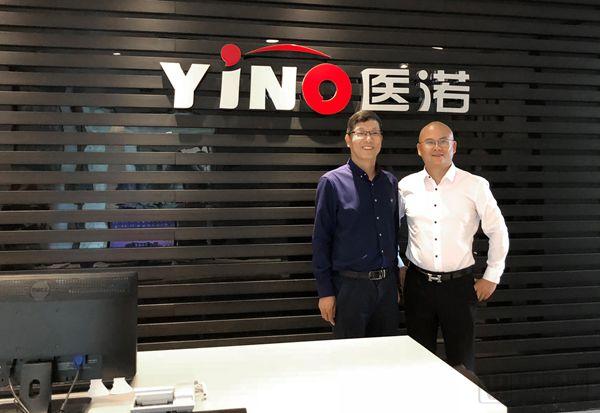
VCBeat (WeChat ID: vcbeat) has learned that Shenzhen Yino Intelligence Technology Development Co., Ltd. (“Yino”) recently signed a strategic cooperation agreement with Zhuhai Hejia Medical Equipment Co., Ltd. (“Hejia Shares”) to establish a new company, Zhuhai Nuojia Medical Technology Service Co., Ltd. (“Nuojia Medical”), jointly promoting the development of oncology diagnosis and treatment services, particularly radiotherapy, in primary healthcare institutions.
Yino Intelligence is a leading oncology medical technology company in China. It has overcome multiple technological barriers established by foreign competitors, resolving data interface challenges for core radiotherapy equipment (including accelerators from various manufacturers). The company has built China’s most comprehensive radiotherapy information management and clinical application system, and has established a remote technical service platform and mobile applications for radiotherapy. By integrating clinical applications with artificial intelligence technologies, it has developed AI-driven clinical tools such as intelligent target volume delineation and treatment plan evaluation. To date, Yino Intelligence has accumulated over 60 intellectual property rights, including invention patents, and its solutions have been implemented in more than 400 radiotherapy centers.
In September 2017, the major research project of the 13th Five-Year Plan supported by the Ministry of Science and Technology, titled “Research on a New Remote Radiotherapy Service Model Based on Big Data and Artificial Intelligence,” jointly applied for by Yino Intelligence, Zhejiang Cancer Hospital, Sun Yat-sen University Cancer Center, and Shandong Cancer Hospital, was approved for establishment by the Ministry of Science and Technology.
The company previously secured tens of millions of RMB in Series A financing, led by Fenxiang Investment. Fenxiang Investment has consistently prioritized providing professional and systematic post-investment services to its portfolio companies, including facilitating and integrating various resources essential for corporate development to foster business synergies. The partnership between Yino and Hejia is inextricably linked to Fenxiang Investment’s emphasis on post-investment support, its timely provision of resource connections to portfolio companies, and its active promotion of collaboration between the two parties.
In recent years, the Chinese government has introduced a series of policies to promote the decentralization of medical resources, creating significant opportunities for primary healthcare development. Yino recognizes that leveraging radiotherapy’s inherent advantages in telemedicine to advance its deployment at the grassroots level should be the future direction. However, the development of radiotherapy in primary hospitals still faces numerous constraints. “First, there is a shortage of specialized professionals; second, technological methods are outdated; third, primary hospitals generally lack the funding and experience needed to establish and operate radiotherapy departments; and fourth, patient retention remains a challenge,” said Li Qiang, Founder of Yino and Chairman of Nuojia Company.
This is precisely why Yino and Hejia have entered into a deep strategic partnership. As a leading domestic oncology medical technology company, Yino has broken through multiple technological barriers previously held by foreign entities. By leveraging its first-mover advantage and industry resources accumulated over years of specialization in radiation therapy, and integrating Hejia’s 20-plus years of experience in the construction, management, and operation of grassroots oncology departments along with its extensive grassroots user channels, the two companies aim to advance the development of grassroots radiation therapy infrastructure.
Hejia Co., Ltd. is a publicly listed company focused on the field of oncology diagnosis and treatment. For over two decades, it has been deeply engaged in interventional oncology services at primary-care hospitals across China, accumulating extensive experience in the development, management, and operational oversight of grassroots oncology departments.
Hejia Shares announced that this collaboration is a proactive response to the national tiered diagnosis and treatment policy, aimed at further expanding its investment layout in the field of oncology treatment. Leveraging its medical resources and operational experience accumulated in tumor interventional therapy, the company will provide systematic tumor radiotherapy solutions to primary care hospitals. This initiative seeks to achieve business expansion and value chain extension in the field of comprehensive oncology treatment, thereby building an ecosystem platform for comprehensive cancer care.
Looking ahead, Hao Zhenxi, Chairman of Hejia Shares, expressed the company’s aspiration to ultimately establish a network of radiotherapy centers spanning diverse regions, serving cancer patients with varying financial capacities and geographic backgrounds. The company aims to build a comprehensive ecosystem for holistic cancer treatment, positioning itself as a driver in the development of primary-care radiotherapy infrastructure in China and as the leading private-chain radiotherapy brand.
The signing ceremony garnered widespread attention within the industry. Nearly 100 renowned experts from across the Chinese Mainland, Taiwan, Hong Kong, and Macao attended the event, affirming the collaboration between the two parties and expressing high expectations for the future of third-party independent radiotherapy centers.
At the signing ceremony, Professor Chen Ming, President of Zhejiang Cancer Hospital and Secretary-General of the Society of Radiation Oncology under the Chinese Medical Association, pointed out that the current development of radiotherapy in China is characterized by “inadequacy, imbalance, and mismatch.” Given the broad consensus on the trend of “Internet + Healthcare,” it has become an inevitable development path to leverage informatization and remote radiotherapy collaboration to support the development of grassroots radiotherapy services, and to promote the establishment of independent third-party radiotherapy centers open to the public.
Sun Ying, Assistant to the President of Sun Yat-sen University Cancer Center, stated at the signing ceremony that radiotherapy is a complex, multidisciplinary oncology treatment modality integrating advanced imaging, clinical practice, and medical physics. It involves intricate workflows and stringent quality control, and is closely intertwined with information technology. The popularization of radiotherapy at the primary care level must be built upon the integration of informatization and tele-radiotherapy. She expressed her expectation that the collaboration between Yino and Hejia would effectively promote the development and establishment of radiotherapy services at the grassroots level.