

Four Key Fiscal Signals to China's Healthcare Sector Following the 2018 Central Government Budget Announcement
Recently, the Ministry of Finance publicly released the “2018 Central-Level Expenditure Budget Table” (hereinafter referred to as the “Budget Table”) and simultaneously issued the “Explanation on the 2018 Central-Level Expenditure Budget” (hereinafter referred to as the “Explanation”), clarifying the plan for the use of fiscal funds this year. VCBeat (WeChat ID: vcbeat) has reviewed the “Budget Table” and the “Explanation,” highlighting key reading points for professionals in the healthcare sector.For ease of reading, VCBeat has included excerpts from the “Budget Table” in its key summaries.
Through horizontal comparison, we found that the 2018 budget for healthcare and family planning expenditures was RMB 20.905 billion, representing a 55.5% increase from the 2017 actual expenditure of RMB 13.447 billion. Meanwhile, the 2018 budget for central-level expenditures was RMB 3,246.6 billion, an 8.1% increase from the 2017 actual figure of RMB 3,003.769 billion. The budget growth rate for healthcare and family planning expenditures was significantly higher than that for central-level expenditures, with fiscal budget support once again placing the healthcare industry in the spotlight.
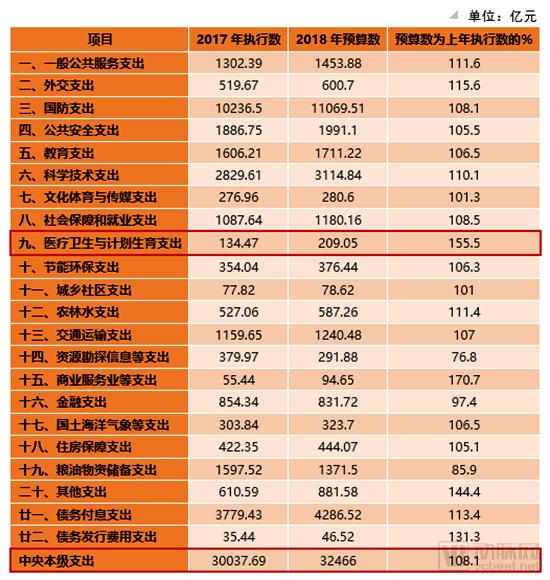
Data source: Official website of the Ministry of Finance
A year-on-year comparison reveals that the 2018 budget for “Medical and Health Services and Family Planning Expenditure” increased by RMB 7.458 billion compared to the 2017 actual expenditure, with the additional funds allocated across 30 subcategories. Among these, the 2018 budget for “Other Public Hospital Expenditure” rose by RMB 943 million compared to the 2017 actual expenditure, accounting for more than one-eighth of the total budget increase in “Medical and Health Services and Family Planning Expenditure,” representing a substantial growth rate of 10,477.8%.
According to the "Instructions,"The additional expenditure will be primarily used to subsidize the comprehensive reform of public hospitals.The comprehensive reform of public hospitals commenced in 2010 and was gradually rolled out in 2011. It has consistently remained the core of the new healthcare reform and constitutes its most challenging domain. To date, the mechanism of subsidizing hospital operations through drug profits has been fundamentally dismantled by abolishing drug markups. The compensation structure for public hospitals has been transformed from the previous three channels—service fees, drug markup revenue, and government subsidies—to two channels: service fees and government subsidies, thereby consolidating the public welfare nature of public hospitals. The significant changes in the "Budget Table" align with the requirements for fully implementing government funding responsibilities as stipulated in the "Notice on Consolidating the Achievements in Abolishing Drug Subsidies and Continuously Deepening the Comprehensive Reform of Public Hospitals," issued by the National Health Commission in March this year. This further safeguards the comprehensive reform of public hospitals from the perspective of government compensation.
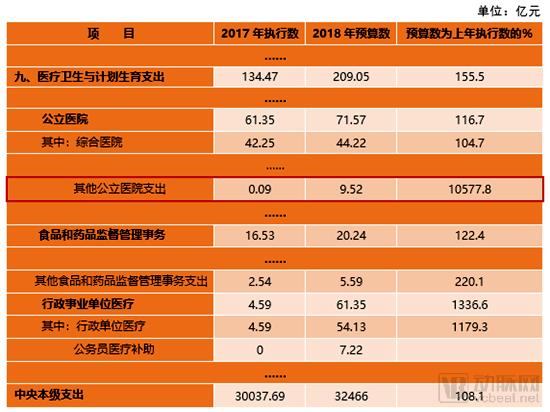
Source: Official Website of the Ministry of Finance of China
By further deconstructing the Budget Table, we note that while analyzing the absolute changes in expenditure budgets can reveal signals of sustained efforts in the comprehensive reform of public hospitals, examining the relative changes in expenditure budgets can also help us identify significant fiscal signals. In this section, we focus on cases where the relative growth in expenditure budgets exceeds20%sub-sectors.
According to the “Explanation,” excluding one-time capital construction expenditures, expenditures related to the Xinjiang Production and Construction Corps, and other factors such as institutional reforms, based on fiscal investment,Occupational Disease Prevention and Treatment Hospitals, Children's Hospitals, Industry-Specific Hospitals, Urban Community Health Institutions, Blood Collection and Supply InstitutionsDevelopment in these niche sectors will be relatively active.
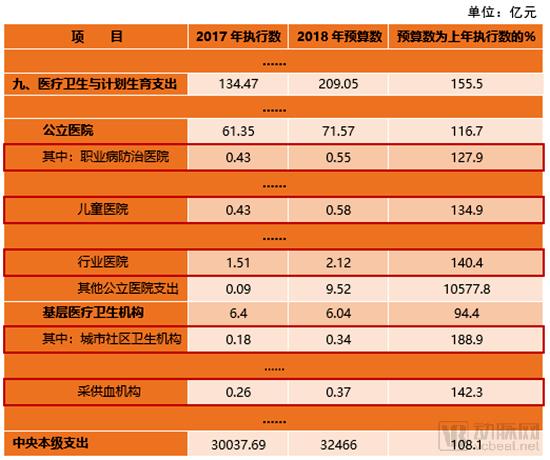
Data Source: Official Website of the Ministry of Finance
Having identified the above three signals, we believe it is more appropriate to shift the focus from the 55.5% year-on-year increase in healthcare-related fiscal expenditure this year to the reform of public hospitals. To this end, we have compiled a time series of budgetary expenditures for public hospitals since the launch of the new healthcare reform in 2009.
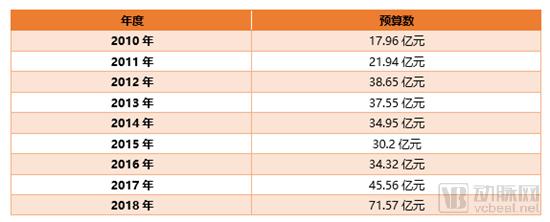
Source: Official Website of the Ministry of Finance of China
We have observed a significant upward trend in the expenditure budgets of public hospitals between 2016 and 2018. By reviewing the explanatory notes on the central-level expenditure budgets for the corresponding years, we found that the fluctuations in public hospital expenditure budgets from 2010 to 2016 were all due to increases or decreases in one-off capital construction expenditures, whereas the growth in public hospital expenditure budgets in 2017 and 2018 was centered aroundSubsidies for Comprehensive Reform of Public HospitalsExpand.
Meanwhile, our review of the budget explanations for central-level expenditures over the past decade reveals that the probability of budget increases being driven by the same rationale for two consecutive years is nearly zero in other sectors. This finding allows us to cautiously conclude that the comprehensive reform of public hospitals may signal an impending wave of capital investment. Going forward, VCBeat will continue to closely monitor new developments in the comprehensive reform of public hospitals.