

Tencent's Three Key Overseas AI Healthcare Collaborations: Strategic Insights for Entrepreneurs
Recent reports indicate that Tencent has reached an agreement with Babylon Health, a renowned UK-based AI healthcare company, to pilot health assessments on the WeChat platform using its artificial intelligence algorithms. Through this collaboration, Tencent aims to introduce into the Chinese market the capabilities of emerging companies that have established a foothold overseas. This is not the first time Tencent has undertaken such an initiative. In the realm of medical innovation, particularly in AI-driven healthcare, Tencent appears to be advancing a strategy of seeking overseas partners and leveraging external expertise to accelerate and deepen its healthcare business operations.
It is worth noting that this case differs from the overseas investments by BAT (Baidu, Alibaba, and Tencent) that we have frequently observed in the past; it also differs from the business collaborations between tech and industrial giants with long-established operations in China, such as IBM and AstraZeneca, and local Chinese innovative companies.
Tencent’s approach to such strategic partnerships is characterized by four key features: First, the partners are overseas innovative companies with no prior business presence in China, meaning they lack an established foothold in the Chinese market. Second, the collaborations are not predicated on equity investment; there is currently no equity stake or shareholding involved. Third, the scope of cooperation is closely aligned with Tencent’s own business needs. Fourth, the objective of these partnerships is to deeply penetrate the Chinese market, rather than to pursue overseas expansion.
Tencent has integrated and directly operated numerous healthcare-related businesses, with its pace accelerating significantly since 2017. These initiatives include WeChat Smart Pharmacies, WeSure, TengAi Doctor, Penguin Doctor, Tencent Miying, and Penguin Medical Encyclopedia. By personally engaging in operations, Tencent is adopting a fundamentally different approach from its previous strategy of purely financial investments.
Rapidly deepening and expanding layer by layer in sectors where Tencent has already established a presence requires multidimensional integration, particularly the application of leading-edge technologies, exploration of implementation models, and access to certain specialized capabilities or resources. With scarce domestic alternatives or prohibitively high costs, importing solutions from overseas has become a viable option. This evolving trend will inevitably impact the opportunities and prospects for local startup teams.
Next, I will examine the details of Tencent’s various collaborations.
Babylon Health Chatbot Consultation
In April 2018, Tencent announced a strategic partnership with the UK-based health tech company Babylon Health. Those following developments in AI-driven healthcare are likely familiar with Babylon Health. Although the company was founded in 2013, it became a hot topic within China’s health tech startup community in 2017.
This is primarily because Babylon Health offers remote medical consultation services powered by AI technology, including the use of chatbots for symptom checking. Babylon Health raised $25 million in its Series A funding round in 2016, and subsequently secured $60 million in its Series B funding round in April 2017.
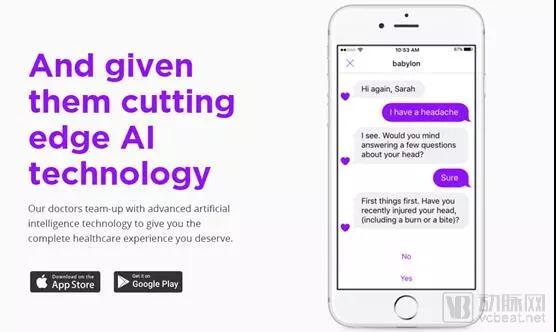
Babylon Health Uses AI Technology to Provide Remote Consultations
Achieving reliable self-diagnosis or triage, whether fully or partially, has been a target area for many health tech companies in recent years. In fact, Chunyu Doctor attempted to offer simple online self-diagnosis tools at least three years ago. This demand has always existed, but there has yet to be a satisfactory solution.
Currently, there are no mature projects in China that leverage intelligent conversational interfaces at the initial consultation stage to provide users with medical inquiry and advisory services. As an instant messaging platform, WeChat inherently possesses advantages for hosting chatbot applications.
Not long ago, many were wondering when China would see an app like Babylon Health. Now, Tencent has ushered it through the door. Tencent’s engagement with Babylon Health appears highly targeted. Reports indicate that the two parties will collaborate on exploring and researching health assessments and other areas based on Babylon Health’s artificial intelligence system, while also piloting the localization of this system in China. We will wait and see how things unfold.
Medopad Data Value Extraction
In February 2018, UK-based health technology company Medopad announced a strategic partnership with Tencent. Founded in 2011, Medopad raised $5.4 million in seed funding in 2016. Coinciding with the announcement of its collaboration with Tencent, the company secured $28 million in Series A financing from a Hong Kong-based institution.
Medopad leverages AI technology to develop a medical data collection platform that serves both patients and healthcare providers. For instance, by integrating with Apple’s HealthKit, Medopad enables hospitals to consolidate patient data onto its platform, allowing physicians to monitor patients remotely and access real-time information.
In this collaboration, Medopad is partnering with Tencent’s AI Medical Laboratory. Reports indicate that Tencent and Medopad will jointly research the clinical applications of AI technologies to provide more intelligent medical diagnostic and healthcare support for physicians and patients. This includes AI-powered chatbots for clinical decision support, as well as tools for monitoring patient conditions, analyzing patient data, and providing decision-making assistance for physicians’ diagnoses.
Currently, the Tencent AI Healthcare Laboratory primarily focuses on two main areas: AI medical imaging and AI diagnosis. The collaboration with Medopad appears to center mainly on AI diagnosis. According to Tencent, its dual-track development model—simultaneously expanding in both domestic and international markets—facilitates the adoption of the latest cutting-edge technological trends from abroad and the integration of mature overseas healthcare system models.
Unlike the partnership with Babylon Health, Tencent’s collaboration with Medopad reflects not only a technological alliance but also a stronger intent to introduce overseas resources and learn from its business model. It is evident that Medopad offers tailored solutions for various stakeholders, including healthcare providers, insurance companies, pharmaceutical firms, and governments, thereby serving multiple segments across the industry value chain.
For example, Medopad can also provide valuable experience to Chinese enterprises and relevant medical institutions in areas such as storage management data and the integration of patient and physician resources.
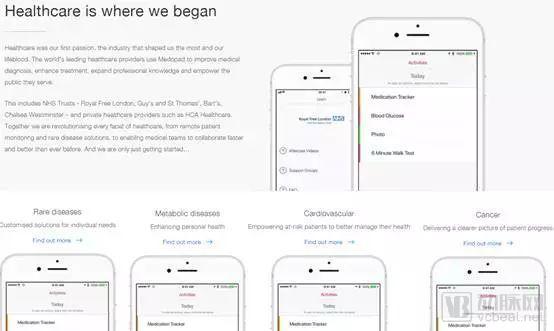
Medopad Provides Healthcare Institution Solutions

Medopad Offers Solutions for Pharmaceutical Companies
Nevertheless, Medopad has also secured 15 collaborative agreements with other domestic healthcare enterprises, including Ping An Good Doctor and GlaxoSmithKline China, claiming that its cooperative projects in China involve hundreds of millions of pounds. It is evident that Medopad’s strategic intent is focused on the Chinese market. In contrast, Tencent is not targeting overseas markets; rather, it aims to introduce and leverage overseas resources, technologies, and expertise to deepen its penetration of the Chinese market through collaboration.
Healthwise Authoritative Medical Information
In October 2017, Tencent entered into a partnership with Healthwise, a leading U.S. health and medical information platform. Two months later, Penguin Medical Encyclopedia was officially launched, positioning itself as a hub for top-tier popular science medical resources from both China and abroad. The two developments are closely linked.
For the general public, authoritative and reliable medical and health information has long been difficult to access, which is one of the key reasons why the information gap between doctors and patients remains hard to bridge. Baidu’s previous approach drew widespread criticism. While leveraging internet technologies to reduce information asymmetry is inherently an efficient model, the reliability of online information sources has repeatedly come under scrutiny. Behind the content produced by various websites and official WeChat accounts lie numerous opaque interest relationships. To date, no satisfactory solution has emerged to address this market pain point—a gap that Tencent has recognized.
Tencent stated: By leveraging big data and AI capabilities, Tencent is able to uncover more application scenarios and distribute content across a broader range of platforms, including WeChat and QQ, thereby providing authoritative, precise, and highly practical medical science popularization content to a wider user base.
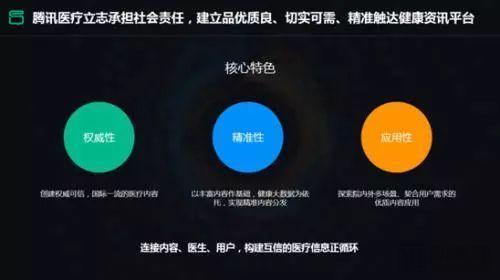
Three Core Features of the Tencent Health Information Platform
How, then, can authority be ensured? Partnering with Healthwise is a key strategic approach to achieving authoritative and reliable content.
Healthwise is, in fact, a U.S.-based non-profit organization with a 42-year history in the United States. Recognized as an authoritative provider of health and medical information, its patient education materials are widely adopted by numerous renowned clinical medical institutions.
By partnering with Healthwise, Tencent has introduced high-quality licensed content from overseas into China. Meanwhile, Tencent stated that it has established its own professional medical editorial team and collaborated with leading experts across 22 specialty fields in China to localize the content by integrating Chinese clinical experience, thereby making it more aligned with national conditions.
It is worth noting that, regarding the future development of the product "Penguin Medical Dictionary," authority is only one aspect, addressing the public's trust in information. Beyond authority lies precision; in other words, precision corresponds to the accurate matching of individual needs. It is foreseeable that Tencent will employ various technological means, including AI technology, to deliver personalized medical and health content services.
Furthermore, applicability represents a more advanced dimension. It can be understood as leveraging content to explore a wider range of use cases, going beyond the simple provision of general public health information. The most typical example is patient education tailored to diverse scenarios, including both in-hospital and out-of-hospital settings. This approach will closely connect with other stakeholders within the healthcare industry, thereby serving as a pathway for future value monetization.
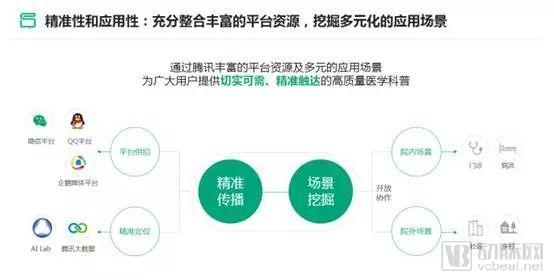
The Intent of Precision and Applicability of Tencent Health Information Platform
As we can see, all three of Tencent’s aforementioned partnerships have taken place in recent months. Spanning frontier technologies, application models, and authoritative content, these initiatives are multidimensional yet closely aligned with Tencent Healthcare’s core business operations. This demonstrates not only consistency with its overall strategic layout but also a remarkably tight integration with actual business practices. These gradually emerging intentions compel us to regard the future of Tencent Healthcare with greater awe. For other grassroots teams operating within the same competitive landscape, the pressure will be significantly amplified.
This also serves as a reminder:
First, in the field of medical technology entrepreneurship, overlap with Tencent across many sectors has become unavoidable;
Second, overseas teams have, in one form or another, become competitors to domestic entrepreneurs in the Chinese market;
Third, if conditions permit, forming overseas alliances is also an option to accelerate progress.
Author: Gu Beini
Long engaged in innovative business research and providing strategic consulting for tech startup teams. Holds a Master’s degree in Management, with 15 years of experience in the consulting industry and financial media. Co-founded VCBeat in 2014. Contributing author to prominent media outlets such as CEIBS Business Review, 36Kr, and TMTPost.
WeChat: gugreaty; WeChat Official Account: Future Main Agenda