

Ma Huateng Outlines Tencent's Vision for Smart Hospitals, AI, and Blockchain-Powered Prescription Flow at 2018 Internet+ Digital Economy Summit
From April 12 to 13, 2018, the China “Internet Plus” Digital Economy Summit was held in Chongqing. Themed “Empowering the New Ecosystem, Sharing New Opportunities,” the summit was guided by the Chongqing Municipal People’s Government and jointly organized by the National Party Media Information Public Platform of People’s Daily, the Chongqing Municipal Commission of Economy and Information Technology, and Tencent. At the event, Ma Huateng, Chairman of the Board and Chief Executive Officer of Tencent, delivered a speech titled “Internet Plus Empowers the Construction of Digital China.”
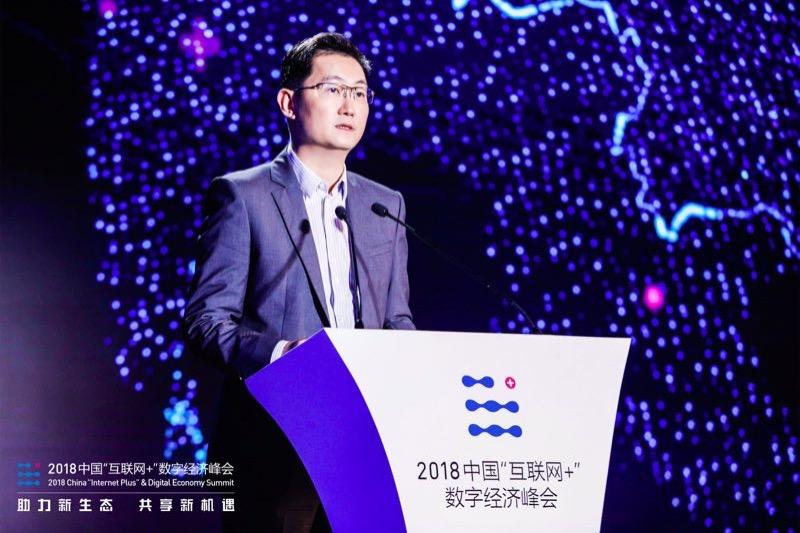
As one of the media outlets participating in the 2018 China “Internet Plus” Digital Economy Summit, VCBeat has compiled first-hand materials from Ma Huateng’s speech for its readers.
Pony Ma used the four digits “1-3-5-7” to share his further reflections on “Internet Plus,” namely: one goal, three roles, five domains, and seven tools.
Among them, “one goal” refers to Tencent’s aim to become a “digital assistant” for various industries, helping them achieve digital transformation and upgrading.
“The Three Roles” refer to Tencent’s focus on three key areas: building connections, providing tools, and fostering an ecosystem.
“Five Domains” refers to the expansion and advancement of Digital China over the past two years across five areas: public welfare and government services, daily consumption, production services, life and health, and ecological environmental protection. Tencent aims to support the digital transformation and upgrading of these “Five Life” sectors.
"The Seven Tools" include digital tools such as Official Accounts, Mini Programs, mobile payments, social advertising, WeCom, cloud computing, big data and artificial intelligence, and security capabilities.
In the healthcare sector, Tencent’s positioning as a “connector” has remained unchanged. In his morning speech, Ma Huateng primarily highlighted Tencent’s efforts in smart hospitals, artificial intelligence, and prescription outflow.
Below is a transcript of the speech along with a summary of the corresponding background events:
Smart Hospital
In previous years, it was a common experience that patients had to queue up for registration and payment at hospitals. By partnering with hospitals, we have streamlined the entire patient journey—from appointment scheduling to payment—through WeChat, saving valuable time for everyone. After addressing these initial bottlenecks, we identified further opportunities to integrate processes related to laboratory test reports, prescriptions, basic medical insurance, and commercial health insurance. Consequently, in collaboration with social security authorities, we have rolled out the “WeChat Social Security Card” in 27 provinces and municipalities across China.
Based on implementation experience across multiple cities, the launch of “WeChat Medical Insurance Payment” in hospitals has saved each patient an average of over 40 minutes.
Background
In terms of healthcare payments, after several years of promotion and operation, WeChat’s medical insurance payment service has been implemented in multiple regions, including Guangxi, Shenzhen, Chengdu, Zhengzhou, Shantou, Tongchuan, and Xiamen, enabling in-clinic hospital payments and WeChat Pay for medication purchases at pharmacies. Meanwhile, numerous other cities across China, such as Xinjiang, Weifang, Jiaxing, Taizhou, Xiamen, Harbin, Nanchang, Shenyang, Yongkang, and Kaifeng, are accelerating their deployment efforts.
On August 20, 2017, the Chongqing Municipal Commission of Economy and Information Technology signed a strategic cooperation agreement with Tencent to deepen collaboration in sectors including commerce, education, government services and public welfare, community development, healthcare, and transportation, jointly building an open and shared mobile-payment-enabled smart city. In the healthcare sector, 22 hospitals in Chongqing, such as Southwest Hospital, the First Affiliated Hospital of Chongqing Medical University, the Second Affiliated Hospital of Chongqing Medical University, and Chongqing Three Gorges Central Hospital, have implemented online appointment registration services. Residents can schedule appointments simply by accessing the “City Services” feature on WeChat.
In December 2016, the Children’s Hospital of Chongqing Medical University officially became China’s first flagship hospital to support WeChat Pay. To date, transactions for medical fees made via WeChat Pay account for 59% of all payment transactions. At this hospital, every step—from parking and registration, consultation, inquiries, and bill payment to inpatient admission procedures—even meal ordering services, can be completed through WeChat.
Medical AI
In 2017, we advanced the application of digital technologies in healthcare to the diagnosis and treatment stages. Tencent launched “Tencent Miying,” an AI-based medical product that leverages AI medical imaging technology to support diagnosis and treatment, covering screening for multiple conditions including esophageal cancer, pulmonary nodules, and diabetic retinopathy.
Currently, Tencent Miying has been deployed in more than 100 Grade A tertiary hospitals, helping physicians improve diagnostic efficiency and accuracy. “Tencent Miying” has already been implemented in multiple Grade A tertiary hospitals in Chongqing.
Background
On August 23, 2017, Tencent Miying’s early esophageal cancer screening system was launched at the People’s Hospital of Guangxi Zhuang Autonomous Region;
As of the end of September 2017, Tencent Miying had jointly established Artificial Intelligence Medical Imaging Joint Laboratories with Sun Yat-sen University Cancer Center (Guangdong Esophageal Cancer Institute), Guangdong Second Provincial General Hospital, Shenzhen Nanshan District People’s Hospital, Liuzhou Workers’ Hospital, West China Second University Hospital of Sichuan University, West China Fourth Hospital of Sichuan University, and Sichuan Second Traditional Chinese Medicine Hospital.
On September 26, 2017, Lishui Central Hospital signed a framework cooperation agreement on “Internet + Smart Hospital” with Tencent in Shenzhen, becoming the first hospital in Zhejiang Province to formally sign an agreement with Tencent.
In late October 2017, Tencent Miying joined forces with 69 members of the “Western Ophthalmology Alliance,” including the Fourth Hospital of Xi’an, to establish the “Joint Laboratory for Artificial Intelligence in Medical Imaging.”
On November 15, 2017, Tencent Miying was included in the first batch of national open innovation platforms for next-generation artificial intelligence.
On November 17, 2017, the Tencent Miying AI Medical Imaging Diagnosis Project was launched at Wenzhou Central Hospital;
On November 21, 2017, the Obstetrics and Gynecology Hospital of Fudan University signed an agreement with Tencent, planning to leverage Tencent Miying to enhance operational efficiency within the hospital and its medical consortium. The two parties will collaborate and explore opportunities in the field of AI-driven healthcare, including applications such as screening for cervical cancer.
On November 23, 2017, Tencent Miying was fully deployed in Hebei Province, establishing collaborations with Hebei Medical University, the First Hospital of Hebei Medical University, the Third Hospital of Hebei Medical University, the Fourth Hospital of Hebei Medical University, and Hebei Eye Hospital.
On December 1, 2017, Tencent Miying was fully deployed in Chongqing. Five major Grade A tertiary hospitals in the Chongqing region—including the First Affiliated Hospital of Chongqing Medical University, Chongqing Fuling Central Hospital, Chongqing Fourth People’s Hospital, Chongqing Three Gorges Central Hospital, and Chongqing Ninth People’s Hospital—will gradually leverage Tencent Miying’s artificial intelligence technology to assist physicians in screening for early-stage esophageal cancer, pulmonary nodules, diabetic retinopathy, and other conditions.
On December 3, 2017, the Tongxiang Health and Family Planning Bureau and Tencent signed a cooperation agreement on the “Medical Artificial Intelligence Project” in Wuzhen, establishing the “Tencent Internet+ Medical Big Data Research and Demonstration Base,” marking the full deployment of Tencent Miying in Tongxiang City;
On December 4, 2017, Zhejiang Provincial People’s Hospital and Tencent unveiled the “Joint Laboratory for Artificial Intelligence in Medicine” in Hangzhou, leveraging Tencent Miying to conduct research and applications in AI-powered healthcare. Meanwhile, the two parties will also collaborate with Zhuojian Technology to promote the launch of innovative medical payment services, including WeChat-based medical insurance payments and WeChat-based payments for the New Rural Cooperative Medical Scheme.
On December 6, 2017, Tencent Miying was launched at Shenzhen Traditional Chinese Medicine Hospital;
On December 7, 2017, the Second Hospital of Lanzhou University and Tencent held a signing ceremony for the “Internet + Smart Hospital” initiative and unveiled the “Joint Laboratory for Artificial Intelligence in Medicine.” The two parties will join forces to explore the applications of Tencent Miying in the fields of AI medical imaging and AI-assisted diagnosis, while also collaborating on innovations in mobile payment and electronic prescriptions.
On December 9, 2017, Liuzhou, Guangxi, partnered with Tencent Miying to deepen cooperation in “Internet + Healthcare,” strengthening collaboration in areas such as medical insurance payment, online consultations, and prescription circulation to jointly build smart hospitals.
On December 14, 2017, Tencent Miying was fully launched at the Affiliated Hospital of Yan’an University to assist physicians in conducting AI-assisted screening for lung cancer.
In less than six months, the number of hospitals partnering with Tencent Miying has approached 100 (including 69 medical institutions from the “Western Ophthalmology Alliance”).
Prescription Outflow and Blockchain
Meanwhile, in collaboration with Liuzhou, Guangxi, we built upon existing WeChat-based registration and payment functionalities to launch China’s first “out-of-hospital prescription circulation” service. This model enables prescriptions to be issued within the hospital while medications are purchased externally, with even home delivery options available. Given that prescription circulation involves multiple stakeholders—including the National Health and Family Planning Commission, hospitals, pharmacies, and pharmaceutical manufacturers—we employed blockchain technology to ensure the integrity and immutability of prescriptions. We are also actively promoting the practical implementation and adoption of this technology.
Background
Prescription Outflow
In August 2015, WeChat unveiled the “WeChat Smart Pharmacy” solution, proposing an “Internet Plus” action guide for the pharmaceutical retail industry to address the pain points of traditional pharmacies. The solution encompasses online pharmacist consultations, member profiles, medication reminders, and marketing campaigns, as well as in-store shopping assistance and WeChat Pay.
In May 2017, Tencent, Liuzhou Workers' Hospital, and Guangxi Liuzhou Pharmaceutical Co., Ltd. established a partnership, launching the "Out-of-Hospital Prescription Circulation" service at Liuzhou Workers' Hospital. By accepting electronic prescriptions issued by physicians via its WeChat official account, the platform enables patients to purchase medications outside the hospital. The system initially covered eight pharmacies under the Liuzhou Pharmaceutical Group. Going forward, patients can freely choose to pick up their medications either within the hospital or at designated out-of-hospital pharmacies after their consultations.
Blockchain
In 2016, Tencent began independently developing its underlying blockchain technology, completed the comprehensive accumulation of this foundational technology in 2017, and successfully entered the commercial application phase.
In April 2017, Tencent released the *Blockchain Solution White Paper*, and in September of the same year, it became the first company to pass the *Trusted Blockchain Testing Standards* issued by the China Academy of Information and Communications Technology (CAICT). To date, Tencent Blockchain has been applied across multiple sectors, including finance, healthcare, philanthropy, legal services, and logistics.
At the conclusion of his speech, Ma Huateng stated that China’s economy is currently undergoing a transition from old to new growth drivers, with innovation playing a pivotal role. The development of Digital China will accelerate the global digitalization process and offer the world a “Chinese model” and “Chinese solutions.”