

Berry Genomics Reports 2017 Revenue of RMB 1.17 Billion, with 94.54% from Medical Testing Services and Products
On the evening of April 11, 2018, VCBeat learned that Berry Genomics, a leading domestic genetic testing company, had released its 2017 annual report. The report showed that Berry Genomics’ total revenue for 2017 reached RMB 1.17 billion, representing a 27.07% increase compared to 2016.
Financial indicators show that Berry Genomics' total operating revenue for the full year 2017 amounted to approximately RMB 1.17 billion, representing a year-on-year increase of 27.07% compared with 2016. The net profit attributable to shareholders of the listed company was approximately RMB 233 million, a year-on-year increase of 54.12% over 2016. The basic earnings per share for 2017 were RMB 0.92, up 22.67% from RMB 0.75 in 2016.
However, the profit distribution plan for 2017 announced by the company shows that, based on the company’s operational and financial performance in 2017 and in light of its development plans for 2018, the proposed profit distribution plan for 2017 is as follows: no cash dividends will be distributed, no bonus shares will be issued, and no capital reserve will be converted into share capital.
In August 2017, Berry Genomics completed a major asset restructuring and officially listed on the A-share market through a backdoor listing of Tianxing Instrument. Currently, the company’s business primarily consists of two segments: sequencing-based genetic testing services, and the sale of equipment and reagents. These two business segments cover the fields of medical products and basic scientific research services, with medical testing services mainly divided into two application areas: genetics and oncology.
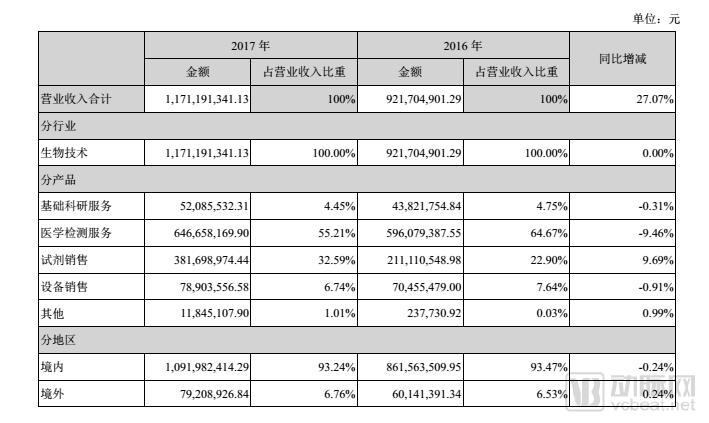
The annual report shows that among the revenue proportions of various businesses, medical testing is currently the company's primary source of income, with product and service revenues accounting for 94.54% of the company's total income; among them, medical testing services totaled approximately RMB 647 million, accounting for 55.21% of the total revenue. Additionally, reagent sales and equipment sales accounted for 32.59% and 6.74%, respectively, while basic scientific research services currently account for only 4.45%.
The gene sequencing industry, a frontier sector in biotechnology, is predominantly driven by clinical medical applications and is increasingly expanding into the broader health and wellness domain. Among its various segments, genetic testing and oncology testing are currently the fastest-growing areas.
In the field of genetics, Berry Genomics has adopted a dual strategy of products and services, establishing cooperative relationships with 2,000 hospitals across China through medical testing services and the sale of instruments and reagents.
In the field of oncology, the company conducts its cancer-related business by investing in and taking equity stakes in project companies, and develops comprehensive personalized tumor testing products based on its independent intellectual property rights.
In November 2017, Berry Genomics injected RMB 3.4 million into its subsidiary, Fujian Huirui Gene, and sold a 70.59% equity stake, thereby securing a total investment of RMB 800 million from seven institutional investors for the subsidiary. Currently, Huirui Gene is fully dedicated to the research and development of early-stage tumor diagnosis projects. Through this strategy, Berry Genomics aims to establish its market presence in early detection, transitioning from its previous focus on late-stage testing.
In 2017, the company’s R&D investment amounted to approximately RMB 40.26 million, representing a 17.12% decrease from RMB 48.58 million in 2016. During this period, however, the company increased its R&D spending on technological development in the clinical translation of genetics and oncology, particularly in the productization of various testing services. While developing new testing service offerings on its existing platform, the company also extended its existing testing services toward productization.
Following its listing on the A-share market, Berry Genomics gained access to new financing channels and subsequently intensified its strategic deployment in oncology testing. In September 2017, the company entered into a strategic partnership with IBM Watson, introducing the Watson for Genomics solution into China’s cancer treatment system for the first time. In November, it launched an R&D project for early cancer diagnosis through equity investment, thereby extending its oncology testing business from late-stage to early-stage detection.
On the path to commercializing gene sequencing technologies, the company has incubated a multi-tiered product portfolio, including the Beibian series, Konuoan, Whole Exome Sequencing series, Whole Genome Sequencing series, Oncology OncoAn series, and early cancer detection solutions. It has established testing centers in Beijing, Shanghai, Chengdu, Chongqing, Changsha, Qingdao, Fuzhou, Hong Kong, and other locations. To date, the company has expanded its presence across more than 30 provinces and municipalities in China, serving over 2,000 hospitals.
In the future, the company will focus on clinical medical applications as its main line of business and gradually expand into broader areas of general health. In the field of medicine, it will concentrate on two of the fastest-growing market segments: genetic testing and clinical oncology testing. The goal is to achieve full control over genetic diseases and make gene-based testing the cornerstone of cancer prevention and treatment, progressively enabling early diagnosis of cancer and comprehensive monitoring throughout the entire course of cancer therapy. The company will also establish a healthcare big data industrial park, integrating phenotype-genotype databases, and leverage artificial intelligence and other methods to enhance their accuracy and user-friendliness.
In addition, Berry Genomics will focus on the research and development of whole-genome sequencing testing services in the coming years, with the aim of achieving clinical application.