

Fosun Pharma Reports Q1 2018 Revenue of RMB 5.719 Billion, Up 47% YoY, Driven by New Drug Launches and Hospital Operations
Recently, Fosun Pharma released its first-quarter report for 2018, reporting revenue of RMB 5.719 billion, a year-on-year increase of 47.38%; net profit excluding non-recurring items amounted to RMB 527 million, up 1.72% year on year. Meanwhile, Fosun Pharma continued to increase its R&D investment in monoclonal antibody biologic innovative drugs and biosimilars, small-molecule innovative drugs, and the promotion of consistency evaluations, with R&D expenses reaching RMB 277 million, a year-on-year increase of 40.28%.
Beyond the annual report, capital markets’ sentiment toward Fosun Pharma is also quite intriguing. VCBeat (WeChat ID: vcbeat) has observed that from March 2017 to March 2018, Fosun Pharma’s market capitalization climbed steadily, surging from approximately RMB 65 billion to nearly RMB 120 billion—roughly doubling in value. However, over the past month, its stock price has experienced volatility, with market capitalization retreating to around the RMB 100 billion mark.
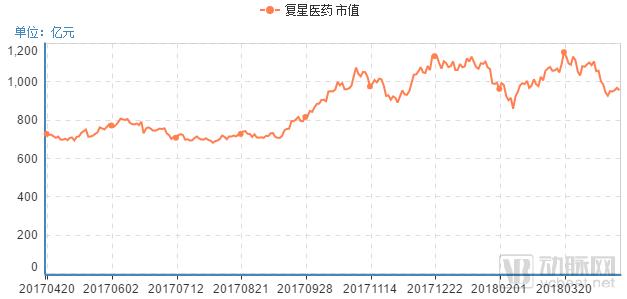
Fosun Pharma adheres to the development philosophy of “organic growth, inorganic expansion, and integrated development,” maintaining rapid growth over the past decade—with a compound annual growth rate (CAGR) of approximately 22% in net profit attributable to shareholders after deducting non-recurring items. In recent years, Fosun Pharma’s strategic layout in pharmaceutical manufacturing and the integration of healthcare resources has begun to yield tangible results, further elevating market expectations.
Cumulative fundraising from the capital markets exceeded RMB 21 billion
Fosun Pharma was formerly known as Fosun Industrial, which was established in 1994. In 1998, Fosun Industrial went public on the A-share market, raising RMB 350 million through its initial public offering (IPO). In December 2004, Fosun Industrial was renamed Fosun Pharma, becoming the most important pharmaceutical business platform under the Fosun Group.
Since its listing, Fosun Pharma has successively raised funds through bond issuances, notes, and follow-on offerings, with total financing amounting to approximately RMB 16.453 billion.
Financing Status of Fosun Pharma's A-Shares
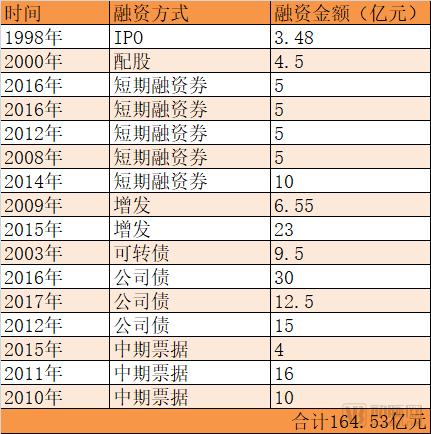
Source: Fosun Pharma announcements, compiled by VCBeat
In addition, Fosun Pharma was listed on the Hong Kong Stock Exchange in October 2012, raising approximately HK$3.764 billion. Meanwhile, Fosun Pharma completed an H-share placement in 2017, with total proceeds from the placement amounting to approximately HK$2.323 billion.
In summary, since its listing, Fosun Pharma has raised over RMB 21 billion from the capital markets, providing ample financial support for its capital operations and resource integration.
Resource Integration Drives High-Speed Growth
The development history of Fosun Pharma is a history of resource integration. The convenient financing channels available to the listed company, combined with the support from Fosun Group at both the capital and business levels, have enabled its rapid business expansion.
Currently, Fosun Pharma primarily operates three core business segments: pharmaceutical manufacturing and R&D, healthcare services, and medical devices and diagnostics. Additionally, Fosun Pharma holds a stake in Sinopharm Group, China’s largest pharmaceutical distributor, which is of significant importance to its market expansion and product commercialization.
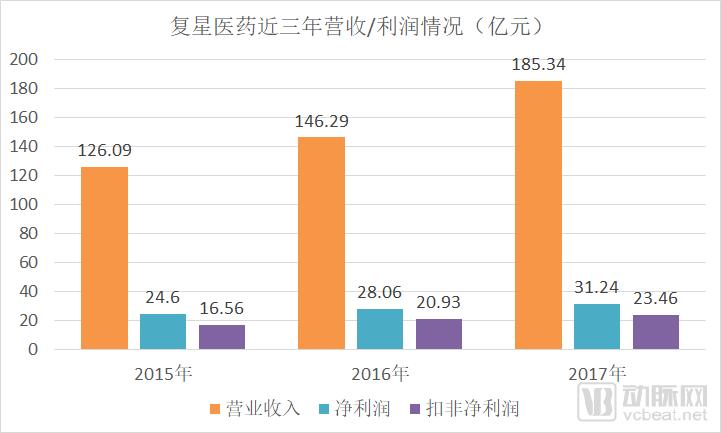
According to its annual report, Fosun Pharma achieved a revenue of RMB 18.534 billion in 2017, representing a year-on-year increase of 26.69%. Of this total, revenue from pharmaceutical manufacturing and R&D amounted to RMB 13.195 billion, revenue from medical devices and medical diagnostics reached RMB 3.214 billion, and revenue from healthcare services stood at RMB 2.088 billion.
Based on data from the past three consecutive years, pharmaceutical manufacturing and R&D have remained the primary revenue source, accounting for 70% of total revenue; medical devices and medical diagnostics contributed 17%-18%; and medical services accounted for 11%.
Pharmaceutical Manufacturing and R&D
Fosun Pharma’s core subsidiaries in manufacturing and R&D include Chongqing Youyou, Jiangsu Wanbang, Hubei Xinshengyuan, and Aohong Pharmaceutical, with key products focused on therapeutic areas such as the cardiovascular system, anti-infectives, and the central nervous system. In 2017, Fosun Pharma completed its acquisition of Gland Pharma, an Indian generic drug manufacturer, further enriching its footprint in the pharmaceutical industry.
In 2017, excluding the newly acquired Gland Pharma, Fosun Pharma’s pharmaceutical segment had 21 finished dosage form products and product series with annual sales exceeding RMB 100 million. Among these, five products or series—Deproteinized Calf Blood Serum Injection (Aodejin), Reduced Glutathione series (Atomolan Injection and Atomolan Tablets), Alprostadil Dry Emulsion for Injection (Youdier), Cefmetazole Sodium for Injection series, and Potassium Sodium Dehydroandrographolide Succinate for Injection (Shaoduoka)—each achieved annual sales surpassing RMB 500 million.
Medical Devices and Medical Diagnostics
Fosun Pharma’s products in the medical device and medical diagnostics sectors include the da Vinci surgical robot systems and consumables (distributed under agency agreements), aesthetic medicine devices (acquired through the acquisition of Israel-based Sisram Medical), HPV diagnostic reagents, and tuberculosis diagnostic products.
In September 2017, Sisram was listed on the Main Board of The Stock Exchange of Hong Kong (SEHK), becoming the first Israeli company to be listed on the SEHK Main Board. Fosun Pharma stated that while continuing to accelerate its global market expansion with a focus on emerging markets, Sisram further strengthened the development of new products, particularly medical therapeutic devices, thereby expanding its product portfolio into the clinical treatment sector. In 2017, two of Sisram’s products obtained EU CE certification, and three products received approval from the U.S. Food and Drug Administration (FDA).
Fosun Pharma has also gained full control of CML by acquiring its remaining 30% equity stake, thereby strengthening synergies in medical device R&D, manufacturing, sales, product services, and investment and M&A activities. CML is a leading medical equipment supplier primarily engaged in the production and sales of medical devices and consumables. For over three decades, it has been providing cutting-edge medical technologies and high-quality products and services to China’s healthcare sector.
Fosun Pharma also jointly established the joint venture Intuitive Fosun with Intuitive Surgical, the owner of the “da Vinci Surgical System” technology and products, to accelerate the development and adoption of high-end medical technologies in China. Additionally, it completed an investment for an 80% equity stake in Breas, a Swedish respiratory medical device company, further enriching its product portfolio in respiratory medicine.
Medical Services
According to its 2017 annual report, Fosun Pharma primarily holds controlling interests in Chancheng Hospital, Hengsheng Hospital, Zhongwu Hospital, Wenzhou Geriatric Hospital, Guangji Hospital, Jimin Hospital, and Zhuhai Yannian Hospital, with a total of 3,818 approved beds.
Through investments, mergers and acquisitions, and participation in the restructuring of public hospitals, Fosun Pharma has initially established a strategic layout for its healthcare services business, combining high-end medical care in developed coastal cities with specialized and general hospitals in second- and third-tier cities. The company aims to build regional medical centers and a comprehensive health industry chain, continue to explore cooperative models with large local state-owned enterprises, public hospitals, and university-affiliated hospitals, accelerate the development strategy of internet-based healthcare, and steadily enhance its business scale and profitability.
In 2017, Fosun Pharma continued to actively support and promote the development and strategic layout of United Family Healthcare (UFH), a leading premium healthcare services brand under its subsidiary. UFH Hospitals maintained their brand appeal and leadership in the premium healthcare sector across core cities such as Beijing, Tianjin, and Shanghai. Qingdao United Family Hospital commenced operations, while Guangzhou United Family Hospital and Shanghai Pudong United Family Hospital were under accelerated construction.
Pharmaceutical Distribution and Retail
Fosun Pharma holds approximately 32.05% of the shares in Sinopharm Group, the largest pharmaceutical distributor and retailer in China. In 2017, Sinopharm Group reported operating revenue of RMB 277.717 billion and net profit of RMB 7.868 billion.
As of the end of 2017, Sinopharm Group’s distribution network had covered all 31 provinces, autonomous regions, and municipalities directly under the central government in China. The number of its direct customers reached 15,032 (referring exclusively to tiered hospitals, including 2,301 tertiary hospitals, which are the largest and highest-level facilities), with 128,000 small-scale end-terminal clients (including primary healthcare institutions) and 87,000 retail pharmacies.
During the reporting period, Sinopharm Group’s pharmaceutical distribution business generated revenue of RMB 264.352 billion. Meanwhile, its pharmaceutical retail business maintained growth, achieving revenue of RMB 12.392 billion during the same period. As of the end of the reporting period, Sinopharm Group’s retail stores covered 19 provinces and municipalities across China, with a total of 3,834 retail pharmacies (referring exclusively to those under Guoda Drugstore), including 2,801 company-operated stores and 1,033 franchised stores.
Sinopharm Group’s comprehensive pharmaceutical distribution and retail network has laid a solid foundation for the market implementation of Fosun Pharma’s products and services. Fosun Pharma stated that it will leverage its collaboration and synergy with Sinopharm Group to fully capitalize on the latter’s distribution network and logistics capabilities, thereby expanding its own drug sales channels.
Earnings Gradually Materialize, Supporting High Valuations
As previously mentioned, in recent years the capital market has given Fosun Pharma a high valuation, which is directly reflected in its stock price, resulting in the impressive achievement of its market capitalization doubling within a year. The reason for the market’s high regard for Fosun Pharma lies in optimism about the resource aggregation effect brought by its global mergers and acquisitions, as well as the gradual realization of returns on R&D investments in its pharmaceutical manufacturing segment.
Breaking it down, resource integration has always been a key growth strategy for Fosun Pharma, and the capital market often views Fosun Pharma as an “investment company.” However, based on its recent M&A and integration targets, Fosun Pharma actually follows a clear strategic thread: introducing high-quality overseas products and services into China, and securitizing high-quality domestic medical resources.
First, let us examine the integration of high-quality overseas resources, which primarily follows two operational models: direct acquisition and the establishment of joint ventures.
In terms of mergers and acquisitions, Fosun Pharma has successively acquired Gland Pharma, an Indian manufacturer of injectable pharmaceuticals; Sisram, an Israeli developer and manufacturer of medical aesthetic devices; Breas, a Swedish respiratory medical device company; and Tridem Pharma, a French pharmaceutical distributor.
These companies are all “high-quality assets” in the overseas healthcare sector. Among them, Gland Pharma is the first Indian injectable pharmaceutical manufacturer to receive approval from the U.S. FDA, and it has obtained Good Manufacturing Practice (GMP) certifications from major global pharmaceutical markets. Its business revenue is primarily derived from the United States and Europe.
Sisram’s product portfolio spans postpartum recovery, anti-aging, hair removal, skin treatments, and pigmentation treatments, with its product technology and sales volume ranking among the global leaders.
Tridem Pharma is the third-largest pharmaceutical distributor in Francophone West Africa, primarily engaged in the export and distribution of pharmaceutical products to French-speaking African countries and French overseas territories, with its sales network covering 21 countries and regions in the Francophone world.
Regarding joint ventures, Fosun Pharma co-invested with Intuitive Surgical to establish Intuitive Fosun, formed a joint venture with Kite Pharma to establish Fosun Kite, and established Henlius, Chongqing Fuchuang, and Fosun Xingtai by introducing overseas talent and technical teams.
In October 2017, Kite Pharma’s CAR-T therapy, Yescarta, received FDA approval. Subsequently, Fosun Kite announced that phased progress had been achieved in the technology transfer and manufacturing validation for Yescarta, bringing the introduction of the world’s first CAR-T therapy targeting specific types of large B-cell lymphoma to China closer to reality. Yescarta is poised to become the first cell therapy product approved for commercialization in China.
Henlius, founded in 2010, currently has nine products with 14 indications under clinical trial applications. Among these, one product is pending marketing approval, and two are in Phase III clinical trials. Reports indicate that Henlius is seeking a listing in Hong Kong, with the company’s valuation exceeding $1.5 billion.
High R&D investment is a key highlight of Fosun Pharma’s industrial segment, with its R&D spending consistently ranking among the top in the A-share pharmaceutical sector.
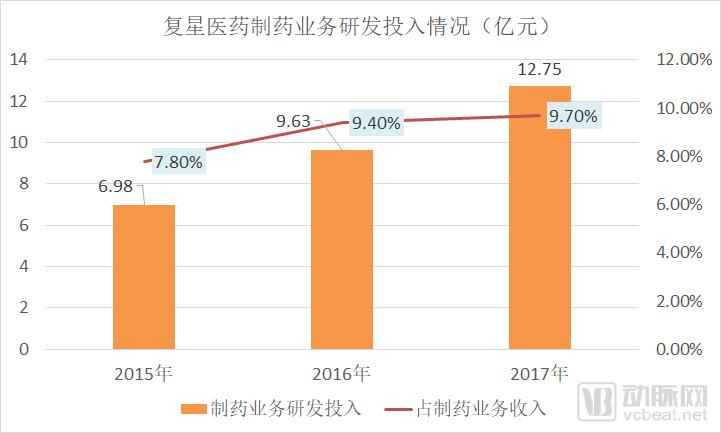
Data shows that Fosun Pharma’s R&D investment in its pharmaceutical business has increased year by year over the past three years, with its proportion of pharmaceutical industry revenue also rising annually to exceed 9%. By comparison, the average R&D investment ratio for chemical drug companies listed on China’s A-share market is around 5%.
Currently, Fosun Pharma has nearly 1,500 R&D personnel, accounting for approximately 5% of its total workforce. The company has established R&D teams in Shanghai, Chongqing, San Francisco (USA), and Taiwan. In terms of R&D strategy, Fosun Pharma adopts diversified collaborative approaches, including forming joint ventures, establishing technological innovation incubation platforms, and exploring partnership-based innovative R&D companies. By leveraging models such as technology introduction, patent licensing, “deep incubation,” and value management, the company integrates cutting-edge global innovative technologies, promotes the global development of frontier products, and facilitates the translation and commercialization of advanced global innovations.
Fosun Pharma stated that it will further increase R&D investment, strengthen marketing for its core products, and accelerate the M&A and integration of outstanding pharmaceutical R&D companies, healthcare enterprises, and innovative firms both domestically and internationally.
Sustained high-level investment has yielded substantial results in Fosun Pharma’s R&D pipeline. Currently, the company has 171 projects underway, covering new drugs, generic drugs, biosimilars, and consistency evaluation initiatives. These include 10 small-molecule innovative drugs, 8 biologic innovative drugs, 14 biosimilars, 98 international-standard generic drugs, 39 consistency evaluation projects, and 2 traditional Chinese medicine products.
As of the end of 2017, Fosun Pharma had obtained clinical trial approvals in mainland China for six monoclonal antibody products (including one innovative monoclonal antibody) covering 11 indications. Among these, three products had entered Phase III clinical trials, and one product (Rituximab Injection) had filed a production application and been included in the list of drug registration applications eligible for priority review. Additionally, three innovative monoclonal antibodies—Recombinant Fully Human Monoclonal Antibody against VEGFR2 for Injection, Recombinant Humanized Monoclonal Antibody against EGFR for Injection, and Recombinant Humanized Monoclonal Antibody against PD-1 for Injection—had obtained clinical trial approvals in the United States and the Taiwan region. The Recombinant Humanized Monoclonal Antibody against HER2 for Injection was concurrently advancing clinical trials in both mainland China and Europe.
Securities firms predict that rituximab injection is expected to be launched in 2018, while trastuzumab, adalimumab, and third-generation insulin are anticipated to reach the market before 2020. The combined market potential for these four products is estimated at RMB 5–10 billion, which will significantly boost the performance of Fosun Pharma’s pharmaceutical segment.
Overall, Fosun Pharma’s current businesses are benefiting from favorable policies, market conditions, and industrial trends. These include an increasingly clear environment for pharmaceutical innovation, government encouragement of private capital entry into the healthcare services sector, and consumption upgrades driving prosperity in the medical aesthetics market. Adhering to its “4IN” strategy (Innovation, Internationalization, Integration, and Intelligentization), Fosun Pharma continues to strengthen the integration of high-quality medical resources. Its organic growth is gradually translating into performance results, positioning the company to evolve into a comprehensive healthcare industry group.