

"Internet + Healthcare" Enters Spring Mode: Explorations by Medical Institutions and Renewed Hope for Digital Health Enterprises
Recently, topics such as “telemedicine” and “chronic disease management” have remained highly popular. The familiar concept of “internet-based healthcare” has evolved into “Internet + Healthcare,” once again dominating social media feeds. The philosophy of “putting people first and prioritizing health” is gradually being implemented.
On April 11, Premier Li Keqiang of the State Council, Shanghai Municipal Party Secretary Li Qiang, National Health Commission Director Ma Xiaowei, Shanghai Mayor Ying Yong, and other officials conducted an on-site visit to the Telemedicine Center of Huashan Hospital Affiliated to Fudan University to inspect the new pattern of tiered diagnosis and treatment established through models such as “Internet + Healthcare” and medical consortiums.
On April 12, the Premier presided over an executive meeting of the State Council. Key healthcare-related decisions included: first, adopting measures to develop “Internet Plus Healthcare” to alleviate difficulties in accessing medical care and improve public health; second, implementing zero tariffs on imported anticancer drugs and encouraging the importation of innovative medicines, thereby responding to public expectations and enabling greater benefits for patients.
On April 16, the State Council Information Office held a media briefing on the “Guiding Opinions on Promoting the Development of ‘Internet Plus Healthcare’.” The key takeaway from the meeting was that internet hospitals have received official accreditation. Meanwhile, the internet will be comprehensively integrated with medical care, pharmaceutical services, and medical insurance. The briefing also addressed concerns regarding security risks in online healthcare, data safety, and the establishment of internet hospitals.
How have these major events benefited the development of the internet healthcare industry? How will medical institutions at all levels across China launch “Internet + Healthcare” services? VCBeat (WeChat ID: vcbeat) has compiled an overview.
The Premier primarily focused on three key areas in Shanghai:
The first is a visit to the Telemedicine Center of Huashan Hospital, Fudan University;
Second, assess drug supply and pricing to ensure that interested individuals can access HPV and other vaccines locally at the earliest opportunity;
Third is the home-based elderly care project implemented at the Jiangnan Xincun Neighborhood Hub in Xietu Subdistrict, Xuhui District.
At the State Council executive meeting presided over by the Premier, it was pointed out that, in accordance with the arrangements of the CPC Central Committee and the State Council, accelerating the development of “Internet + Healthcare” can improve the efficiency of medical services, reduce the need for patients to make repeated visits, enhance convenience, and enable more people to access high-quality medical resources.
The meeting confirmed that,First, accelerate the widespread provision of online services by hospitals at Level II and above, such as appointment scheduling and inquiry of laboratory and imaging test results.Medical institutions are permitted to provide internet-based medical services, including follow-up consultations for common and chronic diseases.Second, promote the nationwide coverage of telemedicine across all medical consortia and county-level hospitals, facilitating the alignment of high-quality medical resources in eastern China with the healthcare demands in central and western regions.Support high-speed broadband network coverage for urban and rural medical institutions, and establish dedicated internet lines to meet the needs of telemedicine.Third, explore the sharing of prescription information from medical institutions with drug retail data.Implement intelligent review of medical insurance and "one-stop" settlement. Improve the standard system for "Internet + Healthcare", accelerate information interoperability and sharing, and strengthen supervision of medical quality and protection of information security.
The three items determined at this meeting are all closely related to medical institutions. It was also mentioned that telemedicine coverage should be promoted across all medical consortia and county-level hospitals in China.
In the past, internet-based initiatives in healthcare institutions might have been implemented on a pilot basis. However, following this conference, such initiatives are likely to be rapidly promoted and applied nationwide, extending from within hospitals to external settings, and permeating healthcare institutions at all levels across China both horizontally and vertically along the medical consortium framework.
Prescription information sharing mentioned in Article 3.It is a patient-centric information platform, jointly developed with regional Health and Family Planning Commissions, Food and Drug Administrations, social security agencies, hospitals, and retail pharmacies, to achieve interconnectivity and real-time sharing of prescription data from medical institutions, medical insurance settlement information, and pharmaceutical retail consumption records.
In May 2017, Wuzhou Red Cross Hospital in Guangxi partnered with Qingdao Yifuzhen Network Technology Co., Ltd. to launch China’s first prescription information sharing platform, implementing the separation of prescribing and dispensing through the “Wuzhou Model.”
The introduction of this measure will further reduce the proportion of pharmaceutical expenditures in hospital revenue and achieve the separation of prescribing from dispensing; however, only time will tell how its implementation unfolds.
The State Council’s regular policy briefing on April 16 primarily announced the findings of research and discussions on the “Opinions on Promoting the Development of ‘Internet + Healthcare’.”
The content mainly consists of three aspects:
First, improve the “Internet + Healthcare” service system.Promote the integration of the internet with healthcare services across multiple domains, including medical care, public health, family doctor contracting, pharmaceutical supply assurance, health insurance settlement, medical education and science popularization, and artificial intelligence applications. This encompasses numerous aspects of the “Three-Medical Linkage” involving medical care, pharmaceuticals, and health insurance.
Second, improve the support system for “Internet + Healthcare.”Proposed measures include the timely formulation and improvement of supporting policies, accelerating the realization of interoperability and sharing of medical and health information, establishing and improving the “Internet + Healthcare” standard system, enhancing hospital management and public convenience services, and strengthening the infrastructure support capabilities of healthcare institutions.
Third, strengthen industry regulation and security safeguards.It provides clear stipulations on strengthening the supervision of medical quality and ensuring data security.
The “Opinions” put forward a series of policy measures, which clarify the clear stance on supporting the development of “Internet + Healthcare,” highlight the policy orientation of encouraging innovation and adopting an inclusive yet prudent approach, specify the key areas and support systems for integrated development, and delineate the regulatory and security baselines.
In response to the medical safety risks associated with “Internet + Healthcare,” Yu Xuejun, Director of the Department of Planning and Information, stated that regulation must be strengthened in three areas:
First, clearly define the boundaries of conduct.Expedite the development of management measures to clarify regulatory baselines while lowering market entry thresholds. Strengthen in-process and post-event supervision to ensure the safety and quality of healthcare services.
Second, strengthen accountability.Whoever provides internet-based medical and health services must assume responsibility, implementing a safety accountability system. The development of internet hospitals relies on physical medical institutions, with the medical institutions themselves remaining the primary entities liable for such services. Furthermore, regulatory principles follow localized management, enforcing unified oversight of both online and offline operations. Third-party institutions, such as internet medical and health service platforms, must ensure that the qualifications of personnel providing services comply with relevant regulations and bear responsibility for the services rendered. Meanwhile, a mechanism for sharing medical liability should be established, and informed consent procedures should be implemented online to prevent and mitigate medical risks.
3. Enhance regulatory capabilities.On one hand, regulatory interfaces will be established for health administrative departments. All medical institutions providing internet-based healthcare services and internet healthcare service platforms must promptly push, transmit, and back up data to regional comprehensive health information platforms, enabling dynamic oversight of internet-based medical practices by health administrative authorities. On the other hand, efforts will be made to advance the construction of a trusted internet ecosystem by accelerating the development of a nationwide unified system for trusted digital medical identities, electronic real-name authentication, and data access control for healthcare professionals and medical institutions. This includes improving the electronic registration systems for physicians, nurses, and medical institutions to facilitate easy verification and inquiry.
These measures ensure full traceability of data generated by “Internet + Healthcare” services, enabling query and tracking capabilities, thereby guaranteeing that data access and processing behaviors are controllable and manageable, and safeguarding patient safety during medical care.
Standards, regulations, and laws in the “Internet + Healthcare” industry have long been a topic of concern for various stakeholders. Zeng Yixin, Deputy Director of the National Health Commission, provided clarifications on five aspects:
1. The development of “Internet + healthcare services” is clearly stipulated in regulations, which permit the establishment of internet hospitals based on medical institutions. An internet hospital may use its name as a secondary designation alongside the physical hospital it relies upon. For hospitals, this equates to an expansion of their business scope and service radius, representing a favorable policy development. Meanwhile, qualified third-party organizations are also supported in building internet information platforms to conduct telemedicine. These third-party entities likewise benefit from policy support for carrying out such activities.
II. There are also clear provisions for optimizing internet-based family doctor contract services, which can promote the intelligent and informatization development and application of such services. Contracting services can be conducted online, and various tasks related to family doctor contract services—such as providing online health consultations, appointment referrals, follow-up visits for chronic diseases, health management, and extended prescriptions—can all be carried out via the internet;
III. In terms of “Internet + Pharmaceuticals” supply assurance services, after prescriptions issued online have been reviewed by pharmacists, medical institutions and pharmaceutical distributors may entrust qualified third-party agencies to handle delivery;
IV. Promote the “Internet + Insurance Settlement” initiative by gradually expanding online payment and settlement capabilities, including cross-regional settlement and one-stop settlement;
V. In the application of new technologies such as artificial intelligence, encourage the promotion of research, development, and application to improve the efficiency of medical services.
In addition, the conference provided answers to questions such as: How can data breaches be prevented? How does one apply to establish an internet hospital? Why are internet hospitals permitted to conduct online follow-up consultations for certain chronic and common diseases?
Telemedicine is the most critical component in realizing the “Internet + Healthcare” model for diagnosis and treatment. From the Premier’s visit to Huashan Hospital to his presiding over executive meetings of the State Council, telemedicine has been the most frequently mentioned topic. In fact, telemedicine is no longer a novel concept. As early as the late 1980s, China had already initiated exploratory research trials in telemedicine, and by the mid-1990s, the construction and application of practical telemedicine systems had begun. What telemedicine policies have been issued in recent years?
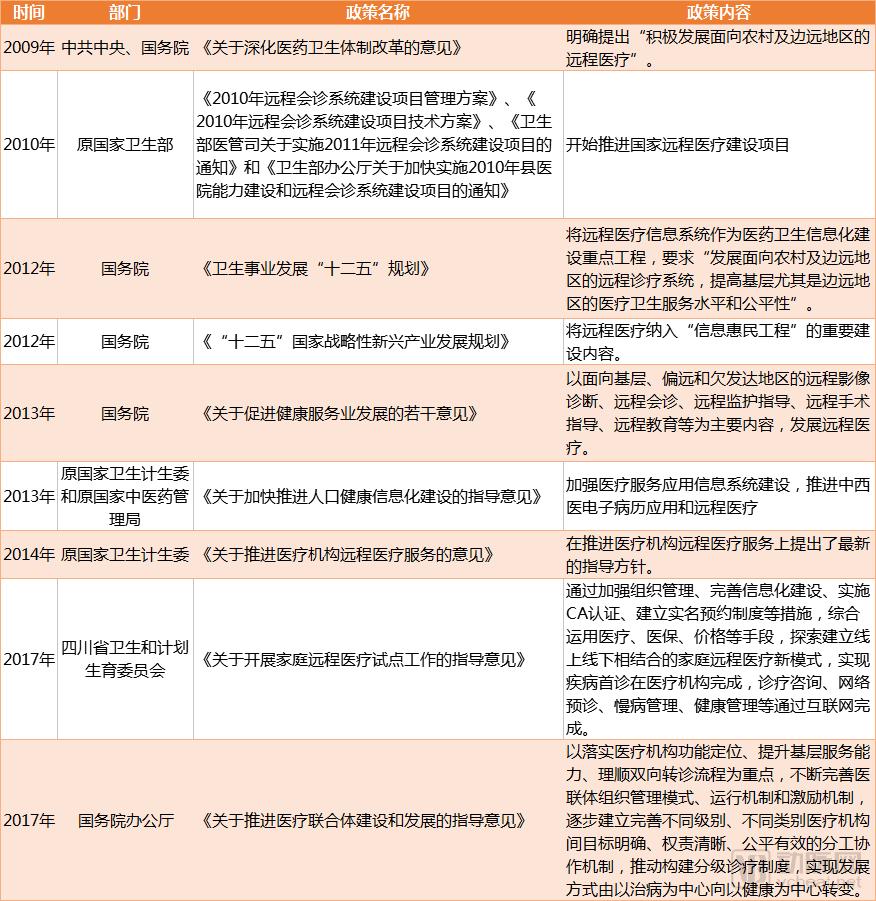
The promulgation and implementation of these policies aim to address practical challenges such as difficulty in accessing medical care and high healthcare costs.
In the traditional doctor-patient model, patients commonly face a lack of preventive care beforehand, poor experience during treatment, and an absence of follow-up services afterward. With internet-based healthcare, however, patients can monitor their own health data via mobile medical platforms to enhance preventive measures; leverage mobile health services for online appointment scheduling, consultations, purchases, and payments, thereby reducing time and financial costs and improving the in-treatment experience; and utilize internet technologies to communicate with physicians during follow-up visits.
Consequently, most hospitals across China have successively launched explorations into the “Hospital + Internet” model.
With the development of “Hospital + Internet,” many large hospitals have launched “Internet+” initiatives, advancing mobile healthcare through disease-specific focus, system upgrades, and platform construction. To date, VCBeat has identified eight mainstream models from among China’s leading “Hospital + Internet” practices.
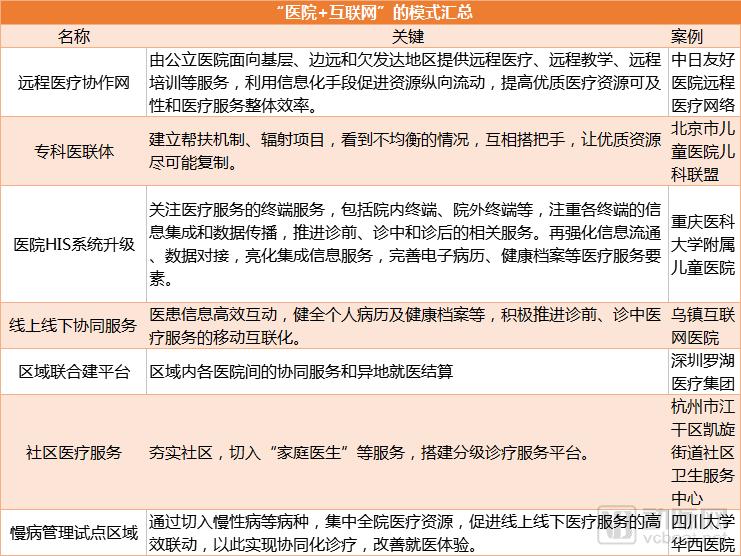
As shown in the figure, telemedicine is a component of the “Hospital + Internet” model and will become an important part of hospitals’ implementation of the “Internet + Healthcare” initiative.
As of October 2017, more than 6,800 public hospitals across China had launched telemedicine services.Taking the Telemedicine Center of Huashan Hospital as an example, it has completed more than 6,500 remote consultations to date. Of these, 72.3% were provided to central and western regions (with central China accounting for 26.3% and western China for 46.0%), covering 24 provinces including Yunnan, Inner Mongolia, Tibet, and Xinjiang, and encompassing a wide range of diseases.
Another notable example is the new internet-based remote medical collaboration model jointly established in 2017 by Sir Run Run Shaw Hospital, Zhejiang University School of Medicine, together with multiple regional medical centers—including the First Division Hospital of the Xinjiang Production and Construction Corps, the First People’s Hospital of Kashgar Prefecture, and the Second People’s Hospital of Aksu Prefecture—leveraging the “Shao Yi Health Cloud Platform.”
The platform supports business functions such as remote joint outpatient consultations, multimodal remote consultations, remote mobile ward rounds, remote imaging diagnosis, internet-based remote teaching, and mobile technical guidance. In the future, the platform will deepen its service capabilities, expand international medical services, and build the “Silk Road Cross-Border Medical Service Platform.”
In addition to the development of telemedicine infrastructure by large tertiary hospitals, primary healthcare institutions are also exploring this field.
According to VCBeat, in 2017, Wafangdian City in Dalian, Liaoning Province established a medical community centered on the Wafangdian Central Hospital, integrating the management of personnel, finances, and materials across ten township health centers. This initiative gradually achieved seamless informational connectivity between all township health centers and the Wafangdian Central Hospital, enabling the sharing of medical resources. The platform was built by Medlinker (Xinyi International). Furthermore, the Wafangdian Central Hospital collaborated with the First Affiliated Hospital of Dalian Medical University to establish a multi-tiered collaborative telemedicine platform for remote consultations on complex and difficult cases. Currently, it has achieved telemedicine collaboration with 23 renowned hospitals in Beijing and 22 in Shanghai.
This telemedicine platform has implemented point-to-point technology, with the remote system located in physicians’ departments. Specialists and local doctors can conduct remote consultations without leaving their examination rooms. Currently, remote consultation services are available in five departments: Critical Care Medicine, Neurology, Hepatobiliary Surgery, Spinal Surgery, and Endocrinology. Nearly 40 remote consultations have been conducted, with the highest volumes in Critical Care Medicine and Neurology. The hospital actively leverages the Xinyi Remote Teaching Platform for disciplinary development, delivering multiple clinical teaching sessions to meet the continuing education needs of grassroots physicians through efficient and convenient learning pathways.
In early April 2018, VCBeat visited Shizuishan City in Ningxia, known as the “Coal City on the Frontier,” which is also one of the regions in China where internet healthcare has been relatively well implemented. The trip primarily focused on visiting the Shizuishan Internet Medical Consortium.
It is an internet-based medical consortium built upon public healthcare institutions, led by the Shizuishan Municipal Government and jointly established by the Municipal Health and Family Planning Bureau and WeDoctor. With Shizuishan No. 2 People’s Hospital (hereinafter referred to as “the Second Hospital”) serving as the core hospital, the consortium covers its affiliated hospitals in the surrounding areas. The model adopts a “1+3+X” structure: one Shizuishan Internet Medical Consortium Comprehensive Service Center acts as the central hub; three municipal-level general hospitals across the three counties/districts serve as centers to establish three internet-based medical consortia, each connecting primary healthcare institutions within their respective regions, thereby extending coverage to “X” primary healthcare service points throughout the city. Leveraging internet and AI technologies, the platform integrates the Hospital Information System (HIS), Laboratory Information System (LIS), and Picture Archiving and Communication System (PACS) across member hospitals, meeting the connectivity needs of five tiers of medical institutions—autonomous region, municipal, county, township, and village levels.
Currently, the Shizuishan Internet Medical Consortium has achieved direct HIS system integration with five medical institutions, including the Second People’s Hospital of Shizuishan, the Yongle Community Health Service Station in Dawukou District, the Xinghai Town Central Health Center, the Changsheng Community Health Service Center, and the Changxing Health Center. This connectivity enables medical services such as remote consultations, sharing of electronic medical records, laboratory and imaging reports, online physician orders, e-prescriptions, and remote training. Furthermore, by linking upward to WeDoctor’s platform, which comprises over 2,700 key hospitals nationwide, 7,400 expert teams, and 220,000 medical specialists, the consortium facilitates the decentralization of high-quality medical resources to grassroots levels.
Compared with the two telemedicine projects recently established, the telemedicine platform built by Shanba Telemedicine for Zhenxiong County People's Hospital in Zhaotong City, Yunnan Province, deserves more attention. Since the platform went into operation in 2006, the hospital has vigorously promoted patient education and applied to the local Health Bureau for reimbursement policies under the New Rural Cooperative Medical Scheme (NRCMS). Starting from 2009, 75% of the costs for intra-provincial remote consultation services became reimbursable. Meanwhile, the hospital also provided a subsidy of RMB 10 per patient for remote diagnosis and treatment fees, which not only reduced patients' out-of-pocket expenses but also generated economic benefits for the local hospital.In 2011, Yunnan Province invested in and upgraded new projects at 37 county-level hospitals. Zhenxiong County People's Hospital operated the new teleconsultation system equipment alongside the legacy systems, cumulatively conducting nearly 10,000 telemedicine cases.
Telemedicine is an indispensable component of the “Internet + Healthcare” initiative; however, its implementation still faces numerous challenges, including low patient trust, inability to guarantee quality and safety, issues with pricing and payment, and the lack of a standardized system.
Taking remote surgery as an example, if a medical malpractice incident occurs during the treatment process, it remains legally undefined whether liability should rest with the remotely supervising physician, the operating surgeon, or be attributed to communication failures caused by hardware equipment.
According to the 2016 Latitude Health report, “Telemedicine: Value, Challenges, and Opportunities,” one pricing model involves B2B teleconsultations initiated by hospitals, with hospitals as the payers. This model primarily targets complex and refractory cases, emergencies, and serious illnesses in remote areas. Consultation fees are substantial; for example, at the First Affiliated Hospital of Zhejiang University School of Medicine, the fee for a telemedicine outpatient consultation is RMB 280 per session, for an emergency consultation RMB 1,000 per session, and for a scheduled consultation RMB 600 per session. In Anhui Province, synchronous remote pathology consultations are priced at RMB 300 per session, asynchronous remote pathology consultations at RMB 280 per session, and clinical expert consultations at RMB 600 per hour.
Another model is the B2B2C model, which is initiated by patients, with patients as the payers, and the fee structure remains unclear. For instance, the Guangdong Internet Hospital initially offered services free of charge and currently charges a registration fee of RMB 10 per visit. Many other telemedicine services are also offered as free trials, such as those provided by the Shizuishan Internet Medical Consortium in Ningxia.
From this perspective, for patients seeking specialist care, the total medical costs are actually reduced. After all, traveling to another location to consult a specialist incurs additional expenses, including transportation, accommodation and meals, caregiver fees, and lost wages. In contrast, by accessing specialists through telemedicine, patients not only receive timely consultations but also benefit from lower overall medical expenditures.
From the patient’s perspective, telemedicine is often perceived as expensive, with costs comparable to VIP outpatient services at public Grade 3A hospitals in major cities. However, a detailed calculation reveals that it is actually more affordable than seeking care in person at large hospitals. If remote consultations were incorporated into the national medical insurance system, patients’ out-of-pocket expenses for diagnosis and treatment would be even lower.However, remote consultations are not currently covered by the medical insurance system.
Certainly, integrating telemedicine into the medical insurance system also faces some challenges, with significant variations in reimbursement rates across different regions. Teleconsultation often serves the dual purpose of training and education, leading to inconsistent and opaque pricing. The necessity of consultations, demand for specialists, and allocation of resources all influence pricing, as well as the specific reimbursement ratios applied by medical insurance.It is quite challenging to calculate the specific prices and reimbursement ratios.
There are significant disparities between urban and rural medical insurance systems in China. Although some regions have merged the Urban Resident Basic Medical Insurance with the New Rural Cooperative Medical Scheme, most areas have yet to integrate all three major insurance schemes. Furthermore, substantial differences in benefit coverage and funding mechanisms between the Urban Employee Basic Medical Insurance and the other two schemes make it highly challenging to unify their coverage levels. The fragmentation of medical insurance across different regions and population groups increases the technical complexity of reimbursement settlements, thereby posing even greater obstacles to cross-regional collaborative services such as telemedicine.
Moreover, the financial pressure on the medical insurance fund pool is mounting. Even the Basic Medical Insurance for Urban Employees, which boasts relatively strong coverage and fundraising capabilities, is grappling with a declining annual surplus ratio and expenditure growth outpacing revenue growth, pointing to a significant funding gap in the future. There remains substantial room to expand insurance coverage, such as for major outpatient diseases, rehabilitation, and long-term care. In the face of a shrinking workforce and an aging population, it will be highly challenging for the already strained medical insurance fund pool to support large-scale coverage of telemedicine services.
Previously, hospitals lacked sufficient motivation to promote telemedicine, resulting in low implementation frequency.
Although the B2B2C model of telemedicine services helps large hospitals expand outpatient volumes and reach patients in more regions, these hospitals will face the outflow of prescriptions, and doctors will only receive minimal service fees, which is insufficient to serve as their motivation.
In the B2B model, hospitals are motivated to conduct consultations to enhance their capabilities in scientific research, education, and the treatment of complex and critical diseases. However, many of these cases must be sourced from primary care institutions, and implementing telemedicine requires significant upfront technological investment. Currently, primary care facilities face development challenges and lack the financial capacity for such investments. Furthermore, high consultation fees charged by hospitals are not reimbursable by medical insurance, and the mechanisms for benefit distribution among hospitals remain unclear. Since Chinese physicians are required to provide research outputs for professional promotion, hospitals tend to pursue closed-loop research on their databases of complex and critical disease cases, refraining from making their case data publicly available. Consequently, there is insufficient incentive for data sharing and large-scale interoperability.
Despite many issues yet to be resolved, this significant policy benefit marks a long-awaited turning point for internet healthcare companies. As determined by the meeting, telemedicine will be promoted to cover all medical consortiums and county-level hospitals across China. This initiative will facilitate smoother business expansion for internet healthcare enterprises, akin to securing an entry ticket, while also strengthening hospitals’ proactive willingness to launch internet healthcare projects.
Liao Jieyuan, founder of WeDoctor, recalled: “On December 7, 2015, the Wuzhen Internet Hospital emerged amidst considerable challenges. After 858 days and nights, the ‘Xiaogang Village’ at the head of Wuzhen Bridge finally heard the ‘decisive gavel strike.’”
“Suddenly, I feel that all perseverance can be rewarded; Internet Plus Healthcare is ushering in unprecedented opportunities,” wrote Wei Jianfeng, Founder and CEO of Hangzhou Zhuojian Technology, on his WeChat Moments.
Zhang Kun, CEO of Chunyu Doctors, stated, “We do not gamble on trends nor chase policy shifts. We hold firm to our own beliefs and a clear sense of direction, and we believe that by adhering to the right values in our work, we will ultimately earn the recognition of the people—and of the government!”
Wang Hang, founder of Haodf.com, believes that the “Internet + Healthcare” initiative mentioned in this policy plays a promoting and driving role for the entire industry, which is welcome news. Judging from the information disclosed so far, this marks the first time that national functional departments have incorporated “Internet + Healthcare” into policy documents. The content is not only in-depth but also highly practical, addressing issues of concern to the general public and aligning with the needs of the people. This will significantly boost the development of the healthcare industry across the country.
Has the Internet healthcare sector entered an acceleration phase? It’s worth watching!